
 Arabic tutors · Los Angeles · Since 2006
Arabic Tutors & Classes in Los Angeles. Marhaba.
Private lessons with native-speaking instructors. Matched to your goals, your schedule, and your life. Start any time.


Your instructors
Arabic class instructors
I want to learn…
Every tutor, personally met. — founder-vetted since 2006, in Los Angeles and online worldwide.
Get a personalized plan
Pick your language — a language advisor will match you with the right tutor and map out your path.

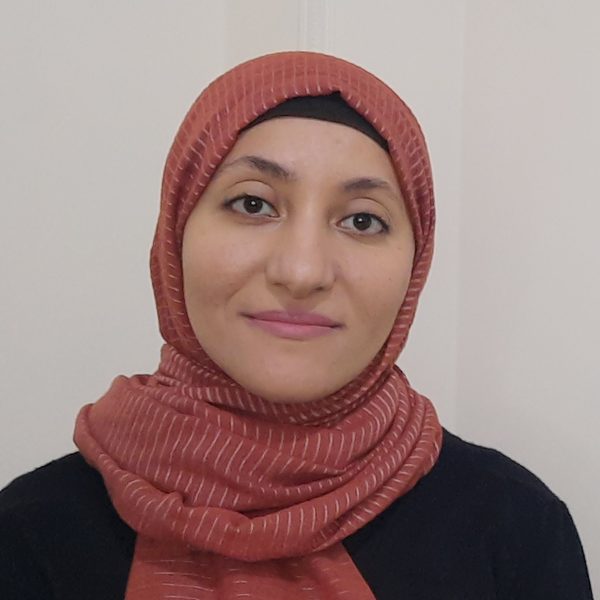
A master degree in Education in Teaching Arabic language to non Arabic speakers
Arabic language teacher (Modern standard, and Egyptian Arabic)
Personally vetted · Strommen’s note
Somaia teaches both Modern Standard and Egyptian Arabic, useful if you need the textbook version and the way people actually talk.
Specialties
A master degree in Education in Teaching Arabic language to non Arabic speakers
Arabic language teacher (Modern standard, and Egyptian Arabic)
Specialties
Personally vetted · Strommen’s note
Somaia teaches both Modern Standard and Egyptian Arabic, useful if you need the textbook version and the way people actually talk.
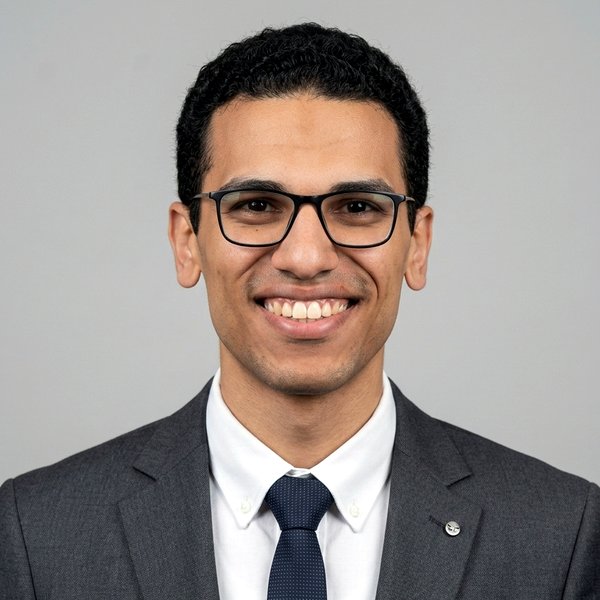


Bachelor of Education (B.Ed.) and pursuing a degree in Aerospace Engineering. · I have a TEFL certification | Certifications in Adobe Graphic Design (Level 1 & 2) for interactive presentations and educational materials.
English, German, and Arabic classes
Personally vetted · Strommen’s note
Arabic, English, and German sit alongside AP Calculus and AP Physics on Omar's schedule, a genuinely rare tutor who crosses from language straight into STEM.
Specialties
Also speaks: French, Italian, Spanish
Bachelor of Education (B.Ed.) and pursuing a degree in Aerospace Engineering. · I have a TEFL certification | Certifications in Adobe Graphic Design (Level 1 & 2) for interactive presentations and educational materials.
English, German, and Arabic classes
Specialties
I also speak: French, Italian, Spanish
Personally vetted · Strommen’s note
Arabic, English, and German sit alongside AP Calculus and AP Physics on Omar's schedule, a genuinely rare tutor who crosses from language straight into STEM.
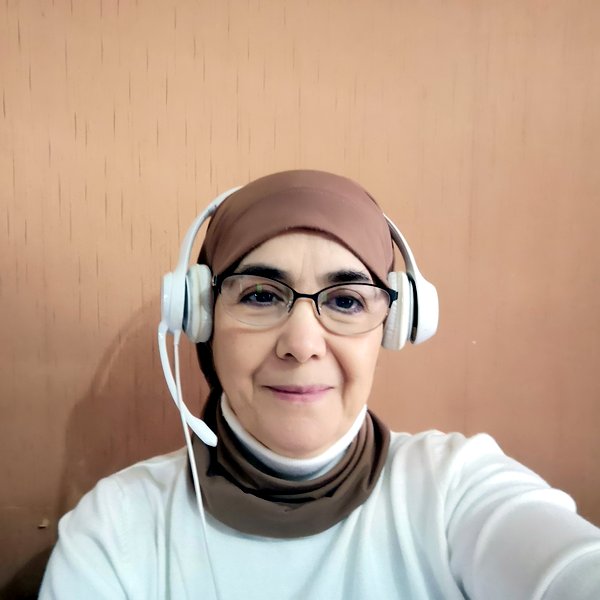
University Degree
Helping students learn with clarity, confidence, and motivation
Personally vetted · Strommen’s note
Quebec-based, Rahma teaches Arabic and French together, four Maghreb dialects covered, Algerian through Libyan.
Specialties
Also speaks: English
University Degree
Helping students learn with clarity, confidence, and motivation
Specialties
I also speak: English
Personally vetted · Strommen’s note
Quebec-based, Rahma teaches Arabic and French together, four Maghreb dialects covered, Algerian through Libyan.

Master’s Degree in Translation and Conference Interpreting (Arabic–French–English), University of Algiers 2, 2026.Bachelor’s Degree in Translation and Interpretation (Arabic–French–English), University of Algiers 2, 2024. · No formal professional teaching certifications. I hold a Master’s degree in Translation and Conference Interpreting and have professional teaching experience.
Learn to speak Arabic just like a native.
Specialties
Also speaks: French, Spanish
Master’s Degree in Translation and Conference Interpreting (Arabic–French–English), University of Algiers 2, 2026.Bachelor’s Degree in Translation and Interpretation (Arabic–French–English), University of Algiers 2, 2024. · No formal professional teaching certifications. I hold a Master’s degree in Translation and Conference Interpreting and have professional teaching experience.
Learn to speak Arabic just like a native.
Specialties
I also speak: French, Spanish

Bachelor degree in french studiesMaster's degree in french studies · DALF C2
Online certified french tutor delf/DALF/ TEF/TCF Preparation
Personally vetted · Strommen’s note
Hela has taught French and Arabic for thirteen years, DELF, DALF, TEF, and TCF certification prep included, plus four different Maghreb Arabic dialects.
Specialties
Bachelor degree in french studiesMaster's degree in french studies · DALF C2
Online certified french tutor delf/DALF/ TEF/TCF Preparation
Specialties
Personally vetted · Strommen’s note
Hela has taught French and Arabic for thirteen years, DELF, DALF, TEF, and TCF certification prep included, plus four different Maghreb Arabic dialects.
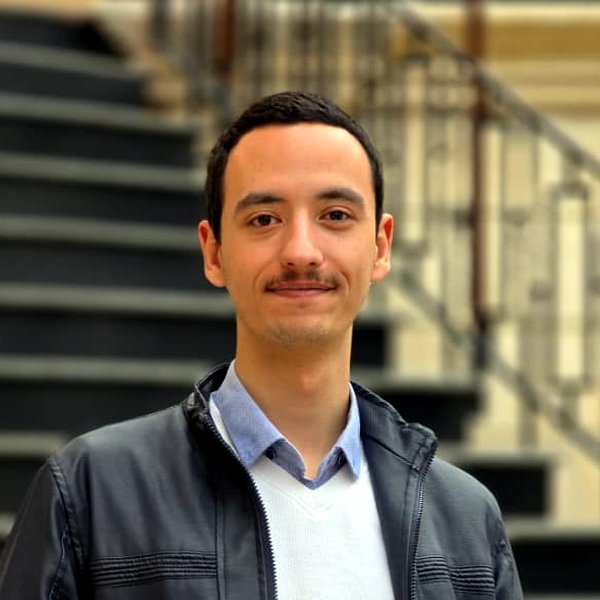
BA in English Literature · TOT , ITM Interactive teaching methodology. BA in English Literature
Step by step to English mastery.
Personally vetted · Strommen’s note
Emad's Arabic dialect range is genuinely enormous: Syrian, Gulf, Levantine, Emirati, Saudi, Moroccan. English is taught step by step alongside it.
Specialties
Also speaks: Copywriting, Spanish, Translation
BA in English Literature · TOT , ITM Interactive teaching methodology. BA in English Literature
Step by step to English mastery.
Specialties
I also speak: Copywriting, Spanish, Translation
Personally vetted · Strommen’s note
Emad's Arabic dialect range is genuinely enormous: Syrian, Gulf, Levantine, Emirati, Saudi, Moroccan. English is taught step by step alongside it.
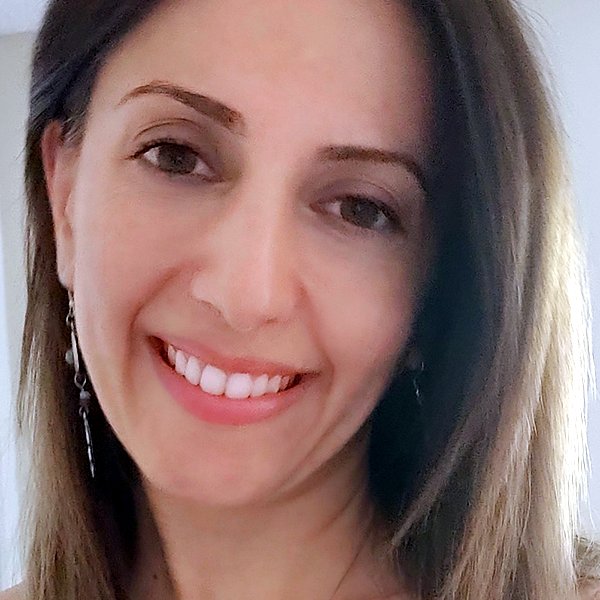

BA and MA in Arabic Studies, PhD in Philology (Arabic & Hebrew Studies)
Polyglot tutor with 15 years’ experience in Armenian, Arabic, Hebrew, and Russian
Personally vetted · Strommen’s note
Alvina holds a BA and MA in Arabic Studies and has spent fifteen years teaching Arabic, Hebrew, Russian, and Armenian, genuinely rare range in one tutor.
Specialties
BA and MA in Arabic Studies, PhD in Philology (Arabic & Hebrew Studies)
Polyglot tutor with 15 years’ experience in Armenian, Arabic, Hebrew, and Russian
Specialties
Personally vetted · Strommen’s note
Alvina holds a BA and MA in Arabic Studies and has spent fifteen years teaching Arabic, Hebrew, Russian, and Armenian, genuinely rare range in one tutor.
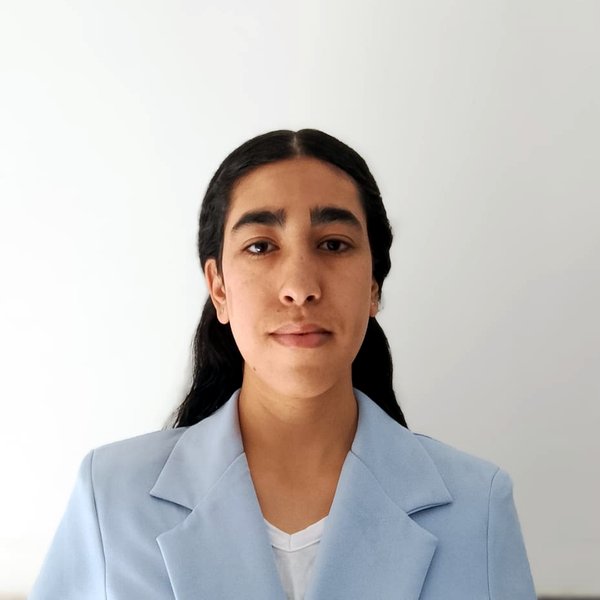
Degree in biology · Certificate in biology
#Moroccan #Arabic #Darija
Specialties
Degree in biology · Certificate in biology
#Moroccan #Arabic #Darija
Specialties
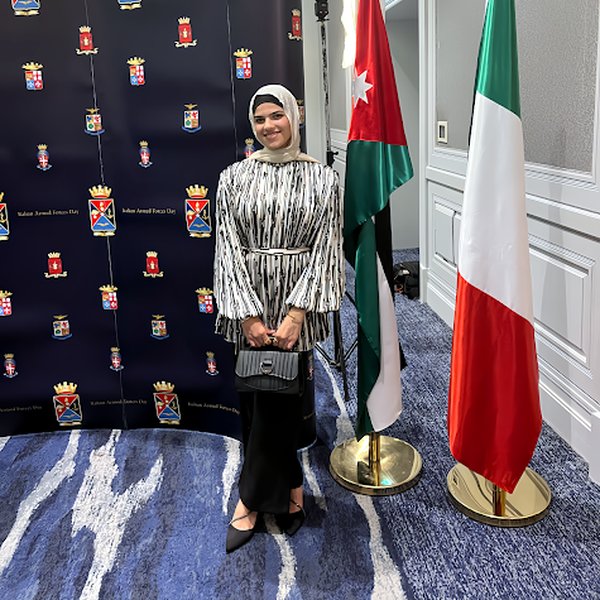
Bachelor’s Degree in Arabic Language and Literature, University of Jordan · Certificate in Teaching Arabic to Children – Jannah Way Canadian Institute.Certificate of Teaching Excellence (5+ Years of Experience) – Intensive Arabic Language Center for Foreigners, Amman.
Your Gateway to Fluent Arabic: Fusha and Jordanian Dialect for All Levels
Specialties
Also speaks: English
Bachelor’s Degree in Arabic Language and Literature, University of Jordan · Certificate in Teaching Arabic to Children – Jannah Way Canadian Institute.Certificate of Teaching Excellence (5+ Years of Experience) – Intensive Arabic Language Center for Foreigners, Amman.
Your Gateway to Fluent Arabic: Fusha and Jordanian Dialect for All Levels
Specialties
I also speak: English

I have a Bachelor degree in French and English Linguistics · TEFL Certeficate
Exellent French teacher
Specialties
saida a
Personally vettedI have a Bachelor degree in French and English Linguistics · TEFL Certeficate
Exellent French teacher
Specialties
Why Arabic?
Four reasons to take Arabic classes
Read the Quran and Classical Poetry in the Original
Arabic literature spans 1,500 years, from pre-Islamic poetry to Naguib Mahfouz's Nobel-winning novels. Translations flatten the wordplay and rhythm that make Arabic prose extraordinary.
Work Across 25 Countries
Arabic is an official language from Morocco to Oman and one of six UN languages. Fluency opens careers in diplomacy, energy, journalism, and international development across the entire Arab world.
Connect With LA's Arab Community
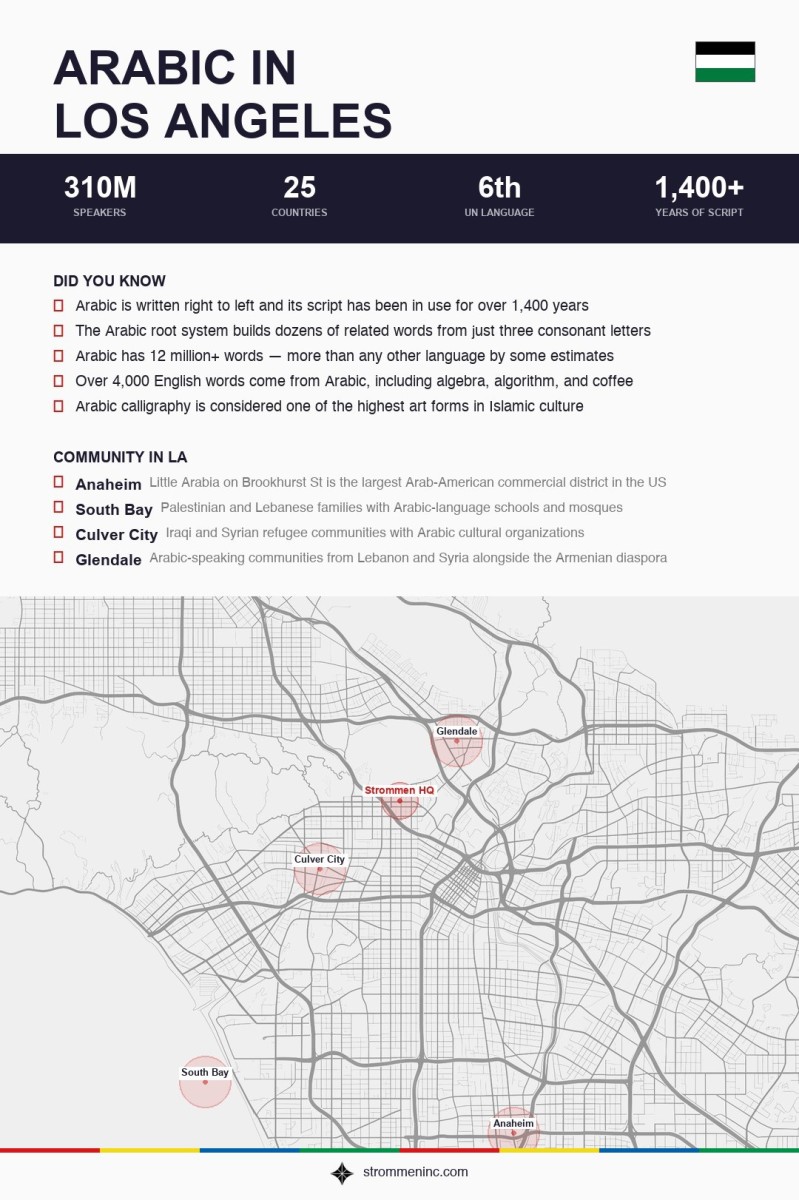
Little Arabia in Anaheim, Glendale's Middle Eastern corridor, South Bay's Yemeni families — Arabic is alive in Los Angeles. Speaking it transforms you from a neighbor into a member of the community.
Decode a Root-Based Language System
Arabic builds entire word families from three-consonant roots. Learn the root k-t-b and you unlock "book," "writer," "library," "office," and "correspondence" — all from the same skeleton.
Since 2006
Arabic in Los Angeles
Arabic is spoken by over 310 million people across 25 countries, stretching from Morocco to Iraq. But Arabic is not one language in the way English is one language. Modern Standard Arabic (MSA), the formal register used in news broadcasts, literature, and official documents, exists alongside dozens of regional dialects that can differ from each other as much as Spanish differs from Portuguese. Egyptian Arabic, Levantine Arabic, Gulf Arabic, and Moroccan Arabic are practically separate spoken languages, though all educated speakers share MSA as a common written standard. The script runs right to left, letters connect in cursive, and most vowels are left unwritten. Arabic also operates on a root system: three consonants form the backbone of a word family, and patterns of vowels and affixes build related meanings from that root.
Los Angeles has a substantial Arab-American community with roots going back decades. Anaheim and Garden Grove in Orange County have large concentrations of Arabic speakers, particularly from Lebanon, Syria, and Palestine. Glendale’s Middle Eastern population includes many Arabic-speaking families alongside the Armenian majority. In South Bay, you will find Yemeni and Egyptian communities. Arabic grocery stores, bakeries, and hookah lounges dot Brookhurst Street in Anaheim, a corridor sometimes called Little Arabia. Heritage speakers are a major part of the student base: kids who grew up hearing Arabic at home but attended English-language schools, and now want to read, write, and speak their parents’ language properly.
Strommen has been matching students with private Arabic tutors in Los Angeles since 2006. Our tutors are native speakers who can teach MSA, Egyptian, Levantine, or Gulf dialect depending on your needs, and that distinction matters, because learning the wrong variety for your situation wastes time. Whether you are a heritage speaker reconnecting with family, a professional working in the Middle East, a student preparing for government language exams, or someone drawn to Arabic calligraphy and Quranic study, your tutor builds each lesson around your goals. Every session is one on one, conversation-driven, and available online or in person.
No public Arabic group classes right now — but we can set up a semi-private class for your family, friends, or company with as few as two people. Get in touch.
Arabic class FAQ
What is the best way to learn Arabic?
Start by deciding which Arabic you need. Modern Standard Arabic is essential for reading, writing, and formal contexts, but nobody speaks it at home. If you want to talk to family in Lebanon, you need Levantine Arabic. If your work takes you to Cairo, you need Egyptian. A native-speaking tutor helps you choose the right focus and teaches both the formal and colloquial registers so you can operate in real situations. Learn the Arabic script early — it takes a couple of weeks and unlocks everything else. Pair your lessons with Arabic media: Al Jazeera for MSA, Egyptian movies for dialect, music for ear training.
How long does it take to learn Arabic?
The State Department classifies Arabic as Category IV — the hardest tier for English speakers — estimating 2,200 class hours for professional proficiency. That number reflects the dual challenge of MSA plus a dialect. For conversational ability in one dialect, most students with regular weekly lessons can handle everyday situations within 8 to 12 months. The script takes about 2 to 4 weeks to learn. Heritage speakers who already understand spoken Arabic but cannot read or write often make rapid progress in a few months.
Is Arabic hard for English speakers?
It is genuinely challenging, but not for the reasons people expect. The script is learnable in weeks. Pronunciation includes a few sounds — the 'ayn and the emphatic consonants — that take practice but are not impossible. The real difficulty is the diglossia: formal written Arabic and everyday spoken Arabic are different enough that learning one does not automatically give you the other. Grammar is complex, with a root-based morphology, dual number, and verb conjugations that encode gender and number. But Arabic is extremely systematic. Once you learn the root patterns, you can decode unfamiliar words on sight.
Can I take Arabic classes online?
Yes. All Arabic lessons are available online via video call. Online works well because screen sharing lets you practice the script in real time, and our tutors can switch between MSA and dialect within a single lesson. Many of our Arabic students are heritage speakers or professionals with unpredictable schedules, so the flexibility of online sessions is a genuine advantage. You work with the same native-speaking tutor each week.
Are you a Arabic teacher in Los Angeles? Join us →
Since 2006 · Los Angeles
Start Arabic classes this week.
Call 323-638-9787 or fill out our form. We match you with an instructor within 24 hours.
Get Started