
Cantonese tutors · Los Angeles · Since 2006
Cantonese Tutors & Classes in Los Angeles. Néih hóu.
Private lessons with native-speaking instructors. Matched to your goals, your schedule, and your life. Start any time.


Your instructors
Cantonese class instructors
I want to learn…
Every tutor, personally met. — founder-vetted since 2006, in Los Angeles and online worldwide.
Get a personalized plan
Pick your language — a language advisor will match you with the right tutor and map out your path.


Bachelor's degree in Economics. · Cambridge Business English Certificate
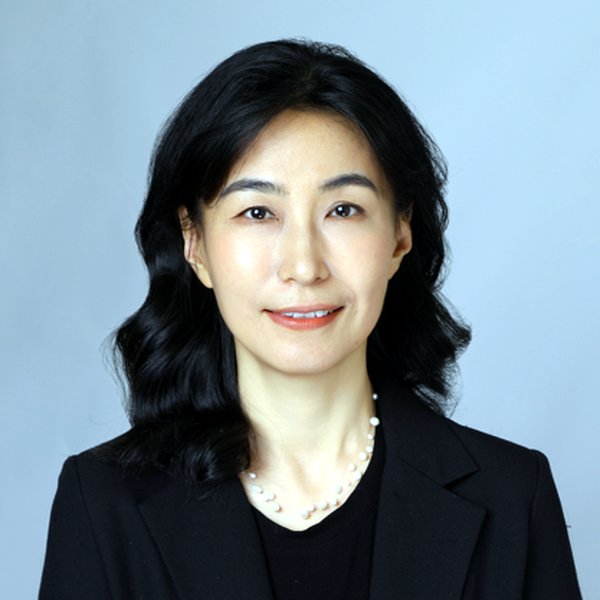
Master Chinese with a Former Senior Diplomatic Mission Manager: 25 Years of High-Level Strategic Communication
Personally vetted · Strommen’s note
Before this, Ying spent twenty-five years as a senior diplomatic mission manager. She runs Chinese lessons like a project plan: milestones, roadmap, real scenarios.
Specialties
Bachelor's degree in Economics. · Cambridge Business English Certificate
Master Chinese with a Former Senior Diplomatic Mission Manager: 25 Years of High-Level Strategic Communication
Specialties
Personally vetted · Strommen’s note
Before this, Ying spent twenty-five years as a senior diplomatic mission manager. She runs Chinese lessons like a project plan: milestones, roadmap, real scenarios.
Human Resources and Education · Qualifications:※ Sun Yat-sen University in China with a bachelor's degree certificates.※Chinese National Putonghua Level 1 B certificates.※China National Primary School Chinese Teacher Qualification Certificate.※National Public English Level 3 Oral Exa...
Experienced native Chinese (Mandarin)/Cantonese tutor
Personally vetted · Strommen’s note
A native Cantonese and Mandarin speaker, Kate teaches both and keeps every class lively, tailored to the student's own goals and personality.
Specialties
Human Resources and Education · Qualifications:※ Sun Yat-sen University in China with a bachelor's degree certificates.※Chinese National Putonghua Level 1 B certificates.※China National Primary School Chinese Teacher Qualification Certificate.※National Public English Level 3 Oral Exa...
Experienced native Chinese (Mandarin)/Cantonese tutor
Specialties
Personally vetted · Strommen’s note
A native Cantonese and Mandarin speaker, Kate teaches both and keeps every class lively, tailored to the student's own goals and personality.


BA (Hons) in Bilingual Studies. · TCSOL and TEFL.
Bridging cultures through language, story, and authentic communication.
Specialties
Also speaks: Japanese, Spanish
BA (Hons) in Bilingual Studies. · TCSOL and TEFL.
Bridging cultures through language, story, and authentic communication.
Specialties
I also speak: Japanese, Spanish

Bachelor of Arts (BA) in Global and Development Studies – Jagiellonian University of Krakow, Poland (Graduated, 2020–2023)Master of Science (MSc) in European Urban Studies – Bauhaus-Universität Weimar, Germany (Expected completion in September 2026) · CityMinds Summer School Certificate – EIT Urban Mobility, Thessaloniki, Greece (July 2025)Erasmus+ Academic Exchange Program – Goethe Universität Frankfurt, Germany (Focus on Social and Political Sciences, 2022–2023)
Multilingual tutor making Cantonese, Mandarin, and English practical and engaging
Specialties
TSANG T
Personally vettedBachelor of Arts (BA) in Global and Development Studies – Jagiellonian University of Krakow, Poland (Graduated, 2020–2023)Master of Science (MSc) in European Urban Studies – Bauhaus-Universität Weimar, Germany (Expected completion in September 2026) · CityMinds Summer School Certificate – EIT Urban Mobility, Thessaloniki, Greece (July 2025)Erasmus+ Academic Exchange Program – Goethe Universität Frankfurt, Germany (Focus on Social and Political Sciences, 2022–2023)
Multilingual tutor making Cantonese, Mandarin, and English practical and engaging
Specialties

Why Cantonese?
Four reasons to take Cantonese classes
Speak the Language of Hong Kong Cinema
From Bruce Lee to Wong Kar-wai, Cantonese is the language of one of the world's great film traditions. Dubbed versions lose the rhythm, humor, and street slang.
Connect With Chinatowns Worldwide
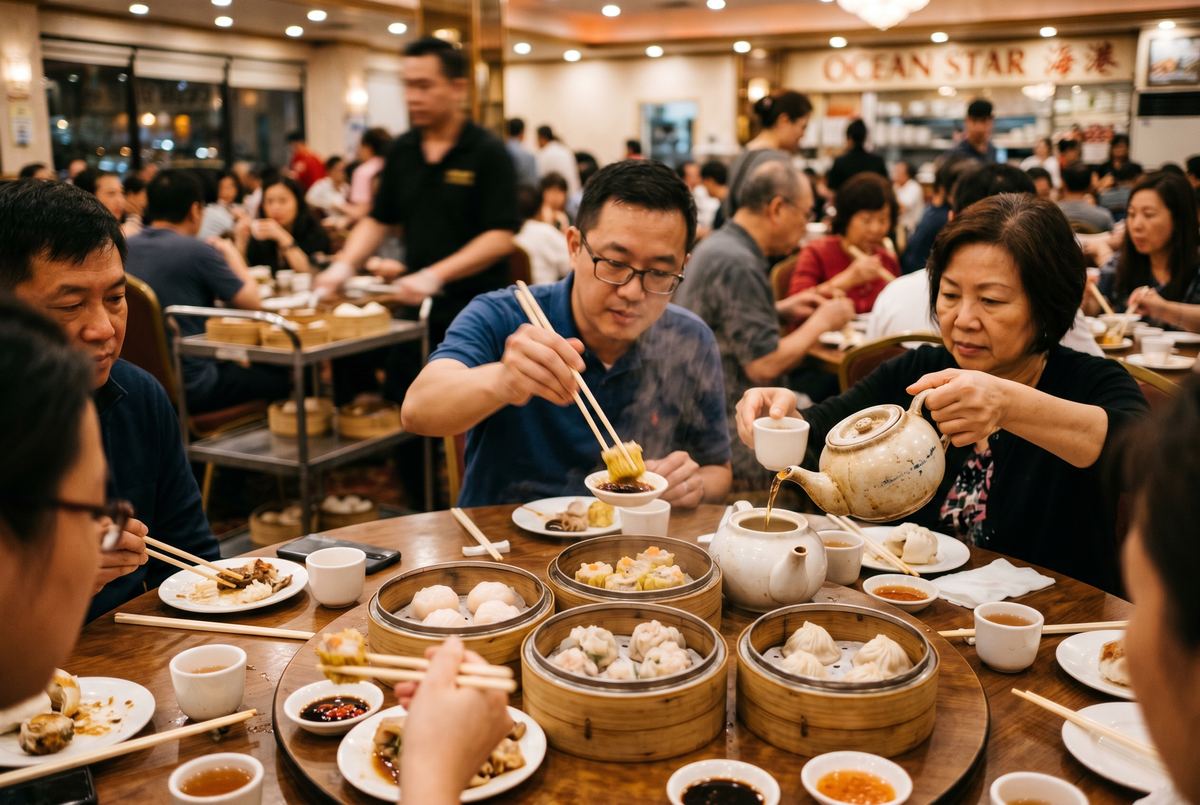
Most overseas Chinese communities — in San Francisco, New York, London, and Sydney — speak Cantonese, not Mandarin. It's the language of dim sum, family, and diaspora.
Preserve a Living Ancient Chinese
Cantonese retains more features of classical Chinese than Mandarin does, including tones and vocabulary. Linguists consider it closer to Tang Dynasty Chinese.
Do Business in the Pearl River Delta
Guangdong province and Hong Kong form one of the world's wealthiest economic regions. While Mandarin is spreading, Cantonese remains the language of trust and local business.
Since 2006
Cantonese in Los Angeles
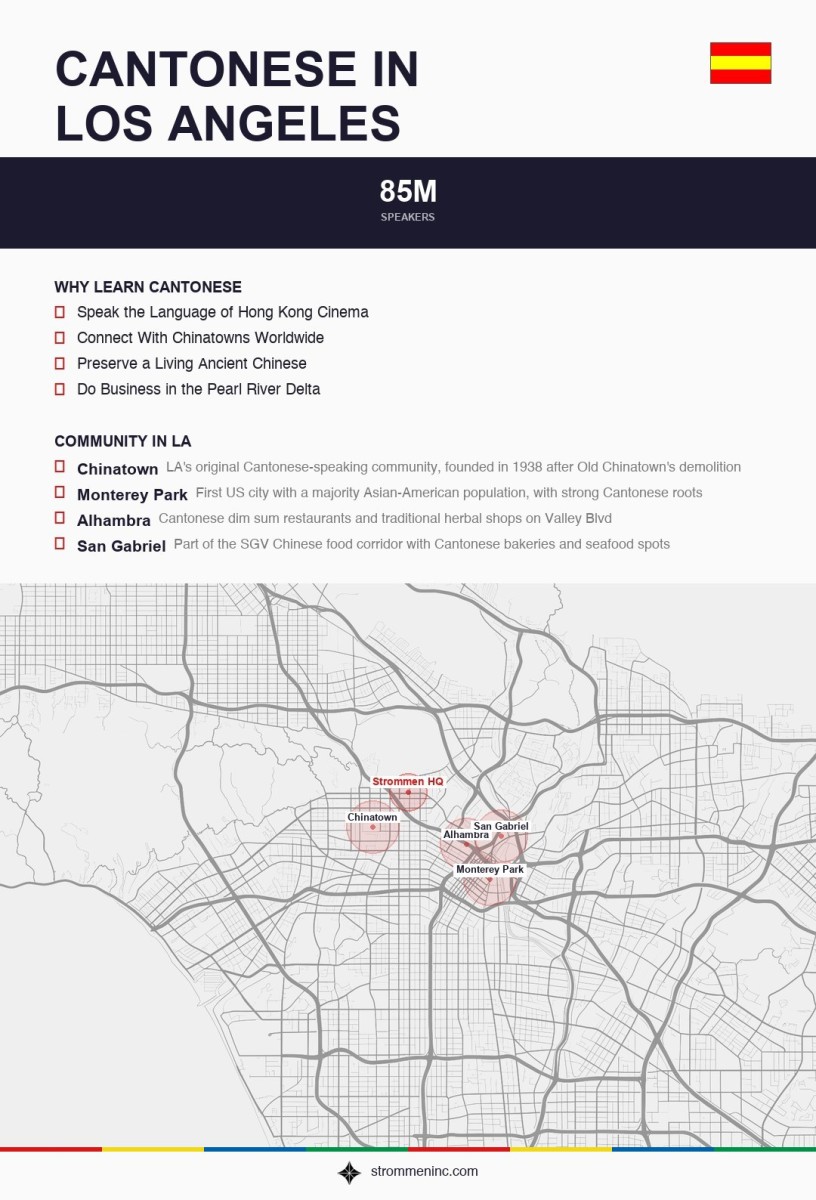
Cantonese is spoken by roughly 85 million people worldwide, primarily in the Guangdong province of southern China, Hong Kong, Macau, and a massive global diaspora. It is one of the major Chinese languages, distinct enough from Mandarin that the two are not mutually intelligible when spoken. Cantonese has six tones (some linguists count nine, depending on whether short stopped syllables are tracked separately), compared to Mandarin’s four, and a phonological structure that has preserved features of older Chinese that Mandarin lost. Cantonese is written using traditional Chinese characters, often with additional characters specific to Cantonese vocabulary that do not exist in Mandarin writing. Most Cantonese speakers in Hong Kong are biliterate in standard written Chinese (which follows Mandarin grammar) and Cantonese-specific writing used in informal contexts.
LA has one of the largest Cantonese-speaking populations outside Asia. The San Gabriel Valley (Monterey Park, Alhambra, San Gabriel, Rosemead, Rowland Heights) became the heart of the community after the 1965 immigration reform, and waves of Hong Kong emigration through the 1980s and 1990s reinforced it. Cantonese is the working language of a huge swath of Chinese-American business, food, and family life across the SGV. Many of our Cantonese students are heritage speakers, kids and grandkids of immigrants from Hong Kong or Guangdong, who grew up understanding Cantonese but never learned to read it or speak it confidently. Others are partners of Cantonese-American families, people building business relationships in Hong Kong, or fans of Cantopop and Hong Kong cinema who want the language without subtitles.
Strommen has been matching students with private Cantonese tutors in Los Angeles since 2014. Our tutors are native speakers from Hong Kong and Guangdong who can teach the conversational Cantonese spoken in HK or work with the regional variations the SGV community uses. We focus on tones from day one because Cantonese tones are the make-or-break element of sounding natural. Lessons are one on one, online or in person, and your tutor designs every session around your goals.
No public Cantonese group classes right now — but we can set up a semi-private class for your family, friends, or company with as few as two people. Get in touch.
Cantonese class FAQ
What is the best way to learn Cantonese?
One-on-one work with a native speaker is not optional — it's essential. Cantonese tones cannot be learned from a book or an app. You need someone who can listen to you, correct you in real time, and drill you repeatedly until your ear and your mouth are calibrated. Beyond tutoring, immerse yourself in the language however you can. Watch Hong Kong dramas and films (TVB series are a goldmine for colloquial Cantonese). Listen to Cantopop. And if you're in LA, use the advantage you have: go eat in the SGV and practice ordering in Cantonese. The language is alive all around you here in ways it isn't in most American cities.
How long does it take to learn Cantonese?
The FSI doesn't separate Cantonese from Mandarin Chinese in its ratings, but Cantonese is generally considered harder than Mandarin for English speakers due to the additional tones. It sits firmly in Category IV — the hardest category — with 2,200+ class hours estimated for professional proficiency. For functional conversation — enough to chat with family, navigate Hong Kong, or order food in Cantonese at a restaurant — expect at least a year of serious study. Heritage speakers who already have listening comprehension can reach conversational ability much faster, sometimes within a few months, because they're activating knowledge that already exists rather than building from scratch.
Is Cantonese hard for English speakers?
Yes, it's one of the hardest. The tone system is the biggest challenge — Cantonese has six tones in standard analysis, and using the wrong tone doesn't just sound off, it changes the meaning of the word entirely. The writing system (shared with Mandarin) uses thousands of characters that must be memorized individually. And the grammar, while simpler than English in some ways (no conjugations, no plurals), has its own complexities with measure words and aspect markers. For heritage speakers, the difficulty is different — the sounds are already familiar, but formal grammar and literacy are new. Either way, it's a serious commitment, which is exactly why having a good tutor matters so much.
Can I take Cantonese classes online?
Yes. While LA is one of the few cities where you might find in-person Cantonese classes through community schools, the scheduling and commute usually make online tutoring more practical for working adults. Our lessons are conducted over video call with a native Cantonese speaker, one-on-one. The format works well because the core work — tone drilling, listening practice, and conversation — translates naturally to a video setting. And for heritage speakers in particular, the private one-on-one environment is more comfortable than a classroom where you might feel self-conscious about gaps in your knowledge.
Are you a Cantonese teacher in Los Angeles? Join us →
Since 2006 · Los Angeles
Start Cantonese classes this week.
Call 323-638-9787 or fill out our form. We match you with an instructor within 24 hours.
Get Started