
 Tagalog tutors · Los Angeles · Since 2006
Tagalog Tutors & Classes in Los Angeles. Kumusta.
Private lessons with native-speaking instructors. Matched to your goals, your schedule, and your life. Start any time.



Your instructors
Tagalog class instructors
I want to learn…
Every tutor, personally met. — founder-vetted since 2006, in Los Angeles and online worldwide.
Get a personalized plan
Pick your language — a language advisor will match you with the right tutor and map out your path.

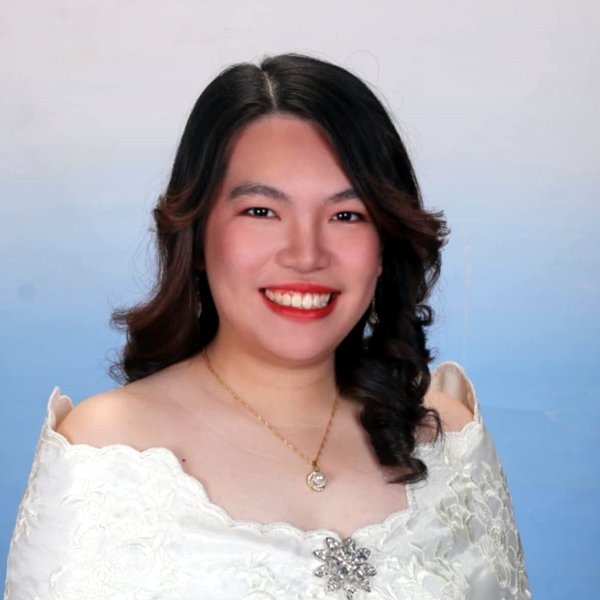


Bachelor's degree in secondary education, majoring in English. Masters degree in English language teaching. · multilingual classroom and TEFL
English and Tagalog Certified Teacher with Masters Degree in English
Personally vetted · Strommen’s note
Princess is a licensed secondary teacher with a Master's in English. She also teaches Tagalog, a genuinely rare pairing on our roster.
Specialties
Also speaks: Spanish
Bachelor's degree in secondary education, majoring in English. Masters degree in English language teaching. · multilingual classroom and TEFL
English and Tagalog Certified Teacher with Masters Degree in English
Specialties
I also speak: Spanish
Personally vetted · Strommen’s note
Princess is a licensed secondary teacher with a Master's in English. She also teaches Tagalog, a genuinely rare pairing on our roster.
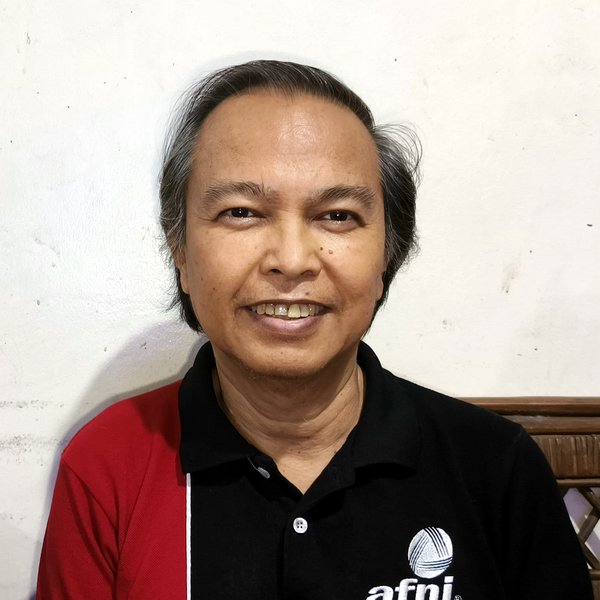
B. S in Biology F. E. U Graduate. Post grad 2nd year proper Medicine NRMF inst of Medicine · N. A
Kuya Rommel from the beautiful country Philippines
Personally vetted · Strommen’s note
Rommel, known to students as 'Kuya,' starts every lesson by pinpointing exactly where someone's stuck, then builds the plan from there.
Specialties
B. S in Biology F. E. U Graduate. Post grad 2nd year proper Medicine NRMF inst of Medicine · N. A
Kuya Rommel from the beautiful country Philippines
Specialties
Personally vetted · Strommen’s note
Rommel, known to students as 'Kuya,' starts every lesson by pinpointing exactly where someone's stuck, then builds the plan from there.

Why Tagalog?
Four reasons to take Tagalog classes
Connect With 4 Million Filipino Americans
Filipinos are the second-largest Asian American group in the US. Speaking Tagalog builds deep community bonds in healthcare, the military, and cities like LA and San Francisco.
Navigate 7,641 Islands
The Philippines is one of the world's most beautiful archipelagos. While many Filipinos speak English, Tagalog is the language of humor, affection, and real local life.
Understand a Unique Linguistic Blend
Tagalog naturally mixes with English and Spanish in everyday speech. Learning it reveals how colonialism, trade, and culture shape language in real time.
Tap Into the World's Service Economy Leader
The Philippines is the world's largest BPO hub and a major source of healthcare workers globally. Tagalog proficiency is a genuine professional asset in these industries.
Since 2006
Tagalog in Los Angeles
Tagalog is the basis of Filipino, the national language of the Philippines, spoken natively by about 28 million people and understood by over 80 million across the archipelago. It is an Austronesian language with a surprisingly complex verb system. Verbs change form based on whether the focus of the sentence is the doer, the receiver, the location, or the instrument. The vocabulary borrows heavily from Spanish (after 333 years of colonization), English (after American rule), Malay, and Chinese. A casual sentence can mix Tagalog grammar with English nouns and Spanish numbers without anyone batting an eye. This switching is called Taglish, and it is the way Filipinos actually talk in cities like Manila and increasingly LA.
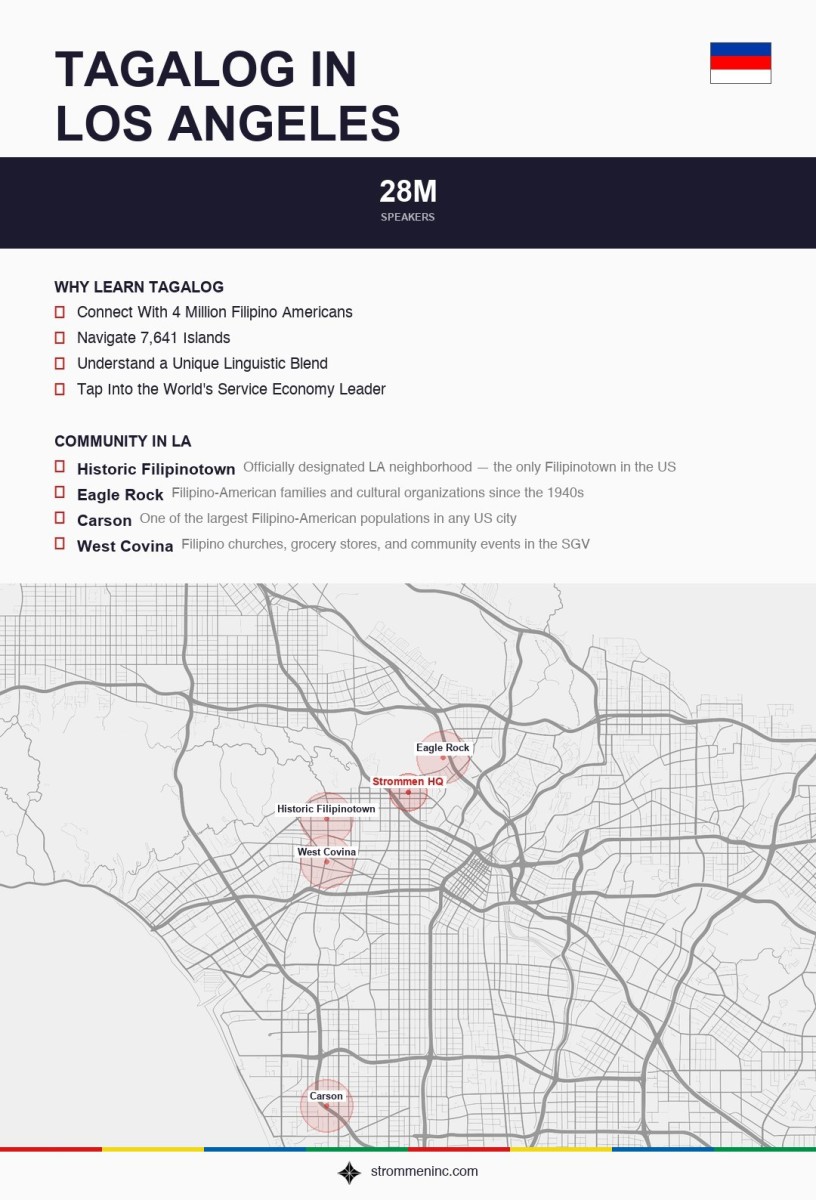
The Filipino-American community in LA is one of the largest in the country, with major concentrations in Historic Filipinotown west of downtown, Eagle Rock, West Covina, Cerritos, and Carson. Filipino restaurants, bakeries, and grocery stores anchor neighborhoods across the LA basin. Many of our Tagalog students are second- and third-generation Filipino-Americans who grew up hearing the language at home but never learned to speak it confidently. Others are professionals working with Filipino business contacts, healthcare workers serving Filipino patient populations, or partners and spouses of Filipino-Americans wanting to connect with their in-laws.
Strommen has been matching students with private Tagalog tutors in Los Angeles since 2014. Our tutors are native speakers from the Philippines, mostly from Manila and surrounding regions, who can teach formal Tagalog or the everyday Taglish that LA Filipino families actually use. Lessons are one on one, online or in person, and built around your goals. Whether you are reconnecting with grandparents in Cebu, preparing for a healthcare interview with Filipino patients, or finally being able to follow what your in-laws are gossiping about in the kitchen, your tutor designs every session around that.
No public Tagalog group classes right now — but we can set up a semi-private class for your family, friends, or company with as few as two people. Get in touch.
Tagalog class FAQ
What is the best way to learn Tagalog?
The most effective way to learn Tagalog is through consistent conversation with a native speaker, combined with exposure to real-world media like Filipino TV shows, music, and podcasts. Tagalog's verb focus system is unlike anything in English, so having a tutor who can explain it in practical terms — not just grammar charts — makes a big difference. Many of our students also benefit from practicing with family members between lessons. Apps and self-study tools can supplement, but they won't teach you the natural Taglish mixing that actual Filipino speakers use every day.
How long does it take to learn Tagalog?
The U.S. Foreign Service classifies Tagalog as a Category III language, estimating about 1,100 class hours for professional proficiency. But most people aren't aiming for diplomat-level fluency. If you want to hold casual conversations, follow along at family gatherings, or handle everyday situations during a trip to the Philippines, you can get there in 6 to 12 months of regular lessons and practice. The Spanish and English loanwords in Tagalog give English speakers a head start on vocabulary. Grammar takes longer — the focus system is genuinely different from how English works — but it clicks with practice.
Is Tagalog hard for English speakers?
Tagalog has some features that trip English speakers up — especially the verb system, where you conjugate based on what part of the sentence is in focus, not just tense. Pronunciation, though, is straightforward. Tagalog uses a Latin alphabet and is largely phonetic, so what you see is what you say. Sentence structure is flexible (verb-subject-object is common, but not rigid), which can feel disorienting at first. On the plus side, Tagalog has absorbed thousands of English and Spanish words, so your existing vocabulary carries over more than you'd think. Most students say the hardest part is the verbs; the rest comes fairly quickly.
Can I take Tagalog classes online?
Yes. All of our Tagalog tutoring is available online via video call, which is how the majority of our students take lessons. Online sessions work especially well for Tagalog because so much of learning the language is conversational — you don't need a physical classroom for that. Our tutors are based in various time zones, so we can usually accommodate early morning or evening schedules. If you're in the LA area and prefer meeting in person, we can arrange that too.
Are you a Tagalog teacher in Los Angeles? Join us →
Since 2006 · Los Angeles
Start Tagalog classes this week.
Call 323-638-9787 or fill out our form. We match you with an instructor within 24 hours.
Get Started