
 Turkish tutors · Los Angeles · Since 2006
Turkish Tutors & Classes in Los Angeles. Merhaba.
Private lessons with native-speaking instructors. Matched to your goals, your schedule, and your life. Start any time.



Your instructors
Turkish class instructors
I want to learn…
Every tutor, personally met. — founder-vetted since 2006, in Los Angeles and online worldwide.
Get a personalized plan
Pick your language — a language advisor will match you with the right tutor and map out your path.


I have a Master's degree in Communication Sciences
From Amsterdam's Heart to Global Fluency, Eser Offers Experience-Driven Coaching!
Specialties
I have a Master's degree in Communication Sciences
From Amsterdam's Heart to Global Fluency, Eser Offers Experience-Driven Coaching!
Specialties

The Department of Turkish Language and Literature:Bachelor's & Master's DegreePhD (Ongoing)
Learn Turkish with Me! Friendly professional teacher.
Personally vetted · Strommen’s note
Osman teaches Turkish with what he calls the 'Eclectic Method,' eight or nine years of figuring out that no two students need the same one.
Specialties
The Department of Turkish Language and Literature:Bachelor's & Master's DegreePhD (Ongoing)
Learn Turkish with Me! Friendly professional teacher.
Specialties
Personally vetted · Strommen’s note
Osman teaches Turkish with what he calls the 'Eclectic Method,' eight or nine years of figuring out that no two students need the same one.
Why Turkish?
Four reasons to take Turkish classes
Bridge Between Europe and Asia
Turkey straddles two continents, and Turkish culture reflects both. The language is your passport to understanding this unique geopolitical position.
Perfectly Logical Grammar
Turkish is agglutinative — you build words by stacking suffixes in a predictable order. Once you learn the system, it's remarkably consistent with almost no exceptions.
Unlock the Turkic Language Family
Turkish is mutually intelligible with Azerbaijani and shares deep roots with Uzbek, Kazakh, and Turkmen. Learning Turkish gives you a foothold across Central Asia.
Experience Turkey Beyond the Tourist Trail
From Istanbul's back-street meyhanes to Cappadocia's cave villages, Turkish transforms your travel. Hospitality culture means every conversation becomes an invitation.
Since 2006
Turkish in Los Angeles
Turkish is the native language of about 80 million people, mostly in Turkey but also in Cyprus, parts of the Balkans, and across a wide diaspora in Germany and Western Europe. It belongs to the Turkic language family, which puts it in a completely different category from the Indo-European languages most English speakers know. Turkish is agglutinative: it builds words by stacking suffixes onto a root, which means a single Turkish word can encode information that would take an entire English sentence. Vowel harmony controls which suffixes attach to which words. The language uses the Latin alphabet (a 1928 reform replaced the Arabic-based Ottoman script), and the spelling is almost perfectly phonetic. Once you can pronounce the alphabet, you can pronounce any Turkish word you read.
The Turkish community in LA is smaller than in cities with major Turkish business hubs, but it is well networked through the Turkish Consulate in Beverly Hills, Turkish-American organizations, and businesses across the Westside and the Valley. Many of our Turkish students are partners of Turkish nationals, professionals with Turkish business contacts (Istanbul has become a major regional finance and tech hub), travelers preparing for extended stays in Istanbul or along the Aegean coast, or fans of Turkish television (the dizi industry has become one of the world’s largest TV exporters) who want the language without subtitles.
Strommen has been matching students with private Turkish tutors in Los Angeles since 2014. Our tutors are native speakers from Istanbul and other Turkish regions who can teach the standard Istanbul Turkish that dominates education and media. Turkish rewards consistency: the agglutination feels strange at first and then becomes addictive once you see how the patterns work. Lessons are one on one, online or in person, and your tutor builds every session around your goals.
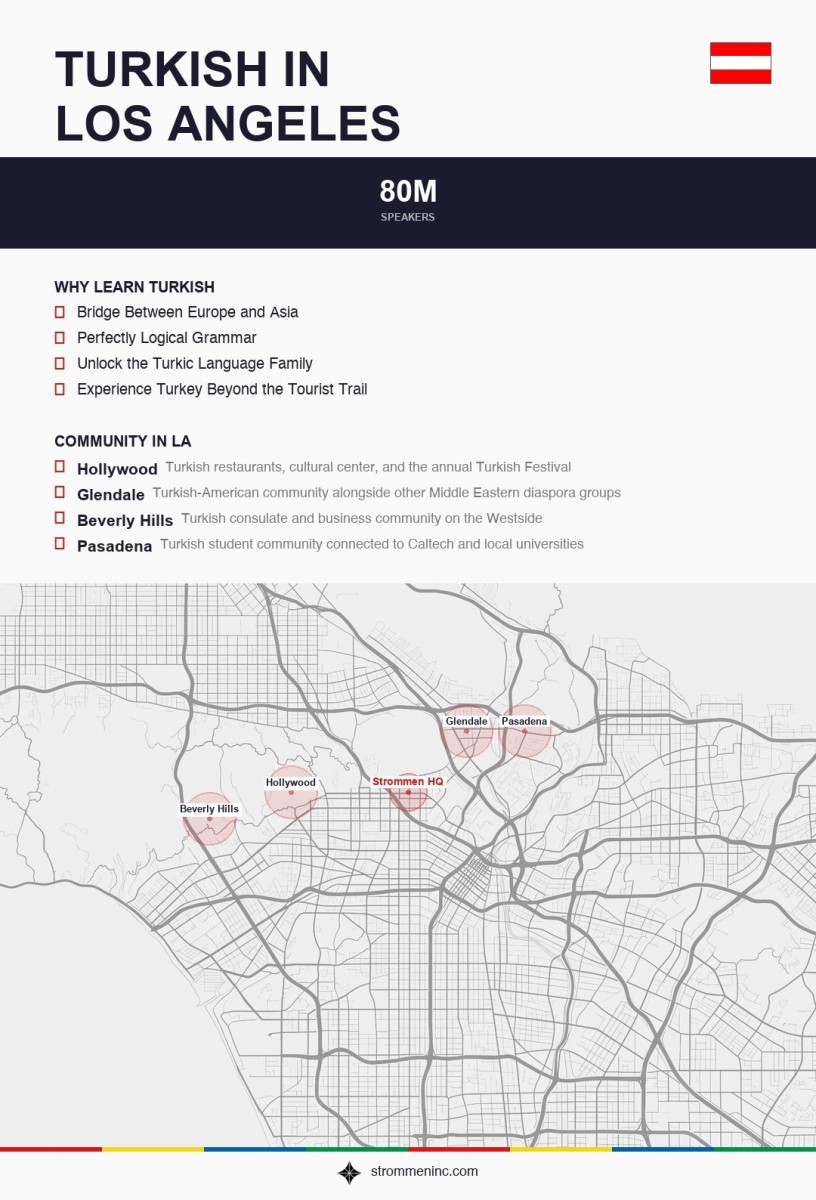
No public Turkish group classes right now — but we can set up a semi-private class for your family, friends, or company with as few as two people. Get in touch.
Turkish class FAQ
What is the best way to learn Turkish?
Consistent conversation practice with a native speaker is the fastest route. Turkish grammar follows very regular rules with almost no exceptions, which is unusual for a language — but you need someone to walk you through the suffix-stacking system in a way that makes sense. Pair weekly tutoring sessions with listening practice (Turkish music, podcasts, or TV shows) and you'll build both comprehension and speaking confidence. Apps can help with vocabulary, but they won't teach you how to actually form a sentence in real time. That takes a human.
How long does it take to learn Turkish?
The U.S. State Department rates Turkish as a Category III language, estimating about 1,100 class hours to reach professional proficiency. For conversational ability — ordering food, having basic discussions, navigating travel — most dedicated students get there in 6 to 9 months of regular study. The grammar is logical and consistent, which helps. The biggest hurdle is usually vocabulary, since Turkish shares very few cognates with English. But the flip side is that once you learn a root word, you can build dozens of related words from it using suffixes.
Is Turkish hard for English speakers?
It's different, which people sometimes confuse with hard. The sentence structure is Subject-Object-Verb (the verb goes at the end), which takes adjustment. And the agglutinative grammar — where you attach multiple suffixes to build meaning — is unlike anything in English. But here's the thing: Turkish spelling is completely phonetic, the grammar has almost no irregular forms, and there are no grammatical genders. Compare that to French or German. The learning curve is steep at the start, but it flattens out faster than most languages because the rules are so consistent.
Can I take Turkish classes online?
Yes. All of our Turkish tutoring is available online via video call, and most of our Turkish students prefer it that way. You get the same native-speaking tutor, the same personalized lesson plan, and the same conversation-focused approach — just from wherever you happen to be. Scheduling is flexible, and since our tutors span multiple time zones, we can usually accommodate early morning or late evening sessions if that's what your schedule requires.
Are you a Turkish teacher in Los Angeles? Join us →
Since 2006 · Los Angeles
Start Turkish classes this week.
Call 323-638-9787 or fill out our form. We match you with an instructor within 24 hours.
Get Started