
 Urdu tutors · Los Angeles · Since 2006
Urdu Tutors & Classes in Los Angeles. Adaab.
Private lessons with native-speaking instructors. Matched to your goals, your schedule, and your life. Start any time.



Your instructors
Urdu class instructors
I want to learn…
Every tutor, personally met. — founder-vetted since 2006, in Los Angeles and online worldwide.
Get a personalized plan
Pick your language — a language advisor will match you with the right tutor and map out your path.




Bachelor of arts (Hindi) · Bachelor of arts (Hindi)
Master Hindi with Ritu: Fun, Culture, and Success in Every Lesson - over 1000 classes taught
Specialties
Bachelor of arts (Hindi) · Bachelor of arts (Hindi)
Master Hindi with Ritu: Fun, Culture, and Success in Every Lesson - over 1000 classes taught
Specialties

Why Urdu?
Four reasons to take Urdu classes
Speak the Language of Mughal Poetry
Urdu is one of the world's great literary languages, with a poetic tradition (ghazal, nazm) spanning centuries. Ghalib, Faiz, and Iqbal are best experienced in the original.
Communicate Across South Asia
Urdu and Hindi are mutually intelligible in everyday speech. Learning Urdu effectively gives you access to over a billion speakers across Pakistan, India, and the diaspora.
Read One of the World's Most Beautiful Scripts
Urdu's Nastaliq script is considered calligraphic art in its own right. Learning to read and write it is as much an aesthetic experience as a linguistic one.
Understand Pakistan and Its Diaspora
Pakistan is the world's fifth most-populous country, and Urdu-speaking communities thrive in the UK, US, and Gulf states. Urdu bridges cultural gaps that English alone cannot.
Since 2006
Urdu in Los Angeles
Urdu is spoken natively by about 70 million people, primarily in Pakistan (where it is the national language) and in parts of northern India. It is mutually intelligible with Hindi at the conversational level (the two share grammar and most everyday vocabulary), but they diverge in formal register, with Urdu drawing heavily on Persian and Arabic vocabulary while Hindi pulls from Sanskrit. Urdu is written in a modified Persian-Arabic script (Nastaliq) that flows right to left in flowing, calligraphic strokes. The grammar uses three genders, postpositions instead of prepositions, and an honorific system that shifts pronouns and verb endings based on social hierarchy and respect.
The Pakistani and Urdu-speaking community in LA is concentrated in the Westside, Artesia (which it shares with the Indian community), and pockets across the Valley. Pioneer Boulevard in Artesia, while best known as Little India, has Pakistani sweet shops, halal butchers, and clothing stores serving the Urdu-speaking population. Many of our Urdu students are heritage speakers whose parents came from Karachi, Lahore, or Hyderabad, kids who understand spoken Urdu but never learned the script. Others are professionals working with Pakistani business contacts, partners of Urdu speakers, or scholars interested in classical Urdu poetry by Ghalib, Iqbal, or Faiz.
Strommen has been matching students with private Urdu tutors in Los Angeles since 2014. Our tutors are native speakers from Pakistan who can teach the conversational Urdu families use at home, the formal Urdu of news and literature, or the script and poetry separately if that is what you need. Lessons are one on one, online or in person, and your tutor designs every session around your goals, whether that is talking to your nani, reading Faiz in Nastaliq, or holding business conversations with partners in Karachi.
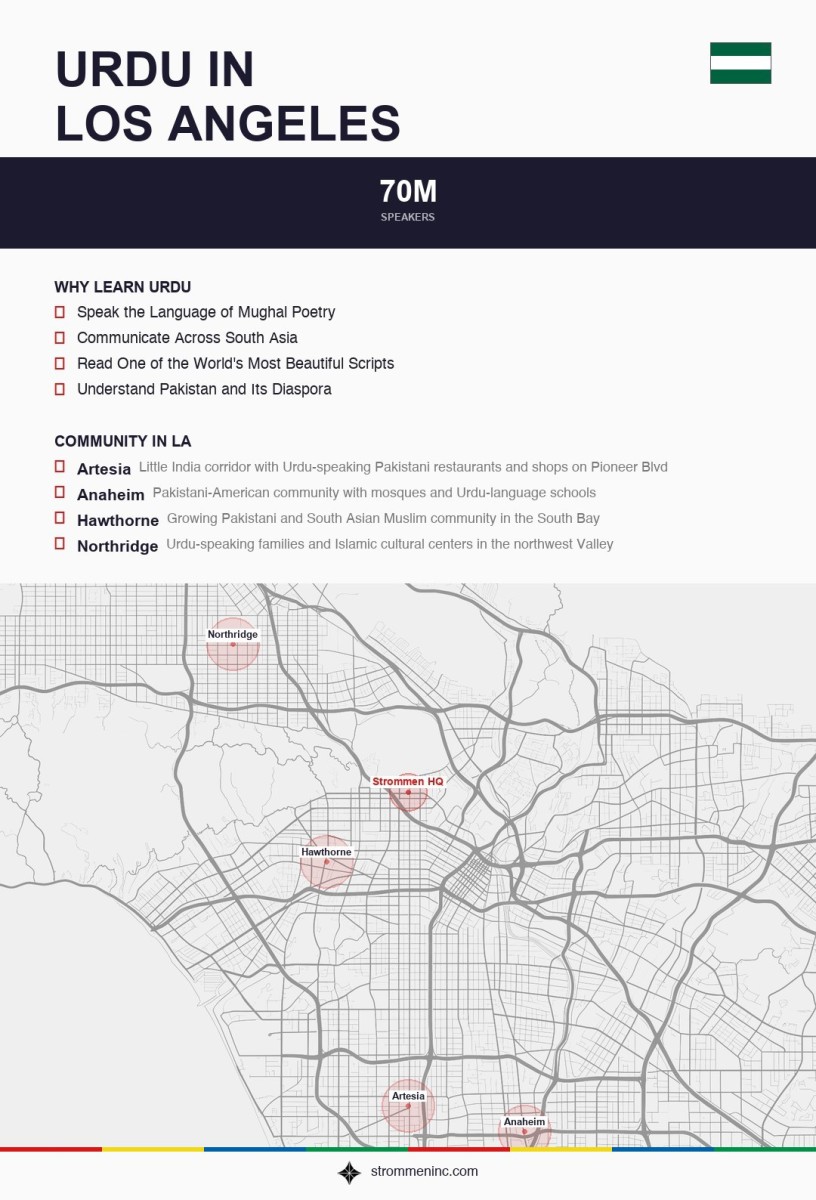
No public Urdu group classes right now — but we can set up a semi-private class for your family, friends, or company with as few as two people. Get in touch.
Urdu class FAQ
What is the best way to learn Urdu?
Regular conversation with a native speaker is the foundation. Urdu has a lot of nuance in politeness levels and formality — the difference between tum, aap, and tu matters socially, and a tutor can guide you through those distinctions in ways a textbook can't. Watching Pakistani dramas (which are popular worldwide and easy to find with subtitles) is excellent for listening practice and picking up natural phrasing. If you already understand spoken Hindi, you have a huge head start — focus on learning the Nastaliq script and building your Persian-Arabic-origin vocabulary. For complete beginners, starting with the spoken language before tackling the script often works best.
How long does it take to learn Urdu?
The FSI classifies Urdu as a Category IV language, with an estimated 1,100 hours to professional proficiency. That estimate is largely driven by the Nastaliq script, which takes time to learn because letters change form depending on their position in a word. Conversationally, though, Urdu grammar is more accessible than many European languages — no grammatical gender for inanimate objects in casual speech, relatively regular verb conjugation patterns, and a word order (subject-object-verb) that becomes intuitive quickly. Many students reach comfortable conversational ability within 6 to 12 months. If you already know Hindi, you can focus on script and formal vocabulary and progress much faster.
Is Urdu hard for English speakers?
It depends on what you mean by hard. The Nastaliq script is a real learning curve — it's cursive, right-to-left, and letters look different depending on where they fall in a word. Some sounds, like the retroflex consonants (where you curl your tongue back) and the aspirated stops (like "kh" and "ph"), don't exist in English and take practice. But Urdu grammar is fairly regular, the verb system is less complicated than French or German, and there are more English loanwords in everyday Urdu than you'd expect — especially for modern concepts. The biggest advantage? Urdu and Hindi share a spoken base, so learning Urdu effectively gives you access to two major languages at once.
Can I take Urdu classes online?
Yes, and most of our Urdu students do. Online lessons via video call work very well for Urdu, including script instruction — our tutors use screen sharing and digital whiteboards to teach Nastaliq writing in real time. We have tutors available across multiple time zones, which is helpful for students with nonstandard schedules. If you're in the LA area and prefer face-to-face sessions, that's an option too. Either way, the lesson content and quality are the same.
Are you a Urdu teacher in Los Angeles? Join us →
Since 2006 · Los Angeles
Start Urdu classes this week.
Call 323-638-9787 or fill out our form. We match you with an instructor within 24 hours.
Get Started