



Personally vetted instructors
Medical Spanish tutors, lessons & classes
¿Cómo se siente hoy? The opening line of a Spanish-language clinical visit.
Personally vetted Medical Spanish tutors. Lessons calibrated to clinical encounters: intake, history of present illness, pain assessment, medication counseling, and the cultural and legal lines around when functional Spanish is enough and when a certified medical interpreter belongs in the room.
Your instructors
Medical Spanish tutors for private lessons & classes
Strommen has been teaching Spanish since 2006. Medical Spanish has always been a real demand here: residents and attendings working in safety-net hospitals and community clinics, ED nurses and PAs whose triage panels are majority Spanish-speaking, pharmacists at neighborhood pharmacies, EMTs and paramedics, school-based therapists and social workers, and bilingual-credentialing candidates preparing for the OPI. Every tutor below was met and vetted by us in person or via thorough video interview. No marketplace. No automated profile-creation. Real teachers with real backgrounds in clinical Spanish instruction.
Filter by location, age, or price. Then book a 30-minute free trial.
Below are the Strommen tutors who specialize in Medical Spanish. Photos, ratings, and rates are real. Click any card to read their bio and book a free 30-minute trial.
I want to learn…
Every tutor, personally met. — founder-vetted since 2006, in Los Angeles and online worldwide.
Get a personalized plan
Pick your language — a language advisor will match you with the right tutor and map out your path.


BS Agricultural Engineering, Profesora de Español ELE (Español como Lengua Extranjera) · Certificado Profesor ELE (Español como Lengua Extranjera)
Certified ELE Spanish teacher from Colombia. With 5+ years of diverse teaching experience
Personally vetted · Strommen’s note
Carolina is certified ELE-trained and specializes in Medical Spanish, on top of general instruction, out of Medellín.
Specialties
BS Agricultural Engineering, Profesora de Español ELE (Español como Lengua Extranjera) · Certificado Profesor ELE (Español como Lengua Extranjera)
Certified ELE Spanish teacher from Colombia. With 5+ years of diverse teaching experience
Specialties
Personally vetted · Strommen’s note
Carolina is certified ELE-trained and specializes in Medical Spanish, on top of general instruction, out of Medellín.

En la clínica — culture & register
5 Medical Spanish moves that change the encounter
These aren't textbook phrases. They are the high-yield moves that separate a provider whose Spanish actually serves patients from one whose Spanish is technically correct and clinically thin. Screenshot the infographic, then book a tutor to drill the rest.
-
01
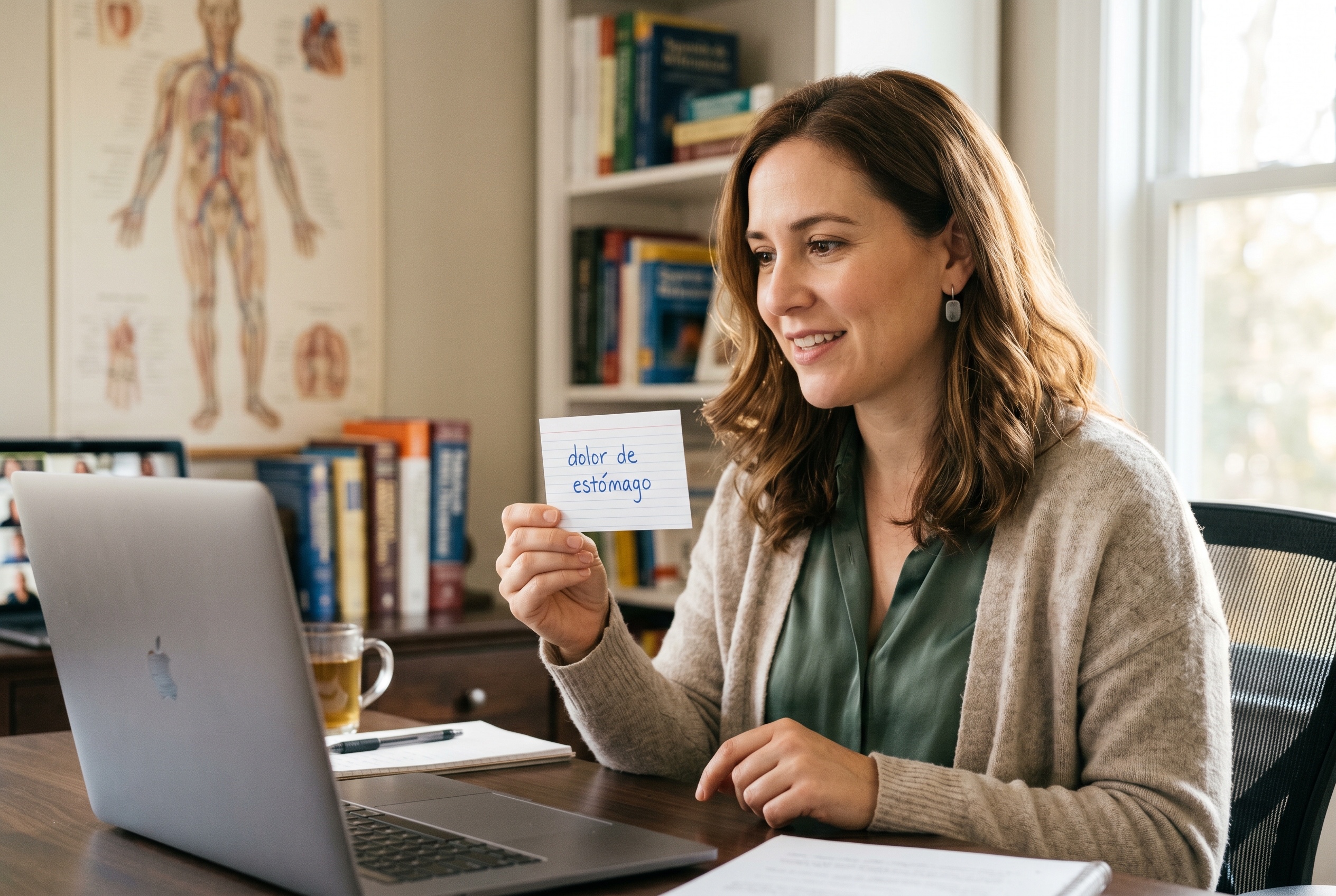
La barriga / la panza
The everyday word most Spanish-speaking patients use for the abdomen, where the textbook offers el estómago. La barriga is broadly pan-Hispanic; la panza is common in Mexican and Central American varieties. A patient pointing to her lower abdomen and saying “me duele la barriga” is reporting abdominal pain, not gastric pain specifically. Recognize both registers and respond in the one the patient used.
e.g. Patient: “Me duele la barriga desde anoche.” Provider: “¿En qué parte de la barriga le duele más?”
-
02
¿Del uno al diez, cuánto le duele?
The pain-scale question that works across virtually every Spanish-speaking patient population. Pair it with the qualifier vocabulary patients actually use to describe pain: punzante (stabbing), sordo (dull), ardiente (burning), pulsante (throbbing), opresivo (pressure-like), cólico (cramping). “¿Cómo es el dolor?” invites the patient to choose the descriptor.
e.g. “Del uno al diez, cuánto le duele? Y ¿cómo es el dolor: punzante, sordo, ardiente?”
-
03
¿Es alérgico o alérgica a algún medicamento?
The phrasing that includes both gender-marked endings and lets the patient self-identify rather than the provider guessing. The standard follow-ups: ¿Qué le pasó cuando lo tomó? to distinguish a true allergy from a side effect, and ¿Qué medicamentos toma ahora, incluyendo los de venta libre y los suplementos? to capture the full medication list.
e.g. “¿Es alérgico o alérgica a algún medicamento? ¿Qué le pasó cuando lo tomó?”
-
04
¿Está embarazada?
The direct phrasing for the pregnancy question. The reason every Medical Spanish curriculum drills this phrase is the inverse trap: embarazada is the famous false friend for embarrassed (the right word for embarrassed is avergonzada), and a confident provider who translates English literally will eventually use it the wrong way in a clinical encounter. Use it correctly here, and never the other way.
e.g. “¿Hay alguna posibilidad de que esté embarazada? ¿Cuándo fue su última regla?”
-
05
Usted, always
The clinical register across virtually every Spanish-speaking culture is usted, not tú. A provider who slips into tú with an adult patient is read as either presumptuous or as treating the patient like a child. Pediatrics is the exception: tú with the child, usted with the caregiver. Drill the usted conjugations until they are automatic; under cognitive load you will reach for whichever form you practiced most.
e.g. “¿Cómo se siente hoy? ¿Qué lo trae a la clínica?” (not “¿Cómo te sientes?”)
About Medical Spanish
Spanish for the exam room
A well-meaning physician once told a Spanish-speaking patient, in front of her husband, that she looked embarazada. He meant embarrassed by something on the intake form. The patient laughed politely, the husband laughed less politely, and the rest of the visit was a careful negotiation of whether she could trust the rest of his vocabulary. Embarazada means pregnant. Avergonzada is the word he wanted. No one was harmed. The rapport that does the actual work of a clinical encounter was, however, undercut for the rest of that appointment and likely for the next one too. This is the recurring shape of Medical Spanish: the grammar is rarely the part that breaks. The register, the false friend, the body-part word that means one thing in a textbook and a different thing at a bedside, and the question of which patients you can serve in your own Spanish versus which patients legally and ethically require a certified medical interpreter — those are the parts that change clinical outcomes.
Medical Spanish is its own specialty for a reason. Conversational fluency does not prepare a provider to take a history, run a focused review of systems, explain a differential diagnosis at a sixth-grade reading level, counsel on medication adherence, or break difficult news. Each of those is a learnable skill, with vocabulary that does not appear in general-language courses, idioms that do not translate, and cultural conventions that vary across the roughly 41 million primary Spanish speakers in the United States (American Community Survey, 2022) and the dozens of distinct national and regional varieties they bring with them. A patient from rural Oaxaca, a second-generation patient from East LA, a first-generation patient from Bogotá, and a patient who immigrated last year from Caracas will all answer “¿Tiene dolor?” in recognizable Spanish and in meaningfully different idioms. Lessons start by mapping which patient populations a provider actually serves, then build the vocabulary, the register, and the cultural calibration around that real panel.
The body-part vocabulary alone is a multi-hour curriculum. The textbook word for stomach is el estómago; the word a patient is more likely to use to describe abdominal discomfort is la barriga, or in many Mexican and Central American patients la panza, and in some Caribbean patients el vientre. None of these are wrong. A provider who only recognizes estómago will mishear a patient who points to her lower abdomen and says “me duele la barriga.” The same pattern repeats with chest (el pecho versus el tórax), throat (la garganta versus el cuello, where cuello in many varieties means neck and in others is used for the front of the throat), and dozens of other terms where the lay register and the medical register diverge. Lessons drill both, with audio from real patient encounters where possible, so the provider can recognize what a patient actually says and respond in the register the patient will actually understand.
Pain assessment is where most Medical Spanish curricula spend disproportionate time, because it is where the highest-frequency clinical question lives. ¿Del uno al diez, cuánto le duele? works almost everywhere. The qualifier vocabulary is where providers stall: punzante (stabbing), sordo (dull), ardiente (burning), pulsante (throbbing), opresivo (pressure-like), cólico (cramping). The location modifiers (se irradia for radiates, se corre in many Latin American varieties for the same), the temporal modifiers (desde cuándo, cuánto dura, qué lo empeora), and the functional impact (le impide dormir, le impide trabajar) round out the question set. Real history-of-present-illness Spanish is a short list of perhaps 40 high-frequency phrases that a provider can drill into automaticity in a few weeks of focused work.
Medication counseling is its own register again. Patients ask whether a medication should be taken con comida or en ayunas (fasting), cada cuántas horas, and what the side effects are. The verb tomar covers pills and most oral medications; aplicar covers topicals; inyectar or ponerse una inyección covers injections; inhalar covers inhalers, where the verb-noun pair la bomba is the everyday word many patients use for a rescue inhaler in Mexican and Caribbean varieties. ¿Es alérgico o alérgica a algún medicamento? is the safer phrasing for the standard allergy question, because it lets the patient self-identify gender without the provider guessing from name or appearance, and it includes the gender-marked adjective ending that Spanish requires. Counseling on adherence (tomar todas las pastillas aunque se sienta mejor) and on warning signs that should prompt a call back (si tiene fiebre, dolor de pecho, dificultad para respirar, regrese a la clínica o llame al 911) are short scripts worth memorizing verbatim.
Pregnancy and reproductive-health vocabulary deserves separate attention because the false-friend traps are most consequential there. ¿Está embarazada? is the right way to ask whether a patient is pregnant. ¿Tiene la regla? or ¿le vino el periodo? are the everyday phrasings for whether a patient is menstruating. El parto is labor and delivery; el aborto covers both miscarriage and induced abortion and patients often disambiguate with aborto espontáneo for miscarriage; the distinction matters and the chart note should reflect what the patient actually said. La menopausia, la menstruación, el sangrado, el flujo all carry the formal medical and lay registers; lessons drill both.
The register of usted in clinical encounters is non-negotiable and often missed by providers who learned Spanish in social or family settings where tú is the default. Usted is the form clinicians use with patients across virtually every Spanish-speaking culture: it conveys respect, professional distance appropriate to a clinical setting, and acknowledgment that the patient is the authority on their own body. A provider who slips into tú with an older patient, or with any patient at a first encounter, is read as either presumptuous or as treating the patient as a child. The only exceptions are pediatrics (tú is appropriate with children, with caregivers addressed as usted) and long-established relationships where the patient has explicitly invited the switch. Lessons drill the usted conjugations until they are automatic, because under cognitive load (a busy clinic, a complex case, a difficult conversation) the brain reaches for the form it has practiced most.
A short list of pitfalls trips up American providers more reliably than anything else. Embarazada for embarrassed is the famous one and remains the most common false friend in clinical conversation. Constipado in many varieties (especially peninsular Spanish) means congested or having a cold, not constipated; estreñido is the word for constipated. Intoxicado means poisoned or food-poisoned in clinical Spanish, not drunk; borracho or ebrio covers alcohol intoxication. Molestar means to bother, not to molest. La condición in calque-influenced Spanish has come to mean medical condition but historically meant social or physical state; older patients may not parse it the way you intend. The careful Medical Spanish move is to use plain everyday words (la enfermedad, el problema de salud) and to confirm comprehension explicitly: ¿Me entendió bien? or, better, the teach-back question ¿Me puede repetir lo que va a hacer cuando llegue a casa?
Where functional Medical Spanish ends and a certified medical interpreter must take over is a legal question, not a preference. Title VI of the Civil Rights Act of 1964 prohibits discrimination on the basis of national origin in any program receiving federal financial assistance, and the federal courts and HHS Office for Civil Rights have consistently interpreted that to require meaningful language access for patients with limited English proficiency. The HHS Office of Minority Health’s National Standards for Culturally and Linguistically Appropriate Services in Health and Health Care (the CLAS standards, updated 2013) operationalize this with concrete expectations around qualified interpreter services. The International Medical Interpreters Association (IMIA) and the Certification Commission for Healthcare Interpreters (CCHI) maintain the credentialing pathways. The practical line: a provider with functional Medical Spanish can take an uncomplicated history, perform routine counseling, and handle most outpatient encounters with reasonable safety, provided the patient understands and consents to the language of care. For informed consent for procedures, for complex diagnostic conversations, for end-of-life discussions, for any encounter where the provider notices the patient asking for clarification more than once, the standard of care is a qualified medical interpreter. Bender et al. (Journal of General Internal Medicine, 2019; Diamond et al., JGIM 2012) document the patient-safety case for the line: provider self-reported Spanish proficiency consistently overestimates actual clinical communication competence, and the cost of overestimating in a high-stakes encounter is borne by the patient. The Bilingual Medical Provider OPI (Oral Proficiency Interview) is the standardized assessment many health systems now use to credential providers above or below that line. Lessons name the line explicitly and rehearse the language for calling for an interpreter without losing the patient’s trust: Su caso es complicado y quiero asegurarme de que entienda todo. Voy a llamar a un intérprete profesional para que nos ayude.
The Strommen Medical Spanish roster is small and specialized. Tutors include native speakers with clinical or interpretation backgrounds and longtime bilingual instructors with deep healthcare-vocabulary teaching experience. They calibrate lessons to the provider’s actual practice: family-medicine intake Spanish for a primary-care physician, focused triage and disposition Spanish for an emergency-department PA, medication-counseling Spanish for a community pharmacist, motivational-interviewing and trauma-informed Spanish for a social worker or therapist, pediatric-encounter Spanish for a nurse working in a school-based clinic. The trial lesson maps the provider’s patient panel, current Spanish level, highest-frequency clinical scenarios, and target proficiency, and the curriculum follows from there. For broader Spanish foundations our 1,000 most common Spanish words list is a useful supplement, and the healthcare vocabulary post on the blog covers the same ground in a self-study format. The Spanish course page shows the broader family of programs, and you can browse the full tutor list if you want to filter by location, price, and availability.
Lessons are one-on-one and built around your clinical work. The trial is free, the curriculum is yours, and the goal is the same goal you already have: better care for the patients in front of you.
What you'll cover
Lessons & classes tailored to Medical Spanish
Intake, history of present illness, and review of systems
The opening twenty minutes of a clinical encounter in Spanish: chief complaint (¿Qué lo trae hoy?), HPI vocabulary (desde cuándo, cómo empezó, qué lo empeora, qué lo mejora), the focused review of systems by organ (cabeza, garganta, pecho, abdomen, urinario, ginecológico, musculoesquelético, neurológico), past medical and surgical history (cirugías previas, hospitalizaciones, enfermedades crónicas), family history (antecedentes familiares), and social history calibrated to your patient population. Drilled with real intake transcripts.
Body parts, symptom vocabulary, and the pain scale
The dual-register body-part vocabulary every provider needs: the textbook word and the word patients actually use (estómago/barriga/panza, tórax/pecho, cuello/garganta, and dozens more). The full symptom-qualifier set for pain assessment (punzante, sordo, ardiente, pulsante, opresivo, cólico), the time and trigger modifiers (se irradia, se corre, empeora con, mejora con), and the functional-impact phrasing that turns a pain score into a clinical picture. Audio drills from real Spanish-speaking patient encounters.
Medication counseling, allergies, and discharge instructions
The verb-and-noun pairs for each route of administration (tomar for oral, aplicar for topical, inyectar or ponerse una inyección for injectable, inhalar or usar la bomba for inhalers). Dosing and frequency phrasing (cada ocho horas, con comida, en ayunas). Allergy history phrased to capture true allergies versus side effects. Discharge-instruction templates with teach-back confirmation (¿Me puede repetir lo que va a hacer cuando llegue a casa?) and the warning-sign script that prompts a call back or an ED return.
Cultural register, sensitive topics, and when to call an interpreter
The usted register and why it matters in clinical encounters. Trauma-informed phrasing for sensitive histories (intimate-partner violence, substance use, mental health, sexual history). Pediatric versus adult register. The cultural conventions around family presence in the room, the role of la familia in decision-making across many Latin American cultures, and the language for asking permission to speak with the patient alone. The legal and ethical line where functional Medical Spanish ends and a certified medical interpreter is required under Title VI and CLAS, and the practical script for calling for one without losing the patient’s trust.
FAQ
About Medical Spanish lessons & classes
How is Medical Spanish different from conversational Spanish?
Register, vocabulary, and stakes. Conversational Spanish defaults to tú in social settings; Medical Spanish stays in usted with adult patients across virtually every Spanish-speaking culture. Conversational vocabulary doesn't include punzante, opresivo, en ayunas, aborto espontáneo, or the dual-register body-part vocabulary patients actually use. And the cost of a vocabulary miss is different: confusing embarazada with embarrassed at a dinner party is a story; making the same call at an intake is a chart note and possibly a patient-safety event. The curriculum starts where general Spanish leaves off.
I have functional Spanish already. How do I know when to use it with a patient versus call a certified medical interpreter?
Title VI of the Civil Rights Act and the HHS CLAS standards require meaningful language access for patients with limited English proficiency, and the patient-safety literature (Diamond et al., JGIM 2012; Bender et al., JGIM 2019) consistently shows that provider self-reported Spanish proficiency overestimates clinical communication competence. The practical line most health systems now draw: a provider with assessed proficiency at the Bilingual Medical Provider OPI level can handle routine outpatient encounters with patient consent. Informed consent for procedures, complex diagnostic conversations, end-of-life discussions, and any encounter where the patient asks for clarification more than once call for a qualified medical interpreter. Lessons rehearse the language for making that call without losing the patient’s trust.
Which Spanish-speaking patient population should the curriculum be calibrated to?
Yours. The vocabulary, idioms, and cultural register of the patients you actually serve drive the lesson plan. A primary-care physician in a clinic with a majority-Mexican panel needs different idioms (la panza, the diminutive ahorita, the Mexican habit of softening with diminutives) than an ED nurse at a hospital with a large Central American population (Salvadoran and Guatemalan varieties bring their own vocabulary) or a community pharmacist whose counter sees Caribbean, Andean, and Southern Cone patients in the same shift. Tell your tutor your panel in the trial, and the curriculum follows.
I am an EMT, a pharmacist, a social worker, a school nurse. Can lessons be calibrated to my specific role?
Yes, and they should be. Triage and disposition Spanish for emergency medical services has a different highest-frequency phrase set than medication-counseling Spanish for a pharmacist, motivational-interviewing Spanish for a social worker, or pediatric-encounter Spanish for a school nurse working with caregivers. The trial lesson maps the highest-frequency scenarios in your actual practice and the curriculum starts there. Real source documents from your work (intake forms, counseling scripts, discharge templates) make the strongest lesson material.
Do you prepare providers for the Bilingual Medical Provider OPI or similar credentialing assessments?
Yes. Several of our Medical Spanish tutors prep providers for the Oral Proficiency Interview that many health systems now use to credential bilingual providers above the line for taking Spanish-language histories without an interpreter. Sessions cover the assessment format, the clinical scenarios most commonly tested, the register expected (formal usted, accurate medical vocabulary, teach-back), and mock interviews scored against the standard. The credentialing pathway varies by employer; tell us yours and we map the prep accordingly.
I already speak some Spanish. How long does it take to feel competent in a clinical encounter?
If you are solid at B1 conversational level, expect 8 to 12 weeks of focused weekly lessons (60 to 90 minutes each) to feel competent running a routine outpatient encounter end to end in Spanish. Faster if your goal is narrower (just pain assessment, or just medication counseling), slower if you are starting closer to A2. Plateau-level conversational Spanish speakers often gain the most from this work because the language is already in place and what is missing is the medical vocabulary, the usted register, the cultural calibration, and the discipline around recognizing when a case has crossed the line into interpreter territory.
Are tutors native speakers, and do any have clinical or interpretation backgrounds?
Most are native Spanish speakers, and several on the Medical Spanish roster have clinical backgrounds (former nurses, medical interpreters, public-health workers in Spanish-speaking countries) or formal training in healthcare interpretation. Others are longtime bilingual instructors with deep experience teaching medical vocabulary to American providers. Each tutor’s bio names where they are from, their professional background, and the provider profiles they work with most often. Match yourself to the tutor whose background fits your patient panel and your role.
Can my hospital or clinic group sponsor lessons for several providers at once?
Yes. Small-group corporate sessions for clinical teams (typically 3 to 8 providers, weekly cadence, video or on-site at LA-area facilities) work well when a department is investing in language access as part of a broader quality or equity initiative. Curricula can be standardized across the cohort or split by role (intake-focused for one group, medication-counseling-focused for another). Contact us directly for hospital and clinic group quotes. For individual providers, one-on-one weekly cadence remains the most effective structure.
Ready for Medical Spanish lessons or classes?
Book a free 30-minute trial with one of our personally vetted tutors. Private lessons or small-group classes — your choice.