Every Spanish speaker is generally expected to recognize the major authors and classic works from Spain and Latin America, especially those taught in school and referenced constantly in culture—such as Cervantes, García Márquez, Borges, Cortázar, Lorca, Neruda, and Allende.
Below is a clear, modern list of the most universally recognized authors, followed by the essential books and short summaries that form the cultural foundation of the Spanish-speaking world.
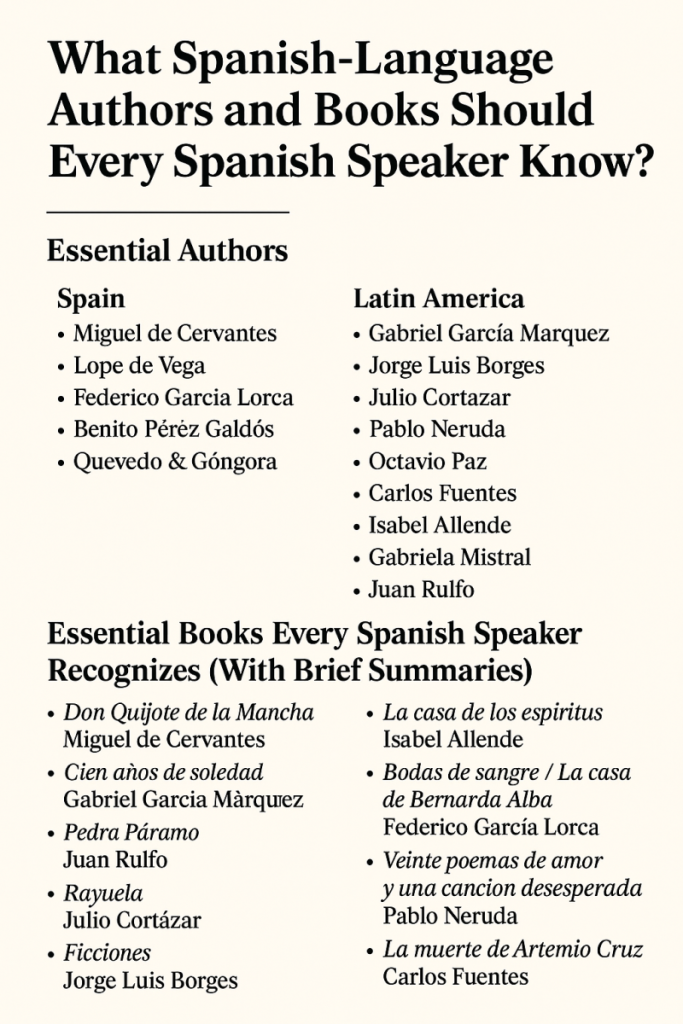
Essential Spanish-Language Authors
Spain
-
Miguel de Cervantes – Widely considered the father of the modern novel.
-
Lope de Vega – Prolific Golden Age playwright with hundreds of works.
-
Federico García Lorca – Iconic poet and dramatist known for tragedy, symbolism, and Spanish identity.
-
Benito Pérez Galdós – Realist novelist exploring society, politics, and morality.
-
Francisco de Quevedo & Luis de Góngora – Central poets of the Golden Age known for baroque style.
Latin America
-
Gabriel García Márquez (Colombia) – Nobel Prize–winning master of magical realism.
-
Jorge Luis Borges (Argentina) – Foundation of modern short fiction, philosophy, labyrinths, and metaphysics.
-
Julio Cortázar (Argentina) – Innovator of nonlinear narrative and surreal storytelling.
-
Pablo Neruda (Chile) – Nobel Prize–winning poet of love, politics, and nature.
-
Octavio Paz (Mexico) – Nobel Prize–winning poet and essayist (identity, solitude, Mexican culture).
-
Carlos Fuentes (Mexico) – Key figure of the Latin American Boom.
-
Isabel Allende (Chile) – Beloved novelist blending family sagas, magical realism, and history.
-
Gabriela Mistral (Chile) – Nobel Prize–winning poet whose work explores love, grief, childhood.
-
Juan Rulfo (Mexico) – Sparse but legendary output; foundation of modern Latin American fiction.
Essential Books Every Spanish Speaker Recognizes (With Brief Summaries)
Don Quijote de la Mancha – Miguel de Cervantes
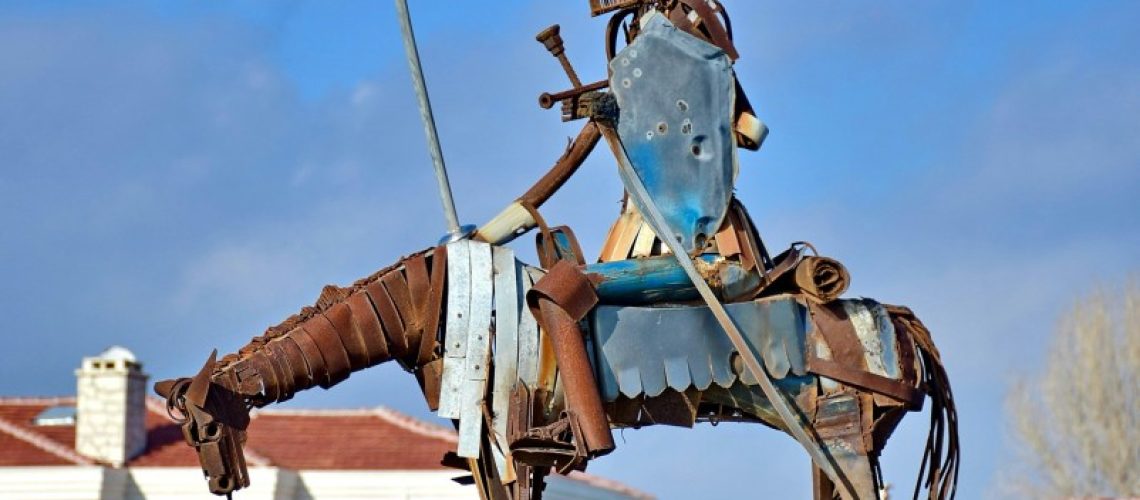
Often considered the first modern novel. It follows the misadventures of Don Quijote, a man who becomes convinced he’s a knight, and Sancho Panza, his loyal squire. A mix of comedy, philosophy, and social satire.
Cien años de soledad – Gabriel García Márquez
A multigenerational epic about the Buendía family in the magical town of Macondo. The novel blends political history, myth, and magical realism and is one of the most famous books in world literature.
Pedro Páramo – Juan Rulfo
A haunting, compact novel about a man searching for his father in a ghost town filled with whispers of the dead. Sparse, poetic, and deeply influential, it shaped García Márquez and the entire “Boom” generation.
Rayuela – Julio Cortázar
A groundbreaking experimental novel that can be read in multiple sequences. It explores existentialism, art, relationships, and the surreal experience of life in Paris and Buenos Aires.
Ficciones – Jorge Luis Borges
A collection of short stories that bend reality, time, philosophy, mathematics, and identity. Includes classics like “The Library of Babel” and “Tlön, Uqbar, Orbis Tertius.”
El Aleph – Jorge Luis Borges
Short stories exploring infinity, obsession, mirrors, and the nature of the universe. The title story is one of the most famous in Spanish literature.
La casa de los espíritus – Isabel Allende
A family saga spanning multiple generations, combining political history with magical realism, love, and tragedy. Inspired by Chilean history.
Bodas de sangre / La casa de Bernarda Alba – Federico García Lorca
Two of Lorca’s most widely taught plays. They explore repression, honor, desire, and tragedy through powerful, symbolic storytelling.
Veinte poemas de amor y una canción desesperada – Pablo Neruda
One of the world’s most famous poetry collections. Passionate, lyrical love poems that remain staples in schools and cultural memory.
A: Don Quijote is widely considered the foundational work of Spanish literature and one of the most influential novels ever written.
Cien años de soledad, Pedro Páramo, Rayuela, and Borges’ Ficciones are central pillars of the Latin American Boom.
A literary style where the extraordinary appears natural—common in works by García Márquez, Allende, and Rulfo.
Neruda, Lorca, Mistral, Paz, and the Golden Age poets Quevedo and Góngora.