



Personally vetted instructors
Italian Academic Writing tutors, lessons & classes
Buongiorno The neutral formal greeting that opens any Italian academic correspondence.
Personally vetted Italian academic writing tutors. Coaching for graduate students, PhD candidates, postdocs, and researchers writing theses, articles, conference papers, and book-length work in scholarly Italian.
Your instructors
Italian Academic Writing tutors for private lessons & classes
Strommen has been teaching Italian since 2006, and Italian academic writing has been a steady specialty for graduate students at USC, UCLA, Stanford, NYU, Columbia, Harvard, and the European institutions whose graduate students come to us for support on Italian-language work. The demand spans humanities (art history, classics, philosophy, literature) and increasingly the social sciences and law. Every tutor below was met and vetted by us in person or via thorough video interview. No marketplace. No automated profile-creation. Real coaches with real backgrounds in Italian academic writing.
Filter by location, age, or price. Then book a 30-minute free trial.
Below are the Strommen tutors who specialize in Italian academic writing. Photos, ratings, and rates are real. Click any card to read their bio and book a free 30-minute trial.
I want to learn…
Every tutor, personally met. — founder-vetted since 2006, in Los Angeles and online worldwide.
Get a personalized plan
Pick your language — a language advisor will match you with the right tutor and map out your path.



Master's Degree in Modern Philology · Post-graduate course in Teaching Italian L2/LS
La grande bellezza dell'italiano
Personally vetted · Strommen’s note
Giuseppe teaches four rare southern Italian dialects, Napoletano, Dialetto Campano, Sabino, and Barese, alongside standard Italian and academic writing.
Specialties
Also speaks: English, French, Spanish
Master's Degree in Modern Philology · Post-graduate course in Teaching Italian L2/LS
La grande bellezza dell'italiano
Specialties
I also speak: English, French, Spanish
Personally vetted · Strommen’s note
Giuseppe teaches four rare southern Italian dialects, Napoletano, Dialetto Campano, Sabino, and Barese, alongside standard Italian and academic writing.
University Master Degree of teaching Italian to ForeignersUniversity bacherloo degree in Foreign Languages and cultures · Master University of Italian teaching
Creative Italian Teacher with Masters in Teaching Italian as a foreign language, from the Tuscan countryside. Turn your Italian journey into a story worth telling!
Specialties
University Master Degree of teaching Italian to ForeignersUniversity bacherloo degree in Foreign Languages and cultures · Master University of Italian teaching
Creative Italian Teacher with Masters in Teaching Italian as a foreign language, from the Tuscan countryside. Turn your Italian journey into a story worth telling!
Specialties

Modern languages · Ditals and a master
Certified with 5 years of experience in teaching Italian. I like to organize my Italian lessons according to each student's learning goals. I will be happy to be your Italian teacher and help you to achieve your goal.
Specialties
Modern languages · Ditals and a master
Certified with 5 years of experience in teaching Italian. I like to organize my Italian lessons according to each student's learning goals. I will be happy to be your Italian teacher and help you to achieve your goal.
Specialties


Psychology · N/A
Expert Native Italian Tutor | Personalized Lessons | Learn Italian with confidence, clarity, and authentic conversation
Specialties
Also speaks: French, Japanese, Russian, Welsh
Psychology · N/A
Expert Native Italian Tutor | Personalized Lessons | Learn Italian with confidence, clarity, and authentic conversation
Specialties
I also speak: French, Japanese, Russian, Welsh
I have a degree in "Media and Journalism" from the Faculty of Political Science in Florence.I have obtained several certificates of suitability for teaching the Italian language L2/Ls to foreigners, and as administrator of the CILS exams (of all levels... · The certificate of suitability for teaching the Italian language L2/Ls to foreigners was issued by DILIT International House in Rome after being admitted through an initial test and passing the various stages of the training.
Learn Italian with confidence, clarity, and real-world results.
Personally vetted · Strommen’s note
Federica covers every CILS certification level from A2 to C2 in her Italian lessons, out of Barcelona, with Sicilian dialect and opera-singer coaching too.
Specialties
Also speaks: English, Spanish
I have a degree in "Media and Journalism" from the Faculty of Political Science in Florence.I have obtained several certificates of suitability for teaching the Italian language L2/Ls to foreigners, and as administrator of the CILS exams (of all levels... · The certificate of suitability for teaching the Italian language L2/Ls to foreigners was issued by DILIT International House in Rome after being admitted through an initial test and passing the various stages of the training.
Learn Italian with confidence, clarity, and real-world results.
Specialties
I also speak: English, Spanish
Personally vetted · Strommen’s note
Federica covers every CILS certification level from A2 to C2 in her Italian lessons, out of Barcelona, with Sicilian dialect and opera-singer coaching too.
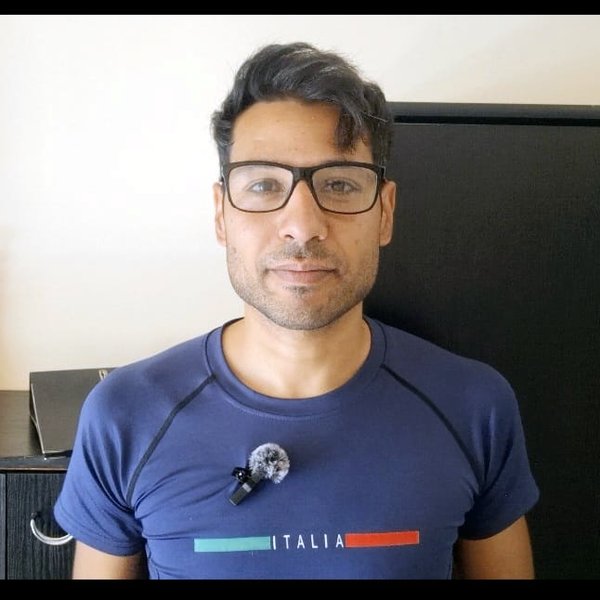
degree in tourism
Just do it
Personally vetted · Strommen’s note
Edgar teaches Venetian dialect and Italiano Antico Volgare, old vernacular Italian, genuinely unusual specialties alongside standard conversational Italian.
Specialties
Also speaks: English, French, Spanish
degree in tourism
Just do it
Specialties
I also speak: English, French, Spanish
Personally vetted · Strommen’s note
Edgar teaches Venetian dialect and Italiano Antico Volgare, old vernacular Italian, genuinely unusual specialties alongside standard conversational Italian.

EDUCATION * MA in Global Economy, Cooperation, and Innovation | University of Calabria | 110/110 Cum Laude * MA in Sociology and Social Research | University of Calabria (Ongoing) * University Master (Level 1) in Labor Consulting & Corporate Law | Pega... · * Languages: Italian (Native), English (b2 level trinity collage), Arabic (Learner),
Native italian coach high level : italian language, business, sociology and cultural mastery
Personally vetted · Strommen’s note
A licensed labor consultant with degrees in economics and law, Maria teaches high-level business Italian plus four rare southern dialects.
Specialties
Also speaks: English
EDUCATION * MA in Global Economy, Cooperation, and Innovation | University of Calabria | 110/110 Cum Laude * MA in Sociology and Social Research | University of Calabria (Ongoing) * University Master (Level 1) in Labor Consulting & Corporate Law | Pega... · * Languages: Italian (Native), English (b2 level trinity collage), Arabic (Learner),
Native italian coach high level : italian language, business, sociology and cultural mastery
Specialties
I also speak: English
Personally vetted · Strommen’s note
A licensed labor consultant with degrees in economics and law, Maria teaches high-level business Italian plus four rare southern dialects.

Scrittura accademica — register & convention
5 things that distinguish Italian academic writing from English
These aren't optional stylistic preferences — they're the conventions Italian-language journals and thesis committees expect. Screenshot to share with your advisor.
-
01
Il congiuntivo
The subjunctive mood, mandatory in many academic constructions where colloquial Italian has loosened. Penso che sia importante, not penso che è importante. Sembra che siano, not sembra che sono. Indicative-where-subjunctive-is-required is one of the fastest register tells in Italian academic writing. Get it right.
e.g. Si ritiene che la fonte sia attendibile.
-
02
Long, nested sentences
Italian academic sentences run 60-100 words with carefully nested subordinate clauses. English academic prose has shifted toward 20-30 word sentences over the last 50 years; Italian has not. Trying to write short English-style sentences in Italian academic prose makes the work read as juvenile. The right length and complexity is part of the register.
e.g. Pur riconoscendo la complessità del fenomeno...
-
03
Citazione all'italiana
Italian citation conventions differ from MLA and APA. Footnotes are more common than parenthetical citation in humanities. Cit., ibidem, op. cit. appear with specific spacing and italicization. Edited volumes cite the editor differently than English conventions. Bibliography formatting follows Italian-specific conventions. Get the conventions right, because Italian journals and committees notice.
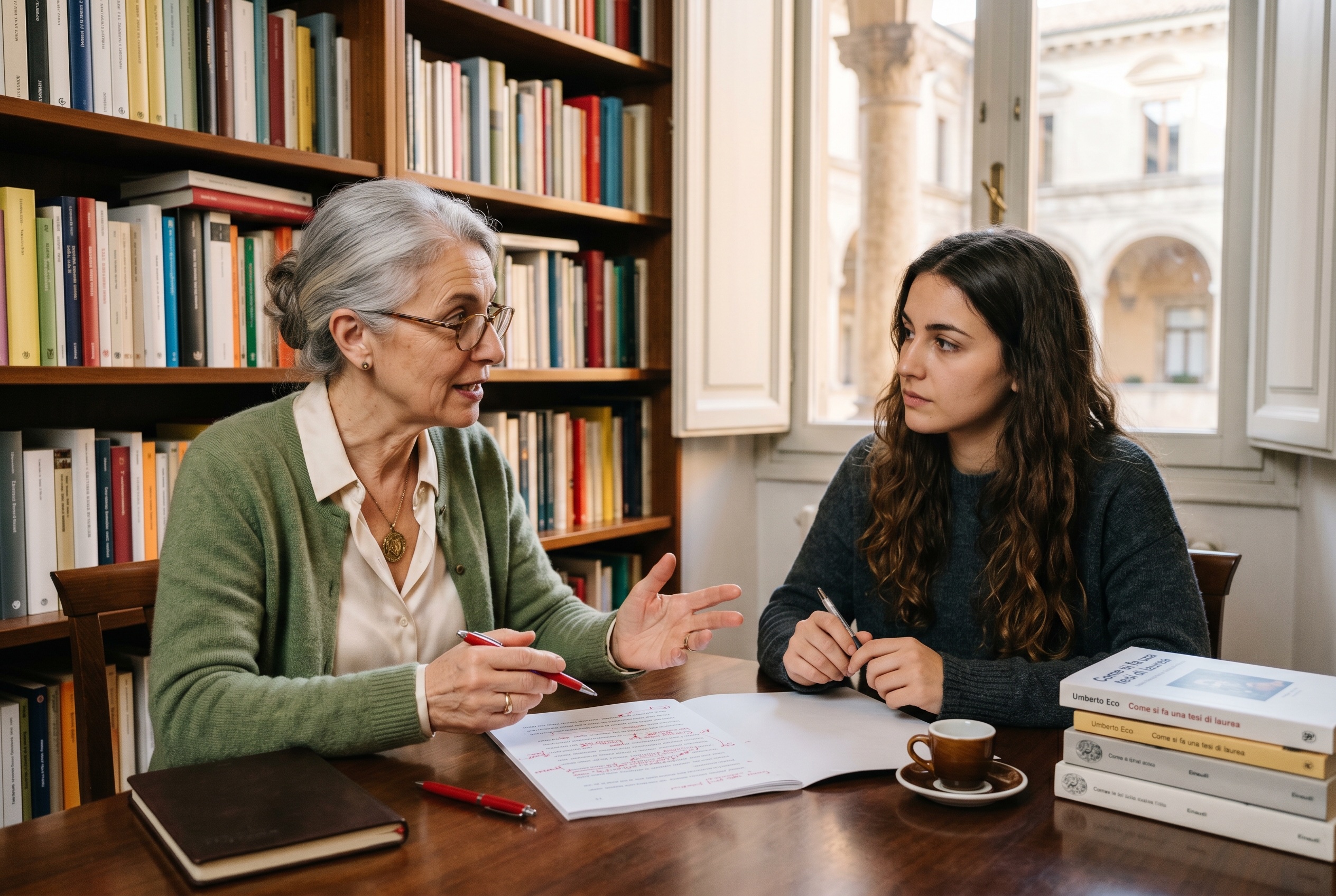
e.g. Cfr. U. Eco, <em>Come si fa una tesi di laurea</em>, Milano, Bompiani, 1977, p. 23.
-
04
Discourse markers: tuttavia, pertanto, peraltro
Italian academic prose uses a richer vocabulary of logical-transition markers than English. Tuttavia (however), pertanto (therefore), peraltro (moreover, with concessive nuance), nondimeno (nonetheless), orbene (well then, opening a new section of argument). Each carries specific logical-rhetorical weight. Variety matters; quindi quindi quindi repeats reads as undergraduate.
e.g. Tuttavia, occorre considerare che...
-
05
Il discorso indiretto
Italian academic prose paraphrases cited authors more extensively than English, often in free-indirect mode that engages with the source over multiple sentences without direct quotation. The result is a more dialogical, less quote-driven argumentative style. Adapting to this from English-trained writing habits is a noticeable register shift that distinguishes graduate-level work.
e.g. Secondo Eco, la tesi di laurea costituirebbe...
About Italian Academic Writing
Italian for scholarly writing
Italian academic writing is its own register: formal, syntactically elaborate, vocabulary-dense, and shaped by a thousand-year tradition of scholarly prose running from medieval Latin through Renaissance humanism to the modern Italian university system. Italian is the working language of scholarship at the major Italian universities (Bologna, La Sapienza, Padova, Florence, Pisa, Milan), the Italian-language journals of art history, classics, philosophy, literature, history, musicology, and other humanities fields, and the European Italianistic studies community more broadly. For graduate students writing theses in Italian, PhD candidates publishing in Italian-language journals, postdocs producing peer-reviewed work, and visiting scholars preparing conference presentations, the academic register is what separates publishable work from work that gets returned for language revision.
The written register first. Italian academic prose uses long, complex sentences with multiple subordinate clauses where English-language scholarly prose has shifted toward shorter sentences over the last few decades. The subjunctive mood (congiuntivo) is mandatory in many constructions where colloquial Italian has loosened standards ("penso che sia" must remain, not "penso che è"). Passive constructions appear more frequently than in English academic prose. Formal vocabulary draws heavily on Latin-rooted forms (sussistere over esserci, concernere over riguardare). Citation conventions follow specific patterns. The Italian academic citation style differs from MLA and APA, with its own format for in-text references, footnotes, and bibliographies. Lessons drill all of these specifically because mismatched register is the most common reason Italian-language manuscripts come back from peer review with language objections.
Discipline shapes everything. Italian academic writing in the humanities is rich, elaborate, and traditional. Art history (especially Renaissance and modern), classics, philology, philosophy, history, musicology, archaeology all carry their own conventions. Italian academic writing in the sciences has largely Anglicized at the publication level (most STEM publication is in English), but Italian remains the working language for teaching, theses (graduate and PhD), and Italian-language journal articles. Italian academic writing in law (the world's oldest law faculty is at the University of Bologna, founded 1088) follows civil-code tradition and produces some of the most elaborate written Italian in active use. The social sciences sit somewhere in between, with Italian-language sociology, political science, and economics journals coexisting with English-language publication routes. Tell your tutor your discipline in the first lesson; the coaching calibrates from there.
Vocabulary in Italian academic writing is substantially expanded from the everyday lexicon. Discipline-specific terminology (the technical vocabulary of your field, in Italian, often distinct from the English-language terms you've internalized). Academic discourse markers: tuttavia, pertanto, nondimeno, peraltro, infatti, cionondimeno, orbene, with far more variety and precision than English-language transitions, used to signal exact logical relationships between ideas. Citation language: secondo, come sostiene, nelle parole di, come argomentato in. Hedging language for academic claims: the conditional, the subjunctive, and specific verbs like parrebbe, sembrerebbe, è possibile ipotizzare che. Building this vocabulary alongside the register is what makes academic Italian feel natural rather than imitated. For broader Italian foundations our 1,000 most common Italian words list is a useful supplement, though academic Italian draws from a much higher-register vocabulary base than that list covers.
A few honest observations on what graduate students miss when starting extended Italian academic writing. The subjunctive cannot be skipped. Colloquial Italian has loosened standards but academic Italian has not, and indicative-where-subjunctive-is-required reads as uneducated. Sentence length matters next. Italian academic sentences run 60-100 words routinely, with carefully nested subordinate clauses, where English academic prose has shifted toward 20-30 words. Writing short English-style sentences in Italian academic prose makes the work read as juvenile. Citation conventions catch most international graduate students out. Italian footnoting differs from MLA and APA in specific ways: the cit. abbreviation, ibidem conventions, the formatting of edited volumes vs. journal articles, the way Italian humanities cite manuscript sources. The convention around direct vs. indirect quotation is different too; Italian academic prose paraphrases far more than English, with extended free-indirect engagement with cited authors that's stylistically rare in English. And the structural surprise that comes last for most students: Italian academic argument is typically more spiral and dialectical than the thesis-evidence-conclusion structure American graduate programs teach. Lessons address each of these specifically, with revision work on your actual writing.
For revising existing work, the work is different from generative writing. Many students arrive at Strommen with a draft thesis chapter, journal article, or book chapter that they've written in Italian (or had translated from English) and need polish. The coaching here moves through the draft systematically: register elevation, vocabulary upgrade, subjunctive corrections, sentence-length expansion where appropriate, citation conformance, discourse-marker refinement. The coach reads with you in real time and explains each suggested change, so the work doubles as instruction. Our blog post on Italian academic writing conventions covers the discipline-specific layer in more depth.
Between lessons, the most effective preparation is reading widely in academic Italian in your discipline. Italian humanities journals: Critica del testo, Lingua e stile, Italianistica, Studi storici, Quaderni storici, Rivista di filosofia, Studi di estetica, Il pensiero politico, give you the exact register and vocabulary used in your field. Italian university monograph series (Carocci, Il Mulino, Laterza, Einaudi, Bollati Boringhieri) publish the standard book-length scholarly works your field will reference; read recent ones in your area. Italian academic conferences and lectures available through university websites give you the spoken register. For style models, the most-praised contemporary Italian academic prose-writers in the humanities include Carlo Ginzburg, Giulio Lepschy, Massimo Cacciari, Carlo Ossola, Roberto Calasso (Calasso writes essayistic prose that crosses academic-popular boundaries elegantly). For methodological work, Umberto Eco's Come si fa una tesi di laurea (written in 1977 and still in print) is the canonical guide to thesis-writing in Italian and worth reading regardless of your discipline.
The Strommen Italian Academic Writing roster includes native Italian academics or former academics, several with PhDs from Italian universities or American universities with Italian-language doctoral work, plus credentialed Italian language teachers with substantial academic-writing-instruction backgrounds. Several of our tutors have direct peer-review experience for Italian-language journals or have served on Italian thesis committees. Each tutor's bio specifies their disciplinary background, academic credentials, and which student profile they fit best (humanities, social sciences, law, science thesis-writing). Pricing reflects experience. You can match yourself to a discipline-specific coach (art history, classics, philosophy, history) for the most discipline-aware coaching, or to a generalist coach with strong language pedagogy for foundational register work. For other Italian programs, our Business Italian and Italian dialect coach specialty pages cover related but distinct needs.
Lessons calibrate to your actual project. Doctoral thesis-writing support over months or years is a different curriculum from one-off journal article polish, which is different again from CILS DUE B2 or DALI C2 certification preparation for academic-level proficiency proof. We don't run a generic Italian academic writing course. Each lesson is one-on-one, your tutor plans it around your project and your timeline, and the trial is free. Existing Italian is a head start, not a liability. The most common adjustments for graduate students arriving with intermediate Italian are register elevation, vocabulary expansion into discipline-specific terminology, subjunctive precision, and the structural conventions of Italian scholarly argument-building. For a head-start before lessons begin, our Italian course page shows the family of related programs. Or just browse the full tutor list and book a trial. Bring your draft. Bring your reading list. Let's write.
What you'll cover
Lessons & classes tailored to Italian Academic Writing
Register elevation: subjunctive, sentence length, vocabulary
The mechanical layer of academic Italian: mandatory subjunctive in academic constructions, long-and-nested sentence structure, Latin-rooted formal vocabulary, the discourse-marker repertoire. Drilled through revision work on your actual writing rather than textbook exercises. Most fluent Italian speakers arriving at academic writing have register gaps here even when their conversational Italian is strong.
Citation conventions and bibliographic style
Italian academic citation differs from MLA and APA in specific, important ways. Footnoting conventions, abbreviation rules (cit., ibidem, op. cit.), bibliography formatting, the distinct conventions for citing edited volumes, manuscripts, archival sources, and primary historical sources. Discipline-specific variations (art history vs. classics vs. law) covered.
Thesis structure and argumentation conventions
Italian academic argument is typically more spiral and dialectical than the thesis-evidence-conclusion structure American graduate programs teach. Coaching covers how to structure introductions, literature reviews, methodological sections, and conclusions in Italian academic conventions, with examples from successful theses and articles in your field.
Manuscript revision, certification prep, conference paper writing
Line-by-line revision of existing drafts (thesis chapters, journal articles, book chapters) is the most common service. CILS DUE B2 (academic-level proficiency) and DALI C2 preparation for HR-required or program-required certification. Conference paper writing covers the shorter, more dialogical register used in spoken academic delivery, with practice presentations in real time.
FAQ
About Italian Academic Writing lessons & classes
I write fluent academic English. Why is Italian academic writing different?
Register, sentence structure, citation conventions, and argument-building structure. Italian academic prose uses mandatory subjunctive in many constructions, runs to 60-100 word sentences with nested clauses, follows different citation formatting (footnotes-heavy in humanities, distinct abbreviation conventions), and tends toward a more spiral-dialectical argument style than the linear thesis-evidence-conclusion structure of American academic writing. Writing academic Italian as if it were translated English produces work that reads as foreign even when grammatically correct.
Do you support specific disciplines or just general academic Italian?
Both. Our roster includes coaches with PhDs in specific humanities fields (art history, classics, philosophy, literature, musicology) who can support discipline-specific work with field-aware coaching. We also have generalist Italian academic-writing coaches who can work across humanities and social sciences and provide foundational register work. Tell us your discipline and we'll match appropriately. Sciences are harder for us to support because most STEM publication is in English; we can help with Italian-language theses and Italian-language journal work but not the cutting-edge science conventions.
Can you revise my existing manuscript?
Yes. Manuscript revision is one of the most-requested services. Bring a draft (chapter, article, book chapter) and we'll work through it systematically: register elevation, vocabulary upgrade, subjunctive precision, citation conformance, sentence-structure refinement, discourse-marker variety. Sessions move through the manuscript page by page, with the coach explaining each suggested revision so the work doubles as instruction. Typical journal article revision: 4-8 weekly sessions; doctoral thesis chapter: 6-12 sessions.
Do you prep for Italian-language proficiency certifications?
Yes. CILS DUE B2 and DALI C2 are the most-common certifications students need, typically required by Italian universities for foreign-student admission or by employers as proof of Italian proficiency. Academic-track candidates also sometimes need PLIDA C1 or C2 (the Dante Alighieri Society certification). Sessions cover the four exam modules plus exam-specific strategy. Mock exams included.
I'm writing a doctoral thesis. Will the same coach work with me over years?
Yes, and this is the most common arrangement for thesis support. Consistency over years matters for a long project, because the coach learns your voice, your field, your committee's preferences, and your particular blind spots. Most thesis students with us settle into a weekly or bi-weekly cadence over 18-36 months, scaling up during heavy writing periods. The relationship matters as much as the lessons.
Are tutors based in Italy or in the US?
Both. Native Italian academics teaching from Italy (Rome, Bologna, Florence, Milan, Padova) via video, plus longtime Italian-American academics or former academics based in the US for in-person sessions in Los Angeles and via video everywhere. Time-zone-wise, Italy-based tutors offer late-afternoon Italian hours that map to morning US hours; US-based tutors offer evening US flexibility.
What does the trial include?
30 minutes, free, with the tutor you select. Bring a sample of your writing in Italian (a paragraph, a recent draft, even rough notes) so the tutor can assess your current register and identify the highest-impact gaps. Bring your project description and timeline. The tutor will propose a study plan, and you decide whether to continue. Most students settle into a consistent weekly rhythm with their trial tutor.
Ready for Italian Academic Writing lessons or classes?
Book a free 30-minute trial with one of our personally vetted tutors. Private lessons or small-group classes — your choice.