



Personally vetted instructors
Intensive Dutch tutors, lessons & classes
Beginnen we! "Let's begin!" — the standard Dutch classroom opener for the first exercise of the session.
Personally vetted Dutch tutors who build accelerated tracks for students with a fixed deadline. FSI Category I means Dutch responds to compressed schedules better than almost any other language for English speakers, and the tutors below know how to use that.
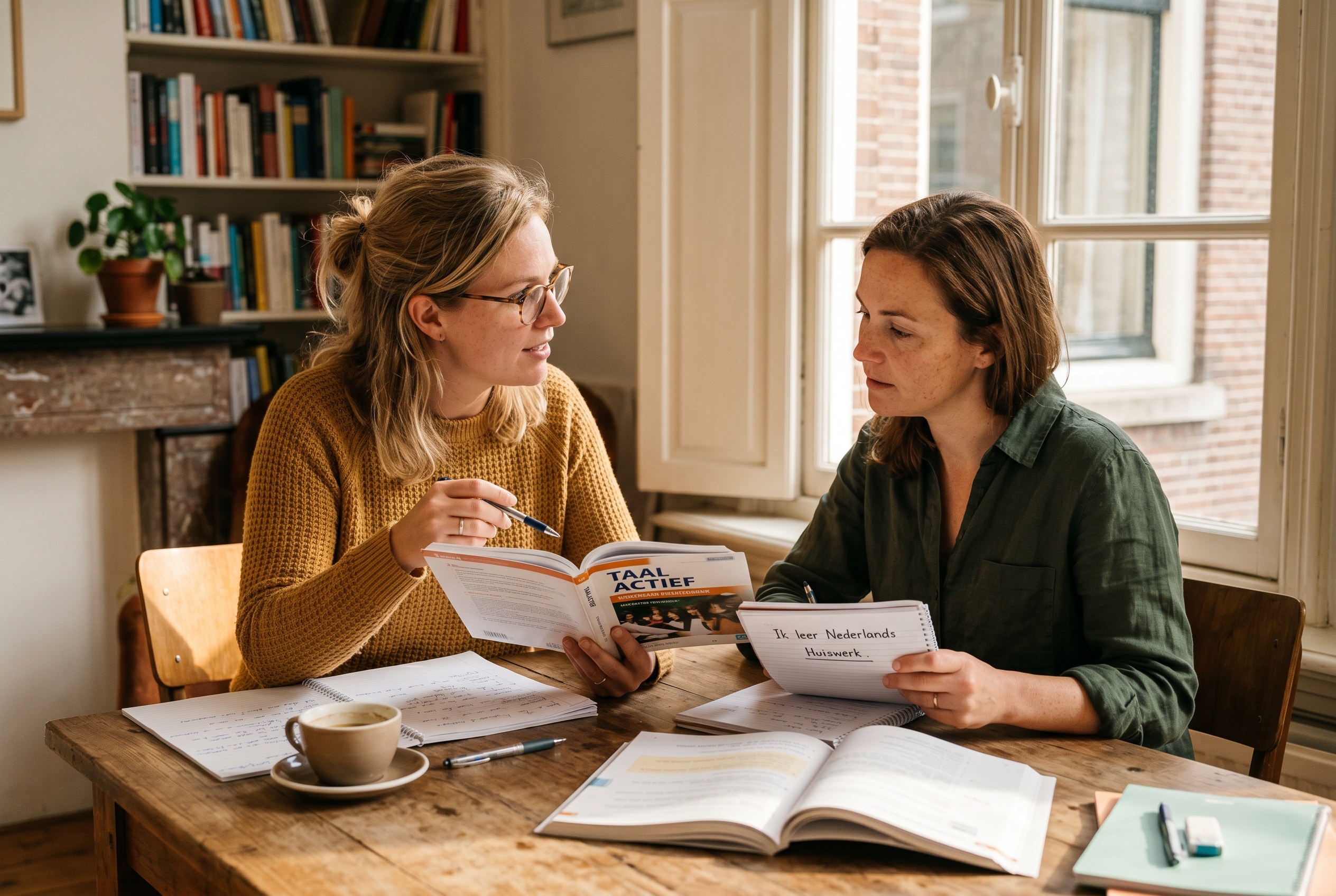
Your instructors
Intensive Dutch tutors for private lessons & classes
Strommen has Dutch tutors who specialize in working against deadlines — the inburgering exam, the relocation, the graduate program start date. Intensive work is a different discipline from relaxed weekly conversation, and the tutors below were vetted specifically for the pacing and accountability that intensive students actually need.
Filter by location, age, or price. Then book a 30-minute free trial and bring your deadline.
Below are the Strommen tutors who build intensive Dutch tracks. Photos, ratings, and rates are real. Click any card to read the bio and book a free 30-minute trial.
I want to learn…
Every tutor, personally met. — founder-vetted since 2006, in Los Angeles and online worldwide.
Get a personalized plan
Pick your language — a language advisor will match you with the right tutor and map out your path.


I have a Master's degree in Communication Sciences
From Amsterdam's Heart to Global Fluency, Eser Offers Experience-Driven Coaching!
Specialties
I have a Master's degree in Communication Sciences
From Amsterdam's Heart to Global Fluency, Eser Offers Experience-Driven Coaching!
Specialties
Intensief — accelerated Dutch tracks
5 things to know about intensive Dutch before starting
These are the facts about Dutch difficulty, methodology, and milestones that shape how an intensive track actually works. Knowing them changes how you plan the months ahead.
-
01
FSI Category I
The US Foreign Service Institute classifies Dutch as Category I, alongside Spanish, French, Italian, and the other languages closely related to English. FSI estimates roughly 600 to 750 classroom hours to professional proficiency, which puts Dutch at the lighter end of the FSI spectrum. An adult doing four hour-long lessons a week plus self-study covers roughly 500 to 600 hours a year, so FSI-level proficiency arrives in 12 to 18 months of intensive work for committed students.
e.g. Dutch sits alongside Spanish in FSI Category I, well below Russian (III) or Arabic (IV).
-
02
The Inburgering exam
The Dutch civic integration exam, required for most non-EU residents seeking permanent residency or naturalization in the Netherlands. The language portion targets B1 on the CEFR. The exam covers reading, listening, speaking, writing, plus a Knowledge of Dutch Society component (KNM). Most intensive Dutch students preparing for inburgering plan a 9-to-12-month track with mock exams in the final months.
e.g. DUO publishes the official practice materials at inburgeren.nl.
-
03
De versus het
Dutch has two definite articles, with roughly 75 percent of nouns taking de and 25 percent taking het. Some rules help (diminutives in -je always take het; plurals all take de; abstract nouns in -heid all take de), but many common het-words simply have to be memorized. Intensive tutors front-load this from day one because it is one of the few features that meaningfully slows progress.
e.g. Het huis. Het boek. Het kind. De man. De vrouw. De boom.
-
04
The hard G and the SCH cluster
The northern Dutch hard G is a scraping consonant at the back of the throat with no English equivalent, softening to a palatal fricative in southern Dutch and Flemish Belgium. The famous SCH cluster (in words like Scheveningen) combines an S with the hard G and a vowel. Intensive students drill the G in the first month and accept incremental progress rather than chasing perfection.
e.g. Goedemorgen, graag, genoeg. Scheveningen, schaal, school.
-
05
Textbook + tutor + immersion
The Dutch intensive methodology most students settle into. A textbook series (De opmaat, Code, or an inburgering-focused curriculum) provides the grammar progression. The tutor adds conversational practice, cultural context, and corrective feedback. Between-lesson immersion (Buurtaal podcast, NOS Jeugdjournaal, Dutch TV with subtitles) accumulates the volume that compounds the contact hours.
e.g. Lessons on Tuesday and Thursday, Buurtaal podcast on the commute, Dutch news on Saturday.
About Intensive Dutch
Dutch on a compressed schedule
Almost everyone who reaches out about intensive Dutch has a deadline. A relocation to Amsterdam or Rotterdam for work, often in the tech, finance, or design sector. A move to Brussels for a European institution role. A graduate program at Leiden, Utrecht, Wageningen, or Groningen. An inburgering exam scheduled for the year ahead as part of a residency or citizenship path. A marriage into a Dutch family where vows or in-law conversations need to land naturally. The honest first thing an intensive Dutch tutor will tell you is that Dutch responds remarkably well to compressed schedules, more so than almost any other language an English speaker will encounter. The US Foreign Service Institute classifies Dutch as a Category I language, alongside Spanish, French, Italian, and the other languages closely related to English. The FSI estimate is roughly 600 to 750 classroom hours for general professional proficiency, which puts Dutch at the lighter end of the FSI spectrum and well below Category III languages like Hebrew or Russian or Category IV languages like Arabic or Mandarin.
That FSI number gets thrown around without much context, so it is worth unpacking. 600 to 750 hours assumes a typical Foreign Service Officer's classroom-and-homework rhythm, which translates to roughly 6 months of full-time intensive study at the FSI school in Arlington. A working adult doing two to four hour-long lessons a week with the tutor, plus daily self-study, covers roughly 350 to 600 hours a year, so the FSI proficiency target arrives in 12 to 18 months for committed intensive students rather than the 6 months a full-time learner would need. Comfortable conversational fluency, which is a lower bar than FSI professional proficiency, typically arrives in 6 to 9 months for intensive students. The B1-level inburgering exam target, which is the practical threshold for Dutch residency requirements, usually takes 9 to 12 months. These are not promises; they are realistic ranges given the FSI category and the cadences our students actually maintain.
The Dutch advantage for English speakers is real and worth understanding before you commit to an intensive track. Dutch is a West Germanic language closely related to English, with extensive vocabulary overlap and a basic grammar architecture that English speakers find intuitive much faster than the Romance languages, never mind the Slavic or Semitic ones. Cognates are dense: huis, boek, melk, water, open, winter, nacht, vader, moeder, broer, zuster. Word order in Dutch main clauses follows the V2 rule (the conjugated verb sits in the second position), which is similar enough to English declarative structure that beginners adapt within the first month. The case system of Old Dutch has essentially disappeared in modern Dutch, leaving only fossilized expressions like te paard or op den duur as historical traces. Adjective endings are simpler than in German. Plurals are mostly -en or -s, with predictable rules. None of this makes Dutch trivial, but it does mean that the hours you put in compound faster than they would in a more distant language.
The places where Dutch is genuinely difficult are concentrated and identifiable. The hard G sound is the most famous, a scraping consonant at the back of the throat in standard northern Dutch (Amsterdam, Rotterdam, the Randstad) that softens to a palatal fricative in southern Dutch (Limburg, North Brabant) and in Flemish Belgium. The SCH cluster (in words like Scheveningen, the seaside town used as a Dutch resistance shibboleth during WWII because Germans could not pronounce it cleanly) combines an S with the hard G and a following vowel. The de-versus-het distinction (Dutch has two definite articles, with roughly 75 percent of nouns taking de and 25 percent taking het, and many het-words simply have to be memorized) is a friction point that intensive tutors front-load aggressively. The diminutive endings -je and -tje appear constantly in everyday speech and pull nouns into the het category automatically, which is one of the few mercies of the article system. Word order in subordinate clauses pushes the verb to the end, which is a German-style pattern that takes deliberate practice for English speakers. None of these is unmanageable, but each one needs focused attention in the early intensive months.
The inburgering exam is its own substantial topic for many intensive students. The Dutch civic integration exam (inburgeringsexamen) is required for most non-EU residents seeking permanent residency or naturalization in the Netherlands, and the language portion targets B1 level on the Common European Framework. The exam tests reading, listening, speaking, and writing in Dutch, plus a Knowledge of Dutch Society component (Kennis van de Nederlandse Maatschappij, KNM) that covers civics, history, and practical Dutch life. The Belgian equivalent for citizenship varies by region but is generally less rigorous than the Dutch version. Intensive Dutch tutors with inburgering experience can map a 9-to-12-month preparation track against your residency timeline and run mock exams in the final months. Practice materials are widely available through DUO (the Dutch government education service) and through commercial publishers like Boom and Intertaal.
The Dutch versus Flemish question matters for some intensive students. Written Dutch in the Netherlands and written Dutch in Belgium are essentially the same standard language, with minor preferences in vocabulary (the Netherlands uses tof for cool while Belgium often prefers leuk for the same flavor; the Netherlands uses computer while Belgium often uses ordinator from French interference). Spoken Dutch differs more substantially. The Hollandic accent of Amsterdam and the Randstad is the textbook standard. The Brabantian and Limburgish accents of southern Netherlands and Belgian Flanders soften the G and use different intonation. The various regional Flemish dialects (West Flemish, East Flemish, Brabantian-Antwerp, Limburgish) get genuinely different from standard Dutch in casual speech, though Flemish speakers all switch to standard Dutch in formal contexts. For an intensive student headed to Antwerp, Ghent, or Bruges, working with a Belgium-based tutor early helps the ear calibrate; for a student headed to Amsterdam or Utrecht, a Hollandic-accent tutor is the standard choice.
Lesson methodology in an intensive Dutch track usually leans on direct instruction, conversational immersion, and structured grammar work in roughly equal measure. The Netherlands has produced strong adult-language pedagogy across the postwar decades, with the De opmaat textbook series (Boom Publishers), the Code series (ThiemeMeulenhoff), and various Inburgering-focused curricula serving as the institutional backbone. Tutors typically work from one of these textbook series or from a syllabus calibrated to your specific goal, with the textbook providing the grammar progression and the tutor adding the conversational practice, the cultural context, and the corrective feedback that a textbook alone cannot give. Between-lesson resources include the Buurtaal podcast (slow Dutch news for learners), the NOS Jeugdjournaal (a kids' news show with simpler vocabulary, useful for intermediate learners), and the children's programming on NPO Zapp.
Who actually does intensive Dutch with us. The largest group is professionals relocating for work in the Dutch or Belgian tech and finance sectors, often on 1-to-3-month timelines that are too short for the full intensive arc but long enough to build a functional starter base. The next group is students preparing for Dutch-language master's programs at Leiden, Utrecht, Wageningen, Groningen, Maastricht, or the Belgian universities. The third major group is non-EU residents working through the inburgering process, where the language requirement is non-negotiable and the deadline is real. We see partners of Dutch or Flemish speakers preparing for family integration, often before a major life event like an in-law visit, a wedding, or a relocation. And we see committed intensive learners pursuing Dutch out of personal interest, often after multiple trips to the Netherlands or Belgium that left them wanting to engage at a deeper level.
The accountability piece is what an intensive track really delivers beyond ordinary lessons. A relaxed learner who misses a week loses a week. An intensive learner against a fixed deadline who misses a week loses ground that has to be made up somewhere, and a good intensive tutor builds that reality into the plan. Weekly check-ins on what landed and what needs more reinforcement. Honest conversations when the available hours and the deadline are not lining up. A willingness to tell a student the truth when the timeline is unrealistic. That last conversation is uncomfortable, and it is among the most valuable things an intensive tutor offers.
Our intensive Dutch tutors include native speakers from across the Netherlands and Flanders, plus longtime fluent teachers based in the United States. Several have direct experience with the inburgering exam, with Dutch-language master's program preparation, and with the specific vocabulary and cultural calibration that the Dutch and Belgian professional sectors expect. Each tutor's bio specifies their background and which deadline profile they fit best. For other Dutch specialties, our Dutch for Beginners, Conversational Dutch, and Dutch for Business pages cover related programs. The trial lesson is the place to map the plan against your specific deadline, and the trial is free.
What you'll cover
Lessons & classes tailored to Intensive Dutch
FSI Category I methodology adapted to private lessons
Direct instruction, conversational immersion, and structured grammar work in roughly equal measure, with a textbook series providing the grammar progression and the tutor adding the practice and feedback. The Dutch advantage (closely related to English, with extensive cognate density) compounds the hours, but the de-versus-het distinction, the hard G, the V2 word order, and the subordinate-clause verb-final pattern still need focused attention from day one.
Inburgering and B1 exam preparation
Tracks calibrated to the Dutch civic integration exam: reading, listening, speaking, and writing at B1 plus the Knowledge of Dutch Society (KNM) component. DUO's official practice materials, Boom and Intertaal textbooks, and tutor-led mock exams in the final months. Belgian citizenship-track Dutch follows a related but distinct path; tutors with Belgian experience handle this calibration.
Hollandic versus Flemish accent calibration
For students headed to Amsterdam, Utrecht, Rotterdam, or the Randstad, a Hollandic-accent tutor is the standard choice. For students headed to Antwerp, Ghent, Bruges, or Brussels, working with a Belgium-based or Flemish-trained tutor early helps the ear calibrate. Written Dutch is the same standard in both countries; the spoken differences are concentrated in accent and intonation rather than core grammar.
Professional and academic vocabulary mapped to the deadline
Tech and finance professionals get sector-specific vocabulary tuned to the Amsterdam or Brussels professional context. Graduate-program students get academic Dutch and the registration and bureaucratic vocabulary universities require. Family-integration students get household, holiday, and warmth vocabulary. The Dutch high-frequency vocabulary is the structural baseline; situation-specific vocabulary layers on top.
FAQ
About Intensive Dutch lessons & classes
How fast can I actually reach functional Dutch with an intensive schedule?
Faster than most other languages, because Dutch sits in FSI Category I alongside Spanish and French. An adult doing two to four hour-long lessons a week plus daily self-study covers roughly 350 to 600 hours a year. Functional conversational Dutch typically arrives in 6 to 9 months. The B1-level inburgering exam target usually takes 9 to 12 months. FSI-level professional proficiency typically arrives in 12 to 18 months. Honest milestones get set at the trial and adjust as your pace shows.
Why is Dutch easier than German for English speakers?
In most ways. Dutch has lost almost all of its case marking (German retains four cases in active use), adjective endings are simpler, vocabulary overlap with English is slightly higher, and the pronunciation is generally easier to approximate (the hard G and SCH cluster being the famous exceptions). Word order patterns are similar in both languages: V2 in main clauses, verb-final in subordinate clauses. Many English speakers who tried German and bounced off find Dutch much more approachable.
Do I need to prepare specifically for the inburgering exam?
If you are working toward Dutch residency or naturalization, yes. The exam targets B1 on the CEFR and tests reading, listening, speaking, and writing in Dutch, plus the Knowledge of Dutch Society component. DUO publishes the official practice materials at inburgeren.nl. Tutors with inburgering experience can map a 9-to-12-month preparation track against your residency timeline and run mock exams in the final months. The Belgian citizenship-track Dutch is structured differently and tutors familiar with the Belgian process handle that calibration.
Will I be able to understand Flemish Dutch if I learn Hollandic Dutch?
Mostly yes. Written Dutch in the Netherlands and Belgium is essentially the same standard language. Spoken Flemish differs in accent and intonation, with the G softening to a palatal fricative and various regional dialects (West Flemish, East Flemish, Limburgish) getting genuinely different in casual speech. Flemish speakers switch to standard Dutch in formal contexts, so a Hollandic-trained learner functions in Flanders for any professional or formal interaction. Casual Flemish takes more deliberate exposure.
What does an intensive Dutch lesson actually look like?
A typical hour might open with a brief Dutch-only conversation about your week, move to focused grammar work on a point that has come up (de-versus-het, separable verbs, subordinate-clause word order), spend time on reading from authentic Dutch material (a news article, an excerpt from a Dutch novel, an inburgering practice text), and close with vocabulary expansion targeted to your specific goals. Between sessions you get structured self-study (Buurtaal podcast, Anki decks calibrated to your tutor's vocabulary curriculum, Dutch TV with subtitles) so the contact hours compound.
Can I prepare for a Dutch-language master's program with intensive lessons?
Yes. Most Dutch and Flemish universities require B2 or C1 Dutch for non-EU master's program admission, and an intensive track can reach B2 in 12 to 18 months for committed students with no prior Dutch. Tutors with university-prep experience can map the work against your specific program's language requirements and the standardized tests (CNaVT, NT2) the universities accept. Leiden, Utrecht, Wageningen, Groningen, and the Belgian universities each have slightly different language requirements; tutors familiar with the Dutch academic system handle the calibration.
Are your intensive Dutch tutors native speakers?
Most are native speakers from the Netherlands and Flanders, with several holding teaching backgrounds at Dutch language institutes or universities. A few are longtime fluent teachers based in the United States with extensive in-country experience. Each tutor's bio specifies their background, regional accent (Hollandic vs Flemish), and intensive-track teaching experience.
Can I take intensive Dutch lessons online?
Yes, and the intensive cadence works particularly well online because frequent sessions are easier to maintain without a commute. Most of our Dutch tutors teach via Zoom or Jitsi and serve students globally. Several also teach in person around Los Angeles. The booking widget on each tutor's profile shows the available formats.
Ready for Intensive Dutch lessons or classes?
Book a free 30-minute trial with one of our personally vetted tutors. Private lessons or small-group classes — your choice.