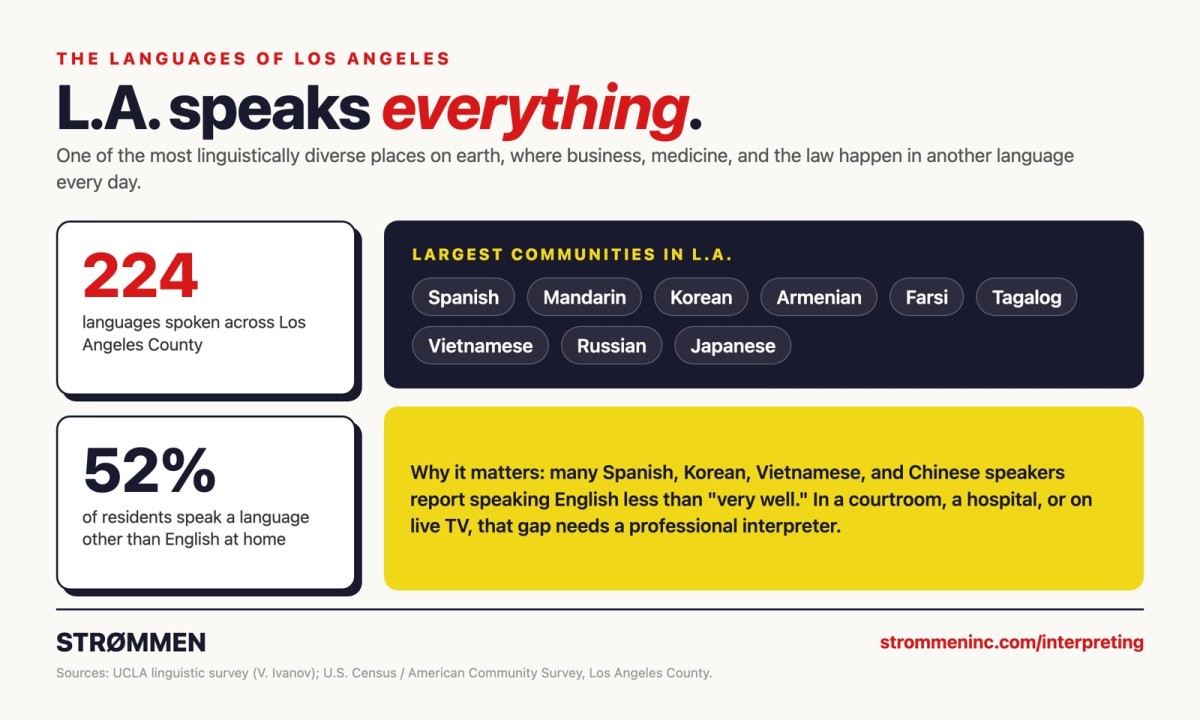
Los Angeles is one of the most linguistically diverse places on earth. By one well-known count from UCLA linguist Vyacheslav Ivanov, at least 224 languages are spoken across Los Angeles County, and more than half of residents speak a language other than English at home. On any given day, that diversity runs straight into rooms where getting the words exactly right is not optional.
That is what an interpreter does, and why the demand here never really slows down. Below is a look at where Los Angeles actually needs interpreters, what separates a professional from a bilingual bystander, and a few of the rooms we have worked in.
A city that runs on more than one language
The numbers tell the story. Spanish, Mandarin, Korean, Armenian, Farsi, Tagalog, Vietnamese, Russian, and Japanese all have deep, established communities in Los Angeles, several of them the largest of their kind outside their home countries. Koreatown, Tehrangeles, Little Armenia, and Historic Filipinotown are not nicknames, they are neighborhoods where business, medicine, and the law happen in another language every day.
And fluency at home does not mean fluency under pressure. A large share of Spanish, Korean, Vietnamese, and Chinese speakers in the county report speaking English less than “very well.” Put someone in a courtroom, a deposition, or a hospital exam, and “pretty good English” is not a margin anyone should be betting on.
Where Los Angeles needs interpreters
Interpreting is not one job. The setting changes everything about who should be in the room:
-
Courtrooms and legal. California certifies court interpreters by exam for a reason. A court interpreter renders testimony in real time, under oath, with the record on the line. The same goes for depositions, where a single mistranslated phrase can be argued over for months.
-
Medicine. A medical interpreter sits between a patient and a clinician where a misunderstanding is a safety issue, not an inconvenience.
-
Conferences and events. A conference interpreter works from a booth, delivering simultaneous interpretation to a room full of headsets without ever falling behind the speaker.
-
Broadcast and live events. A broadcast interpreter has to be accurate and camera-ready at the same time, on a red carpet, at a press junket, or live on air.
The night a fight needed a second language
Here is the kind of thing that makes the case better than any statistic. When a championship fight at the Intuit Dome needed live Spanish coverage for the broadcast, our interpreter was on the earpiece, keeping pace with a moment that was going out to a huge audience in real time with no second takes.
That is the part people underestimate. On-camera and live-broadcast interpreting is its own craft. The interpreter has to be fluent, fast, composed under lights, and invisible enough that the audience forgets there is a language gap at all. Over the years we have put interpreters into red-carpet arrivals, network broadcasts, studio press days, and sports media events, alongside the steadier work in courtrooms, hospitals, and conference halls. Out of respect for the productions and people involved, most of those names stay private, which is exactly the discretion this work demands.
Why not just use a bilingual friend or an app?
Because the stakes usually do not allow it. A bilingual friend has never been trained to interpret a leading question without softening it, or to hold a doctor’s exact phrasing without “helping.” A translation app cannot read a courtroom, carry tone, or be held accountable for accuracy. Professional interpreting is a skill of its own: neutrality, memory, terminology, and the judgment to render what was actually said, not what someone wishes had been said.
It is also about confidentiality. The settings that need interpreters most, legal, medical, and entertainment, are the ones where privacy is the whole point. A professional interpreter signs NDAs as a matter of course and treats the room accordingly.
Frequently asked questions (FAQ)
How many languages are spoken in Los Angeles? Estimates vary by method, but Los Angeles County is among the most linguistically diverse places on the planet, with counts ranging from well over 100 in census data to 224 in linguistic surveys. More than half of county residents speak a language other than English at home.
What is the difference between a translator and an interpreter? Translators work with written text. Interpreters work with the spoken word in real time. They are related skills but different jobs, and most people who need “a translator” for a meeting, hearing, or event actually need an interpreter.
Do I need a certified interpreter? For court and most medical settings, yes. California certifies court interpreters by exam, and medical interpreting has its own credentials. For business meetings, conferences, and events, experience and subject fluency matter more than a specific certificate.
Can you provide interpreters for live broadcasts or on-camera work? Yes. On-camera and live-event interpreting is a specialty of ours, from red carpets and press junkets to live sports and broadcast coverage.
Need an interpreter in Los Angeles?
Tell us the language, the setting, and the date, and we will match you from a vetted roster, usually the same business day. Reach out here, or explore our interpreting services by language and setting.