Italian roads are better than their reputation. The autostrada network is fast and well maintained, signage is consistent, and Italian drivers are more disciplined than the stereotype suggests. The problem for Americans is not chaos, it is that Italy enforces a different set of rules, largely by camera, and the fines find you at home months later. The December 2024 reform of the Codice della Strada (highway code, Law 177/2024) raised the stakes further, especially for phone use. This guide covers the rules of the road; if you are moving to Italy and need the license itself, see our guide to getting an Italian license.
Speed limits and speed cameras
Limits are in kilometers per hour and depend on the road type:
-
Autostrada (motorway). 130 km/h (about 81 mph), reduced to 110 km/h in rain or fog. Green signs mark the autostrada (the reverse of the US color code — blue means an ordinary road); the rain reduction applies whether or not you notice the posted sign.
-
Strade extraurbane principali (major highways). 110 km/h, reduced to 90 km/h in rain.
-
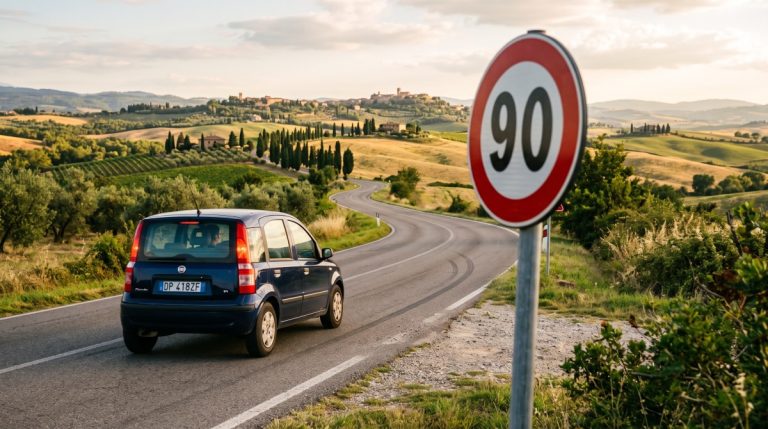
Strade extraurbane secondarie (secondary rural roads). 90 km/h.
-
Centro abitato (built-up area). 50 km/h, sometimes 30 km/h in marked zones. Many cities are expanding 30 km/h zones.
Enforcement is the real difference from the US. Instead of patrol cars with radar, Italy relies on fixed cameras. The autovelox photographs your speed at a single point and must be announced by a warning sign. The Tutor system on the autostrada is sneakier: it reads your plate at one gantry, reads it again many kilometers later, and computes your average speed for the whole stretch. Slowing down when you see a camera does not help if you were fast in between. There is a small tolerance (5 percent, minimum 5 km/h), and fines start around €42 for minor excesses but climb past €500 with license suspension for exceeding the limit by more than 40 km/h.
ZTL zones: how most Americans get fined
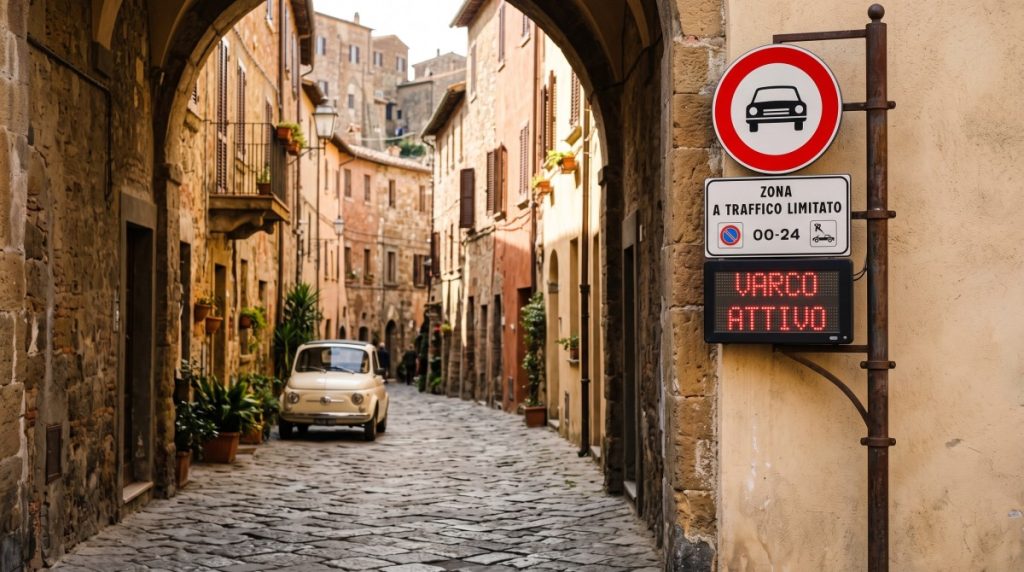
The zona a traffico limitato (limited traffic zone), or ZTL, is the single most common source of fines for foreign drivers. Hundreds of Italian cities restrict their historic centers to residents and permit holders. The entrance is marked by a sign, usually a white circle with red border and the word varco attivo (gate active) on an electronic panel, and a camera photographs every plate that crosses.
There is no barrier and no warning beep. You drive in, see nothing happen, and assume it was fine. The fine, typically €80 to €100 plus fees per entry, arrives by mail months later. If you crossed the zone several times looking for your hotel, each pass is a separate violation. With a rental car, the city bills the rental company, the rental company hands over your details (and charges you an administrative fee of €30 to €50 per ticket), and the notice follows you to your US address. Italian authorities have up to 360 days to notify a driver resident abroad, so the letter can arrive nearly a year after your trip.
The defenses are simple: keep the car outside the center, park in a garage and walk, and if your hotel is inside a ZTL, ask them to register your plate before you drive in. Most hotels in restricted zones can do this.
Right of way: what surprises Americans
-
No right turn on red. Turning right at a red light is illegal in Italy, always, even after a full stop with a clear road. This is the single reflex Americans most need to unlearn.
-
Precedenza a destra. At unsigned intersections, the vehicle coming from the right has priority. In older towns with narrow, unmarked streets, this rule does real work, and locals will take their priority without hesitating.
-
Roundabouts. Nearly all Italian roundabouts are signed to give priority to traffic already circulating, as in the US. But where signs are absent, the default right-priority rule technically favors entering traffic, which explains some of the improvisation you will see. Yield on entry unless signage says otherwise.
-
Trams and buses. Trams have priority, and you may not pass a stopped tram while passengers are boarding or getting off.
Alcohol: a much stricter limit than the US
The standard limit is 0.5 grams of alcohol per liter of blood. The typical US limit of 0.08 percent BAC is equivalent to 0.8 g/l, so Italy’s limit is roughly 40 percent lower. A second glass of wine at dinner can put an average-sized person over.
-
0.5 to 0.8 g/l. Administrative offense: a fine of €543 to €2,170 and license suspension of three to six months.
-
0.8 to 1.5 g/l. Criminal offense: fines to €3,200, suspension of six months to a year, possible arrest.
-
Over 1.5 g/l. Fines to €6,000, suspension of one to two years, arrest of six months to a year, and vehicle confiscation if you own the car.
-
Zero tolerance. Drivers under 21, drivers licensed for fewer than three years (neopatentati), and professional drivers have a limit of zero.
The 2024 reform added an alcolock requirement, an ignition interlock, for drivers convicted at the higher tiers. The practical rule for anyone used to American limits: if you are driving, do not drink.
Phones: the December 2024 crackdown
Holding a phone while driving now costs €250 to €1,000, five license points, and a suspension of 15 days to two months from the first offense. A repeat within two years brings €350 to €1,400 and a suspension of one to three months. The ban covers anything that takes a hand off the wheel, including phones, tablets, and laptops, and also headphones covering both ears. Hands-free systems and earpieces remain legal. This was the headline change of Law 177/2024, and enforcement has been active since it took effect on December 14, 2024.
Rules of the autostrada
-
Tolls. The autostrada is a toll road. Take a ticket when you enter and pay when you exit, by cash (white lanes), card (blue lanes marked carte), or Telepass, the electronic transponder that uses the yellow lanes. Many rental cars include one; charges bill automatically. Do not enter a yellow lane without a Telepass.
-
Left lane is for passing only. This is enforced by law and by custom. Cruising in the left lane earns you flashed headlights from behind at closing speeds Americans underestimate. Pass, then move right.
-
No U-turns, no reversing. If you miss your exit, continue to the next one. Reversing on the autostrada, even on the shoulder, is one of the most heavily punished violations in the code.
-
Emergency lane. The corsia di emergenza is for breakdowns and emergencies only, never for skipping traffic.
-
Headlights. Dipped headlights (anabbaglianti) are required at all times, day and night, on all roads outside built-up areas, including the autostrada.
Two fuel notes for the road: benzina is gasoline and gasolio is diesel, a pairing that has misfueled many rentals, and at the pump fai da te (self-service) is noticeably cheaper than servito (attendant service).
Seatbelts, kids, and required equipment
-
Seatbelts. Mandatory in all seats. Fines run €83 to €332 per unbelted occupant.
-
Child seats. Children under 150 cm (about 4 feet 11 inches) must ride in an approved child seat or booster, regardless of age. Children under four must use seats fitted with an anti-abandonment alarm (dispositivo antiabbandono); this applies to cars registered in Italy and to residents, so it matters once you move rather than on a short visit.
-
Helmets. Required for all riders of motorcycles and scooters, including passengers, with no age exception.
-
Required equipment. Every car must carry a warning triangle (triangolo) and a high-visibility vest (giubbotto catarifrangente), which you must wear if you exit the car on a road outside town. Keep the vest in the cabin, not the trunk.
-
Winter rules. On many roads, winter tires or chains on board are required from November 15 to April 15 where signed (obbligo di catene a bordo). Mountain routes can require them outside those dates.
Parking: read the lines
-
Blue lines. Paid parking. Pay at the meter (parcometro) and display the ticket, or use apps like EasyPark where posted.
-
White lines. Usually free, but check the sign: in many city centers white spaces are reserved for residents (solo residenti) or time-limited with a parking disc (disco orario).
-
Yellow lines. Reserved: disabled permits, loading zones, taxis, residents. Do not use them.
-
Tow zones. Zona rimozione means tow-away zone, and passo carrabile marks a driveway you must not block. Both are enforced.
If you have an accident
For a minor collision with no injuries, Italian drivers fill out the constatazione amichevole (friendly accident statement), a standardized blue form known as the CAI (formerly CID) that both drivers complete and sign at the scene, with a copy for each insurer. Rental cars usually have one in the glovebox. If the other driver will not sign, or there are injuries, or the vehicles block traffic, call 112, the European emergency number, and wait for the police. Never admit fault beyond what the form records, and photograph everything.
Points, fines, and how they reach you in the US
Residents hold a patente a punti, a license that starts with 20 points; violations subtract points and virtuous years add them back. Points cannot be docked from a US license, but the fines are real and portable. For camera violations in a rental car, the chain is mechanical: the authority identifies the rental company from the plate, the company supplies your contract details, and the notice goes to your home address, with up to 360 days allowed for notification abroad. Collection agencies working for Italian municipalities do pursue US addresses. Paying promptly usually earns a 30 percent discount; ignoring a fine lets it grow and can complicate future rentals in Italy.
If you want to test yourself on Italian road signs and rules before you go, try our free Italian driving test practice quiz. And since every sign, toll booth, and parking meter is in Italian, it helps to know where your comprehension actually stands: take our free Italian level test to find out.
Frequently Asked Questions (FAQ)
Can I turn right on red in Italy? No. Turning right at a red light is always illegal in Italy, even after a complete stop with no traffic. You may only turn on a green light or a green arrow.
What is a ZTL and how do I avoid a fine? A zona a traffico limitato is a camera-controlled restricted zone covering most Italian historic centers. Every plate that crosses an active gate (varco attivo) is photographed, and each entry is a separate fine of roughly €80 to €100 plus fees. Avoid them by parking outside the center, and if your hotel is inside one, have the hotel register your plate before you arrive.
What is the drink-driving limit in Italy compared to the US? Italy’s standard limit is 0.5 g/l, well below the usual US limit of 0.08 percent (0.8 g/l). Drivers under 21, drivers licensed for fewer than three years, and professional drivers must be at zero. Penalties start at €543 with a three-to-six-month suspension.
Do I need an International Driving Permit to drive in Italy? Yes, visitors driving on a US license need an International Driving Permit or a sworn Italian translation of their license. If you become a resident, you have one year to get an Italian license, since Italy has no exchange agreement with the US. Our guide to getting an Italian license covers the process.
Will an Italian traffic ticket really reach me in the United States? Usually, yes. For rental cars, the rental company gives the authority your details and charges you an admin fee, and the fine can legally be notified up to 360 days after the violation. Prompt payment typically gets a 30 percent discount.
Do I need winter tires in Italy? On roads where it is signed, you must have winter tires or carry chains from November 15 to April 15. Rental cars in northern Italy are usually equipped in season, but confirm before driving into the mountains.
Reading a varco attivo sign at 50 km/h is a language skill as much as a driving skill. Strommen’s native Italian tutors teach practical, real-life Italian, including the vocabulary of signs, tolls, and bureaucracy that daily life in Italy runs on. Many of our tutors offer a free 30-minute lesson, so you can find the right fit before you commit. Contact us to get started.