



Personally vetted instructors
Sardo tutors, lessons & classes
Salude The Logudorese Sardu hello. Campidanese speakers say "Saludi"; Italian "Salve" works everywhere on the island.
Personally vetted Sardo (Sardinian) tutor for heritage learners, Romance linguists, and serious students of Italy's most Latin-conservative minority language. Lessons calibrated to the specific variant (Logudorese, Campidanese, Nuorese) that matches your family village or research interest.
Your instructors
Sardo tutors for private lessons & classes
Sardo is a small specialty by design. An endangered Romance language with a global qualified-teacher pool in the low hundreds doesn't get a deep roster, and we'd rather match you carefully to one vetted tutor than pad the page with names we haven't met. The Strommen Sardo tutor was met and vetted by us personally. No marketplace. No automated profiles. If the calendar doesn't fit or your needed variant is outside their region, write to us and we'll either wait-list you or route to a vetted external coach we trust.
Filter by location, age, or price. Then book a 30-minute free trial.
Below is the Strommen tutor who teaches Sardo. Photo, ratings, and rate are real. Click the card to read the bio and book a free 30-minute trial.
I want to learn…
Every tutor, personally met. — founder-vetted since 2006, in Los Angeles and online worldwide.
Get a personalized plan
Pick your language — a language advisor will match you with the right tutor and map out your path.


Bachelor's Degree in English and American Literature and Creative Writing
Language Tutor (Italian and English as a foreign language)
Specialties
Bachelor's Degree in English and American Literature and Creative Writing
Language Tutor (Italian and English as a foreign language)
Specialties

Limba sarda — culture & heritage
5 things every heritage learner should know about Sardo
These aren't textbook curiosities. They're the reference points any serious Sardo tutor returns to in the first few sessions, because each one reframes what the language actually is.
-
01
Logudorese vs Campidanese
Sardo is not one language but a family of variants. Logudorese (central-northern interior) is the more archaic and is often treated as the prestige written form. Campidanese (southern plains, Cagliari hinterland) carries centuries of Catalan and Castilian influence. There is no neutral Sardo; any tutor is teaching you a specific variant rooted in a specific region. Pick yours intentionally.
e.g. "He sings": <em>issu cantat</em> in Logudorese, <em>issu cantada</em> in Campidanese.
-
02
Latin -t and SINE
Sardinian preserves Latin features no other Romance language has kept intact. The Latin third-person-singular -t ending is still pronounced in Logudorese verbs (cantat, "he sings"). The Latin preposition SINE survives as kena / chena, "without," where Italian and French long ago replaced it with senza and sans. These are the kind of conservatisms that make Sardinian a magnet for Romance linguists.
e.g. <em>Kena de tene non andu</em> — "Without you I'm not going."
-
03
Sassarese and Gallurese aren't Sardo
Two languages spoken on the island, Sassarese in the northwest and Gallurese in the northeast, are not Sardo. They're Tuscan-derived Italo-Romance varieties that arrived from Corsica in the medieval period and overlay a Sardinian substrate. They have their own ISO codes (sdc, sdn) and their own dignity, but a Sardo lesson won't teach them. Book the corresponding specialty if either is your target.
e.g. "Hello" in Sardo: <em>Salude</em>. In Gallurese: <em>Salutu</em>. Different language.
-
04
Cantu a tenore
Four male voices in close polyphonic harmony, one carrying the text and three providing rhythmic guttural drone. Inscribed on the UNESCO Representative List of the Intangible Cultural Heritage of Humanity in 2008. The tradition runs strongest in the Barbagia interior, and the Tenores di Bitti ensemble is the best-known international entry point. For ethnomusicologists, cantu a tenore fieldwork is often the reason for the Sardo lessons in the first place.
e.g. A canto a tenore quartet sings in four named voices: <em>sa boghe, sa contra, su bassu, sa mesu boghe</em>.
-
05
Nuraghi and the pre-Roman substrate
Sardinia is dotted with roughly seven thousand nuraghi, Bronze Age stone towers built by the Nuragic civilisation between about 1800 BCE and the Roman conquest in 238 BCE. The Nuragic substrate left a vocabulary layer in Sardo (plant names, place names, animal terms) that is older than Latin itself. Understanding this layer is part of what distinguishes Sardo from every other Romance language.
e.g. Place names ending in <em>-ai</em>, <em>-òro</em>, or <em>-ana</em> often carry Paleo-Sardinian roots.
About Sardo
Sardo, the most Latin Romance language
Sardo is the heritage language of Sardinia, and it is not a dialect of Italian. It is a Romance language in its own right, descended directly from the Latin of the western Roman provinces, recognised by Italian Law 482 of 1999 as one of the country's twelve historic linguistic minorities, and classified by UNESCO as definitely endangered. The ISO 639-3 family covers separate codes for the Sardinian varieties (src as umbrella, sro for Campidanese, sdc for Sassarese, sdn for Gallurese). The language has its own grammar, its own lexicon, and a thousand-year continuous written tradition (Eleonora d'Arborea's late 14th-century Carta de Logu is one of the oldest legal codes in Europe written in a Romance vernacular). Sardinians themselves call it limba sarda, "the Sardinian language," not a dialetto.
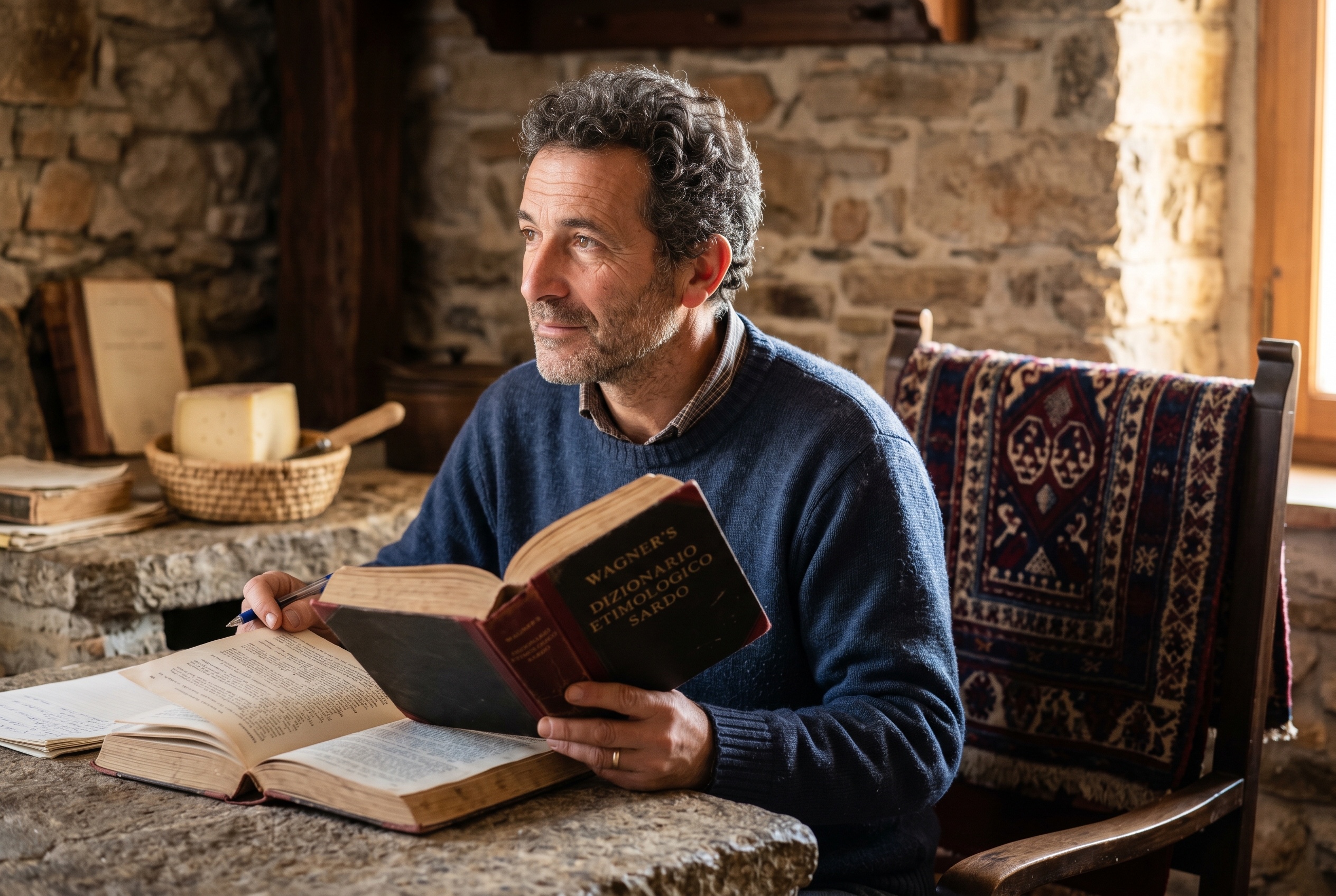
The Latin-conservative profile is what makes Sardo a magnet for Romance linguists worldwide. Sardinian preserves more features of classical Latin than any other surviving Romance language. The Latin third-person-singular verb ending in -t is still pronounced in Logudorese (cantat, "he sings," against Italian canta). The Latin preposition SINE ("without") survives intact as kena / chena, where Italian and French long ago replaced it with senza and sans. The hard Latin /k/ before front vowels is preserved in Nuorese and Logudorese (kentu for "hundred" against Italian cento). The definite article descends from IPSE rather than ILLE, giving su, sa, sos, sas instead of il/la/i/le. Max Leopold Wagner's monumental Dizionario Etimologico Sardo (1960-1964) remains the canonical reference for the lexicon; Eduardo Blasco Ferrer built much of his career mapping how the substrate, including the pre-Indo-European Paleo-Sardinian layer associated with the Nuragic civilisation, threads through modern Sardo.
Sardo is not one language but a family of variants. The two main poles are Logudorese in the central-northern interior (Logudoro, the Nuorese highlands, much of Oristano province) and Campidanese in the southern plains and Cagliari hinterland. Logudorese is the more archaic and is often treated as the prestige written form for Sardo proper. Campidanese carries Catalan and Castilian influences from the long Iberian rule of the island. Nuorese, sometimes treated as a third variant or as a particularly conservative branch of Logudorese, preserves features the other two have shed. Two languages spoken on the island, Sassarese in the northwest and Gallurese in the northeast, are not Sardo: they are Tuscan-derived Italo-Romance varieties that arrived from Corsica in the medieval period and overlay a Sardinian substrate. They have their own ISO codes and their own dignity, but a Sardo lesson will not teach them. The pan-Sardinian written norm promoted by the Regione Autonoma della Sardegna since 2006, the Limba Sarda Comuna, draws mainly on Logudorese-Nuorese; whether to use it or to work in a specific local variant is one of the first decisions in any serious lesson.
The cultural anchors run deep. Sardinia is dotted with roughly seven thousand nuraghi, the Bronze Age stone towers built by the Nuragic civilisation between about 1800 BCE and the Roman conquest in 238 BCE. The Nuragic substrate is the source of the Paleo-Sardinian vocabulary preserved in modern Sardo plant and place names. Pecorino sardo, the island's protected-origin sheep's-milk cheese, sits in a food culture that runs from pane carasau through porceddu and the honey-sweet liqueurs of the interior. The polyphonic singing tradition called cantu a tenore, four male voices in close harmony with one carrying the text and three providing rhythmic guttural drone, was inscribed on the UNESCO Representative List of the Intangible Cultural Heritage of Humanity in 2008. Sa Sartiglia in Oristano and S'Ardia in Sedilo are among the more spectacular living festivals; Sa die de sa Sardigna on 28 April marks the 1794 expulsion of the Piedmontese viceregal authorities and is observed as a regional civic holiday. Heritage learners returning to Sardo do so within this cultural frame, not separately from it.
Who actually studies Sardo with us. Sardinian-heritage learners, often second- or third-generation Italian-Americans tracing family back to specific villages in Logudoro, the Barbagia, the Campidano, or the Sulcis, are the largest group. Romance linguists working comparatively on Latin retention, Italo-Romance phonology, or substrate phenomena form a steady second strand. Anthropologists, ethnomusicologists studying cantu a tenore and the launeddas triple-pipe reed instrument, and folklore scholars doing fieldwork on the island make up a third. A smaller group of serious Italian-language students take Sardo as a comparative window onto early Romance, often paired with reading the Carta de Logu or with archaeological work on Nuragic sites. Strommen's Sardo roster is intentionally small, with one vetted tutor at present. The global pool of qualified teachers for an endangered Romance language is in the low hundreds at most, and matching you well to the right variant matters more than offering you a choice of twenty. If the calendar doesn't fit, or the variant you need is outside our current tutor's region, we'll route you to a vetted external coach or wait-list you rather than pretend we have depth we don't.
A few honest tutor observations on what surprises learners coming to Sardo. The biggest one is the variant question: there is no neutral Sardo. Anyone who teaches you Sardo is teaching you a specific variant rooted in a specific region, and the choice carries real consequence for which family or community you can actually speak with at the end of it. The orthography question follows close behind. Limba Sarda Comuna is useful as a pan-Sardinian writing system for administrative and modern publishing contexts, but it is not how most older Sardo writers wrote, and a heritage learner reading 19th- or early-20th-century Logudorese poetry will encounter spellings that differ visibly from the LSC norm. The Italian-overlay layer confuses returners too: much of what passes for Sardo in casual island speech today is heavily italianised, with Italian function words grafted onto a Sardo lexical base, and pure Sardo from older speakers can sound quite different. And there is the recalibration most students go through when they arrive having been told Sardo is "just an Italian dialect" and have to reframe it as a separate Romance language with its own structural identity. Once that recalibration happens, the work moves forward fast.
Between lessons, immersion takes some hunting and pays off when found. The Regione Autonoma della Sardegna publishes administrative material in Sardo (LSC orthography) and supports the language through its Ufitziu de sa Limba Sarda. Regional RAI sections carry occasional Sardo programming, and the cultural-music tradition is well-documented on record (the Tenores di Bitti ensemble is the best-known international entry point into cantu a tenore). For reading, Wagner's Dizionario Etimologico Sardo remains canonical; Blasco Ferrer's Linguistica sarda: storia, metodi, problemi is the standard introduction to Sardinian linguistics; the journals Officina Linguistica and Studi Sardi carry contemporary scholarship. For broader Italian context, our guide to Italy's regional languages places Sardo within the country's wider minority-language landscape, alongside Friulian, Ladin, Occitan, the Italo-Greek of Calabria and Salento, the Italo-Albanian Arbëresh, and the other historic minorities recognised under Law 482.
Lessons are one-on-one and calibrated to your goal. A heritage-recovery student working back toward a specific Logudorese village vocabulary is on a different curriculum from a Romance linguist working through Latin retention features in Nuorese, who is on a different curriculum again from an ethnomusicologist building enough Sardo to interview cantu a tenore elders. Bring your family village, your research question, the Sardinian text you're trying to read. The tutor will calibrate from there. The trial is free, video by default with in-person available where geography allows, and the same one-on-one model runs across our wider Italian dialect coaching and Italian language programmes. For broader phonetic foundations the Italian pronunciation guide is a useful supplement (Sardo phonology diverges in important ways, but the IPA literacy carries over), and the full tutor directory is the place to browse if you also want an Italian foundation alongside Sardo.
What you'll cover
Lessons & classes tailored to Sardo
Variant-specific Sardo: Logudorese, Campidanese, Nuorese
Calibration to the specific variant of Sardo that matches your family village or research target from the first session. Logudorese-Nuorese for the central-northern interior and the Barbagia. Campidanese for the south, Cagliari, and the Sulcis. Phonology, morphology, and the distinctive Latin-retention features of each variant taught explicitly, with the Limba Sarda Comuna pan-Sardinian written norm used as needed for modern reading.
Heritage recovery for Sardinian-American learners
For students returning to Sardo through family memory, lessons begin with the inherited words you already carry: kitchen vocabulary, family names, the village name, any phrases that survived in grandparents' speech. The tutor identifies which Sardo variant your inherited fragments come from and builds out the rest of the language around them, often paired with whatever family documents, photos, or recordings you have.
Romance linguistics and Latin retention
For comparative-linguistics students, Sardo is the most conservative Romance language documented and a primary case study for Latin survival in vernacular speech. Lessons can focus on the retention of Latin -t, the IPSE-derived article system, the preservation of SINE, the Paleo-Sardinian substrate layer, and the structural divergences that make Sardo a separate Romance branch rather than an Italian dialect. Wagner and Blasco Ferrer scholarship are the reading frame.
Cultural and literary Sardo
Reading the Carta de Logu of Eleonora d'Arborea (late 14th-century legal code) in the original; working through Sardo poetry from Logudorese and Campidanese traditions; cantu a tenore text for ethnomusicology students; coverage of the cultural calendar from Sa Sartiglia to Sa die de sa Sardigna. The cultural frame is inseparable from the linguistic frame for Sardo, and serious lessons treat them together.
FAQ
About Sardo lessons & classes
Is Sardo a dialect of Italian?
No. Sardo is a Romance language descended directly from Latin, structurally separate from Italian, and recognised as a minority language by Italian Law 482 of 1999. UNESCO classifies it as definitely endangered. Sardinian linguists call the language limba sarda, not a dialetto. The page lives under our Italian category because of where Sardo is spoken, not because of what it is linguistically. For comparison, our Arbëresh page covers the Albanian-descended minority language of Italo-Albania under the same category logic.
Which variant of Sardo should I learn?
The one rooted in the region you care about. Logudorese for the central-northern interior, including the Logudoro proper, the Nuorese highlands, and much of Oristano province. Campidanese for the southern plains, Cagliari, and the Sulcis. Nuorese as a particularly conservative branch of Logudorese for the Barbagia. The tutor will calibrate from the first session if you can tell us the family village or research target. There is no neutral Sardo to fall back on.
Are Sassarese and Gallurese the same as Sardo?
No. Sassarese (spoken around Sassari, ISO code sdc) and Gallurese (spoken in the Gallura, ISO code sdn) are Tuscan-derived Italo-Romance varieties that arrived from Corsica in the medieval period, structurally closer to Corsican and to medieval Tuscan than to Sardo. They overlay a Sardinian substrate but are not Sardo. If your family village is in the Sassari or Gallura zone, the language you want is one of these rather than Sardo, and we can route you accordingly.
How different is Sardo from Italian?
Different enough that a monolingual Italian speaker without Sardo exposure cannot follow a Sardo conversation. The grammar uses an IPSE-derived article system (su, sa, sos, sas) rather than the ILLE-derived Italian one (il, la, i, le). The verbs preserve Latin endings Italian has lost. The lexicon carries a substantial Paleo-Sardinian substrate and a separate history of Catalan and Castilian contact in the south. Many Sardinians today are bilingual and code-mix Sardo and Italian in casual speech, but the languages are structurally separate.
I have Sardinian family roots but never spoke any Sardo. Can I still learn?
Yes, and this is the most common student profile we see. Most heritage learners arrive with some inherited words from grandparents, a family village name, perhaps a song or a saying, and otherwise no working Sardo. The curriculum is the same as for any new language but calibrated to your specific village variant, and the inherited fragments often turn out to be a useful entry point once the tutor identifies where they come from in the Sardinian variant landscape.
Will learning Sardo help me with Italian?
Indirectly. Sardo and Italian are separate Romance languages with overlapping Latin ancestry, so general Romance literacy carries between them, and a competent Sardo speaker has an easier time reading Italian than the other way around. But Sardo is not a route to Italian fluency in the way that learning a Spanish dialect is a route to Spanish fluency. If your real goal is Italian, our Italian programme is the better starting point and Sardo can come later as a comparative or heritage layer.
What is Limba Sarda Comuna and should I learn it?
Limba Sarda Comuna (LSC) is the pan-Sardinian written norm promoted by the Regione Autonoma della Sardegna since 2006. It draws mainly on Logudorese-Nuorese and is used for administrative material, modern publishing, and pan-island contexts. It is useful as a reading-and-writing standard, and the tutor will teach it when relevant, but it is not how most older Sardo writers wrote, and a serious heritage learner will encounter local orthographic conventions in any village or family material. The tutor flags these gaps rather than pretending the language has one tidy written standard.
What does the trial include?
30 minutes, free, with the tutor. If you know your family village or your specific research target, tell us; the tutor will calibrate the variant from the first session. Bring any inherited words, family documents, photos with captions, recordings, or the text you're trying to read. The tutor will propose a study plan and you decide whether to continue. Most Sardo students settle into a weekly cadence with the trial tutor.
Ready for Sardo lessons or classes?
Book a free 30-minute trial with one of our personally vetted tutors. Private lessons or small-group classes — your choice.