



Personally vetted instructors
Chinese Calligraphy tutors, lessons & classes
老师好 Lǎoshī hǎo — "hello, teacher." The first thing a calligraphy student says, every lesson.
Personally vetted Chinese calligraphy tutors. Brush-and-ink lessons grounded in the five classical scripts, real tools, and the long tradition behind the practice.
Your instructors
Chinese Calligraphy tutors for private lessons & classes
Strommen has taught Chinese in LA since 2006, and calligraphy is the specialty where the teacher matters most. There is no app, no worksheet, and no shortcut that replaces an experienced eye telling you a stroke is alive or dead and why. Every tutor below was met and vetted by us in person. No marketplace, no auto-generated profiles. Real teachers with real training, described in their own bios.
Filter by location, age, or price, then book a 30-minute free trial.
Below are the Strommen tutors who teach Chinese calligraphy. Photos, ratings, and rates are real. Click any card to read their bio and book a free 30-minute trial.
I want to learn…
Every tutor, personally met. — founder-vetted since 2006, in Los Angeles and online worldwide.
Get a personalized plan
Pick your language — a language advisor will match you with the right tutor and map out your path.

Masters degree
Expert University Teaching with a Friendly Touch: Professional, Engaging, Effective . #1 Mandarin Tutor at Strommen working with Corporate Clients, Kids + Individuals.
Personally vetted · Strommen’s note
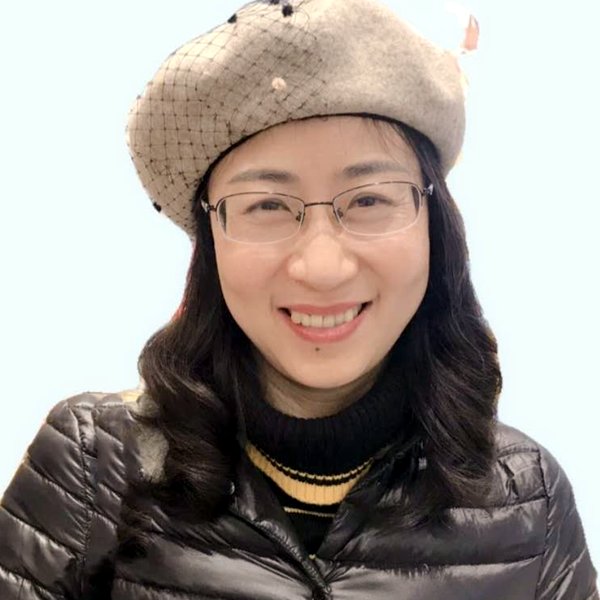
Before joining Strommen, Linna spent twenty-five years teaching Chinese language and literature at a university in China.
Specialties
Masters degree
Expert University Teaching with a Friendly Touch: Professional, Engaging, Effective . #1 Mandarin Tutor at Strommen working with Corporate Clients, Kids + Individuals.
Specialties
Personally vetted · Strommen’s note
Before joining Strommen, Linna spent twenty-five years teaching Chinese language and literature at a university in China.


Masters in education
Looking forward to sharing Chinese language and culture with you.
Personally vetted · Strommen’s note
Simone's Chinese lessons stay interactive by design, heavy on student practice time, light on lecture.
Specialties
Masters in education
Looking forward to sharing Chinese language and culture with you.
Specialties
Personally vetted · Strommen’s note
Simone's Chinese lessons stay interactive by design, heavy on student practice time, light on lecture.

Teacher Permit, Bachelor Degree
Chinese Teacher with 17 Years Experience and Attention to Detail.
Personally vetted · Strommen’s note
Seventeen years teaching Chinese, with a specialty in AP and SAT II prep, and Xue still rewrites her own material rather than teach straight from the page.
Specialties
Teacher Permit, Bachelor Degree
Chinese Teacher with 17 Years Experience and Attention to Detail.
Specialties
Personally vetted · Strommen’s note
Seventeen years teaching Chinese, with a specialty in AP and SAT II prep, and Xue still rewrites her own material rather than teach straight from the page.

书法 — brush & tradition
5 ideas every Chinese calligraphy student meets early
These are the foundations a tutor will introduce in the first lessons. Save the card, then book a tutor to put a brush in your hand.
-
01
五体 (wǔ tǐ) — the five scripts
The five major script styles Chinese calligraphy is built on: seal, clerical, regular, running, and cursive. Each is still practiced today, and each asks for a different brush rhythm. A tutor will place you in one to start, usually regular script for beginners, and map the path from there.
e.g. The standard progression runs 楷 → 行 → 草: regular script first, then running, then cursive.
-
02
楷书 (kǎi shū) — regular script
The orderly, fully legible script most students learn first, with every stroke distinct. The Tang-dynasty masters Yan Zhenqing, Liu Gongquan, and Ouyang Xun set the foundational models, and a beginner usually works directly from one of their copybooks.
e.g. 颜体 (Yán tǐ), the regular-script style of Yan Zhenqing, is one of the most copied models in calligraphy education.
-
03
草书 (cǎo shū) — cursive script
The most abstract and gestural of the five scripts, with characters reduced to flowing forms that non-experts often cannot read at all. Mastery of cursive is treated as the highest level of calligraphic skill, which is why students reach it last.
e.g. The Tang masters Zhang Xu and Huai Su are the great names of cursive, or 草书.
-
04
文房四宝 (wénfáng sìbǎo) — the Four Treasures
The four essential tools of the practice: brush (笔), ink (墨), paper (纸), and inkstone (砚). Traditional brushes are animal hair on a bamboo handle, and Xuan paper from Anhui is the absorbent standard that gives calligraphy its ink-tonal effects.
e.g. A beginner's set of the 文房四宝 can be assembled for under $100; serious practitioners invest over years.
-
05
字如其人 (zì rú qí rén) — writing is like the person
The classical idea, in circulation since the Han dynasty, that a person's calligraphy reveals their character and inner state. It is the reason calligraphy was practiced as moral cultivation, not just craft, and the reason a tutor reads your strokes as more than shapes.
e.g. 字如其人: a teacher looks at a student's brushwork and sees their attention and training in it.
About Chinese Calligraphy
A practice with a tradition behind it
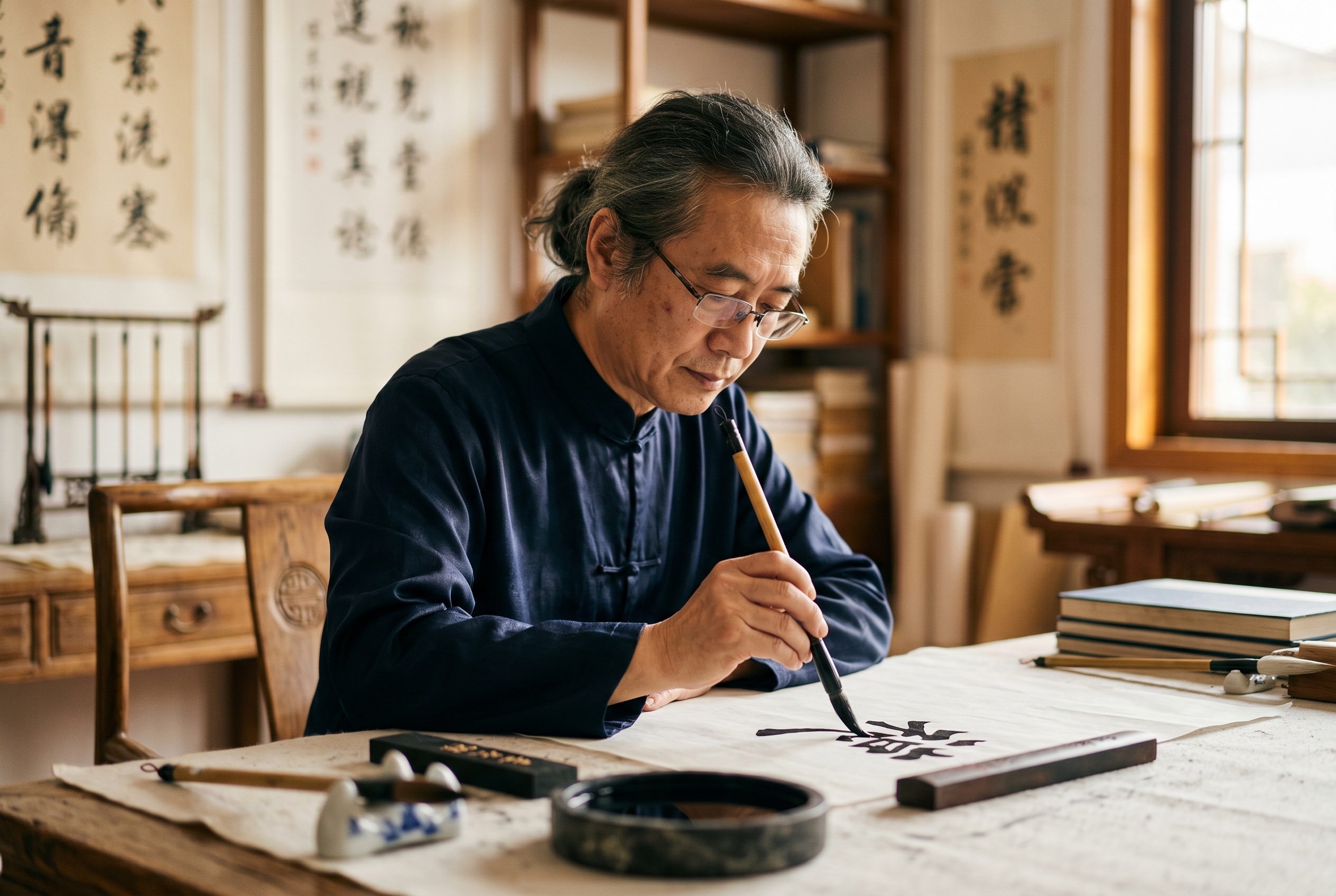
Chinese calligraphy is not handwriting practice with a fancier pen. It is one of the oldest continuous fine-art traditions in the world, and in Chinese culture it has always been read two ways at once: as visual art and as a record of the person holding the brush. The classical formulation, in circulation since the Han dynasty, is 字如其人 (zì rú qí rén) — "one's writing is like one's person." A brush stroke is taken as evidence of the writer's training, attention, and inner state. That is why scholars and officials practiced calligraphy as part of moral cultivation rather than as a craft skill, and it is why a good tutor will not let you treat it as decorative penmanship.
The practice runs through five script styles, each still written today. Seal script and clerical script are the ancient pair, studied for historical grounding and specific stylistic work. Regular script is the orderly, fully legible standard most students learn first. Running script speeds that up into connected, flowing strokes, and cursive abstracts the character almost past the point of reading. A complete calligraphy education moves roughly from regular to running to cursive, with the two older scripts folded in along the way. Knowing where you are in that progression is most of knowing what to work on next.
Because calligraphy carries this much history, it is also the one Chinese specialty where Traditional characters matter more than Simplified. The canon, the master copybooks, the inscriptions a student learns from — they predate the 1950s simplification reforms, so a calligraphy tutor works mostly in Traditional forms even when a student's spoken Mandarin study uses Simplified. That is not a contradiction to resolve. It is simply the shape of the art.
Who actually wants this? Students drawn to brush work for its own sake. Heritage learners reconnecting with a family practice. People who studied Japanese shodō or Korean seoye and want the parent tradition. Meditators who want a discipline that leaves an artifact behind. The honest framing, and the one our tutors use, is that Chinese calligraphy sits closer to a meditation practice than to a writing class. The page in front of you at the end of an hour is the byproduct. The attention you paid getting there is the point.
Our Chinese calligraphy tutors are a small, deliberately small group. Some are trained in the classical copybook method, working a student through the regular-script models of the Tang masters before any free composition. Others come at it through contemporary brush practice and ink painting. Each one can tell you, at a trial lesson, which script and which model copybook fits where you are now. A beginner with no brush experience and a heritage learner who already knows the four tools do not get the same first lesson.
What you'll cover
Lessons & classes tailored to Chinese Calligraphy
Brush technique and the Four Treasures
Lessons start with the tools themselves: how to hold and load the brush, how to grind or pour ink, how Xuan paper absorbs and why that matters. The 文房四宝 (brush, ink, paper, inkstone) are not props. Each one shapes how a stroke lands. Tutors cover what a beginner should buy, what to skip, and how to assemble a workable kit without overspending. From there it is stroke mechanics: pressure, speed, and the lift and turn of the brush tip.
Working through the five scripts
Most students begin in regular script (楷书), the orderly model taught first, copying directly from a Tang-master copybook. As control develops, lessons move into running script (行书), where strokes connect and the hand speeds up, and eventually toward cursive (草书) for students who go that far. Seal script and clerical script are studied for historical depth and specific stylistic work. Your tutor sets the sequence to your starting point rather than a fixed syllabus.
Character structure and aesthetic judgment
A character is a small composition: proportion, balance, the weight of one stroke against another. Calligraphy training is largely training the eye to see this. Lessons work on structure alongside technique, and on the harder skill of aesthetic judgment, telling a stroke that is alive from one that is dead. This is the part no worksheet teaches, and the reason an experienced tutor is worth the time.
Tradition, canon, and Traditional characters
Because calligraphy's models predate the 1950s simplification reforms, lessons work mostly in Traditional characters, even for students whose spoken Mandarin study uses Simplified. Tutors place the practice in context: the master practitioners, the canonical works, and the cultural reading of calligraphy as 字如其人. Students drawn to the literary side can pair this with our Chinese literature lessons.
FAQ
About Chinese Calligraphy lessons & classes
Do I need to speak Mandarin to learn Chinese calligraphy?
No. Calligraphy and spoken Mandarin are separate skills, and plenty of students take calligraphy lessons with little or no spoken Chinese. You will pick up the characters you practice and the vocabulary of the tools and scripts along the way. That said, students who want both can study them together, and several of our tutors teach conversational Mandarin as well. If you would like to add the spoken side, our Chinese classes are a natural companion.
I have never held a calligraphy brush. Where do I start?
At the beginning, which is where most students start. A first lesson covers how to hold and load the brush, how ink and paper behave, and the basic strokes of regular script (楷书), the orderly style taught first. Your tutor works from a Tang-master copybook and builds from there. No prior brush experience is assumed.
What tools do I need, and how much do they cost?
The four essentials are the 文房四宝: brush, ink, paper, and inkstone. A workable beginner's kit can be put together for under $100, and many students start with pre-ground bottled ink for convenience rather than grinding an inkstick. Your tutor will tell you exactly what to buy before your first lesson, what is worth spending more on later, and what you can skip while you are starting out.
Why do calligraphy lessons use Traditional characters?
Because the canon does. The master copybooks, classical inscriptions, and model works that calligraphy students learn from all predate the 1950s simplification reforms, so the practice works mostly in Traditional forms. This is true even if your spoken Mandarin study uses Simplified characters. It is not a conflict to fix, just the historical shape of the art, and your tutor will explain the forms as you go.
Which script will I learn first?
Almost always regular script (楷书). It is the orderly, fully legible style, every stroke distinct, and it builds the control everything else depends on. A complete calligraphy education then moves from regular to running script (行书) and, for students who go that far, to cursive (草书). Seal and clerical script are studied along the way for historical depth. Your tutor sets the order to fit where you are.
Can I take calligraphy lessons online, or only in person?
Both. Many of our calligraphy tutors teach online via Zoom or Jitsi, with a camera angled on the paper so the tutor can watch the brush and correct in real time. Several also teach in person around Los Angeles. The booking widget on each tutor's profile shows their available formats. Online works well for calligraphy because the tutor mainly needs to see your strokes, not the room.
Is calligraphy a good practice for children?
Yes. Calligraphy teaches patience, focus, and fine motor control, and many families want it as a tie to Chinese culture and heritage. Tutors adjust pace and expectations for younger students. If you are looking for broader Mandarin lessons for a child as well, our Chinese for kids tutors cover the spoken and reading side.
How long before my calligraphy looks good?
Honest answer: it depends on practice time and what you mean by good. Comfortable, controlled regular-script strokes come within a few months for most students practicing between lessons. Running script takes longer, and cursive is a multi-year pursuit. Calligraphy rewards steady practice more than talent, and a tutor sets realistic checkpoints at the trial lesson. Browse the tutors above, or see our full tutor directory to find the right fit.
Ready for Chinese Calligraphy lessons or classes?
Book a free 30-minute trial with one of our personally vetted tutors. Private lessons or small-group classes — your choice.