



Personally vetted instructors
Business Dutch tutors, lessons & classes
Goedemorgen How Dutch offices answer the phone before noon.
Personally vetted Business Dutch tutors. Lessons calibrated to the Amsterdam financial sector, the Randstad corporate culture, and the famously direct working register of Dutch and Flemish professionals.
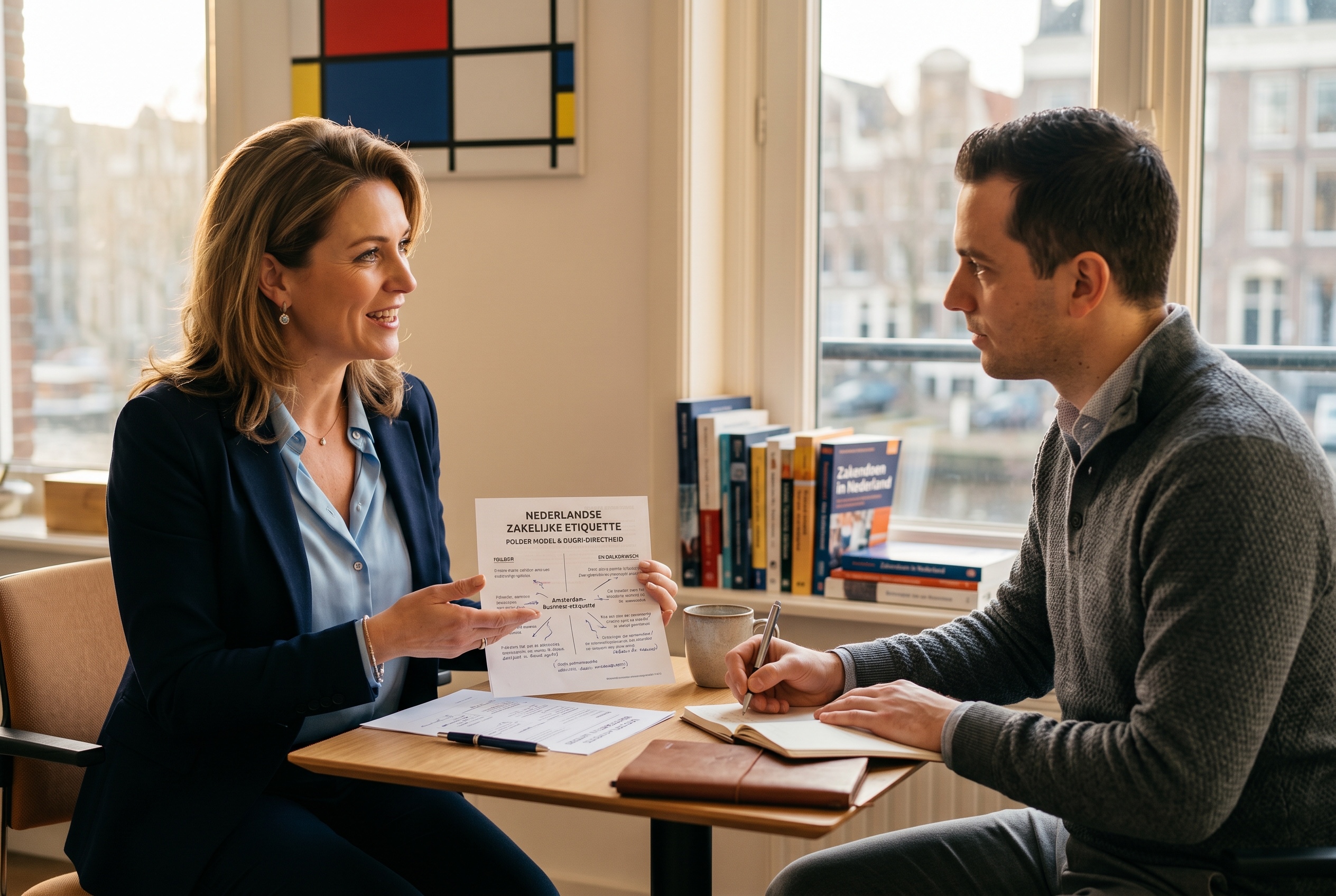
Your instructors
Business Dutch tutors for private lessons & classes
Strommen teaches Business Dutch to professionals working in or with Dutch and Belgian companies — executives, attorneys, consultants, finance professionals, and engineers preparing for relocation, deal work, or daily life inside a Dutch corporate culture. Every tutor below was met and vetted by us in person or via thorough video interview. No marketplace. No automated profile-creation. Real teachers with real backgrounds in Dutch business language and culture.
Filter by location, age, or price. Then book a 30-minute free trial.
Below are the Strommen tutors who specialize in Business Dutch. Photos, ratings, and rates are real. Click any card to read their bio and book a free 30-minute trial.
I want to learn…
Every tutor, personally met. — founder-vetted since 2006, in Los Angeles and online worldwide.
Get a personalized plan
Pick your language — a language advisor will match you with the right tutor and map out your path.


I have a Master's degree in Communication Sciences
From Amsterdam's Heart to Global Fluency, Eser Offers Experience-Driven Coaching!
Specialties
I have a Master's degree in Communication Sciences
From Amsterdam's Heart to Global Fluency, Eser Offers Experience-Driven Coaching!
Specialties
Werkcultuur — register & culture
5 things American executives miss about Dutch business culture
These are the everyday rituals and codes that separate executives who've worked inside a Dutch company from those who've only visited. Screenshot before your next Amsterdam trip.
-
01
Het Poldermodel
The consensus-driven Dutch approach to decision-making, named after the historical cooperation needed to maintain the country's dikes. In business: decisions get extensively discussed, all stakeholders weigh in, hierarchy is flatter than in most other European cultures, and even the most junior person in the room contributes. Slow to decide, unified to implement. Rushing the consultation phase reads as arrogant.
e.g. We moeten dit echt in overleg beslissen; dat is hier zo de cultuur.
-
02
Dutch directness
Dutch colleagues will tell you your idea is bad, your slide is unclear, or your timeline is unrealistic without softening preamble, often within ten minutes of meeting you. This is efficiency, not rudeness. American-style positivity reads as evasive or even dishonest. Learning to give and receive direct feedback without flinching is half of integrating into a Dutch workplace.
e.g. Dat is gewoon geen goed plan, we moeten het anders doen.
-
03
Koffietijd
The 10:00 morning coffee ritual in most Dutch offices. Colleagues gather in the kitchen, often with a single cookie each (the Dutch are famously frugal about cookies; one is standard, two is presumptuous). Skipping koffietijd reads as antisocial, especially in your first months. It's where reputations quietly form.
e.g. Kom je ook koffiedrinken? Het is bijna tien uur.
-
04
Vrijdagmiddagborrel
The Friday-afternoon company drinks, usually starting around 16:30 in the office kitchen or downstairs bar. Beer, wine, sometimes bitterballen. Many of the conversations that shape your professional reputation happen at the borrel, not in formal meetings. Showing up matters more than being a charismatic networker.
e.g. Zie ik je bij de vrijdagmiddagborrel?
-
05
Hybride werken
Hybrid work, the post-COVID Dutch norm. Two to three days in office is typical, with Tuesday or Wednesday usually anchored as the in-office day. This has made written Dutch (Teams, Slack, email) more important for non-native speakers, since the kitchen-osmosis route to language acquisition has thinned considerably.
e.g. Op dinsdag werken we allemaal op kantoor, de rest van de week hybride.
About Business Dutch
Working in Dutch when the company language is English
Business Dutch sits in a peculiar position. Most multinational companies based in the Netherlands run their meetings in English. Amsterdam is one of the most international financial hubs in Europe, second only to London by some measures, and the working language of ING, Shell, ASML, Philips, Heineken, Booking.com, Adyen, and the trading floors around Zuidas is almost always English. So why bother with Business Dutch at all? Because the moments that matter most are still in Dutch. The watercooler conversations where reputations get built. The lunch invitations that decide who's on the inside. The all-hands meetings where the CEO addresses the company in Dutch. The closed-door negotiations between Dutch counterparts that no one bothers translating. The clients in the regional offices outside Amsterdam who switch into English politely but appreciate Dutch enormously. The internal Teams chats that drift back into Dutch the moment the non-Dutch-speakers leave the room.
For anyone working in or with a Dutch-headquartered company, Business Dutch is the difference between being a competent outsider and being someone who actually belongs. Lessons in this specialty focus on the professional register: the formal salutations, the closing formulas, the meeting vocabulary, the negotiation phrases, the email etiquette, and the cultural codes that English alone cannot transmit.
The core cultural code in Dutch business is the famous Dutch directness. This deserves its own section because it surprises and sometimes wounds American, British, and Asian professionals who arrive in the Netherlands expecting the diplomatic cushioning their home cultures take for granted. A Dutch colleague will tell you your idea is bad, your slide is unclear, your timeline is unrealistic, your reasoning is flawed, often within the first ten minutes of a meeting, and without any softening preamble. This is not rudeness. It's efficiency, and Dutch professionals on the receiving end of it experience it as respect rather than aggression. The flipside is that excessive American-style positivity ("great point, love that, let's circle back") reads in Dutch business culture as evasive, performative, or even dishonest. Learning to give feedback the Dutch way and receive feedback the Dutch way is half of integrating into a Dutch workplace, and it's something a Business Dutch tutor with corporate experience can drill far more effectively than a generic conversation tutor.
Close behind directness is the Polder Model, the Dutch consensus-driven decision-making approach named after the historical practice of cooperating across factions to maintain the dikes and polders. In a Dutch business context this means: decisions tend to be discussed extensively, all stakeholders are consulted before a final call, hierarchy is flatter than in most other European business cultures, and the most junior person in the room is generally expected to contribute. American executives accustomed to top-down decision velocity sometimes find the Polder Model agonizingly slow. Once a decision is made, however, implementation tends to be unusually unified, precisely because everyone had a chance to weigh in. Learning to navigate the consultation phase without rushing it, while staying useful and visible in the conversation, is a Business Dutch skill.
The register itself. Business emails in Dutch start with either Geachte heer/mevrouw (formal, used for first contact or with senior people you don't know personally) or Beste followed by first name or last name (semi-formal, the most common default in modern Dutch business correspondence). Closings range from formal (Met vriendelijke groet, often abbreviated to Mvg) to semi-formal (Vriendelijke groet, abbreviated Vr. gr.) to casual (Groet, or even just Groetjes in internal team chat). The progression from Geachte to Beste to first-name basis mirrors the progression of professional intimacy. Skipping rungs reads as forward. Using a too-formal salutation past the point of warmth reads as cold. WhatsApp and Teams have made internal Dutch business communication more casual than it was a decade ago, but the formal email register persists for first contact, legal correspondence, and external clients.
Vocabulary is the second layer. Business Dutch carries a specialized lexicon, much of it borrowed from English in modern usage but with Dutch grammatical handling. Vergadering is a meeting. Overleg is a more consultative meeting, often shorter and less formal. Borrel is the post-work company drink, a real and important institution. Koffietijd is the mid-morning coffee break, also institutional. Notulen are meeting minutes. Agenda is both an agenda and a calendar. Loonstrook is a pay stub. Vakantiegeld is the annual vacation bonus, a legally mandated 8 percent of salary paid in May or June. BV is a private limited company (the equivalent of an LLC). NV is a public limited company. CAO is a collective labor agreement, the sector-wide pay and conditions framework that governs much of Dutch employment. Werknemer is employee; werkgever is employer. Functioneringsgesprek is the annual performance review. None of this is taught in conversational Dutch and all of it appears in your first week working at a Dutch company.
The rituals matter too. Koffietijd at roughly 10:00 in most Dutch offices is a real institution. Colleagues gather in the kitchen, sometimes with a single cookie each (the Dutch are famously frugal about cookies; one is the standard, two is presumptuous). Skipping koffietijd reads as antisocial, especially in your first months. Borrel, the Friday-evening company drink (usually starting around 16:30 or 17:00), is similarly important for relationship-building. Many of the conversations that shape your professional reputation happen at the borrel, not in formal meetings. Showing up matters more than being a charismatic networker; the bar is low and the upside is high.
Post-COVID, hybrid work has become standard across most Dutch white-collar companies. Two to three days in office is the typical norm, with most companies anchoring Tuesday or Wednesday as the in-office day. This has shifted the rhythm of Business Dutch conversation: more written communication via Teams and Slack (which means the casual written register matters more), less spontaneous spoken Dutch in the kitchen, and a real challenge for non-Dutch-speakers who used to absorb Dutch through office osmosis. Active Dutch lessons have become more important, not less, in the hybrid era.
A handful of things American executives tend to underestimate about Dutch business culture. Most surprising for newcomers is just how literally Dutch colleagues take what you say. American hyperbole ("that's incredible", "absolutely game-changing") is heard as flatly inaccurate rather than enthusiastic. Calibrate downward. Next comes the weight of op tijd komen, being on time. Dutch business culture treats punctuality as foundational respect; arriving five minutes late to a 10:00 meeting registers in a way it might not in Rome or Mexico City. The role of the boss is its own trap; flatter hierarchy means your CEO might bike to work and eat the same kitchen lunch as the intern, but disagreement and decision-making still flow through the formal organizational chart. Confusing flat with leaderless is a common American error. And then there's vacation. Dutch professionals take their statutory four to six weeks of annual vacation seriously and expect their colleagues to respect it; sending non-urgent work emails to someone on vacation in July is bad form.
The Strommen Business Dutch roster includes native Dutch teachers based in Amsterdam, Rotterdam, Utrecht, Eindhoven, and the Hague, plus several Flemish teachers based in Antwerp and Brussels for Belgium-focused work, and longtime bilinguals based in the United States with corporate experience. Several of our Business Dutch tutors come from working backgrounds in Dutch finance, law, consulting, tech, and supply chain. Each tutor's bio specifies their region, professional background, and the student profile they fit best. For other Dutch specialties, our Conversational Dutch, Dutch for Beginners, and Dutch for Travel pages cover related programs, and the Dutch course page shows the full family.
Lessons calibrate to your actual goal. Pre-relocation Business Dutch for an executive moving to Amsterdam is a different curriculum from monthly maintenance for a US-based attorney handling Dutch contracts. Both are different from the consultant flying to Eindhoven quarterly. We don't run a generic Business Dutch course. Each lesson is one-on-one, your tutor plans around your week and your industry, and the trial is free. Browse the full tutor list, pick a tutor whose corporate background fits your sector, and book a 30-minute trial. The directness, the consensus, the koffietijd, the borrel: all of it learns faster when someone who's worked inside it is your tutor.
What you'll cover
Lessons & classes tailored to Business Dutch
Email Dutch, formal to casual
The progression from Geachte heer/mevrouw to Beste to first-name basis, and the closings that match (Met vriendelijke groet, Vriendelijke groet, Groet). Internal Teams etiquette and the shifting line between WhatsApp-casual and email-formal. Drills include real first-contact emails, follow-ups, escalations, and the difficult ones (declining, pushing back, negotiating).
Finance, legal, and contract vocabulary
Vergadering, overleg, notulen, CAO, BV, NV, loonstrook, vakantiegeld, functioneringsgesprek, opzegtermijn, concurrentiebeding, akte van levering, volmacht. Industry-specific vocabulary calibrated to your sector (banking, law, tech, consulting, manufacturing, supply chain) with real Dutch source documents.
Meeting dynamics and the Polder Model
How Dutch business meetings actually run: extensive consultation, flat hierarchy, junior contributions expected, decisions reached by consensus rather than executive fiat. Presentation Dutch: slide language, transition phrases, handling pushback from a famously direct audience. Role-play with a tutor who's run these meetings, not just read about them.
Netherlands versus Belgium, register choices
The Dutch business register differs meaningfully between the Randstad (more casual, English-heavy) and Flanders (more formal, longer hold-onto-u). For consultants and executives working across both countries, lessons cover the calibration. CNaVT and Staatsexamen NT2 certification preparation for proof of proficiency. Pre-deal sprint vocabulary for upcoming negotiations.
FAQ
About Business Dutch lessons & classes
If my Amsterdam company uses English, should I bother learning Dutch?
Yes, for two reasons. First, cultural fluency: the watercooler, the koffietijd, the borrel, the all-hands meeting in Dutch, and the closed-door conversations between Dutch counterparts all happen in Dutch regardless of the official company language. Second, signaling: making the effort to learn Dutch communicates commitment and respect in a way that English-only never can. Even reaching B1 conversational level (enough to join the kitchen conversation, follow the all-hands, send a Dutch-language thank-you note) materially changes how Dutch colleagues perceive you.
How direct is Dutch business culture really?
Genuinely direct, more so than American, British, or most Asian business cultures. A Dutch colleague will tell you your idea is bad, your slide is wrong, your timeline is unrealistic, often within ten minutes of meeting you, without softening preamble. This is efficiency, not aggression; Dutch professionals on the receiving end of it experience it as respect. American-style positivity reads as evasive or performative. Lessons in this specialty include explicit work on giving and receiving direct feedback in Dutch, because the cultural calibration matters as much as the vocabulary.
What is the Polder Model and how does it affect business decisions?
The Polder Model is the Dutch consensus-driven decision-making approach, named after the historical practice of cooperating across political and religious factions to maintain the dikes and polders. In a business context this means: decisions get discussed extensively, all stakeholders are consulted, hierarchy is flatter than in most other European cultures, and even junior employees are expected to contribute. American executives sometimes find the consultation phase slow, but implementation tends to be unusually unified once consensus is reached. Rushing the consultation reads as arrogant; participating fully reads as professional.
How should I handle email versus WhatsApp etiquette in a Dutch office?
Email handles formal first contact, legal correspondence, external clients, and any communication that needs a record. WhatsApp and Teams handle internal team chat, quick questions, and scheduling. The salutation in email matters: Geachte heer/mevrouw for first contact, Beste with first or last name for working relationships, first-name only for close colleagues. WhatsApp can be considerably more casual, often skipping salutations entirely. Don't initiate WhatsApp contact with someone you haven't met; let the relationship warm up first.
What's vakantiegeld and why does it appear in every Dutch contract?
Vakantiegeld is the holiday allowance, a legally mandated 8 percent of your annual salary paid as a lump sum, usually in May or June. It's not a bonus; it's deferred salary. The intent is to ensure Dutch workers can afford to take their statutory vacation time. Some employers fold it into a monthly payment instead. Either way it appears prominently in Dutch employment contracts and on your annual loonstrook, and you should expect to see it referenced regularly.
Do you teach Dutch certifications like NT2 or CNaVT?
Yes. Several of our tutors prep students for the Staatsexamen NT2 (the standard Dutch-as-a-second-language exam, with Programme I at A2/B1 level and Programme II at B2 level), the CNaVT (Certificaat Nederlands als Vreemde Taal) at various levels, and the inburgering integration exam required for Dutch citizenship and certain residency categories. HR departments at Dutch-headquartered firms sometimes require proof of proficiency at B1 or B2 level. Mock exams are included in prep.
Are tutors based in the Netherlands and Belgium, or in the US?
Both. Our roster includes native Dutch teachers based in Amsterdam, Rotterdam, Utrecht, Eindhoven, and the Hague, plus Flemish teachers in Antwerp and Brussels for Belgium-focused work, plus longtime bilinguals based in the US who have worked in Dutch corporate settings. European-based tutors typically have late-afternoon and evening availability that maps to US morning hours. US-based tutors offer end-of-business-day flexibility.
What's the trial like for Business Dutch?
30 minutes, free, with the tutor you select. Bring your actual situation: relocating to Amsterdam in three months, signing contracts with a Dutch supplier, joining a Dutch consulting firm, partnering with a Belgian client. The tutor will assess your current level, map a curriculum to your goal, and you decide whether to continue. Most Business Dutch students settle into weekly hour-long lessons with a tutor matched to their sector; corporate group rates are available for teams of three or more.
Ready for Business Dutch lessons or classes?
Book a free 30-minute trial with one of our personally vetted tutors. Private lessons or small-group classes — your choice.