



Personally vetted instructors
Dutch for Travel tutors, lessons & classes
Dag The friendly Dutch "hello" you'll use a dozen times a day on your trip.
Personally vetted Dutch tutors for travelers. Pre-trip prep for Amsterdam, Rotterdam, Brussels, Antwerp, Bruges, Ghent, and anywhere else in the Dutch-speaking world — restaurant, train, café, getting-around register, plus the cultural manners that make a real difference.
Your instructors
Dutch for Travel tutors for private lessons & classes
Strommen has Dutch tutors who specialize in pre-trip travel prep — the focused 8-to-12-lesson sprint that turns a first-time visit to Amsterdam, Brussels, Bruges, Antwerp, or anywhere in the Dutch-speaking world into something more than a transactional trip. Every tutor below was met and vetted by us in person or via thorough video interview. No marketplace. No automated profile-creation. Real teachers with real backgrounds in traveler-focused Dutch.
Filter by location, age, or price. Then book a 30-minute free trial.
Below are the Strommen tutors who specialize in travel Dutch. Photos, ratings, and rates are real. Click any card to read their bio and book a free 30-minute trial.
I want to learn…
Every tutor, personally met. — founder-vetted since 2006, in Los Angeles and online worldwide.
Get a personalized plan
Pick your language — a language advisor will match you with the right tutor and map out your path.


I have a Master's degree in Communication Sciences
From Amsterdam's Heart to Global Fluency, Eser Offers Experience-Driven Coaching!
Specialties
I have a Master's degree in Communication Sciences
From Amsterdam's Heart to Global Fluency, Eser Offers Experience-Driven Coaching!
Specialties
Op reis — travel essentials
5 travel-Dutch essentials worth knowing before your trip
These aren't textbook phrases. They're the everyday tools, words, and small cultural cues that separate tourists from travelers in the Dutch-speaking world. Screenshot before you fly.
-
01
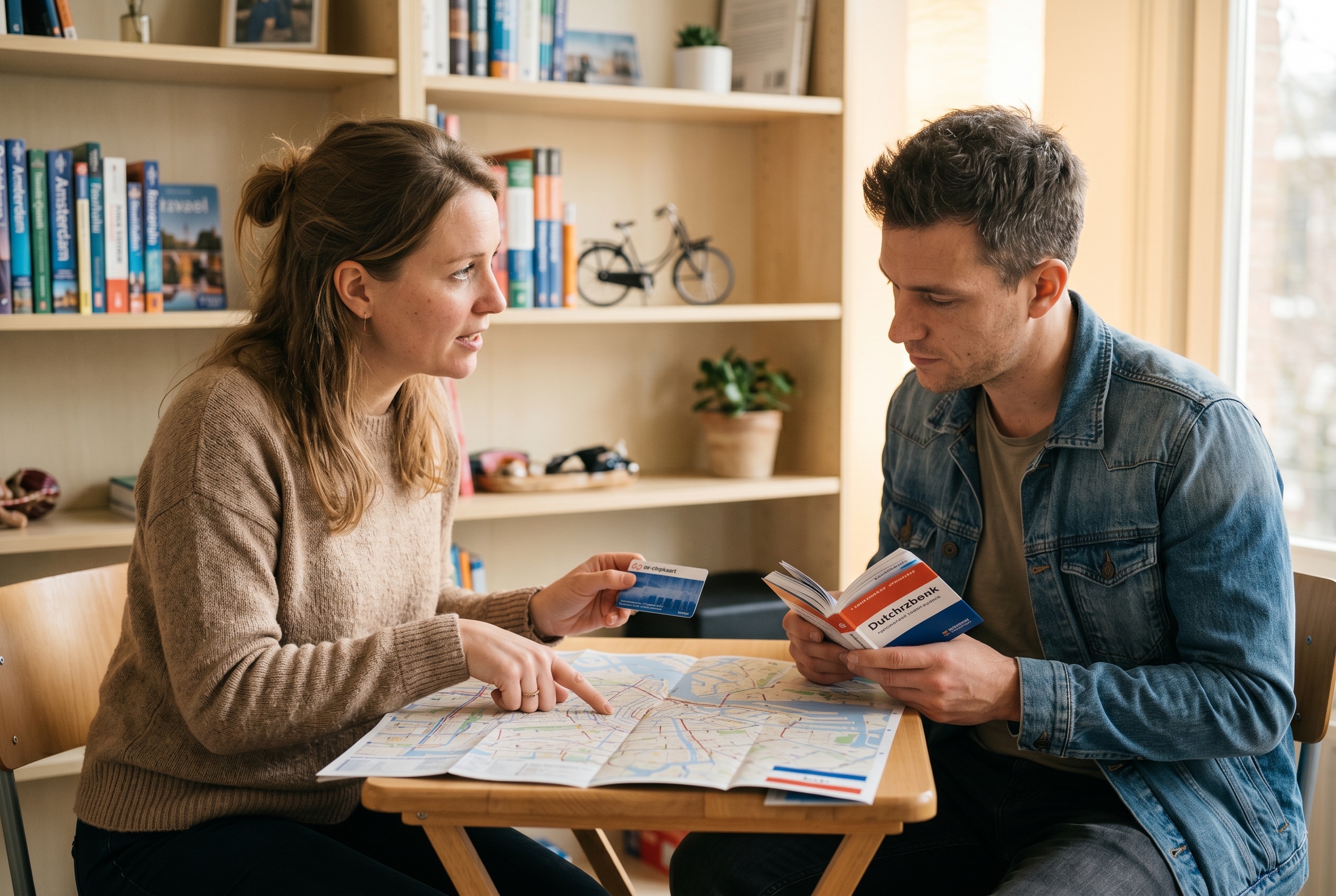
De OV-chipkaart
The Dutch public-transit smart card that runs trains, trams, metros, and buses across the country. Since 2023, casual travelers can also just tap any major contactless credit or debit card directly at the gates (OVpay). For trips longer than a few days, the OV-chipkaart still pays off. The Belgian equivalent is MoBIB. Either way, knowing the vocabulary saves you when the announcement scrolls past too fast.
e.g. Heeft u een OV-chipkaart, of betaalt u met uw bankpas?
-
02
De fiets en de OV-fiets
Bikes are the canonical Dutch transport, and the OV-fiets rental service at every train station is the simplest way to get one for the duration of your stay. Roughly four euros for 24 hours, returned to any station. Amsterdam has notoriously aggressive bike traffic; if you're not a confident urban cyclist, watch for two minutes before stepping into a bike lane.
e.g. Ik heb een OV-fiets gehuurd bij Centraal Station.
-
03
Het bruin café
The traditional Dutch brown café, the small intimate pub with dark-wood interiors stained by a century of smoke, regulars who've been coming for decades, and a patient bartender who'll tolerate halting Dutch with warmth. The right order: een pilsje, alstublieft. The right snack: bitterballen met mosterd. Tip is rounded up by a euro or two; service is included.
e.g. Zullen we naar het bruine café aan de Spuistraat?
-
04
Lekker bezig
Literally "nicely busy," a casual Dutch compliment for someone doing something well. Often said by a local when they hear you attempting Dutch: lekker bezig met je Nederlands! Accept it warmly. It's the small social signal that your effort is being noticed and appreciated, which is most of what travel Dutch is for.
e.g. Lekker bezig met je Nederlands, hoor!
-
05
De koffieshop misnomer
In Dutch usage, koffieshop specifically means a café licensed to sell small quantities of cannabis under the country's tolerance policy. It is not where you go for coffee. The regular word for a café serving coffee is just café or koffiehuis. Ordering een koffie at a real café gets you exactly what you want, no confusion.
e.g. Ik zoek een gewoon café voor koffie, geen koffieshop.
About Dutch for Travel
Dutch that actually travels with you
Travel Dutch starts with a piece of context that surprises most American travelers: you genuinely don't need it. The Netherlands ranks first in the world on the EF English Proficiency Index almost every year it's been published, and Belgium ranks near the top. Almost everyone you'll meet in Amsterdam, Rotterdam, Brussels, or Antwerp speaks fluent English and will switch to it the moment they hear your accent. Train station announcements come in both Dutch and English. Restaurant menus often appear in English by default in tourist neighborhoods. You can travel anywhere in the Dutch-speaking world without a word of Dutch and never get stuck.
That is exactly why a little Dutch goes such a long way. Because no one expects you to speak it, even basic effort registers. Goedemorgen at the bakery counter changes the energy of the interaction. Mag ik een koffie alstublieft? instead of an English request from the bartender at a brown café earns a smile. Dank u wel at the museum ticket window or the train conductor's nod is the kind of small courtesy Dutch and Flemish people quietly notice. Travel Dutch is not about getting through your trip. It's about being a guest who acts like a guest rather than a customer in a country that happens to speak your language.
Lessons in this specialty are practical and tightly focused. Most travel Dutch students come to us four to eight weeks before a trip, often a first-time visit or a return after years away. We don't try to make you fluent. We build out the high-frequency vocabulary and phrases you'll actually use, drill pronunciation enough that locals can understand you on the first try, and brief you on the cultural manners that translate respect more efficiently than words do. The typical travel Dutch student reaches a comfortable A1 to high-A1 level in 8 to 12 lessons, which is enough to handle the daily transactions of a trip with grace.
A few practical specifics. The OV-chipkaart is the contactless smart card that runs all Dutch public transit (trains, trams, metro, buses), and in 2023 it was effectively replaced for casual travelers by direct contactless payment with any major credit or debit card (the system is called OVpay). For trips of more than a few days an OV-chipkaart is still useful; for short trips, just tap your bank card at the gates. The Belgian equivalent is the MoBIB card, also being phased over toward contactless payment. Knowing the vocabulary around train travel (spoor, perron, vertrek, aankomst, overstap) saves you in moments when the announcements scroll past too quickly. Fiets is bike, and renting one is the canonical Amsterdam day-one activity; the OV-fiets rental at every train station is the simplest way to get a bike for the duration of your stay.
Dutch café culture deserves its own paragraph because it's where most travelers' Dutch will actually get used. The bruin café (literally "brown café", referring to the dark-wood interiors stained by a century of cigarette smoke) is the traditional Dutch pub: small, intimate, with regulars who've been coming for decades and where the bartender will tolerate halting Dutch with patient warmth. The standard order: Een pilsje, alstublieft (a small beer) or Een koffie verkeerd (a coffee with hot milk, like a latte). The terras (outdoor café seating) is the summer institution; Mogen wij een terrasje? is the polite way to ask if you can sit outside. Bitterballen, the deep-fried meat-ragout balls, are the canonical Dutch snack to order with beer; ask for them with mosterd (mustard).
A cultural footnote on the famous "coffee shop" misnomer. In Dutch usage, koffieshop or "coffee shop" specifically means a café licensed to sell small quantities of cannabis to adults under the country's tolerance policy. They are not where you go for coffee. A regular café for coffee is called café or koffiehuis; the standalone word koffie at a regular establishment will get you what you want. This confusion catches American travelers regularly and is worth one tutor sentence to settle.
Restaurant Dutch is its own focused micro-curriculum. Mag ik de kaart? for the menu. Wat raadt u aan? to ask the waiter's recommendation, which is genuinely useful since Dutch waiters tend to give honest advice rather than upsell. Ik wil graag... for ordering. De rekening, alstublieft for the check (Dutch waiters do not bring the check until asked, ever). Tipping is a soft 5 to 10 percent rounded up; Dutch service is included in the menu price by law and a small tip is appreciated but not expected. The Belgian convention is similar. Pinnen means to pay by debit card, which is the dominant Dutch payment method (cash is increasingly rare; many establishments are now cashless). Mag ik pinnen? is the question to ask if you're not sure.
The most useful pre-trip phrases beyond restaurant and transit are the small social ones. Pardon for excuse-me. Sorry, ik begrijp het niet for I don't understand. Spreekt u Engels? if you need to switch (almost always yes). Mag ik een foto maken? for can I take a photo. Tot ziens! for goodbye in any formal setting. Tot morgen for see you tomorrow at the hotel breakfast. Een fijne dag verder as a friendly farewell. None of these need much grammar. They just need accurate pronunciation and the confidence to say them first, before the other person switches to English.
For multi-city Belgian trips, Dutch versus French versus Flemish becomes a useful clarification. Brussels is officially bilingual French-Dutch, but practically French-dominant; Antwerp, Ghent, Bruges, and most of Flanders are Dutch-speaking; Wallonia (the southern half of Belgium, including Liège and Namur) is French-speaking. Spoken Flemish has noticeably different pronunciation from spoken Dutch in the Netherlands (the G is softer, intonation is different), but the written language is the same and Flemish speakers understand standard Dutch perfectly. For travel purposes, the Dutch you learn for Amsterdam works fine in Antwerp, Ghent, and Bruges, with the caveat that locals may ask spreekt u Vlaams? if your accent sounds Hollandic.
A quick word on the dialect spectrum. Travelers headed deep into rural Friesland in the north might hear Frisian, a related but distinct language. Travelers in Limburg in the south might hear Limburgish. Travelers in rural Flanders might hear regional dialects that even standard Dutch speakers find challenging. None of this affects travel functionality; standard Dutch will be understood everywhere. The tutor will mention these as cultural color rather than required learning.
The Strommen Dutch for Travel roster includes native Dutch speakers from across the Netherlands and Flanders, plus longtime bilinguals based in the United States. Several of our travel Dutch tutors have spent years working in the Dutch tourism industry and bring direct knowledge of what travelers actually need versus what textbooks teach. Each tutor's bio specifies their background and regional knowledge. For longer-term goals, our Conversational Dutch, Dutch for Beginners, and Dutch for Business pages cover related programs, and the Dutch course page shows the full family. Browse the full tutor list, pick a tutor whose regional knowledge fits your itinerary, and book a 30-minute trial. The trial is free. Eight weeks of weekly Dutch lessons before your trip is enough to change how the country opens up to you.
What you'll cover
Lessons & classes tailored to Dutch for Travel
Restaurant, café, and bar Dutch
The phrases you'll actually use multiple times a day: ordering food and drinks, asking for the menu and the check, paying by card, ordering bitterballen with mustard, asking the waiter's recommendation, handling allergies and dietary restrictions, the polite formulas around saying thank you and goodbye. Dutch waiters appreciate effort and respond warmly when you start in Dutch, even if the conversation eventually switches.
Transit, trains, and the OV-chipkaart
Train station vocabulary (spoor, perron, vertrek, aankomst, overstap) so the scrolling announcements stop being a wall of noise. OV-chipkaart versus OVpay versus contactless card; renting an OV-fiets bike at any station; tram and metro etiquette in Amsterdam, Rotterdam, and Brussels. Includes the practical Dutch and Flemish you'll need for taxis, Ubers, and ride-share.
Getting around and asking directions
Pardon, weet u waar... is? for asking directions. Hoe kom ik bij...? for how do I get to. Reading street signs and the famous Dutch numbered exits. The cultural specifics around bike-lane respect, jaywalking norms (the Dutch are strict pedestrian-signal observers), and the surprising importance of rechts versus links when navigating Amsterdam's concentric canal grid.
Social manners and cultural fluency
The famous Dutch directness in casual encounters, the importance of greetings before transactions (always lead with goedemorgen or goedendag), the tipping norms (5 to 10 percent rounded up, never expected, always appreciated), the difference between a regular café and a koffieshop, the Belgian-versus-Dutch register considerations for travelers crossing the border, and the small cultural cues that mark you as a respectful guest.
FAQ
About Dutch for Travel lessons & classes
Do I really need Dutch for a trip to Holland?
Practically, no. The Netherlands ranks first in the world for English proficiency and almost everyone you'll meet will switch to fluent English the moment they hear your accent. You can travel anywhere in the country without a word of Dutch and never get stuck. But that's precisely the reason a little Dutch goes such a long way: because no one expects it, even basic effort lands. A Dutch goedemorgen at the bakery, alstublieft at the bar, dank u wel at the museum, all change the energy of the interaction in a way that English-only travel cannot. Travel Dutch is about respect, not survival.
Will my high school German help me with Dutch?
Yes, significantly, but watch for false friends. Dutch and German are both West Germanic languages with substantial overlap: word order is similar, many cognates are recognizable, sentence structures often map. Beware of vals vriendje (false friends): bellen means to call in Dutch but to bark in German; aardig means kind in Dutch but earthy in German; doof means deaf in Dutch but stupid in German. With four years of school German, you'll find Dutch listening comprehension comes faster than the average beginner, and basic reading is often intuitive on day one.
What's the difference between Dutch in the Netherlands and Flemish in Belgium for travel purposes?
The written language is identical; the spoken language has noticeably different pronunciation and a handful of vocabulary preferences. For travel purposes, the Dutch you learn for Amsterdam works fine in Antwerp, Ghent, and Bruges, though Flemish speakers may ask spreekt u Vlaams? if your accent sounds Hollandic. In Brussels, plan for a mix: officially bilingual French-Dutch, but practically French-dominant. In Wallonia (Liège, Namur), expect French only; Dutch won't help. We can tailor your lessons toward Netherlands or Flemish pronunciation based on your itinerary.
How many lessons do I need before a trip?
Most travel Dutch students do 8 to 12 weekly hour-long lessons in the two to three months before their trip. That's enough to reach high-A1 to low-A2 level, which covers the daily transactions of travel: greetings, restaurants, transit, asking directions, basic small talk. If you've never studied Dutch before and have less time, even 4 to 6 lessons covers the essentials. If you want to be more independent and have informal conversations, 16 to 20 lessons gets you closer to a confident A2 level.
Should I learn Dutch or French for a Belgium trip?
It depends on your itinerary. Brussels is officially bilingual but French-dominant in practice. Wallonia (Liège, Namur, Mons, southern Belgium) is French-only. Flanders (Antwerp, Ghent, Bruges, Leuven, northern Belgium) is Dutch-speaking. If your trip is mostly Flanders, Dutch is the move. If mostly Wallonia or Brussels, French. If both, French is the more useful single choice because Brussels-French covers the capital and Wallonia, while Flanders speakers almost all have functional French anyway. Many travelers do a few Dutch lessons for Flanders courtesy plus French for everything else.
Is paying by card easier than cash in the Netherlands?
Yes, and it's increasingly the only option. Cash use in the Netherlands has dropped dramatically; many cafés, restaurants, and small shops are now cashless. The Dutch verb pinnen means to pay by debit or contactless card and is the dominant payment method. Mag ik pinnen? is the question to ask. Major credit cards work everywhere that accepts cards. Carrying some cash for tipping and small purchases is still useful, but plan on card as your primary.
What's the tipping etiquette in the Netherlands and Belgium?
Service is included in the menu price by law in both countries. A 5 to 10 percent tip rounded up is appreciated for good service but never expected. The standard move at a casual café or pub is to round up to the next euro or two: a 9-euro bill becomes 10 with a smile. At a sit-down restaurant for a 60-euro dinner, leaving 65 to 70 is generous and noticed. American-style 20 percent tipping is over-tipping by local standards and may confuse the waiter. Belgian tipping etiquette is essentially identical.
What's the trial lesson like for travel Dutch?
30 minutes, free, with the tutor you select. Bring your itinerary and your trip date. The tutor will assess where you are with Dutch (often zero, which is fine), map an 8-to-12-lesson curriculum to your trip dates, and you decide whether to continue. Most travel Dutch students settle into weekly lessons until departure. If you're traveling soon and have only 4 to 6 weeks before your trip, we can run intensive twice-weekly sessions; tell the tutor your timeline at the trial.
Ready for Dutch for Travel lessons or classes?
Book a free 30-minute trial with one of our personally vetted tutors. Private lessons or small-group classes — your choice.