



Personally vetted instructors
Barese tutors, lessons & classes
Ué cumbà! The everyday Barese hello between friends — roughly "hey, mate." Standard Italian would say "ciao" or "ehi."
Personally vetted Barese tutors. Lessons in the dialect of Bari and the wider Apulian coast — the language nonna actually speaks at the kitchen table, not the standard Italian on the news.
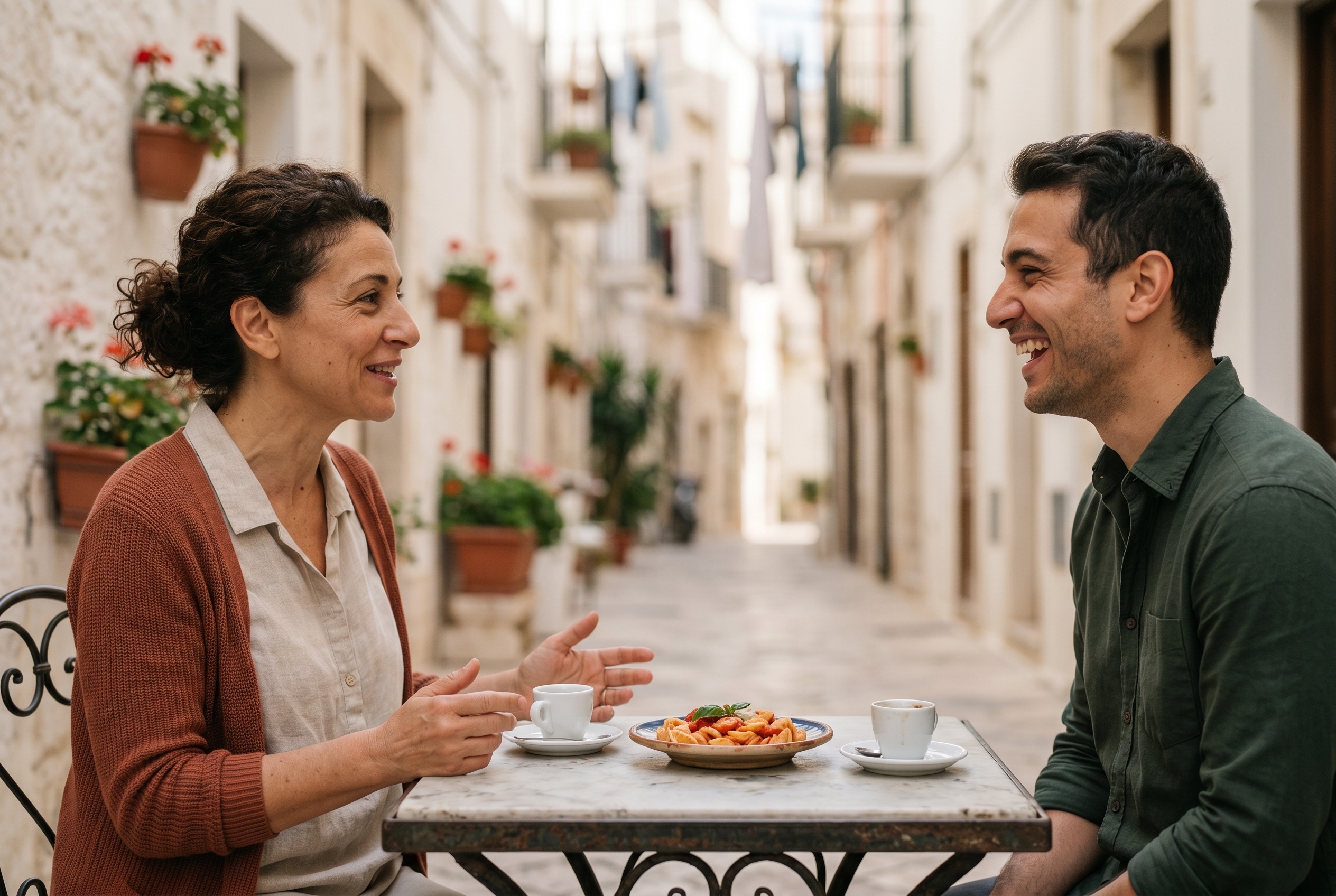
Your instructors
Barese tutors for private lessons & classes
Strommen has been teaching Italian and Italian dialects since 2006, with a roster built specifically for the regional-dialect work that generic Italian-language platforms don't handle. Barese is one of the niche specialties our students ask for: heritage learners with Bari or Puglia family roots, actors and singers preparing Apulian roles, and scholars of southern Italo-Romance who need a working speaker rather than a textbook. Every tutor below was met and vetted by us in person or via thorough video interview. No marketplace. No automated profile-creation. Real teachers with real Apulian backgrounds.
Filter by location, age, or price. Then book a 30-minute free trial.
Below are the Strommen tutors who specialize in Barese. Photos, ratings, and rates are real. Click any card to read their bio and book a free 30-minute trial.
I want to learn…
Every tutor, personally met. — founder-vetted since 2006, in Los Angeles and online worldwide.
Get a personalized plan
Pick your language — a language advisor will match you with the right tutor and map out your path.




Master's Degree in Modern Philology · Post-graduate course in Teaching Italian L2/LS
La grande bellezza dell'italiano
Personally vetted · Strommen’s note
Giuseppe teaches four rare southern Italian dialects, Napoletano, Dialetto Campano, Sabino, and Barese, alongside standard Italian and academic writing.
Specialties
Also speaks: English, French, Spanish
Master's Degree in Modern Philology · Post-graduate course in Teaching Italian L2/LS
La grande bellezza dell'italiano
Specialties
I also speak: English, French, Spanish
Personally vetted · Strommen’s note
Giuseppe teaches four rare southern Italian dialects, Napoletano, Dialetto Campano, Sabino, and Barese, alongside standard Italian and academic writing.
EDUCATION * MA in Global Economy, Cooperation, and Innovation | University of Calabria | 110/110 Cum Laude * MA in Sociology and Social Research | University of Calabria (Ongoing) * University Master (Level 1) in Labor Consulting & Corporate Law | Pega... · * Languages: Italian (Native), English (b2 level trinity collage), Arabic (Learner),
Native italian coach high level : italian language, business, sociology and cultural mastery
Personally vetted · Strommen’s note
A licensed labor consultant with degrees in economics and law, Maria teaches high-level business Italian plus four rare southern dialects.
Specialties
Also speaks: English
EDUCATION * MA in Global Economy, Cooperation, and Innovation | University of Calabria | 110/110 Cum Laude * MA in Sociology and Social Research | University of Calabria (Ongoing) * University Master (Level 1) in Labor Consulting & Corporate Law | Pega... · * Languages: Italian (Native), English (b2 level trinity collage), Arabic (Learner),
Native italian coach high level : italian language, business, sociology and cultural mastery
Specialties
I also speak: English
Personally vetted · Strommen’s note
A licensed labor consultant with degrees in economics and law, Maria teaches high-level business Italian plus four rare southern dialects.

Bare vecchie — dialect & culture
5 things you'll only learn from a Barese speaker
These aren't textbook Italian. They're the Barese-specific features and words that mark you as someone who's actually spent time in Bari, not just read about it. Screenshot to share.
-
01
The schwa (ə)
The single most distinctive feature of Barese phonology: most unstressed vowels collapse into a neutral mid-central vowel, and many final vowels drop almost entirely in speech. Standard Italian nipote sounds closer to nipòt'; mangiare becomes mangià. The Atlante Linguistico Italiano marks this as one of the defining isoglosses of Apulian, and it's the first wall every learner hits.
e.g. Standard <em>il bambino mangia</em> → Barese <em>u uagnone mange</em>, with both final vowels reduced.
-
02
Ce iè?
Barese for "what is it?" Standard Italian would use che cosa? or cos'è?. The Barese ce (cognate with Sicilian and other southern uses) replaces the standard che cosa in everyday question framing. Hearing ce iè? in a Bari conversation is one of the fastest tells that you've left standard Italian behind.
e.g. Ce iè cumbà, ce vu' fà?
-
03
U uagnone, u cumbà, u cummà
The masculine definite article in Barese is u, not Italian il. U uagnone means "the boy" (cognate with Neapolitan guaglione, both from southern Italo-Romance). Cumbà and cummà are the everyday address terms for a male and female friend respectively, used the way standard Italian uses amico and amica but more frequently and more affectionately.
e.g. U cumbà mì stè a casa.
-
04
Orecchiette, focaccia barese, panzerotto
The Bari food vocabulary is part of the language. These aren't translatable as generic "pasta," "flatbread," "turnover." Orecchiette are the hand-shaped "little ears" still made by the nonne of Bari Vecchia in their doorways. Focaccia barese is the tomato-and-olive version specific to Bari, distinct from the Genoese or Roman versions. Panzerotto is the fried mozzarella-and-tomato turnover that's a city specialty. Knowing the words is knowing the city.
e.g. Ci sta na bella focaccia barese e nu panzerotto pure.
-
05
The Mediterranean lexicon
Bari has been a port crossroads for a thousand years, and the lexicon shows it. Centuries of trade with the Balkans and Levant, the Norman period, the Arberesh (Italo-Albanian) communities of Puglia and Calabria, and the older Greek-speaking enclaves of the Salento all left specific vocabulary that doesn't come from Tuscan-derived standard Italian. Treccani's entries on Apulian dialects and Loporcaro's work on southern Italian linguistics map the layers.
e.g. Words for fish, market goods, and seafaring trades often have Greek or Arabic roots invisible to a standard-Italian speaker.
About Barese
The dialect of Bari, not standard Italian
Barese is the Romance dialect of Bari, the port city on Italy's Adriatic coast, and the broader Apulian dialect continuum it sits inside. UNESCO and modern Italian linguists treat the major Apulian varieties as part of an Italo-Romance group distinct from standard Italian, not a colloquial bend of it. A Barese speaker switches between Barese and Italian deliberately, the way a Neapolitan switches between Neapolitan and Italian. The two coexist; one isn't a sloppier version of the other. If you've ever called a relative in Bari and realized within ten seconds that whatever you studied in Italian class isn't going to help you, you've already met the gap this page is about.
The most noticeable feature for newcomers is what linguists call vowel reduction. Most unstressed vowels in Barese collapse into a schwa (the neutral mid-central vowel written /ə/), and many final vowels disappear from speech entirely, even when they're written. Standard Italian nipote (nephew) becomes Barese nepòte with a barely-pronounced final vowel; mangiare (to eat) becomes mangià. The effect is a consonant-heavy, percussive sound that takes ear-time to parse if you're coming from textbook Italian. The Atlante Linguistico Italiano and Loporcaro's work on southern Italian phonology both treat Apulian vowel reduction as one of the defining isoglosses of the south, and it's the single feature that makes Barese sound least like the Italian most learners expect. The same word, written the same way, can be three syllables in standard Italian and effectively one heavy syllable in Barese once the vowels collapse.
Vocabulary is its own world. Ce iè? means "what is it?" where standard Italian uses che cosa?. The definite article u (masculine singular) replaces standard il, so u uagnone means "the boy," recognizably cognate with Neapolitan guaglione since both descend from southern Italo-Romance roots and traveled together into Italian-American speech. Cumbà is the address term for a male friend, cummà for a female. Stè covers a range of standard Italian uses of essere (to be) in ways that surprise standard-Italian speakers; in Barese, place and condition often take stare-derived forms where Tuscan-based Italian would use essere, a pattern shared with other southern Italo-Romance varieties. None of this maps cleanly to the lessons in a typical Italian-language textbook, which is why dedicated coaching matters for anyone trying to actually communicate with Barese-speaking family or community.
The Puglia identity sits behind all of this. Apulians don't think of themselves as "southern Italians" the generic way the post-unification north-south divide framed them; they think of themselves as Puglieisi, with the Bari to Lecce axis as the cultural spine and a distinct food, music, and architectural tradition. The trulli of Alberobello, the Romanesque cathedral and walled old town of Bari, the orecchiette pasta made by hand in the doorways of Bari Vecchia, the focaccia barese with tomatoes and olives, the panzerotto fried turnovers: these aren't tourist shorthand, they're the shared everyday context Barese assumes about the world. A tutor who teaches you the language without that context teaches you sounds without meaning; the food and the city are part of the lexicon. The pizzica music of the Salento further south, the Festa di San Nicola in May, the family rituals around Sunday lunch and the late summer evenings on the lungomare: these reference points come up in everyday conversation the way a Roman might mention the centro storico or a Neapolitan the Quartieri Spagnoli.
Bari is a Mediterranean port and the lexicon shows it. Centuries of trade with the Balkans and Levant, the medieval Norman presence, the Arberesh (Italo-Albanian) communities scattered through Puglia and Calabria, and the older Greek-speaking enclaves of the Salento all left traces in regional vocabulary and phonology. Barese isn't a museum piece preserved in isolation; it's the working speech of a city that has been a crossroads for a thousand years. Some of the most distinctive lexical items have Greek, Arabic, or Spanish etymologies that no amount of Tuscan-derived standard Italian will unlock. The Treccani encyclopedia entries on Apulian dialects are a good starting point if you want the academic version of this; a tutor on a video call is faster. Apulian families that emigrated to the Americas in the late nineteenth and early twentieth centuries carried this layered lexicon with them, which is why heritage learners in the US sometimes recognize Barese words their Italian-class teachers never covered.
A few honest tutor observations on what trips up students starting Barese after standard Italian. The vowel reduction is the first wall: words you'd recognize on the page disappear in speech because the final and unstressed vowels are reduced almost to silence. Listening drills with native audio are the only fix, and the first few weeks of work are mostly retraining the ear before retraining the mouth. The lexicon swap is the next layer: words like uagnone, cumbà, ce, stè, and the dialect-specific verb forms don't come from your Italian course, and they have to be learned as their own vocabulary set rather than guessed from cognates. Code-switching catches American heritage learners especially: families in the US often speak a mix of Barese, regional Italian, and English, and untangling which word came from which language is part of the work, not a distraction from it. And the gesture and intonation layer is real here as everywhere in Italy; Apulian speech has its own prosodic and gestural patterns that are part of the language, not decoration on top of it.
Between lessons, immersion is regionally specific. Find Bari-set film and TV (the Checco Zalone films are the most internationally known; Pugliese RAI productions are an underused resource), seek out the music of Apulian artists, and if you have family connections, get on the phone. The standard Italian foundation is worth keeping in parallel, because most Barese speakers move between dialect and Italian fluidly, and a learner who only studies dialect can't follow a Bari-set film with mixed dialogue. Strommen's general Italian classes, Business Italian, and Italian academic writing pages cover the standard-language side if you want both tracks. For the broader regional landscape, the complete guide to Italian regional languages on the blog puts Barese in context with Neapolitan, Sicilian, and the other major Italo-Romance varieties.
The Strommen Barese roster is small by design. This is a niche dialect with a limited pool of working coaches outside Puglia itself, and we'd rather have two or three real Apulian voices on the page than pad the roster with generic Italian tutors claiming the specialty. Our tutors are native or near-native Barese speakers with deep roots in Bari or the surrounding province, capable of teaching both the dialect and the standard Italian foundation that sits alongside it. Each tutor's bio specifies regional background and which student profile they fit best (heritage learners reconnecting with Apulian family, actors or singers preparing a Bari-set role, scholars working on southern Italo-Romance, travelers who want more than tourist Italian for Puglia). Lessons are one-on-one and calibrated to your goal. For a head-start before booking, our Italian course page shows the family of related programs, or just browse the full tutor list and pick someone whose background matches yours. And a candid note worth ending on: Barese varies real distance from neighborhood to neighborhood and generation to generation. The dialect a sixty-year-old in Japigia speaks is not exactly the dialect a thirty-year-old in Bari Vecchia speaks, which is not exactly the dialect a heritage learner in Brooklyn half-remembers from a grandparent. Your tutor will calibrate to the version you actually need.
What you'll cover
Lessons & classes tailored to Barese
Barese phonology and the schwa
Listening drills with native Barese audio to retrain the ear for vowel reduction and final-vowel drop. IPA-precise work on the schwa (/ə/), the percussive consonant patterns that fall out of vowel collapse, and the rhythmic-prosodic layer of Apulian speech. Foundation step before lexical and grammatical work, because reading Barese on the page is fundamentally different from understanding it spoken at conversational speed.
Lexicon and grammar specific to Barese
The dialect-specific vocabulary that doesn't map to standard Italian: ce, u, uagnone, cumbà, cummà, stè, and the broader inventory of address terms, kinship words, and everyday verbs that mark Barese as its own variety. Verb morphology where it diverges from standard Italian. Code-switching patterns between dialect and standard Italian, which is how most Barese speakers actually operate.
Bari and Puglia cultural grounding
Food vocabulary (orecchiette, focaccia barese, panzerotto, taralli, friselle), city geography (Bari Vecchia, Murat, the seafront), Apulian regional identity distinct from generic "southern Italian" framing, the music and film references Apulians grow up with, and the family and address patterns that come up in everyday conversation. Cultural fluency runs alongside linguistic fluency for any heritage learner or actor preparing a role.
Heritage, actor, and travel calibration
Lessons calibrate to your actual goal. Heritage learners reconnecting with Apulian family work on the dialect needed for phone calls and visits, with code-switching support for mixed-language families. Actors and singers preparing Apulian roles work script-led, with phonetic mapping for specific lines. Scholars and travelers get the standard Italian foundation in parallel so they can follow the bilingual reality of any Bari conversation.
FAQ
About Barese lessons & classes
Is Barese a dialect of Italian or a separate language?
Modern Italian linguists treat the major Apulian varieties, including Barese, as part of an Italo-Romance group distinct from standard Italian, not a regional bend of it. UNESCO recognizes several southern Italian varieties as separate languages on similar grounds. In practice, a Barese speaker and a standard-Italian speaker can communicate but each is using a different system. The label "dialect" is the everyday word in Italy, but the linguistic relationship is closer to two sister languages than to a language and its regional accent.
I already speak some standard Italian. Will that help with Barese?
Yes, as a foundation. Most Barese speakers move fluidly between dialect and standard Italian, and a learner who only studies dialect can't follow a Bari-set film or a phone call that drifts between the two. Your existing Italian is a head start for the standard side. The Barese side is its own work: vowel reduction, dialect-specific lexicon, and a different rhythm to internalize. Most students keep both tracks open at once.
Why does Barese sound so different from the Italian I studied?
Largely because of vowel reduction. Most unstressed vowels in Barese collapse into a schwa, and many final vowels disappear from speech entirely. A word you'd recognize on the page can be unrecognizable when spoken. The Atlante Linguistico Italiano and Loporcaro's work on southern Italian phonology both treat this as one of the defining features of Apulian. Once your ear adjusts, the system becomes predictable, but the first weeks of listening practice are the steepest part of the learning curve.
I have family from Bari and want to reconnect. Is that the typical Barese student?
It's one of the most common profiles. Heritage learners with Apulian roots come in wanting to call relatives, visit Bari and the surrounding province, or pass the dialect down to children. Lessons calibrate to that goal: conversation practice for phone calls and visits, code-switching support for mixed-language family settings, and cultural grounding in the Bari and Puglia context. Your existing exposure to dialect from grandparents or parents is a starting point we build on, not something to discard.
Can I take Barese lessons online or only in person?
Both, depending on the tutor. The Strommen Barese roster includes tutors who teach online via Zoom or Jitsi, available globally, and tutors based in Los Angeles who offer in-person sessions. For listening and pronunciation work, video lessons are functionally identical to in-person; for actors preparing physical scenes with gesture, in-person sometimes works better. The booking widget on each tutor's profile shows their available formats.
Are your Barese tutors native speakers from Bari?
Our roster is small by design. Barese is a niche specialty and the pool of working coaches outside Puglia itself is limited. The tutors we do have are native or near-native Barese speakers with deep roots in Bari or the surrounding province, capable of teaching both the dialect and the standard Italian foundation that sits alongside it. Each tutor's bio specifies regional background, so you can match yourself to a tutor whose city or town and generation fit what you're trying to learn or reconstruct.
What does a Barese lesson actually look like?
One-on-one and built around your goal. A typical hour might include listening practice with native Barese audio (film, music, conversation samples), targeted pronunciation work on the schwa and vowel reduction, vocabulary work on dialect-specific lexical items as they come up, and conversational practice using what's been covered. For heritage learners, family voice memos and recorded phone calls are useful source material when the tutor can listen with you. Lessons calibrate to your level and starting point at the trial.
Ready for Barese lessons or classes?
Book a free 30-minute trial with one of our personally vetted tutors. Private lessons or small-group classes — your choice.