



Personally vetted instructors
Portuguese for Beginners tutors, lessons & classes
Olá The universal Portuguese "hello" every beginner learns first.
Personally vetted Portuguese tutors who specialize in absolute beginners. Patient, methodical, and ready to walk you from the first <em>olá</em> to your first real Portuguese sentence without textbook overwhelm.
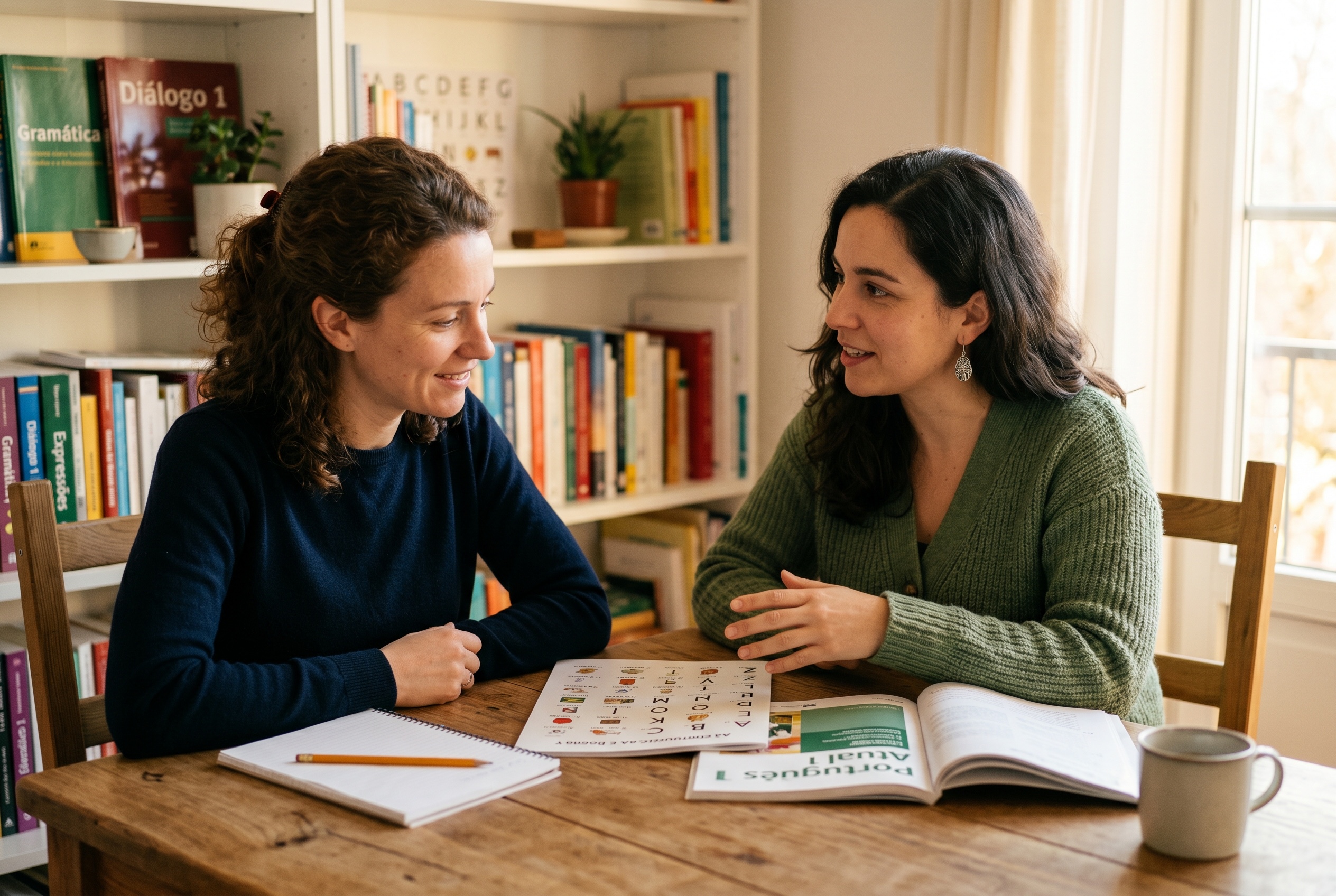
Your instructors
Portuguese for Beginners tutors for private lessons & classes
Strommen has Portuguese tutors who specialize in working with absolute beginners. The opening months are where patience, pronunciation modeling, and steady vocabulary building matter most, and where a real teacher beats any app by a long margin. Every tutor below was met and vetted by us in person or via thorough video interview. No marketplace. No automated profile-creation.
Filter by location, age, or price. Then book a 30-minute free trial.
Below are the Strommen tutors who specialize in teaching Portuguese to absolute beginners. Photos, ratings, and rates are real. Click any card to read their bio and book a free 30-minute trial.
I want to learn…
Every tutor, personally met. — founder-vetted since 2006, in Los Angeles and online worldwide.
Get a personalized plan
Pick your language — a language advisor will match you with the right tutor and map out your path.



Associate of Arts
US expat living in Brazil teaching English all over the world
Personally vetted · Strommen’s note
A US expat based in Brazil, Ben teaches English worldwide and Portuguese on the side, conversational first, grammar only where it actually matters.
Specialties
Associate of Arts
US expat living in Brazil teaching English all over the world
Specialties
Personally vetted · Strommen’s note
A US expat based in Brazil, Ben teaches English worldwide and Portuguese on the side, conversational first, grammar only where it actually matters.

Primeiras palavras — first foundations
5 Portuguese foundations every beginner needs in the first month
These are the building blocks that separate a beginner who's making real progress from one who's spinning on Duolingo. Save the infographic for your trial.
-
01
Nasal vowels ão / õe / ãe
The most distinctive Portuguese sound and one of the first hurdles for English speakers. The nasal ão in pão, mão, não, coração is a single phoneme, not vowel-plus-consonant. The plural ões in limões nasalizes too. Default American pronunciation flattens these into separate sounds. Hearing the nasal correctly takes weeks; producing it consistently takes months.
e.g. Pão, mão, não, coração — all single nasal vowels.
-
02
O versus A (gendered nouns)
Every Portuguese noun is masculine or feminine. Most nouns ending in -o are masculine (o livro, the book), most ending in -a are feminine (a casa, the house). Exceptions exist (o problema, o dia, a mão, a foto) and have to be memorized. Always learn the article with the word from day one.
e.g. O livro, a casa, o problema, a mão.
-
03
Obrigado / obrigada
The famous Portuguese "thank you" agrees with the gender of the speaker, not the listener. A man says obrigado; a woman says obrigada. This catches almost every beginner the first time they encounter it. Plural is obrigados (group of men or mixed group) or obrigadas (group of women).
e.g. Man at a cafe: obrigado. Woman at the same cafe: obrigada.
-
04
Ser versus estar
Portuguese has two verbs for "to be." Ser covers permanent or essential traits (eu sou americano, ela é médica). Estar covers temporary states or locations (eu estou cansado, ela está em casa). The distinction parallels Spanish closely. English speakers spend the first month sorting it out and then it becomes automatic.
e.g. Eu sou alto (permanent). Eu estou cansado (temporary).
-
05
Você / tu / o senhor
Portuguese has three ways to say "you," and the choice depends on region and formality. Brazilian Portuguese uses você almost everywhere (with third-person verbs); European Portuguese keeps tu for informal use (with second-person verbs). Both varieties use o senhor / a senhora for formal address. Beginners default to whichever fits their region and adjust from there.
e.g. Brazil: você fala. Portugal: tu falas. Formal everywhere: o senhor fala.
About Portuguese for Beginners
From zero to your first real Portuguese sentence
Starting Portuguese from zero is a project that rewards a structured first three months more than almost any other intervention. The students who get a real tutor at the start avoid the deep ruts that self-taught learners spend years climbing out of: the wrong vowel system, the wrong rhythm, the wrong assumptions about gender, the wrong instinct about ser versus estar. The students who self-teach for six months and then come to Strommen end up spending the next year unlearning things that should have been right the first time. The single best investment a beginner can make is the first three months with someone who can hear your pronunciation in real time and correct it before it sets.
The variety question matters from day one. Brazilian Portuguese is the standard most US-based beginners want, given the size of the Brazilian diaspora and the cultural footprint of Brazilian music, film, and television. The Strommen roster defaults toward Brazilian Portuguese for that reason, but European Portuguese is fully available for students whose context is Lisbon, Porto, the Azores, Cape Verde, Angola, Mozambique, or a heritage family in Portugal. Beginners are best served by picking one variety and sticking with it for the first six months; trying to learn both at once tends to produce a confused hybrid that doesn't quite work anywhere. Your tutor will help you decide based on your specific goal, then build the curriculum around that choice.
The Portuguese alphabet is the same 26 letters as English, with the addition of frequent diacritics (á, â, ã, é, ê, í, ó, ô, õ, ú, ç) that mark stress, vowel quality, or nasalization. The five basic vowels are a, e, i, o, u, plus the famously nasalized ã and õ that have no direct English equivalent. The nasal ão in pão (bread), mão (hand), and coração (heart) is one of the most distinctive Portuguese sounds and one of the first things a beginner tutor will work on. English doesn't nasalize vowels in the same way, so the default American pronunciation lands as pao with a flat A and a separated O, which sounds noticeably foreign. Hearing the nasal correctly takes a few weeks; producing it consistently takes a few months.
Nouns are gendered. Most Portuguese nouns ending in -o are masculine and take o as the definite article (o livro, the book). Most nouns ending in -a are feminine and take a (a casa, the house). The pattern holds often enough to be useful and breaks often enough to be a recurring source of confusion: o problema, o dia, o mapa, o tema, o sistema are all masculine despite ending in -a; a mão, a foto, a moto, a tribo are feminine despite ending in -o. Beginner tutors teach articles together with vocabulary from day one (never just livro, always o livro) so the gender becomes inseparable from the word. The famous obrigado versus obrigada distinction follows from this: the speaker thanks based on their own grammatical gender, so a man says obrigado and a woman says obrigada, regardless of who they're thanking.
The first essential verbs are ser (to be, permanent or essential), estar (to be, temporary or situational), and ter (to have). These three carry the highest weight of any grammar items in the first month. Eu sou, tu és (Portugal) / você é (Brazil), ele/ela é, nós somos, vocês são, eles/elas são for ser. Eu estou, tu estás / você está, ele/ela está, nós estamos, vocês estão, eles/elas estão for estar. The ser/estar distinction is the single biggest grammatical adjustment for English speakers (English has only one verb "to be"), and roughly parallels the same distinction in Spanish. Permanent or defining traits use ser: eu sou americano, ela é médica, o livro é interessante. Temporary states or locations use estar: eu estou cansado, ela está em casa, o livro está na mesa. The rules sound clean and then complications appear (locations of permanent objects, conditions that feel permanent but are technically temporary), and tutored beginners get those nuances drilled in the right order.
The you-distinction is region-dependent. Brazilian Portuguese uses você for the informal second person almost everywhere south of Bahia, with tu surviving in the Northeast and parts of the South but typically conjugated as third person (tu vai rather than the textbook tu vais). European Portuguese keeps tu as the standard informal second person, with proper second-person conjugations (tu vais, tu falas, tu comes). Both varieties have o senhor / a senhora for formal address, used with elders, in service interactions, and in formal correspondence. Beginners default to o senhor / a senhora for first-contact formality in Portugal, default to você for almost any context in Brazil, and switch based on what the other person uses.
A typical first-month curriculum for a beginner covers greetings, introductions, numbers 1 to 100, days of the week and months, basic family vocabulary, present tense of ser, estar, and ter, plus regular present tense for -ar, -er, and -ir verbs (the three Portuguese verb conjugation classes). By month three, most beginners can hold a basic conversation about themselves, their family, their work, their day, and order food and drinks confidently. By month six, conversational ease at A2 level is realistic for committed students with weekly lessons and 20 to 30 minutes of daily exposure.
Between-lesson resources that work for beginners: the Duolingo Portuguese course is a fine warm-up for reps and vocabulary (Brazilian variety only), the Portuguese With Carla podcast for accessible European Portuguese, the Easy Portuguese YouTube channel for street interviews at slow native speed, Plataforma Babbel for structured vocabulary work, and graded reader books like the Olly Richards Short Stories in Brazilian Portuguese series for reading practice at low CEFR levels. None of these replace a real tutor; they extend the time you spend with the language between lessons. The blog's 1,000 most common Portuguese words list is the right vocabulary spine for an absolute beginner.
The Strommen Portuguese for Beginners roster includes native Brazilian teachers, native European Portuguese teachers, and longtime bilinguals based in the United States who specialize specifically in beginner instruction. Beginner teaching is a separate skill from advanced teaching: the patience to repeat o and a for the tenth time, the ear for which specific pronunciation point a student is missing, the instinct for when to push vocabulary versus consolidate. Each tutor's bio specifies their background, their accent variety, and which student profile they fit best. Pricing reflects experience.
For adjacent specialties, our Conversational Portuguese roster takes over once you have basic foundations, Portuguese Grammar handles structural deep work, and Brazilian Portuguese and European Portuguese are the variety-specific deep dives. The Portuguese course page shows the full family. Browse the full tutor list and book a 30-minute trial. The first lesson is the fastest way to find out whether Portuguese will click for you.
What you'll cover
Lessons & classes tailored to Portuguese for Beginners
Pronunciation foundations from day one
Nasal vowels, the open-versus-closed vowel distinction (the difference between avô grandfather and avó grandmother), the palatalized di and ti in Brazilian speech, the rolled and tapped R variants, the soft l-to-w shift at the end of syllables in Brazilian. Lessons include short listening-and-repeat drills with native audio so your ear builds alongside your speaking. Beginner Portuguese pronunciation is best learned correctly the first time.
Gendered articles and noun memorization
We teach articles with vocabulary from day one: never just livro, always o livro. Patterns where they exist (most -o nouns are masculine, most -a are feminine) get explained, and the common exceptions get drilled until they're automatic. Obrigado versus obrigada falls out naturally from understanding gender agreement.
Ser, estar, ter, and your first 150 words
The three foundational verbs plus 100 to 150 high-frequency nouns and verbs in the first month cover the majority of basic sentences. Family, food, daily routine, work, location, time. Once these are automatic, regular present-tense conjugation across the three verb classes (-ar, -er, -ir) slots in without much additional friction.
Brazilian or European, your choice from day one
We default toward Brazilian Portuguese given the demographic weight, but European Portuguese is fully available for students whose context is Lisbon, Porto, the Azores, or a Portuguese heritage family. Lessons stay variety-specific so you don't end up with a confused hybrid. Pick one for the first six months, absorb the other passively through media, and re-evaluate once you have basic fluency.
FAQ
About Portuguese for Beginners lessons & classes
Should I start with Brazilian or European Portuguese?
Depends entirely on your context. If your goal is Brazil (work, family, travel, music, telenovelas), start with Brazilian Portuguese. If your goal is Portugal, the Azores, Cape Verde, Angola, Mozambique, or a heritage family in Portugal, start with European Portuguese. If you're undecided, the Brazilian variety is what most US-based beginners want and what the broader cultural footprint supports. Pick one for the first six months and stick with it; switching mid-stream is the most common way beginners end up with a hybrid accent that doesn't quite work anywhere.
How long until I can hold a basic conversation in Portuguese?
From zero, weekly hour-long lessons plus 20 to 30 minutes of daily exposure (podcasts, apps, Portuguese media) typically produces functional A2 conversation within 6 to 9 months. That means introducing yourself, ordering food, talking about your day, basic small talk. Conversational comfort at B1 usually takes another 6 months at the same pace. Faster timelines are possible with more intensive schedules; slower timelines are normal for learners with less time. Spanish speakers progress notably faster, often hitting A2 in 3 to 4 months.
How hard are the nasal vowels really?
Real but not impossible. The nasal ão, õe, and ãe sounds have no exact English equivalent, and English speakers default to flat vowel-plus-consonant approximations. Most beginners can hear the nasal correctly within a few weeks of lessons. Producing it consistently takes longer, usually three to six months. Tutored beginners drill it from week one with shadowing exercises; self-taught learners often skip it entirely and develop a noticeable foreign accent that's hard to fix later.
Why is it sometimes obrigado and sometimes obrigada?
The Portuguese "thank you" agrees with the gender of the speaker, not the listener. A man saying thank you says obrigado; a woman saying thank you says obrigada. This is one of the first cultural-grammar points beginners encounter, and it catches almost everyone the first time. Plural is obrigados (group of men or mixed group) or obrigadas (group of women). The plural forms are less common in everyday speech than the singular.
What does a typical beginner Portuguese lesson look like?
A first-month lesson runs about an hour and typically includes 10 minutes of warm-up conversation in Portuguese (even halting), 15 minutes of new vocabulary with pronunciation drill, 15 minutes of grammar in context (a single point introduced through example sentences), 10 minutes of listening practice with a short audio clip, and 10 minutes of structured role-play or guided conversation. Homework is light and primarily listening-focused. Your tutor calibrates based on what's clicking.
Do I need to know Spanish or any other language before starting Portuguese?
No. English is enough background to start. Spanish speakers do progress faster, especially in the first three months, because cognate density is high and many grammar patterns transfer. But absolute beginners with no Romance language background succeed regularly. Knowing Spanish creates a slight risk of interference (Spanish pronunciation habits pulling your Portuguese vowel system the wrong way), which your tutor will catch and correct.
What's the trial lesson like for a complete beginner?
30 minutes, free, with the tutor you select. For absolute beginners, the trial is half assessment and half preview: the tutor will introduce themselves in Portuguese and English, gauge what you already know (even passive cognate recognition counts), explain the typical first-month roadmap, and answer your questions about lesson cadence and goals. You'll leave with a sense of whether this specific tutor's approach feels right for you. Swapping tutors is easy if it doesn't click.
Ready for Portuguese for Beginners lessons or classes?
Book a free 30-minute trial with one of our personally vetted tutors. Private lessons or small-group classes — your choice.