



Personally vetted instructors
Ladin tutors, lessons & classes
Bun di, co vala? How Ladin greets you in the Val Badia or Val Gardena.
Personally vetted tutors of Ladin, the Rhaeto-Romance language of the Dolomites. Around 30,000 speakers across five mountain valleys in northern Italy. A small language with deep roots and a fierce sense of identity.
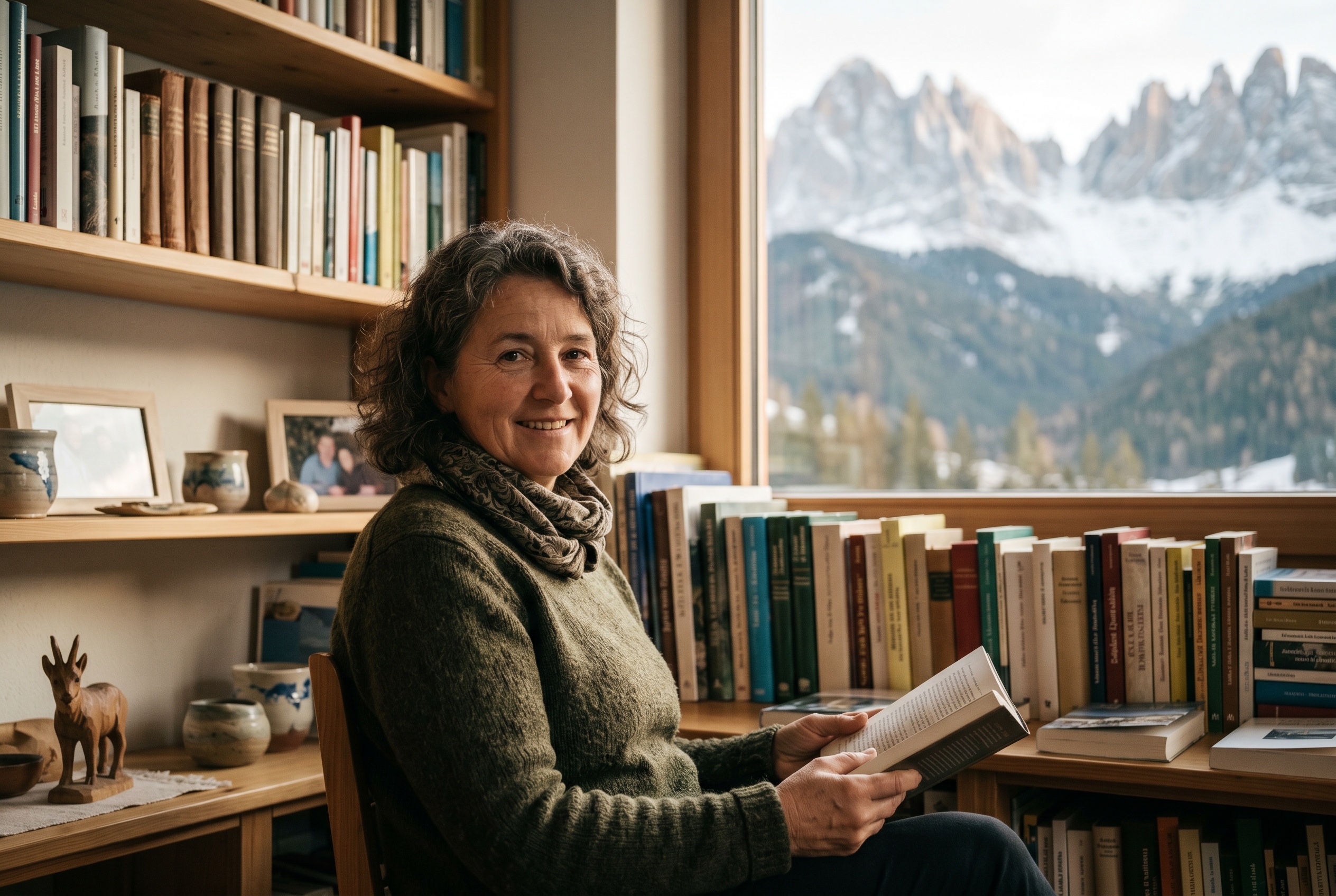
Your instructors
Ladin tutors for private lessons & classes
Strommen teaches small and minority Romance languages with the same care we apply to the major ones. Every Ladin tutor below was met and vetted by us. No marketplace. No automated profile-creation. Real Dolomite speakers with documented backgrounds.
Filter by location, age, or price. Then book a 30-minute free trial.
Below are the Strommen tutors who specialize in Ladin. Photos, ratings, and rates are real. Click any card to read their bio and book a free 30-minute trial.
I want to learn…
Every tutor, personally met. — founder-vetted since 2006, in Los Angeles and online worldwide.
Get a personalized plan
Pick your language — a language advisor will match you with the right tutor and map out your path.


Bachelors degree in Teaching Italian as a Second Language and Translation
Learn Italian, Feel at Home
Personally vetted · Strommen’s note
Venice-based and fluent in five languages, Fabiana teaches two rare Italian threads, Sicilian dialect and Ladin, alongside standard Italian.
Specialties
Bachelors degree in Teaching Italian as a Second Language and Translation
Learn Italian, Feel at Home
Specialties
Personally vetted · Strommen’s note
Venice-based and fluent in five languages, Fabiana teaches two rare Italian threads, Sicilian dialect and Ladin, alongside standard Italian.


Interpreter /translator · Celta
Inspire the love for learning and cultural exploration
Personally vetted · Strommen’s note
Out of Turin, Caterina teaches Ladin, the Dolomite minority language, alongside Italian and English.
Specialties
Interpreter /translator · Celta
Inspire the love for learning and cultural exploration
Specialties
Personally vetted · Strommen’s note
Out of Turin, Caterina teaches Ladin, the Dolomite minority language, alongside Italian and English.

Saluti dales montes — culture & expressions
5 phrases that mark you as someone who knows the Dolomites
These won't be in your Italian phrasebook. They're Ladin, and they're how locals recognize each other in a region where three languages overlap. Screenshot them. Then book a tutor for the rest.
-
01
Bun di
"Good day." The standard Ladin daytime greeting, used in all five valleys with minor pronunciation differences. Italian would be buongiorno, German guten Tag. Ladin gets its own.
e.g. Bun di a duc!
-
02
Co vala?
"How's it going?" Casual, between friends or familiar acquaintances. The verb vala is third-person of jì (to go), recognizable to Italian ears but distinctly Ladin in form.
e.g. Bun di Marco, co vala?
-
03
Ladins de Gherdëina
"Ladins of Val Gardena." The way Ladin speakers identify themselves: by their valley first, then by their broader ethnic identity. Saying this in Gardena lets locals know you understand the cultural geography.
e.g. Sun n Ladin de Gherdëina.
-
04
Mile gracia
"Thank you very much." Mile (a thousand) intensifies gracia. The construction is shared with other Romance languages, but the Ladin pronunciation and rhythm are local.
e.g. Mile gracia per dut!
-
05
Bonsoira
"Good evening." Used after sunset, especially in social settings. Lands as authentic the moment you greet someone with it walking into a Stube in Corvara.
e.g. Bonsoira, n bicer de vin per piaier.
About Ladin
A Romance language with its own alpine grammar
Ladin is a Rhaeto-Romance language spoken by roughly 30,000 to 40,000 people in five mountain valleys around the Sella massif in the Dolomites of northern Italy: Val Badia and Val Gardena in South Tyrol, the Fassa Valley in Trentino, and the Livinallongo (Buchenstein) and Ampezzo valleys in the province of Belluno. The language is officially recognized in South Tyrol and Trentino, where Ladin-speaking children attend Ladin-medium schools and where regional government operates in Ladin alongside Italian and German.
Linguistically, Ladin belongs to the Rhaeto-Romance branch of Romance languages, alongside Romansh (spoken in Switzerland) and Friulian (spoken in northeastern Italy). It descends from the Vulgar Latin spoken by the romanized Raetian population of the eastern Alps, isolated and preserved in mountain valleys while the surrounding lowlands developed into modern Italian and the northern slopes into German. The result is a language that sounds Romance to Italian ears but with notable differences: vowel shifts that produce sounds Italian doesn't have, German-influenced syntax in some valleys, and vocabulary that has held onto Latin roots Italian has discarded.
The five main valley dialects (Badiot, Gherdëina, Fascian, Fodom, Anpezan) differ from each other meaningfully. A speaker of Badiot understands a speaker of Anpezan with some effort, but not without it. Modern efforts to standardize have produced Ladin Dolomitan, a written koiné developed for cross-valley publications and signage. Native speakers usually use their valley dialect at home and Ladin Dolomitan only for formal written contexts.
If you're learning Ladin, the reasons are usually specific. Family ties to one of the Ladin valleys. A move to the region for tourism or hospitality work (the Dolomites are a major ski destination). Academic research in Romance linguistics. Or genuine love for the Dolomites, the region's mountain culture, and the people who carry it. Ladin is not a casual study choice. If you've ended up here, you almost certainly have a reason.
Our Ladin tutors are native speakers from the Val Badia, Val Gardena, and Val di Fassa, with some background in linguistics or pedagogy. Lessons cover the language itself, the cultural framework (the Ladin people, the Habsburg history, the WWI front line that ran through the region, the modern dual identity as Italian citizens with strong Tyrolean and Ladin heritage), and the practical realities of using Ladin in modern Dolomite life. Expect to spend serious time on listening and reading, since published material is limited but exists, including the Ladin newspaper La Usc di Ladins and the cultural journals from the Istitut Ladin Micurà de Rü and the Istitut Cultural Ladin Majon di Fascegn.
If you already speak Italian, you have a strong foundation. The shared Romance roots will get you 40% of the way. If you also speak German, that helps too, since Ladin has absorbed German vocabulary in domains like food and household objects. Starting from zero is doable but slower.
What you'll cover
Lessons & classes tailored to Ladin
The five valley dialects
Lessons can focus on Badiot (Val Badia), Gherdëina (Val Gardena), Fascian (Val di Fassa), Fodom (Livinallongo), or Anpezan (Ampezzo) depending on your needs. Most students with family ties pick the valley dialect of their heritage. Most students with general interest start with Badiot or Gherdëina, which have the most published materials. Tell us which valley matters at the trial.
Ladin grammar and vocabulary
Ladin has its own grammatical patterns that differ from Italian: noun pluralization with -s (Italian has -i and -e), different verb conjugations, distinct pronoun system. Vocabulary holds onto Latin roots Italian has lost and has German loanwords for kitchen and household items (knëidl, krumiri). We teach these as a coherent system, not as departures from Italian.
Reading Ladin newspapers and literature
We use La Usc di Ladins (the weekly Ladin newspaper) and writings from contemporary Ladin authors like Roland Verra and Iaco Rigo for reading practice. The Ladin cultural institutes also publish children's books, poetry, and scholarly works in Ladin, all of which can supplement your study. Reading the language exposes you to vocabulary you'd never hear in conversation.
The cultural and historical context
Ladin identity is shaped by the trilingual situation of the Dolomites: Ladin, Italian, German. The WWI front line that ran through the Dolomites devastated the population. The post-war Italianization under fascism (when Ladin and German were suppressed) shaped how the community sees its language today. Optional but most students want it: lessons covering Ladin literature, music (the choirs of the valleys, traditional Ladin folk songs), and the political negotiations that secured Ladin's protected status.
FAQ
About Ladin lessons & classes
Is Ladin really a separate language or just a dialect of Italian?
It's a separate Romance language, classified in the Rhaeto-Romance branch alongside Romansh and Friulian. Italy officially recognizes it as a minority language. UNESCO classifies it as a vulnerable language. Italian speakers can recognize some Ladin words but not understand a Ladin conversation.
How many speakers does Ladin have?
Roughly 30,000 to 40,000 active speakers, almost all in the Dolomite valleys of Italy. Smaller diaspora communities exist in major Italian cities and internationally. The language is classified as vulnerable but is more stable than many minority Romance languages thanks to school instruction, official recognition, and strong cultural identity.
Should I learn Italian first or can I start with Ladin?
Most students benefit from a foundation in Italian (or another Romance language) before diving deep into Ladin, simply because Italian materials are abundant and Ladin materials are not. That said, we can teach Ladin to zero-start students if you have a real need (family connection, planned move). Just expect a slower pace.
Can I take Ladin lessons online?
Yes. All of our Ladin tutors teach online via Zoom or Jitsi, available globally. We don't currently have Ladin tutors teaching in person in LA.
Will Ladin help me understand Romansh or Friulian?
Yes, somewhat. The three languages share the Rhaeto-Romance grouping and have meaningful linguistic similarities, though they're not mutually intelligible. A Ladin speaker can recognize Romansh and Friulian as related languages but can't follow a conversation in either without study. If you eventually want to learn Romansh or Friulian, Ladin gives you a real head start.
What's the difference between Ladin and Ladino?
They're completely different languages despite the similar name. Ladino is the Judeo-Spanish language of the Sephardic diaspora, descended from medieval Castilian. Ladin is the Rhaeto-Romance language of the Dolomites. The naming confusion is a constant nuisance for both speech communities.
Is there a standard written form of Ladin?
There is now: Ladin Dolomitan, a koiné developed in the 1980s and 90s for cross-valley publications, signage, and official documents. Each valley still uses its own dialect for local writing, but Ladin Dolomitan serves as a unifying written standard. We teach you to read both, and to write whichever variant matches your needs.
Ready for Ladin lessons or classes?
Book a free 30-minute trial with one of our personally vetted tutors. Private lessons or small-group classes — your choice.