



Personally vetted instructors
Japanese for Kids tutors, lessons & classes
おはよう! The cheerful morning hello a Japanese teacher uses to open a class with kids.
Personally vetted Japanese tutors who teach kids ages five to fourteen. Lessons built around picture books, songs, first kanji, and the slow accumulation of a real ear for the language.
Your instructors
Japanese for Kids tutors for private lessons & classes
Strommen has been teaching languages since 2006, and we vet every teacher ourselves rather than running an open marketplace. The kids' Japanese roster is curated tightly because teaching children is a craft very different from teaching adults; a great adult tutor is not automatically a great kids' tutor.
Filter by location, age, or price, then book a 30-minute free trial. The trial is also a chance for the child to meet the tutor; you will know within ten minutes whether the rapport is there.
Below are the Strommen tutors who specialize in teaching Japanese to kids. Photos, ratings, and rates are real. Click any card to read a bio and book a free 30-minute trial.
I want to learn…
Every tutor, personally met. — founder-vetted since 2006, in Los Angeles and online worldwide.
Get a personalized plan
Pick your language — a language advisor will match you with the right tutor and map out your path.

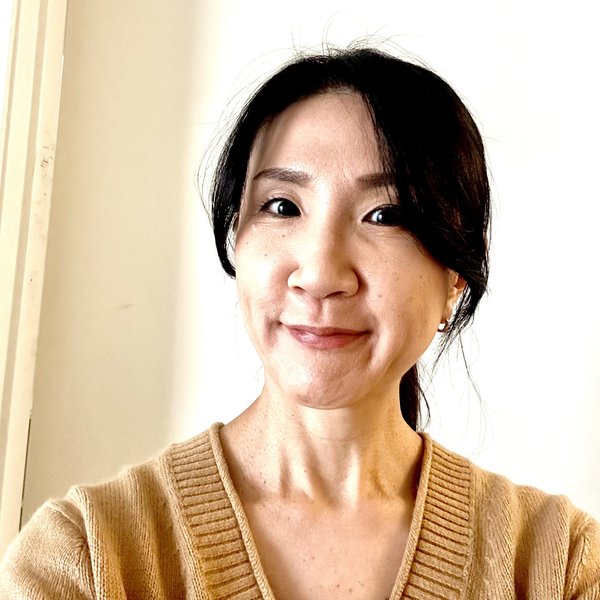
Masters In Linguistics from Cal State Long Beach
Japanese Tutor Eriko - Masters in Linguistics years of experience with Kids and Adults
Personally vetted · Strommen’s note
With us since 2015 and a linguistics master's in hand, Eriko teaches Tokyo-standard Japanese to kids and adults with the same care.
Specialties
Masters In Linguistics from Cal State Long Beach
Japanese Tutor Eriko - Masters in Linguistics years of experience with Kids and Adults
Specialties
Personally vetted · Strommen’s note
With us since 2015 and a linguistics master's in hand, Eriko teaches Tokyo-standard Japanese to kids and adults with the same care.



Linguistic high school diploma · JLPT N1, 日本漢字能力検定一級, Cambridge C2 proficiency
Stop memorising, start understanding!
Personally vetted · Strommen’s note
Veronika taught Japanese on other platforms for five-plus years before Strommen. Her pitch is structure over memorization, JLPT prep included.
Specialties
Also speaks: English, German, Italian, Spanish
Linguistic high school diploma · JLPT N1, 日本漢字能力検定一級, Cambridge C2 proficiency
Stop memorising, start understanding!
Specialties
I also speak: English, German, Italian, Spanish
Personally vetted · Strommen’s note
Veronika taught Japanese on other platforms for five-plus years before Strommen. Her pitch is structure over memorization, JLPT prep included.

子ども kodomo — Japanese the way kids learn it
5 things every Japanese-learning kid encounters early on
These are the building blocks of how Japanese children grow up with the language, and they are the right inputs for a foreign child learning it too. Save the list and book a tutor to build a lesson around them.
-
01
一年生のかんじ ichi-nensei no kanji
The first-grade kanji set of 80 characters that every Japanese first grader learns in school. Numbers, basic verbs, family words, nature words: 一 (one), 山 (mountain), 川 (river), 木 (tree), 人 (person), 大 (big), 小 (small), 父 (father), 母 (mother). Foreign kids learn the same set at the same age because the cultural material designed for that age uses exactly these characters.
e.g. 山に木があります。Yama ni ki ga arimasu. ("There is a tree on the mountain." Two first-grade kanji in one short sentence.)
-
02
~ちゃん -chan
The affectionate diminutive suffix Japanese culture uses with anyone small or close: a young child, a beloved pet, a close friend or family member. A four-year-old daughter named Hana is Hana-chan; the family cat Tama is Tama-chan. Foreign kids learning Japanese pick up the suffix naturally and use it with siblings, pets, and friends in Japanese, which makes the language feel warm rather than academic.
e.g. はなちゃん、ごはんよ。Hana-chan, gohan yo. ("Hana, dinner!")
-
03
Picture-book rhythm and repetition
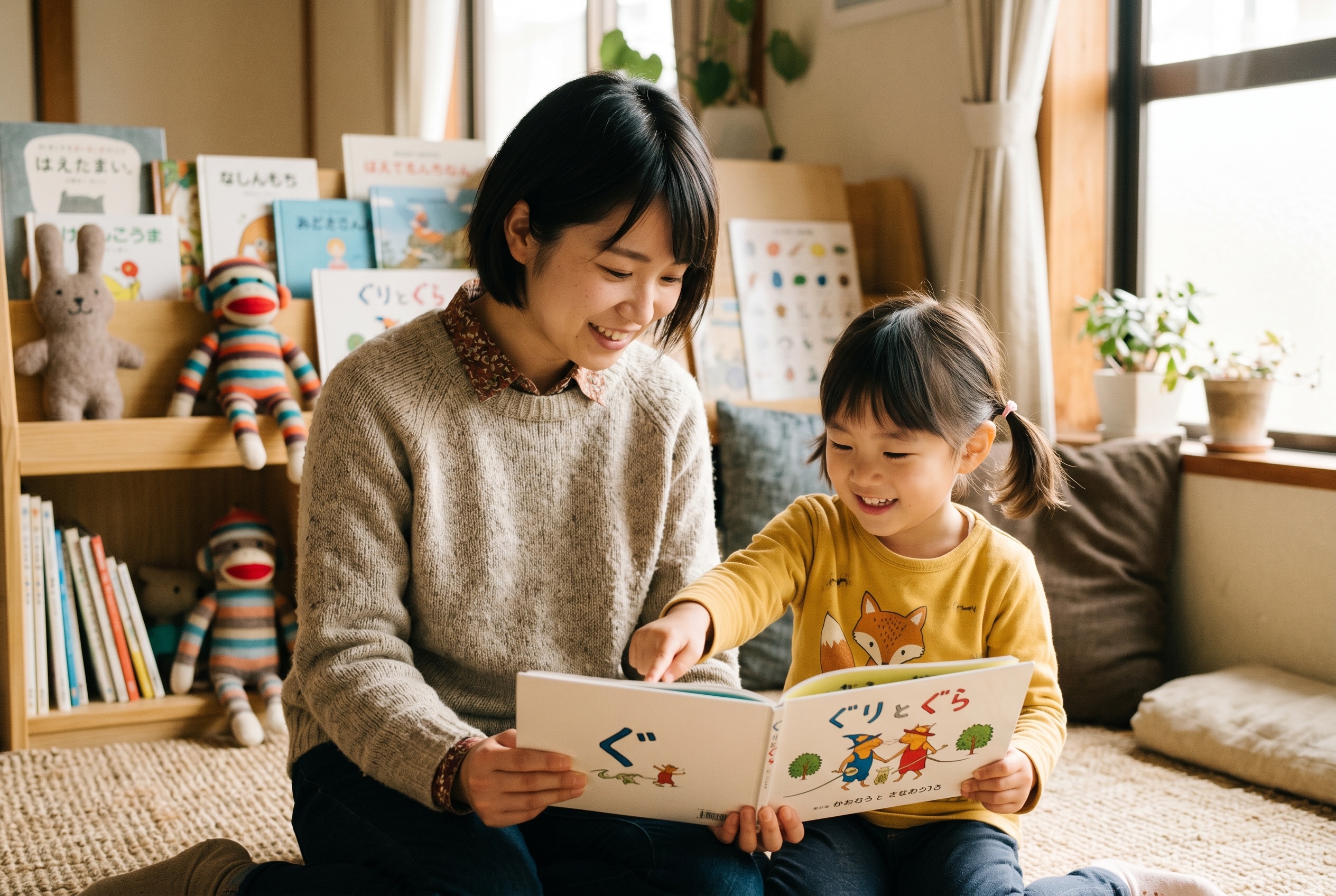
Classic Japanese picture books like the Guri to Gura series, the Daruma-chan books, and the Kogumachan series rely on rhythmic phrasing, sound-symbolic words (gitaigo / giongo), and repeated sentence frames. Younger kids absorb the patterns through repetition rather than explanation, and a tutor reading aloud with expression models natural Japanese intonation in a way no app can.
e.g. ぐりとぐら、ぐりぐら、ぐらぐり。Guri to Gura, guri-gura, gura-guri. (Title song of the classic book series.)
-
04
季節 kisetsu (the seasonal vocabulary thread)
Japanese culture is deeply organized around seasons. Children grow up with seasonal songs, foods, and greetings: cherry blossoms in spring, the rainy season in June, summer festivals, autumn moon-viewing, winter snow. A tutor working over a school year cycles through the season's vocabulary, songs, and short stories, anchoring the language to time and giving the child the cultural context Japanese peers share.
e.g. 春は さくら、夏は はなび、秋は つきみ、冬は ゆき。Haru wa sakura, natsu wa hanabi, aki wa tsukimi, fuyu wa yuki.
-
05
カエルの歌 Kaeru no Uta and other classroom songs
Songs are the most efficient grammar delivery system for younger kids. Kaeru no Uta (the frog song), Sakura Sakura (the cherry-blossom anthem), Ame Ame Furefure (the rainy-season favorite), and Oshōgatsu (the New Year song) each carry vocabulary and grammar a child remembers years later because the melody made it stick. Tutors loop these in regularly across the year.
e.g. かえるのうたが きこえてくるよ。Kaeru no uta ga kikoete kuru yo. ("The frog song is coming through.")
About Japanese for Kids
Japanese for kids, taught at kid pace
Teaching Japanese to a child is a different craft from teaching it to an adult, and a tutor who tries to compress an adult curriculum into shorter blocks usually loses the kid by the fourth lesson. Kids absorb a language through repetition, song, image, story, and play, and a good Japanese tutor for a five to fourteen-year-old builds a lesson around all five at the right ratios for the age in the chair. A six-year-old needs movement, a picture book, and a thirty-second song. A twelve-year-old can sit with a manga page, a writing drill, and a conversation roleplay. Both lessons are Japanese, and both move the child forward, but the pacing and the inputs look almost nothing alike.
The earliest lessons lean on hiragana through games rather than worksheets. A flashcard deck becomes a memory match. A character drawing turns into a stamp the child collects. Songs that teach the gojuon order, the standard A-I-U-E-O grid of the fifty sounds, become the soundtrack of the first month. Children pick up hiragana faster than most adult learners, often inside three to four weeks of regular short sessions, and the early script confidence is what carries the motivation through the longer arc that follows. Katakana arrives later for younger kids, usually after hiragana is automatic, because parallel scripts in the same week tend to bleed into each other in younger learners.
The Japanese government has a first-grade kanji set, the issho no kanji, of eighty characters. These are the kanji a Japanese first grader learns in school: numbers, basic verbs, family words, nature words. They include 一 (one), 山 (mountain), 川 (river), 木 (tree), 人 (person), 大 (big), 小 (small), 父 (father), 母 (mother). For a foreign child learning Japanese, this set is the right first kanji target because each character maps to a concrete word the child already knows in their first language, and because Japanese cultural material designed for the same age uses exactly these eighty characters. Picture books labeled for first grade are the right reading texts at this stage; they are short, illustrated, mostly hiragana with the first-grade kanji sprinkled in, and they teach reading without grinding it.
Diminutive suffixes matter more in kid lessons than in adult ones. The suffix -chan, added to a child's name or to a beloved character or animal, is the soft and affectionate form Japanese culture uses with anyone small or close: a four-year-old daughter is Hana-chan, the family cat is Tama-chan, a friendly teacher might be Yoshi-sensei or Yoshi-chan depending on the relationship. A tutor working with kids uses these suffixes naturally and teaches the child to use them with their own family in Japanese, which makes the language feel personal and warm rather than academic. The parallel suffix -kun for boys and younger male peers comes in shortly after.
Picture-book Japanese carries grammatical patterns younger learners absorb through repetition rather than explanation. The classic Guri to Gura series, the Daruma-chan books, the Kogumachan series each rely on rhythmic phrasing, sound-symbolic words (gitaigo and giongo), and repeated sentence frames that lodge in a child's ear after two or three readings. A tutor who reads these aloud with expression and pauses for the child to fill in the next word turns story time into language acquisition without the child feeling tested. Reading aloud also models the natural intonation of Japanese in a way no app can.
Seasonal vocabulary is its own ongoing thread. Japanese culture is deeply organized around seasons, and Japanese children grow up with seasonal songs, seasonal foods, seasonal greetings: cherry blossoms in spring, the rainy season in June, fireworks and summer festivals, the moon-viewing of autumn, the snow songs of winter. A tutor working over the course of a school year cycles through the season's vocabulary, songs, and short stories, which both anchors the language to time and gives the child cultural context their Japanese-speaking peers share. The famous frog song Kaeru no Uta, the cherry-blossom anthem Sakura Sakura, the New Year song Oshōgatsu, and the rainy-season favorite Ame Ame Furefure each carry vocabulary and grammar a child remembers years later because the melody made it stick.
For older kids, twelve to fourteen, the lesson can shift toward manga, anime dialogue, J-pop lyrics, and short conversations on topics the kid actually cares about. This is the age at which JLPT N5 becomes a realistic goal if the family wants a credential, though most kid programs stay credential-free and focus on building a love of the language. Tutors are honest with parents about what is realistic at each age and at each lesson frequency; a child taking one thirty-minute lesson a week will progress more slowly than a child taking two forty-five-minute lessons with daily five-minute home practice, and a tutor who promises otherwise is overselling.
A candid note on screen time, which most parents now ask about. Lessons over Zoom or Jitsi work well for kids from about age seven; younger than that, in-person tends to hold attention better because the tutor can use physical books, props, and movement. For elementary-age and older kids, online lessons are perfectly effective, and a parent does not need to sit through the lesson; the tutor sends a short note after each session about what was covered and what to practice. Outside of lessons, Japanese exposure through cartoons, short YouTube videos for Japanese kids, and song playlists is broadly good. App-based study like Duolingo for kids in this age range is a complement, not a substitute, for actual instruction.
Our kids' Japanese tutors include native Japanese speakers with classroom experience, parents who taught their own bilingual children, and longtime bilinguals who specialize in pediatric language acquisition. They calibrate to your child's age, attention span, and current level, and they make the lesson the part of the week the child looks forward to.
What you'll cover
Lessons & classes tailored to Japanese for Kids
Hiragana through games, then katakana
Early lessons teach hiragana via memory games, stamps, songs, and short repetition drills rather than worksheets. Kids typically reach automatic hiragana within three to four weeks of regular short sessions, and the early script confidence carries motivation through the longer arc. Katakana follows once hiragana is solid, usually a few weeks later, because parallel scripts in the same week tend to bleed into each other in younger learners. Our top 100 basic Japanese words list is a useful family companion.
First-grade kanji and picture-book reading
Lessons introduce the 80-character first-grade kanji set in the same context Japanese first graders meet them: simple sentences, picture books, age-appropriate readers. Characters land paired with words the child already uses in their first language, which is how they stick. Picture-book reading aloud builds intonation, rhythm, and listening comprehension at once, and the books themselves are short enough for repeat readings without losing the child's interest.
Songs, seasons, and cultural rhythm
A school-year arc cycles through seasonal vocabulary, foods, songs, and short stories. Cherry blossoms in spring, summer festivals, autumn moon-viewing, winter snow. Classroom songs like Kaeru no Uta, Sakura Sakura, and Oshōgatsu carry grammar and vocabulary a child remembers years later because the melody locks it in. Tutors layer in cultural context through stories about how Japanese kids actually celebrate each season.
Conversation, manga, and the older-kid lesson
For older kids (roughly twelve to fourteen), the lesson can shift toward manga, anime dialogue, J-pop lyrics, and short roleplays on topics the kid actually cares about. JLPT N5 becomes a realistic goal at this age if the family wants a credential, though most kid programs stay credential-free and focus on building a love of the language. When kids age into more advanced study, paths open toward conversational Japanese or full JLPT preparation. For small-group options, see our Japanese classes page.
FAQ
About Japanese for Kids lessons & classes
What age can my child start learning kanji?
Most kids are ready for the first kanji around age six or seven, once hiragana is automatic and they have a couple of months of regular lessons behind them. Younger kids can recognize a small handful of high-image kanji like 山 (mountain), 川 (river), 木 (tree) as pictures before they can read them as language, which is a fine on-ramp. The 80-character first-grade set is the right first target because it maps to words the child already knows in their first language.
Will my child get confused between hiragana and katakana?
Some confusion is normal in the first few months because the two scripts use overlapping sounds and a few visually similar characters (シ vs ツ, ソ vs ン). The fix is to teach them sequentially rather than simultaneously, hiragana first to automaticity, then katakana once hiragana feels effortless. Tutors who teach kids handle this transition carefully and use games specifically designed to separate the two scripts in the child's mind.
How much screen time is okay for Japanese learning apps and videos?
Apps like Duolingo and the various Japanese flashcard tools work as supplements, not substitutes for actual lessons with a tutor. Twenty to thirty minutes of app practice per day, broken up rather than in one sitting, is a reasonable upper bound for elementary-age kids. Passive listening through Japanese cartoons, kids' YouTube channels, and song playlists adds up to comprehension over time and counts as low-effort exposure rather than screen time in the burnout sense.
Are online Japanese lessons effective for kids?
Yes, for kids from about age seven and up. Younger than that, in-person tends to hold attention better because the tutor can use physical books, props, and movement. For elementary-age and older kids, online lessons via Zoom or Jitsi work well, and a parent does not need to sit through the lesson. Tutors send a short note after each session summarizing what was covered and what to practice.
How long should a Japanese lesson be for a young child?
Thirty minutes is the typical sweet spot for ages five to nine. Forty-five minutes works for ages ten to twelve. A full hour fits most thirteen and fourteen-year-olds. Shorter, more frequent sessions almost always outperform a single longer weekly lesson at the younger end of the range, both for retention and for keeping the child looking forward to the next session.
What if my child already speaks some Japanese at home?
That is a head start, not a complication. Heritage learners typically come in with strong listening and speaking and gaps in reading and writing, and tutors calibrate to that profile specifically. The lesson plan will look different from a child starting at zero, leaning into script, kanji, and structured reading rather than basic vocabulary. Tutors familiar with heritage learners know how to build the formal side of the language without making the child feel behind.
Are your kids' Japanese tutors native speakers?
Most are native speakers with experience teaching children, either in formal classrooms in Japan or in private lessons abroad. A few are longtime bilinguals who specialize in pediatric language acquisition or who taught their own bilingual children. Each bio specifies background and teaching experience so you can match to a tutor whose style fits your child.
Can my child take Japanese lessons in person or only online?
Both. Several of our kids' Japanese tutors teach in person around Los Angeles, and most also teach online via Zoom or Jitsi worldwide. The booking widget on each tutor's profile shows their available formats. For a small-group option, the Japanese classes page covers that path.
Ready for Japanese for Kids lessons or classes?
Book a free 30-minute trial with one of our personally vetted tutors. Private lessons or small-group classes — your choice.