


Personally vetted instructors
Hiragana tutors, lessons & classes
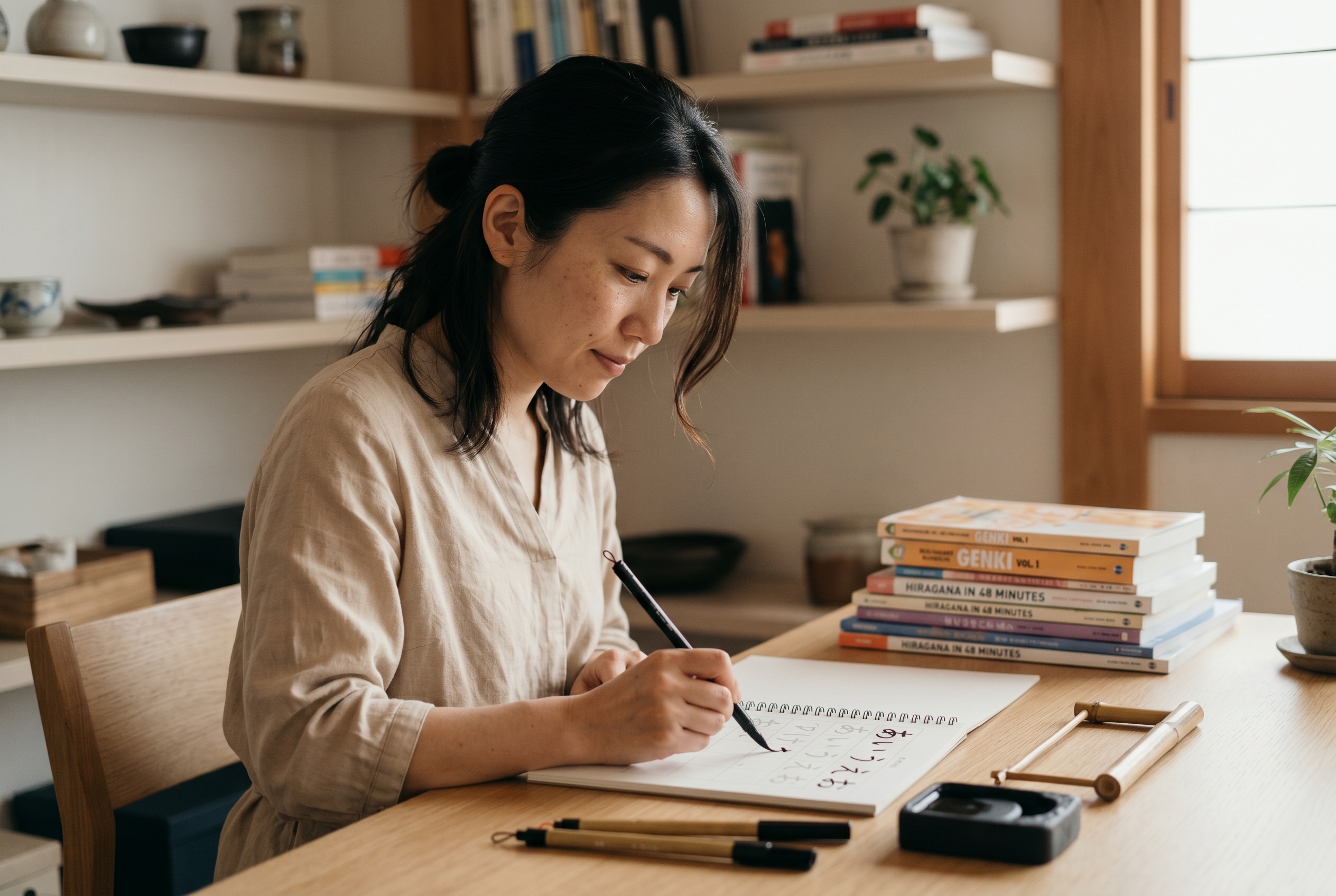
あいうえお The first five hiragana every learner writes out loud.
Personally vetted Japanese tutors who teach hiragana the right way: stroke order, sound, and reading speed, in the order that actually sticks.
Your instructors
Hiragana tutors for private lessons & classes
Strommen has been teaching languages since 2006, and we have always preferred to vet teachers ourselves rather than run an open marketplace. For a script-focused project like hiragana that vetting matters, because the tutor watches your pen, hears your vowels, and catches the small habits before they harden.
Filter by location, age, or price, then book a 30-minute free trial to find the teacher whose pace suits yours.
Below are the Strommen tutors who teach hiragana from scratch. Photos, ratings, and rates are real. Click any card to read a bio and book a free 30-minute trial.
I want to learn…
Every tutor, personally met. — founder-vetted since 2006, in Los Angeles and online worldwide.
Get a personalized plan
Pick your language — a language advisor will match you with the right tutor and map out your path.




High school degree
Japanese Tutor in Tokyo
Personally vetted · Strommen’s note
One of Elisa's students held a ten-minute conversation entirely in Japanese after three months; another passed the JLPT. Tokyo-based, Kansai-ben included.
Specialties
Also speaks: English, History, Kids, Music, Other, Spanish, Yoga
High school degree
Japanese Tutor in Tokyo
Specialties
I also speak: English, History, Kids, Music, Other, Spanish, Yoga
Personally vetted · Strommen’s note
One of Elisa's students held a ten-minute conversation entirely in Japanese after three months; another passed the JLPT. Tokyo-based, Kansai-ben included.



Linguistic high school diploma · JLPT N1, 日本漢字能力検定一級, Cambridge C2 proficiency
Stop memorising, start understanding!
Personally vetted · Strommen’s note
Veronika taught Japanese on other platforms for five-plus years before Strommen. Her pitch is structure over memorization, JLPT prep included.
Specialties
Also speaks: English, German, Italian, Spanish
Linguistic high school diploma · JLPT N1, 日本漢字能力検定一級, Cambridge C2 proficiency
Stop memorising, start understanding!
Specialties
I also speak: English, German, Italian, Spanish
Personally vetted · Strommen’s note
Veronika taught Japanese on other platforms for five-plus years before Strommen. Her pitch is structure over memorization, JLPT prep included.

ひらがな hiragana — script & sound
5 things every hiragana learner needs in the first month
These are the details that separate a textbook reading from a fluent one, and the small habits a tutor installs in the first few weeks. Save the list and book a tutor for the rest.
-
01
Stroke order in あ, き, お, ぬ
The four most commonly mis-stroked beginner characters. あ is three strokes (horizontal, then the long curve, then the small loop). き is four. お is three. ぬ is two strokes with the loop drawn last. The official ministry-of-education stroke order matches how the character was designed for a brush and is what keeps your handwriting legible at speed.
e.g. あ: ー then ノ then a small loop. Not the other way around.
-
02
Dakuten and handakuten (゛ ゜)
Two small marks that change the consonant. The dakuten, two ticks at the upper-right, voices the consonant: か ka becomes が ga, さ sa becomes ざ za, た ta becomes だ da, は ha becomes ば ba. The handakuten, a small circle, applies only to the h row: は ha becomes ぱ pa. With both, the 46 base hiragana open out to 71 distinct sounds.
e.g. か ka, が ga, ぱ pa. Same base shape, different sound.
-
03
The small っ (sokuon)
A small-size つ written between two characters that indicates a one-mora pause, geminating the next consonant. It is the difference between きて kite (come) and きって kitte (stamp). The pause is silent but it occupies a full beat in Japanese rhythm and a beginner who skips it changes the word.
e.g. きって kitte (stamp), three moras: ki, pause, te.
-
04
Long-vowel rules (おう vs うう, えい vs ええ)
Long vowels in hiragana follow rules that look inconsistent at first. Long o is written おう in most native words (おとうさん otoosan, father), and long e is written えい in most native words (せんせい sensei, teacher), even though both are read as a held vowel. A short list of exceptions exists, but the rules cover almost everything in everyday writing.
e.g. おとうさん otoosan (father), せんせい sensei (teacher).
-
05
The yoon digraphs (きゃ, しゅ, ちょ)
Small や, ゆ, よ written after an i-row character form a single syllable with the consonant: き plus small ゃ is kya, し plus small ゅ is shu, ち plus small ょ is cho. These are not two beats but one. Mishearing them as two-mora pairs is one of the most common adult-beginner pronunciation mistakes.
e.g. きょう kyoo (today), one mora plus a long vowel, not three syllables.
About Hiragana
The first script, written in order
Hiragana is where Japanese starts on paper. It is the 46-character syllabary used to write native Japanese words and the grammatical glue that holds every sentence together: verb endings, particles, adjectives, sentence-final markers. An adult learner who treats hiragana as a two-week project and gets to the other side of it has done the single most consequential thing available to a beginner. An adult learner who lingers in romaji past that point spends the next year prying old reading habits loose from new ones.
The shape of hiragana is worth understanding before you start drilling. The 46 base characters represent the moras of standard Japanese, and a mora is what most English speakers think of as a syllable, with one important footnote: in Japanese, ki, kya, kyu, and the small tsu pause are each one mora. The system is laid out as a five-by-ten grid called the gojuuon, organized by vowel column (a, i, u, e, o) and consonant row (k, s, t, n, h, m, y, r, w). A few cells were retired centuries ago and are not used in modern Japanese, which is why the working count is 46 rather than 50. On top of the base set sit two diacritics that change the consonant: the dakuten (two small marks, the so-called tenten) voices a consonant, so ka becomes ga, ta becomes da, ha becomes ba. The handakuten (a small circle) turns h into p: ha becomes pa. With dakuten and handakuten the 46 base characters open out to 71 distinct sounds, plus the digraphs called yoon (small や, ゆ, よ written after an i-row character) which give you kya, kyu, kyo, sha, shu, sho, and so on. The full working inventory is closer to 100 graphemes, but you do not learn them as 100 separate things; you learn the base 46 and a handful of rules.
Stroke order matters more in hiragana than most beginners realize. Japanese was written by hand for fifteen hundred years before keyboards existed, and the shape of each character was designed for the brush. The official ministry-of-education stroke order is not arbitrary aesthetic preference; it is what makes hiragana legible when you write fast, what makes the kana you write resemble the kana in print, and what makes kanji feasible later. The basic rule of thumb is top to bottom, left to right, with horizontal before vertical when the two cross. The character あ is three strokes in a specific order; き is four; お is three; ぬ has the famous loop that beginners reliably draw backwards. A tutor watching you write is the only reliable way to catch this; flashcard apps do not see your pen. If you want a parallel look at how the second syllabary handles the same drills, our katakana tutors page is the natural next step.
Reading hiragana out loud is the other half of the first month. The vowels are five: a as in father, i as in machine, u with no rounding of the lips, e as in bet, o as in hold but shorter. They are short, even, and the same length every time. The double vowel, written as a repeated kana or with the long-vowel rule (おう, えい), holds for exactly two moras and is the difference between obasan, aunt, and obaasan, grandmother. The small つ, written half-size between two characters, indicates a one-mora pause that geminates the following consonant: kitte, stamp, is ki-(pause)-te, three moras, and a beginner who skims past the small つ ends up saying kite, kite, which means "come." These are the kinds of details that separate a textbook reading from a recognizable one, and they go in during the first month or they go in painfully later.
A practical sequence works for most adults. Week one, the five vowels and the k-row, drilled by writing each character ten times, reading them aloud in random order, and writing simple words in a notebook: aoi (blue), kau (to buy), ie (house). Week two, the s, t, and n rows, with dakuten introduced as the marks land: ka with two ticks is ga, sa with two ticks is za. Week three, the h, m, and y rows, plus the handakuten that turns h into p, plus the long-vowel rules. Week four, the r and w rows, the special characters ん and を, and the yoon digraphs. By the end of week four the 46 base characters and their variations should be reading-fluent at slow speed, and the next two weeks are about reading speed itself: simple sentences, easy NHK Web articles labeled for learners, the kana columns of the canonical adult textbooks like Genki by Banno and colleagues or Minna no Nihongo.
One honest thing worth saying. Hiragana is not difficult; it is unfamiliar. There are 46 base characters to memorize, with logical patterns, no ambiguous readings, and no tones. Almost any adult who treats it as a daily practice for two to three weeks reaches reading fluency at slow speed, and most reach comfortable reading inside a month. The reason many self-taught beginners stall is not that hiragana is hard but that they tried to learn it from a chart pinned to a wall, with no one watching the stroke order, no one correcting the long-vowel mistakes, and no one to hand them a sentence and say read this. A tutor compresses the timeline and prevents the bad habits.
Our tutors who teach hiragana are native speakers and longtime bilinguals who have walked many adult beginners through the first script. They calibrate to your goal. A student preparing for the JLPT N5, administered by the Japan Foundation and Japan Educational Exchanges and Services, needs hiragana at a different speed than a student who wants to read menus on a trip to Kyoto. The lessons accommodate both. By the end of the first month you should be writing your own name, reading short sentences without romaji, and ready for the parallel work on katakana and the first kanji.
What you'll cover
Lessons & classes tailored to Hiragana
All 46 base characters with stroke order
Lessons walk you through the gojuuon grid in the standard order (vowels, then k, s, t, n, h, m, y, r, w rows), with stroke order taught from the first character. Your tutor watches you write rather than just listening to you read, which is the only way to catch the backwards loop on ぬ or the missed hook on き before it becomes muscle memory. Reading drills and writing drills run in parallel, so by the end of week two the base 46 are recognizable on sight.
Dakuten, handakuten, and yoon digraphs
After the base set, lessons add the dakuten and handakuten marks that open the consonant inventory from k to g, s to z, t to d, h to b, and h to p. The yoon digraphs (kya, shu, cho, and the rest) come in next, with the crucial point that they are one mora and not two. By the end of week four the full hiragana inventory of around 100 graphemes is in place and reading-fluent at slow speed. Our blog post on the top 100 basic Japanese words is the natural next reading.
Mora rhythm, long vowels, and the small っ
Reading hiragana correctly is not just sounding out characters; it is keeping the Japanese mora rhythm, where every kana is one even beat. Lessons drill the long-vowel rules (おう, えい), the silent one-mora pause of the small っ, and the moraic ん that closes syllables. These three details are responsible for most early pronunciation mistakes and they are easier to learn correctly than to un-learn later.
From kana to first sentences
By the end of the first month, lessons move from individual characters to short sentences written entirely in hiragana, plus the first few words of katakana for loanwords like コーヒー (coffee) and the first few easy kanji like 山 (mountain) and 川 (river). The canonical adult textbooks Genki by Banno and colleagues and Minna no Nihongo are common companion texts. Once hiragana is solid the path opens directly into katakana and the first kanji.
FAQ
About Hiragana lessons & classes
How long does it take to learn hiragana?
Most motivated adults reach reading fluency at slow speed in two to four weeks of daily practice, roughly 20 to 30 minutes a day. Comfortable reading speed (recognizing each character without sounding it out) usually takes another two to four weeks of regular exposure. A tutor compresses both ends of that timeline by catching the stroke-order mistakes and the long-vowel confusions that self-taught learners often miss for months.
Should I learn to write hiragana by hand or just read it?
Write it by hand, at least at first. Writing each character ten or twenty times in the correct stroke order is what installs the shape in memory and gives you the basis for reading legible Japanese handwriting later. Once the characters are solid you can drop the writing drills, but skipping them entirely makes reading slower and writing later kanji noticeably harder. A small notebook and a regular pen are all the supplies you need.
Why are there two ways to write ji and zu (じ vs ぢ, ず vs づ)?
Historical reasons. じ and ず are the dakuten-marked versions of し and す and are the standard modern spellings for these sounds. ぢ and づ come from the dakuten of ち and つ and survive in a small set of compound words where the second element historically began with ち or つ (like はなぢ hanaji, nosebleed, from hana plus chi). For modern writing, default to じ and ず unless your tutor flags one of the legacy exceptions.
What's the difference between hiragana and katakana?
Same set of sounds, different shapes, different uses. Both syllabaries cover the same 46 base moras and the same dakuten and yoon variations. Hiragana writes native Japanese words and grammar (particles, verb endings, adjectives). Katakana writes loanwords, foreign names, scientific terms, animal and plant names in formal writing, and emphasis. The two scripts are visually distinct: hiragana is curvy and brush-derived, katakana is angular and built from fragments of kanji. Most lessons teach hiragana first because it carries the grammar.
Is it okay to keep using romaji while I learn?
Only for the first few days, and even then sparingly. Romaji (Japanese written in Roman letters) is useful for absolute first exposure but becomes a real obstacle if you lean on it past the first week. The textbook habit of reading Japanese sentences through romaji slows your reading by years and trains your eye on a script you will never see in a real menu, sign, book, or message. The fastest path is to retire romaji as soon as you know enough hiragana to sound out a sentence, usually around day five to seven of daily practice.
Do I need to learn the historical kana that are no longer used?
No. The retired characters ゐ (wi) and ゑ (we) were dropped from standard Japanese in the 1946 spelling reform and are not used in modern writing. You will occasionally see them in pre-war signs, on old labels, or in proper names, but they are not part of the working hiragana set. Modern hiragana is 46 base characters, and that is the number you learn.
Are your tutors native Japanese speakers?
Most are native speakers from across Japan, and a few are longtime bilinguals who have taught beginner Japanese for years and know exactly where English-speaking adults stumble on script. Each tutor's bio specifies their background and teaching experience. For a script-focused project the tutor's own handwriting matters, because what you see modeled is what you absorb, so a clean modern Japanese hand is something we screen for.
Can I take hiragana lessons online?
Yes. Most of our Japanese tutors teach online via Zoom or Jitsi, and the script lessons translate well to video: a document camera or phone aimed at your notebook gives the tutor a real-time view of your pen. A few tutors also teach in person around Los Angeles. The booking widget on each profile shows their available formats.
Ready for Hiragana lessons or classes?
Book a free 30-minute trial with one of our personally vetted tutors. Private lessons or small-group classes — your choice.