



Personally vetted instructors
New York Accent tutors, lessons & classes
Ay, how ya doin? The casual New York hello, dropped consonants intact, the way a born-and-raised speaker would actually open.
Personally vetted New York accent coaches for actors and voice-over artists. Script-led phonetic and cultural prep for Brooklyn, Bronx, Queens, Staten Island, Long Island, and Upper-West-Side Manhattan roles across film, TV, theater, and games.
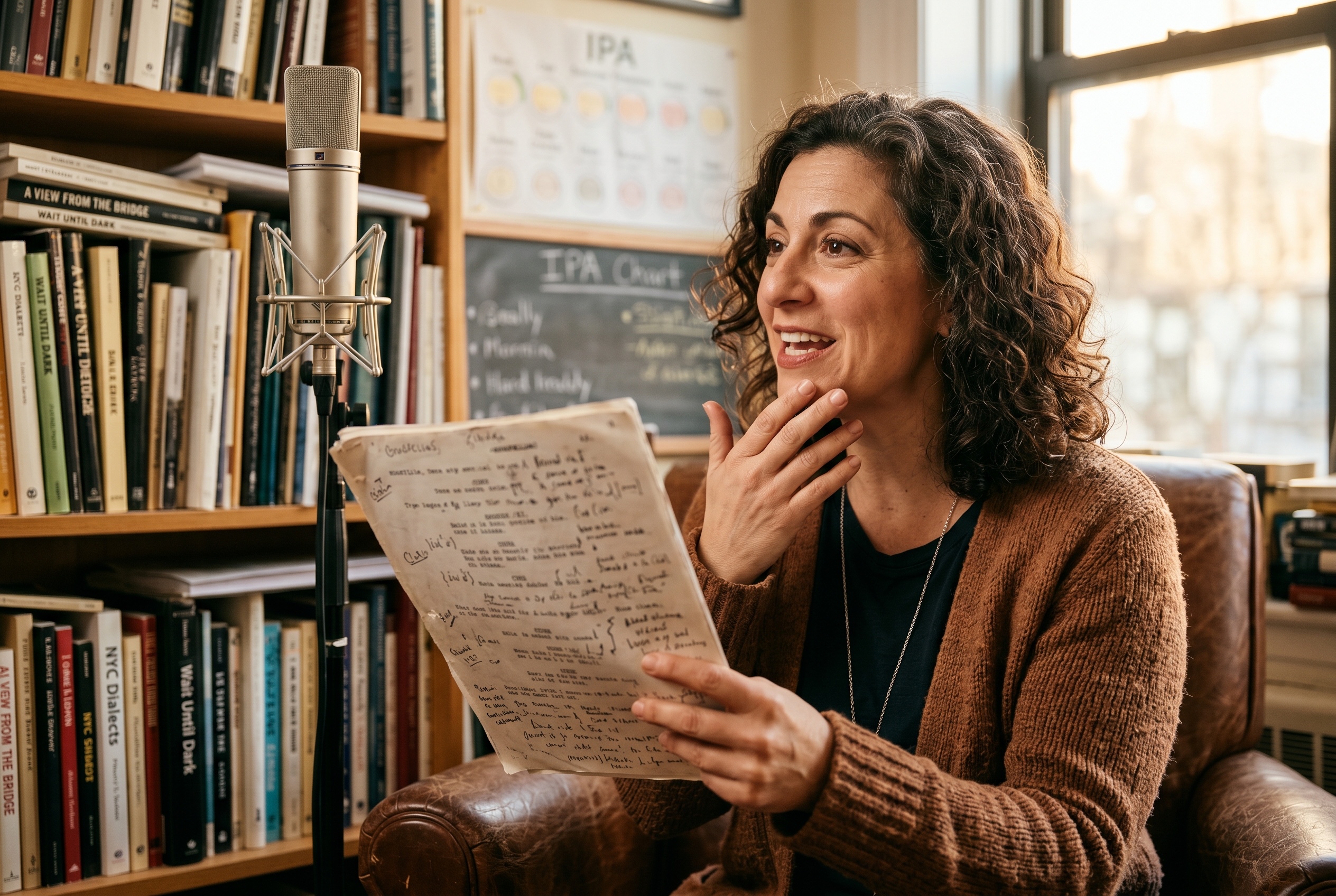
Your instructors
New York Accent tutors for private lessons & classes
Strommen has coached regional-American dialect work for film, TV, theater, and voice productions since 2006. Our New York roster ranges from native speakers across the five boroughs and Long Island (Brooklyn Italian-American, Bronx, Queens, Staten Island, Upper West Side Manhattan, Nassau and Suffolk) to coaches with direct on-set credits on prestige New York-based productions and theater-faculty specialists with stage credits in New York-set repertoire. Every tutor below was met and vetted by us in person or via thorough video interview. No marketplace. No automated profiles. Real coaches with real on-set, on-stage, and in-booth credits.
Filter by location, age, or price. Then book a 30-minute free trial.
Below are the Strommen coaches who specialize in the New York accent for actors. Photos, ratings, and rates are real. Click any card to read their bio and book a free 30-minute trial.
I want to learn…
Every tutor, personally met. — founder-vetted since 2006, in Los Angeles and online worldwide.
Get a personalized plan
Pick your language — a language advisor will match you with the right tutor and map out your path.


BFA, MFA · MDH Breathing Coordination - Level 2 (currently held by 3 people in the US)
There is no index of character so sure as the voice.
Specialties
BFA, MFA · MDH Breathing Coordination - Level 2 (currently held by 3 people in the US)
There is no index of character so sure as the voice.
Specialties

On the block — NYC dialect & culture
5 New York accent features that separate one borough from another
Five phonetic and lexical features, each one a detail a coach will mark up on the first read. Together they tell the audience which borough, which generation, and which substrate the character comes from before the line is finished.
-
01
Cawfee, tawk, dawg
The signature New York THOUGHT-vowel raising: coffee becomes cawfee, talk becomes tawk, dog becomes dawg. The vowel rounds and rises toward something close to a British oh, distinct from the unrounded General American ah. Real speakers raise it inconsistently rather than on every word; the coach calibrates which lexical items take the raised vowel for this specific character, generation, and borough.
-
02
Fawth flaw (fourth floor)
Working-class older New Yorkers drop the R at the end of syllables: fourth floor as fawth flaw, park as pahk, here as heah. The pattern is non-rhotic, inherited from older New York English and British roots, and survives most strongly in Italian-American Brooklyn and Bronx working-class speech of the older generation. Under-40 New Yorkers are far more rhotic; this feature is one of the clearest generational markers in the dialect.
e.g. Meetcha on the fawth flaw in five minutes.
-
03
Tink and dem doze
In some working-class registers, especially older Italian-American Brooklyn and Bronx, the interdental fricatives of think, this, those, and them collapse to dental stops: tink, dis, doze, dem. This is a substrate feature, not a universal one. Pasting it onto every New York character (especially female speakers, younger speakers, or speakers from outside the Italian-American substrate) is the fast way to read parodic. The coach drills it for the parts that call for it and explicitly out of the parts that do not.
e.g. I tink dem guys from da Bronx is comin over.
-
04
Stand on line
New Yorkers stand on line. Everybody else in the United States stands in line. This is a syntactic regionalism unique to New York English, one of the cleanest single-word dialect tells in American English, and a marker an actor can place on a single line of dialogue to ground a character in New York before any vowel does the work. Coaches watch for the opposite mistake too: an actor playing a non-New Yorker who slips into on line betrays the character.
e.g. I was standin on line at Joe's Pizza for twenty minutes.
-
05
Bay-ad cab vs. bat
The famous New York short-A system: bad, man, and cab raise to a tense, diphthongized vowel close to bay-ad, may-an, cay-ab, while bat, map, and cat hold the standard short-A. The split is governed by lexical-set rules (the following consonant matters) that native speakers learn unconsciously and that coaches drill explicitly because the wrong word taking the raised vowel is a clean tell of a non-native dialect attempt. Among the cleanest features to land for a credible New York performance.
e.g. That was a bay-ad cay-ab ride, but the cat was cute.
About New York Accent
New York dialect work, borough by borough
There is no single New York accent, and treating it like there is one is the fastest way to lose a New York-raised audience inside the first scene. The dialect varies sharply across boroughs (Brooklyn does not sound like the Bronx, which does not sound like Queens, which does not sound like Staten Island, which does not sound like Manhattan), across ethnic substrate (Italian-American, Jewish-American, African-American, Puerto Rican English, Dominican-American English each pull the vowels and prosody in different directions), and across generations (the canonical Sopranos-era New York accent of older speakers is in active retreat among under-30 New Yorkers, who often sound much closer to General American with only residual features). The casting note "New York accent" almost never specifies which one. The coach reads the script, asks the questions the part demands, and picks the lane.
The phonetic features that signal New York to a native ear are concrete and learnable. The classic New York vowel raising in the THOUGHT-LOT lexical set turns coffee into cawfee and talk into tawk, with a rounded, raised vowel close to a British oh rather than the General American ah. Working-class older New Yorkers drop the R at the end of syllables (fourth floor as fawth flaw), in a non-rhotic pattern the dialect inherited from British and historical New York English; younger New Yorkers are far more rhotic. The TRAP-BATH split raises bad, man, and cab toward a tense, diphthongized vowel (bay-ad, may-an) in the famous short-A system, which has its own internal rules about which words get the raised vowel and which do not. The dental stops where General American would have interdental fricatives turn think into tink and those into doze in some working-class registers, especially Italian-American Brooklyn and Bronx. The syntactic marker "stand on line" rather than "stand in line" is uniquely New York; no other American English variety uses it. These features, calibrated against the borough and generation a coach picks for the part, will move a performance from generic-East-Coast to a credible New York the audience accepts.
New York is not one accent, and the borough question is the first one a coach will ask. Brooklyn Italian-American (Bensonhurst, Bay Ridge, Carroll Gardens in the older generation) is the Sopranos / Goodfellas / Saturday Night Fever lane, with the heaviest dental stops, the most categorical R-drops, the lexicon (fuhgeddaboudit, gabagool, capeesh) that descended from Southern Italian dialect through three generations of urban speech. The Bronx (Italian-American in the Belmont area, Puerto Rican and Dominican-American across much of the borough) carries its own substrate, distinct from Brooklyn. Queens (Astoria's Greek-American substrate, Jackson Heights' South Asian and Latino mix, Forest Hills' Jewish-American history) varies neighborhood by neighborhood. Staten Island leans into the Italian-American Brooklyn-inflected register with its own prosodic features. Long Island (Nassau and Suffolk counties, the suburban accent of the post-war Italian-American and Jewish-American migration out of the boroughs) sits adjacent to but distinct from the city itself, more rhotic, less marked overall, but holding many vowel features. Manhattan Upper West Side (Jewish-American intellectual register, the lane Woody Allen and Larry David occupy) is more rhotic, more educated-coded, with the THOUGHT-LOT vowel intact but the rest of the working-class features softened or absent. African-American Harlem and Puerto Rican Spanish Harlem each carry their own ethnolectal substrates that intersect with the New York vowel system in specific ways. The script tells the coach which borough; the coach picks the references.
The generational layer is doing a lot of work in 2026. The canonical Sopranos-era New York accent the audience has in their head is the speech of older speakers, born roughly 1930 through 1970, in the working-class ethnic neighborhoods where the dialect features above were the unmarked local norm. Younger New Yorkers (born 1990 onward, especially college-educated speakers) often sound much closer to General American: more rhotic, less THOUGHT-raising, fewer dental stops, the short-A system simplified. The accent is not gone in the younger generation; it is more situational, less categorical, and varies by neighborhood and social setting. A film set in 1973 Bensonhurst is a different dialect target from a film set in 2024 Bensonhurst, even on the same block. The coach calibrates to the year on the call sheet.
Italian-American New York deserves separate framing, because most film and TV casting that uses the phrase "New York accent" actually means this register: the Brooklyn / Bronx / Staten Island Italian-American speech of The Sopranos, Goodfellas, The Many Saints of Newark, the Godfather trilogy, Saturday Night Fever, and the long tradition of Italian-American crime drama and family drama. Most New York speakers are not Italian-American; the dialect varies dramatically across ethnic substrates, and a coach matches the register to the role rather than defaulting to the Sopranos lane just because it is the most familiar. Italian-American New York shares some phonetic features with the broader working-class New York system (THOUGHT-raising, R-drops in older speakers, the short-A system) and layers in others specific to the substrate (the dental stops, the gesture economy, the lexicon descended from Southern Italian dialect). Tell your coach which lane in the trial. The worst notes on set are almost always for actors who showed up with the wrong one.
The method has a shape. Read the script first. The coach builds a phonetic map of the part: which borough, what year, what ethnic substrate, what social class, which features are dialect-distinctive for this character, which the actor lands cleanly, which need targeted drilling. Listening drills come next, pulled from native sources the coach selects to match the character (The Sopranos for Bensonhurst Italian-American, Goodfellas for the older Brooklyn-Bronx register, The Godfather for the immigrant-generation substrate, contemporary New York documentary footage for the modern speech of whatever borough the part is in, Curb Your Enthusiasm for Upper West Side Jewish-American, Spike Lee's Brooklyn films for African-American Brooklyn). The actor records the New York passages and the coach corrects mouth shape, cadence, lexical choices, the THOUGHT-vowel raising, the short-A system, and the prosodic-musical layer that distinguishes credible New York performance from competent-but-flat work. Cultural and gesture coaching threads through when the role demands it. For shoot weeks, the coach can be available on-set or on-Zoom for emotional-scene work where actors typically lose dialect under pressure. The whole arc is one-on-one, calibrated to the part and the production calendar.
Strommen has been an LA-based dialect resource for film, television, and theater since 2006. Rob Hahn handles our general English-accent and accent-modification roster; our regional-American specialists (New York, Boston, Southern, Chicago, Texas, Appalachian) sit alongside that work for the specific-city parts that need a coach who has actually lived inside the dialect. Productions are tight-lipped by contract about which coaches worked on which projects, so we will not publish credit lists on a public page. The trial conversation is where references get exchanged when a casting director or producer needs them.
A few honest observations on what trips up actors taking on the New York accent for the first time. Defaulting to Tony Soprano is the most common stumble. The Sopranos register is real, specific, and beautifully rendered, but it is one borough, one generation, and one ethnic substrate out of dozens of New York options. Most New York characters are not Tony Soprano, and pasting that register onto every New York part reads instantly as actor-shorthand. Overdoing the consonant cluster simplification (askin for asking, walkin for walking) without the matching vowel work produces what sounds like a generic urban Northeast caricature rather than a specific New York character. Treating the THOUGHT-vowel raising as a constant marker rather than a variable feature (real speakers raise it inconsistently, governed by the same lexical-set rules that govern all sociophonetic variation) reads as overshoot. Confusing New York with New Jersey is a quieter mistake: the two regions share some features but diverge in others, and a coach will mark up the script accordingly. Emotional scenes are where dialect drops first; high-emotion lines tend to revert to the actor's native phonology, and rehearsal under coach supervision is the only fix. The script-to-set drift catches actors who prep at home alone: a line that sounds right at 11pm rarely survives the first take. Lessons drill all of these specifically rather than abstractly.
Between sessions, the immersion is character-specific. Your coach will send a curated reference list based on the role: The Sopranos for Bensonhurst and the broader Italian-American crime drama tradition, Goodfellas and Casino for the older Brooklyn-Bronx register, The Godfather for the immigrant-generation substrate, Saturday Night Fever for 1970s Bay Ridge, Do the Right Thing and other Spike Lee films for Brooklyn African-American, Annie Hall and Manhattan for Upper West Side Jewish-American, Curb Your Enthusiasm for the contemporary version of the same register, The Many Saints of Newark for the late-1960s Italian-American substrate, contemporary New York documentary footage for the modern speech of whatever borough the part is in. Real native audio beats fictional dialect work as a reference; the coach will weight accordingly. For an actor without prior dialect work, the foundation work runs alongside the role-specific work rather than before it. You do not need to wait until your general dialect ear is trained to start coaching for a specific part.
The Strommen New York accent coaching roster includes New York-raised speakers from across the five boroughs and Long Island (Brooklyn Italian-American, Bronx mixed-ethnicity, Queens, Staten Island, Manhattan Upper West Side, Nassau and Suffolk counties), trained dialect coaches with theater credits in New York-set repertoire, and bilingual heritage speakers with direct on-set credits on prestige New York-based productions. Each tutor's bio specifies borough background, generational register, ethnic-substrate specialties, and which student profile they fit best (film/TV, theater, voice-over, video games). Pricing reflects experience and credit list. You can match yourself to a Bensonhurst-raised coach for Sopranos-tradition work, a Bronx-raised specialist for Goodfellas-era roles, a Queens coach for contemporary middle-class New York, a Long Island coach for suburban post-war parts, or an Upper West Side coach for the Larry David / Woody Allen register. Our accent modification page covers the opposite direction (actors who need to soften an existing New York accent for general casting); this page is the actor-craft entry point for stepping into a New York role from outside.
Lessons are one-on-one and calibrated to the role. A coached lead on an upcoming shoot is a different curriculum from a self-tape preparing for a callback, which is different from foundation dialect work between projects for an actor who wants to be ready when the next New York role comes through. The trial is free, the coach reads the script with you, the study plan comes out of that read. For an actor coming at the work from another regional dialect, our Boston accent, American accent, and British accent training pages cover the adjacent specialties. Or just browse the full tutor list and book a trial. Bring the script. Tell us the role. We go from there.
What you'll cover
Lessons & classes tailored to New York Accent
Script-led phonetic mapping for the right borough
Read the script with the coach, mark up the lines, identify the borough, ethnic substrate, generation, and social class of the character (Bensonhurst 1973 Italian-American is not Astoria 2024 Greek-American is not Upper West Side Jewish-American). Build the phonetic map: which THOUGHT-raised vowels, which R-drops, which dental stops, which short-A raisings, which lexical items the script implies. Foundation step for any New York role.
Italian-American New York (Sopranos / Goodfellas / Godfather tradition)
The most-requested New York register: Brooklyn / Bronx / Staten Island Italian-American speech, with the heaviest THOUGHT-raising, the most categorical R-drops in older speakers, the dental stops, the lexicon (fuhgeddaboudit, gabagool, capeesh) descended from Southern Italian dialect, and the gesture economy and cultural codes that go with it. Native or near-native coaches who grew up inside the dialect, plus Italian-American specialists with direct on-set credits.
Borough, ethnic, and generational variants
Beyond the Italian-American Sopranos register: Upper West Side Jewish-American (Larry David, Woody Allen), Brooklyn African-American (Spike Lee tradition), Spanish Harlem Puerto Rican English, Dominican-American Bronx, Queens Greek-American, Staten Island contemporary, Long Island suburban, and the under-30 New York register that has receded toward General American with residual features. The coach matches register to script rather than defaulting to the most-familiar lane.
On-set, on-Zoom, audition prep, and voice-over
For shoot weeks, coaches can be available on-set or on-Zoom for emotional scenes where dialect tends to drop. Pre-production coaching for auditions and callbacks. Voice-over and game-character recording sessions. Self-tape calibration. Theater rehearsal coaching for stage runs. The deliverable is a credible New York under real production conditions, not a polished demo reel.
FAQ
About New York Accent lessons & classes
Which NYC borough accent do you mean?
All of them, calibrated per role. Brooklyn Italian-American (Bensonhurst, Bay Ridge) is the Sopranos / Saturday Night Fever lane. The Bronx mixes Italian-American (Belmont) with Puerto Rican and Dominican-American English. Queens varies neighborhood by neighborhood (Astoria's Greek-American substrate, Forest Hills' Jewish-American history, Jackson Heights' South Asian and Latino mix). Staten Island leans Italian-American with its own prosody. Manhattan Upper West Side is the Larry David / Woody Allen register. Each borough has multiple registers within it. The coach reads the script and picks the right lane; tell us in the trial which neighborhood the part is from if the script does not specify.
How do I avoid the Tony Soprano stereotype?
Most New York speakers are not Italian-American, are not working-class, and do not sound like Tony Soprano. The Sopranos register is one borough, one generation, one ethnic substrate out of dozens of New York options. If the part calls for that register, the coach will drill it specifically and credibly. If the part does not, the coach will calibrate to the actual borough, generation, and substrate the script implies. The fastest way to read parodic is to paste the Sopranos register onto every New York character regardless of fit.
What is the difference between Long Island and Brooklyn accents?
Long Island (Nassau and Suffolk counties) is the suburban accent of the post-war Italian-American and Jewish-American migration out of the boroughs, especially Brooklyn and Queens. It holds many of the vowel features of the parent borough accents (the THOUGHT-raising, the short-A system) but is more rhotic, less categorical with the R-drops, and softer overall in prosody. A Long Island character from Massapequa in 1995 sounds Italian-American Brooklyn-derived but milder; a Brooklyn character from Bensonhurst in 1995 sounds fully Brooklyn. The two are distinct enough that coaches treat them as separate calibrations.
Will I sound like a parody if I overdo it?
Yes, and overdoing it is the single most common note actors get on New York work. Three failure modes to watch for. First, treating the THOUGHT-vowel raising as a constant rather than a variable; real speakers raise it inconsistently, governed by lexical-set rules the coach will drill. Second, applying dental stops (tink, doze) to characters outside the Italian-American substrate where the feature does not belong. Third, pasting the Sopranos prosody onto every line rather than letting the dialogue's emotional rhythm carry. Quieter and more specific reads more credibly than louder and more marked.
What is the modern NYC accent vs. the Sopranos-era one?
The canonical Sopranos-era accent is the speech of older speakers born roughly 1930 through 1970 in working-class ethnic neighborhoods where the dialect features were the unmarked local norm. Younger New Yorkers (born 1990 onward, especially college-educated) sound much closer to General American: more rhotic, less THOUGHT-raising, fewer dental stops, the short-A system simplified or absent. The accent has not disappeared in the younger generation; it has become more situational, less categorical, and varies by neighborhood and setting. A film set in 2024 Bensonhurst is a different dialect target from a film set in 1973 Bensonhurst even on the same block; the year on the call sheet drives the calibration.
Is there an Upper West Side Manhattan accent?
Yes, and it is one of the most distinct registers within New York English. The Jewish-American intellectual register of the Upper West Side (the lane Woody Allen, Larry David, and a long tradition of New York literary and academic culture occupy) is more rhotic than working-class Brooklyn, more educated-coded in lexical choice, and holds the THOUGHT-vowel raising while softening or dropping the dental stops and the heaviest R-drops. The prosody is faster and more verbal, the gesture economy is different, and the cultural codes around food, family, and conversation are their own. For Woody Allen-tradition or Curb Your Enthusiasm-tradition parts, this is the register, not the Sopranos one.
How do I prep for a Scorsese-style role?
The Scorsese-tradition New York crime drama (Goodfellas, Casino, The Irishman, Mean Streets) sits in the older Italian-American Brooklyn-Bronx register, with strong THOUGHT-raising, categorical R-drops, the dental stops, and the dense lexicon. The reference film stack tends to be the Scorsese filmography itself plus The Sopranos and The Many Saints of Newark for the same substrate's contemporary and prequel work. The trick on these parts is keeping the dialect credible under high-stakes emotional dialogue, which is where most actors lose it without on-set coach support. The trial gets a coach reading the sides with you and building the prep plan from the read.
How long does it take to nail the basics?
For an audition or callback with a handful of dialect lines, two to four sessions over one to two weeks gets most actors to a credible read. For a supporting role with a film's worth of dialogue, two to three weeks of focused work plus on-set support. For a lead role, four to six weeks of intensive pre-production prep plus continuing coach support through shoot. The variable that matters most is not the actor's prior dialect experience; it is the time the actor puts in between sessions on the listening drills and the recorded passages the coach assigns. Tell us the deadline in the trial and we match a coach with the right availability.
Ready for New York Accent lessons or classes?
Book a free 30-minute trial with one of our personally vetted tutors. Private lessons or small-group classes — your choice.