



Personally vetted instructors
Sanskrit tutors, lessons & classes
स्वागतम् Svagatam, the formal Sanskrit welcome offered to a guest or a new student.
Personally vetted Sanskrit tutors who teach the classical language on its own grammatical terms. Lessons that move from Devanagari and sandhi through real reading of the Bhagavad Gita, the Ramayana, and the philosophical sutras.
Your instructors
Sanskrit tutors for private lessons & classes
The tutors below tend to have the deepest reading backgrounds on our roster: some studied at Indian universities or traditional pathshalas, some hold graduate degrees in Sanskrit, Indology, or comparative philology, several have taught the classical language in classroom settings for years. Every one of them was met and vetted by Strommen directly before being listed, because a Sanskrit track depends on a tutor who actually reads the corpus.
Filter by location, age, or price, read the bios, then book a 30-minute free trial with whoever feels right.
Below are the Strommen tutors who teach Sanskrit. Photos, ratings, and rates are real. Click any card to read the tutor's background and book a free 30-minute trial.
I want to learn…
Every tutor, personally met. — founder-vetted since 2006, in Los Angeles and online worldwide.
Get a personalized plan
Pick your language — a language advisor will match you with the right tutor and map out your path.

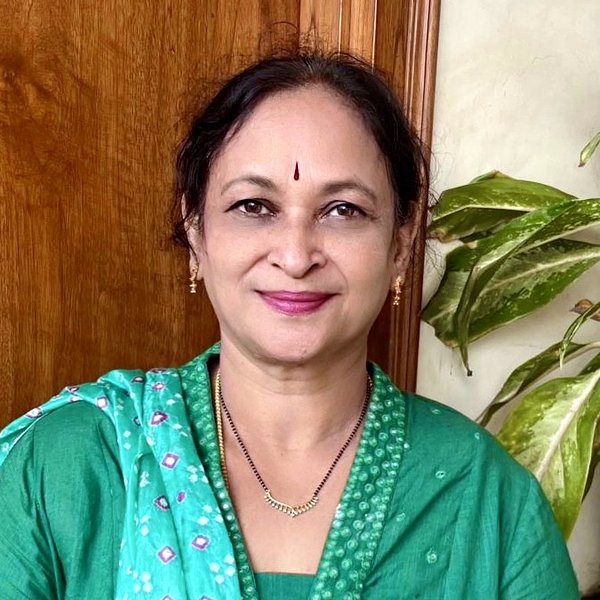
Masters in English Language and Literature, Masters in South Indian Classical Music · Hindi Language Certification.
Knowledge is a journey and Learning never ends—it evolves with every experience.
Personally vetted · Strommen’s note
Sailaja's Hindi lessons come with Sanskrit, the Bhagavad Gita, and traditional stotras built in, a genuinely unusual specialty pairing.
Specialties
Masters in English Language and Literature, Masters in South Indian Classical Music · Hindi Language Certification.
Knowledge is a journey and Learning never ends—it evolves with every experience.
Specialties
Personally vetted · Strommen’s note
Sailaja's Hindi lessons come with Sanskrit, the Bhagavad Gita, and traditional stotras built in, a genuinely unusual specialty pairing.

संस्कृतम् — language & tradition
5 things every Sanskrit reader meets early
These are the structural and textual anchors that recur across the literature. Knowing what each one is, and what it is doing on the page, makes the first months of reading less mysterious and far more rewarding.
-
01
देवनागरी · Devanagari
The standard script for classical Sanskrit, shared with modern Hindi, Marathi, and Nepali. Thirteen primary vowels and thirty-three consonants are arranged in a phonetic matrix that follows the place of articulation in the mouth (velar, palatal, retroflex, dental, labial). Once the matrix is internalized, the script reads in a logical order rather than as an arbitrary list.
e.g. नमस्ते namaste decomposes as न-म-स्-ते, four syllables in order.
-
02
विभक्ति · vibhakti
The eight noun cases that organize Sanskrit syntax: nominative, accusative, instrumental, dative, ablative, genitive, locative, and vocative. Most Indo-European languages collapsed this system; Sanskrit keeps it intact, which is why word order is so free and the case ending carries most of the grammatical weight.
e.g. रामः rāmaḥ (Rama, subject) vs. रामम् rāmam (Rama, object) vs. रामेण rāmeṇa (by Rama).
-
03
सन्धि · sandhi
The systematic sound-change rules at word boundaries that make Sanskrit text look continuous on the page. The final vowel of one word meets the initial vowel of the next and the two combine predictably. Once the rules are learned, the words separate themselves; until then, every line looks like one long word.
e.g. तत् + अस्ति → तदस्ति (tat + asti → tadasti, "that is").
-
04
धातु · dhatu
The verbal root, the heart of Sanskrit word formation. Roots are sorted into ten classes (gana) with distinctive present-tense patterns, and the same root feeds dozens of derived nouns and adjectives via fixed suffixes. Recognizing the root behind an unfamiliar word usually places its meaning before a dictionary is needed.
e.g. From √कृ (kṛ, "to do/make") come karma (action), kartṛ (doer), kriyā (activity), saṃskṛta (perfected, refined).
-
05
पाणिनि · Panini
The fifth- or fourth-century-BCE grammarian whose Ashtadhyayi defines the classical Sanskrit standard in about four thousand compressed rules. It is the reference grammar all later Sanskrit grammar refers back to, and its descriptive method has influenced modern linguistics from Bloomfield onward.
e.g. Tutors will not assign Panini directly to beginners, but you meet his analysis indirectly through any serious grammar.
About Sanskrit
The classical root of the Indo-Aryan family
Sanskrit is a working classical language with more than three thousand years of continuous textual life behind it, and it remains the source from which the modern Indo-Aryan languages (Hindi, Bengali, Marathi, Gujarati, Punjabi, Nepali, Sinhala and others) draw a very large share of their vocabulary. A reader who learns Sanskrit well is gaining access to the Vedas, the two great Sanskrit epics, the entire classical literature of poetry and drama, the philosophical sutras of the six darshanas, the Buddhist and Jain scriptural corpus that uses it alongside Pali and Prakrit, the grammatical tradition that begins with Panini and runs through Patanjali and Bhartrhari, and a still-living register used today in liturgy, scholarship, and a small but real community of contemporary speakers. It is also a language whose grammar has shaped how linguists think about grammar itself, because Panini's Ashtadhyayi (the eighth-century-BCE descriptive grammar that defines the classical standard) is among the most rigorous treatments of any language ever written.
The people who come to Strommen for Sanskrit are a varied group. Some are working through a university or graduate-school curriculum and need a tutor to keep them moving when the textbook stalls between week three and week eight, the stage where most self-taught students drop off. Some are serious yoga practitioners or teachers who want to read the Yoga Sutras of Patanjali in the original rather than through Iyengar or Desikachar in English. Some are students of Hindu philosophy, Vedanta, or Buddhist scholastic traditions who need the language as a research tool. Some are heritage learners from Indian families who heard Sanskrit recited at home and want literacy in it. And some are simply readers who want the Bhagavad Gita in the language Krishna and Arjuna actually speak on the page, not in a translator's voice. Tutors calibrate early: a Gita-first student and a Patanjali-first student need different opening lessons, and a student preparing for a graduate program in Indology needs different ones still.
The early weeks of a serious Sanskrit course are concrete and well-sequenced. You learn the Devanagari script (the writing system shared with Hindi, Marathi, and Nepali) with its thirteen primary vowels and thirty-three consonants laid out in the matrix that Panini's phonetic analysis defined. You learn that Sanskrit is highly inflected: nouns decline through eight cases, three genders, and three numbers (singular, dual, plural), and verbs conjugate through ten classes with distinctive present-tense formations. You learn sandhi, the systematic sound-change rules at word boundaries that make Sanskrit written text look like one long string until the rules become second nature and the words separate themselves on the page. None of this is mysterious. It needs to be sequenced in the right order by someone who has taught it before and who can name the patterns as they appear in actual reading.
The root system is where Sanskrit begins to click. The dhatu (verbal root), filtered through a fixed inventory of suffixes and the ten conjugation classes, generates the language's enormous verb inventory and a large share of its nouns. A reader who internalizes this finds that an unfamiliar word on a page of the Gita is usually a patterned derivation from a root already met. The same root-and-pattern principle, in a different guise, undergirds the relationship Sanskrit has with modern Hindi: a Hindi speaker who learns Sanskrit recognizes hundreds of vocabulary items immediately because Hindi inherits them with predictable phonological adjustments. If you already speak Hindi, that head start is real and your tutor will use it.
The standard reference works are worth meeting early. Tutors lean on the Monier-Williams Sanskrit-English Dictionary for serious vocabulary, on Whitney's Sanskrit Grammar and Macdonell's Vedic Grammar for the structural backbone, on Apte for classical poetry, and on Lanman's Sanskrit Reader as a graded introduction to actual texts. Newer learners often start with Walter Maurer or Robert Goldman's first-year course books, which sequence the grammar against readings from the epics. Your tutor will introduce a reference when the reading earns it, rather than handing you a stack on day one.
A cultural and historical literacy comes with the reading, and it is part of what makes the track worth the time. You cannot read the Ramayana or the Mahabharata without some sense of the dharmic frameworks they argue with. You cannot read the philosophical sutras of the Bhagavad Gita or the Upanishads without the vocabulary of yoga and the categories of Samkhya in your peripheral vision. You cannot fully feel the Sanskrit of Kalidasa's poetry or Bhavabhuti's drama without knowing what the meters are doing rhythmically, which a translation flattens. A literature-aware tutor folds this in as the reading earns it, not as a lecture.
Strommen has been teaching languages in Los Angeles since 2006, and the Sanskrit track sits among the most specialized on our roster. Every tutor below was met and vetted by us in person. There is no marketplace here. Lessons run online for students worldwide and in person for those near Los Angeles. Most students begin with a free 30-minute trial so the tutor can see where your reading actually sits before recommending a first text. If your end goal is more devotional and recitation-focused, our stotras track covers chanted hymns; if you want the most archaic textual layer, see Vedic Sanskrit.
What you'll cover
Lessons & classes tailored to Sanskrit
Devanagari, phonetics, and the sound system
The Devanagari script and the phonetic matrix that organizes it. Vowels (short, long, diphthong) and consonants (sorted by place of articulation), conjunct letters, the visarga and anusvara, and accurate pronunciation of the retroflex and aspirated series that English speakers tend to flatten. Tutors listen to your reading aloud and correct it in real time, which is the part an app cannot do.
The case system and free word order
The eight noun cases (vibhakti) across three genders and three numbers, including the dual (a category most Indo-European languages lost). Lessons teach you to parse a Sanskrit sentence by reading the case endings first, which is how the language actually wants to be read, and to stop expecting subject-verb-object order to do the work that the endings already do.
Sandhi as a reading skill
The systematic sandhi rules at word boundaries, taught as a reading tool rather than as a grammar drill. Once you can mentally undo sandhi at speed, Sanskrit prose stops looking like one long word and starts separating into clean lexical units. This is the single biggest unlock for moving from textbook reading into real texts.
Roots, conjugation classes, and reading real texts
The dhatu system, the ten verb classes, and the participial constructions that drive Sanskrit narrative. From early lessons, tutors pace you through actual passages: Bhagavad Gita verses, Hitopadesha fables, simplified Ramayana selections, eventually advancing to classical poetry, drama, or the philosophical sutras depending on your goals. Reference works (Monier-Williams, Whitney, Apte) get introduced as the reading earns them.
FAQ
About Sanskrit lessons & classes
How long until I can read the Bhagavad Gita in the original?
It depends on your hours and your steadiness between lessons. A motivated beginner doing one or two lessons a week with consistent self-study can usually read individual Gita verses with comprehension within four to six months, and work through a chapter at a time within the first year. Reading the full Gita with real fluency is typically an eighteen-month to two-year arc. The grammar gets faster once sandhi and the case system become second nature; the slow part is vocabulary depth and the philosophical register.
Should I learn Vedic Sanskrit or Classical Sanskrit first?
Almost everyone starts with Classical Sanskrit, the Panini-defined standard, because it has the largest reference apparatus, the most teachable grammar, and the corpus most students actually want to read (the Gita, the epics, the classical sutras). Vedic Sanskrit, the older and more archaic layer used in the Rigveda and the other three Vedas, has additional grammatical forms and an accent system; serious students typically add it after Classical Sanskrit is solid. If your goal is specifically the Vedas, see our Vedic Sanskrit track.
Will my Hindi help me learn Sanskrit?
Significantly, yes. Hindi inherits a very large share of its vocabulary from Sanskrit, usually with predictable phonological adjustments (e.g. Sanskrit karma, Hindi karm; Sanskrit dharma, Hindi dharm). Hindi speakers recognize hundreds of Sanskrit words immediately, share the Devanagari script and most of its phonetics, and have a head start on the abstract vocabulary of philosophy and literature. What Hindi does not give you is Sanskrit's full case system, the dual number, the participial constructions, or sandhi as a productive process; those still need to be learned.
Do I need to know yoga or Hinduism to study Sanskrit?
No, but cultural literacy in the world the texts come from will deepen the reading. The Sanskrit corpus is largely written within Hindu, Buddhist, and Jain intellectual traditions, and a working sense of the categories those traditions use (dharma, karma, the Samkhya elements, the Vedanta vocabulary) makes the texts read with more depth. Many students arrive through yoga and then expand outward; others arrive as scholars of religion or philosophy and want the language as a research tool. Tutors calibrate to whichever doorway you came in through.
Is Sanskrit a dead language?
Not in the strict sense. It has not been a community vernacular for many centuries, but it has been continuously used in liturgy, scholarship, and ritual for two and a half millennia, and there is a small but real community of contemporary Sanskrit speakers (the village of Mattur in Karnataka is the best-known example). Sanskrit also remains officially listed as a scheduled language of India, is taught in schools and universities, and has an active periodical and broadcasting tradition. "Classical" rather than "dead" is the more accurate description.
Are your tutors traditionally trained pandits or academic Sanskritists?
Both, depending on the tutor. Some come from the traditional Indian pathshala lineage, where Sanskrit is learned through recitation, memorization, and oral commentary in an unbroken pedagogical line. Some hold graduate degrees in Sanskrit, Indology, or comparative philology from Western or Indian universities. Several have taught both ways. If you want a tutor whose background matches yours, or one who teaches from a deliberately academic stance, tell us at the trial and we can match accordingly.
Can I take Sanskrit lessons online or only in person?
Both. Many of our Sanskrit tutors teach online via Zoom or Jitsi and work with students worldwide. Several also teach in person around Los Angeles. Reading-focused lessons work very well online because most of the lesson is spent on a shared text. The booking widget on each tutor's profile shows their available formats.
Ready for Sanskrit lessons or classes?
Book a free 30-minute trial with one of our personally vetted tutors. Private lessons or small-group classes — your choice.