



Personally vetted instructors
Catalan tutors, lessons & classes
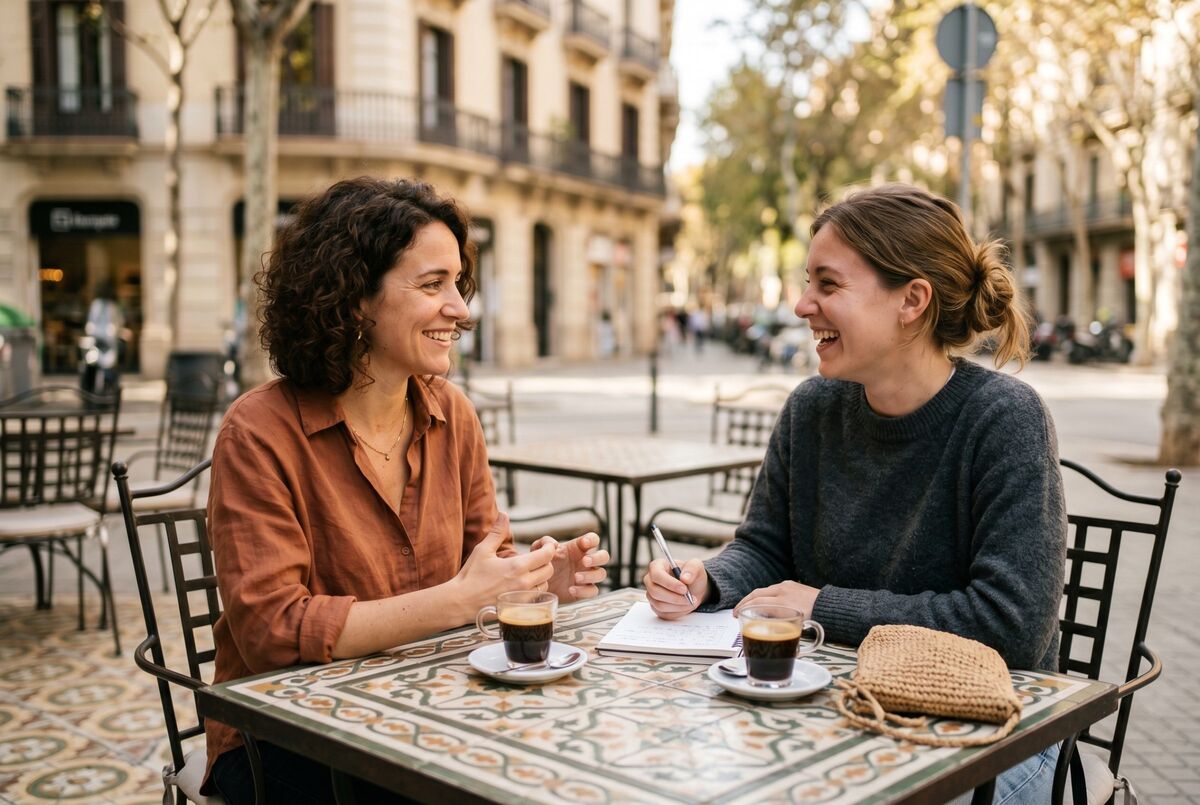
Bon dia, com va? How Catalonia opens a conversation.
Personally vetted Catalan tutors. Lessons grounded in the language as it's actually spoken in Barcelona, Girona, Tarragona, Valencia, the Balearics, and across the Catalan-speaking world.
Your instructors
Catalan tutors for private lessons & classes
Strommen has been teaching less-common languages alongside the major ones since 2006, and Catalan has been on our roster the whole time. Every tutor below was met and vetted by us in person. No marketplace. No automated profile-creation. Real teachers with real backgrounds, which you can read about in their bios.
Filter by location, age, or price. Then book a 30-minute free trial.
Below are the Strommen tutors who specialize in Catalan. Photos, ratings, and rates are real. Click any card to read their bio and book a free 30-minute trial.
I want to learn…
Every tutor, personally met. — founder-vetted since 2006, in Los Angeles and online worldwide.
Get a personalized plan
Pick your language — a language advisor will match you with the right tutor and map out your path.


BA in International Relations & Journalism, BA in French, BA in Italian Language Teaching, Master in International Cooperation · Diploma Course in Spanish as a Foreign Language, Seminar on Professional Challenges in Reading, Translating and Editing in Digital Age (Litprax Erasmus European Union and University of Novi Sad, Serbia), Workshop on Translation and Literature, Seminar...
French, Italian, Spanish & German native speaker & expert. Elite Native-Fluent ESL tutor. Graduate of Université Paris-Sorbonne & Università di Bologna.
Personally vetted · Strommen’s note
Serge's specialties run from Wallon to Ukrainian to actor dialect coaching, arguably the widest range of any tutor on our roster.
Specialties
Also speaks: Dutch, Galician, Ukrainian
BA in International Relations & Journalism, BA in French, BA in Italian Language Teaching, Master in International Cooperation · Diploma Course in Spanish as a Foreign Language, Seminar on Professional Challenges in Reading, Translating and Editing in Digital Age (Litprax Erasmus European Union and University of Novi Sad, Serbia), Workshop on Translation and Literature, Seminar...
French, Italian, Spanish & German native speaker & expert. Elite Native-Fluent ESL tutor. Graduate of Université Paris-Sorbonne & Università di Bologna.
Specialties
I also speak: Dutch, Galician, Ukrainian
Personally vetted · Strommen’s note
Serge's specialties run from Wallon to Ukrainian to actor dialect coaching, arguably the widest range of any tutor on our roster.

Estem en bones mans — culture & expressions
5 ways to sound like you actually speak Catalan
These aren't textbook expressions. They're the everyday phrases that mark you as someone who's been around Catalan speakers, not someone who memorized a phrasebook. Screenshot away. Then book a tutor to learn the rest.
-
01
Déu n'hi do
Untranslatable Catalan exclamation meaning roughly "wow, that's a lot" or "impressive." Used for everything from a big meal to a heavy rainstorm to surprising news. If you can land this naturally, you sound Catalan.
e.g. Has caminat 20 km? Déu n'hi do!
-
02
Adéu-siau
Older, warmer form of goodbye, literally "may you be with God." Common in Mallorca and among older speakers. Younger Catalans say adéu, but adéu-siau marks you as someone who's paid attention.
e.g. Adéu-siau, fins demà!
-
03
Som-hi
"Let's go" or "here we go." One of the most-used Catalan phrases. Used at the start of a task, before a hike, before leaving the house, before anything that requires a small push of energy.
e.g. Som-hi, que arribarem tard.
-
04
Què tal anem?
Catalan version of "how's it going?" More casual than com estàs?. Common between friends, colleagues, anyone you've already met.
e.g. Hola Marta, què tal anem?
-
05
Tinc un cangueli
"I'm starving." Cangueli is Catalan slang for hunger so intense it borders on cranky. Pure Barcelona street talk.
e.g. Anem a dinar ja, tinc un cangueli.
About Catalan
A language, not a Spanish dialect
Catalan is its own language, not a dialect of Spanish. It's spoken by roughly 10 million people across Catalonia, Valencia, the Balearic Islands, Andorra (where it's the only official language), parts of southern France, and a small town in Sardinia called Alghero. It descends from Vulgar Latin along a separate branch from Spanish, closer in many ways to Occitan and the Gallo-Romance family than to Castilian. If you've ever sat in a café in Barcelona and noticed the menu, the conversations, and the street signs feel like a different language, that's because they are.
The sound is the first giveaway. Catalan uses vowel sounds Spanish doesn't have, including a neutral schwa that softens unstressed syllables in eastern dialects. Final consonants get pronounced where Spanish would swallow them. The rhythm is more clipped, more Gallic. Vocabulary often diverges in surprising ways: finestra for window (not ventana), taula for table (not mesa), gat for cat. The articles el, la, els, les behave more like French than Spanish, and the famous personal article (en Joan, na Maria) is a feature you'll find nowhere else in major Romance languages.
If you're learning Catalan, you're probably learning it for a reason most students don't have: family ties to Catalonia, a job that's relocating you to Barcelona, a partner from Valencia, plans to live in Andorra, or a deep love of Catalan literature, music, or film. Maybe you want to read Mercè Rodoreda in the original. Maybe you've been watching Merlí or Drama and want to follow without subtitles. Maybe your kids are in a Catalan-immersion school and you want to keep up.
We don't sell Catalan as a side dish. Our Catalan tutors are native speakers from Barcelona, Girona, Lleida, Tarragona, Valencia, and Mallorca, with a few longtime second-language Catalan speakers who've done the work and can teach the grammar with the clarity that comes from having learned it themselves. Most teach online, a few in person around Los Angeles for students who want face-to-face. We'll match you to a tutor whose accent and dialect match your goal, whether that's the standard eastern Catalan of Barcelona, valencià, mallorquí, or the more conservative western variants.
If you already speak Spanish, French, or Italian, you have a real head start. The grammar will feel familiar. The false friends will trip you up at first (a meal in Catalan is dinar, not the Spanish almuerzo, and pronto means "soon" in Spanish but "early" in Catalan). But you'll progress fast. If you're coming in cold, that's fine too. We'll calibrate.
What you'll cover
Lessons & classes tailored to Catalan
The vowel system Spanish doesn't have
Catalan has open and closed e and o sounds, plus a neutral vowel (the schwa) in unstressed syllables in eastern dialects. Lessons drill these sounds with real audio and direct feedback so you don't slide into Spanish pronunciation. We also cover the final consonants Catalan actually pronounces, which Spanish speakers tend to drop on instinct.
Eastern vs. western Catalan
Standard Catalan as taught in schools is based on the Barcelona variety (eastern), but western Catalan (Lleida, parts of inland Tarragona, much of Valencia under the name valencià) sounds different and uses some different vocabulary. We let you choose. Most students pick standard Barcelona Catalan unless they have family or work tied to a specific region.
Grammar that's closer to French than Spanish
Pronoms febles (weak pronouns) like hi and en have no direct Spanish equivalent and behave more like the French y and en. The compound past with verb "go" (vaig anar = I went, not I'm going to go) is a feature unique to Catalan. We teach these structurally so they stop feeling alien and start feeling natural.
Catalan culture, music, and literature
Optional but most students want it: lessons on the Catalan cultural canon. Films like Estiu 1993, music from Lluís Llach, Sopa de Cabra, and Manel, the novels of Mercè Rodoreda and Jaume Cabré. Plus the cultural reality of Catalonia itself, including the independence question, which is impossible to ignore once you're actually conversational with locals.
FAQ
About Catalan lessons & classes
Is Catalan just a dialect of Spanish?
No. Catalan is a distinct Romance language with its own grammar, vocabulary, and pronunciation. It's closer to Occitan and shares many features with French and Italian. If you speak Spanish, you'll recognize patterns, but Catalan is independent and has its own literary tradition going back to the 12th century.
I already speak Spanish. Will that help or hurt me learning Catalan?
Mostly help. Romance-language overlap means vocabulary and grammar feel familiar. The trap is interference: Spanish speakers tend to import Spanish pronunciation, false-friend vocabulary, and grammar habits that don't fit Catalan. Our tutors are used to working with Spanish speakers and know exactly where the interference shows up.
What variety of Catalan do you teach?
Most lessons default to standard Catalan based on the Barcelona variety, which is what you'll hear on TV3, in most music, and in published literature. If you want valencià, mallorquí, or a specific western variant, we'll match you to a tutor from that region. Just mention it when you book the trial.
Can I take Catalan lessons online or only in person?
Both. Most of our Catalan tutors teach online via Zoom or Jitsi, available globally. A few teach in person around Los Angeles. The booking widget on each tutor's profile shows their available formats.
How fast can I get conversational in Catalan?
If you already speak Spanish, French, or Italian, you can reach a comfortable conversational level in 4 to 6 months at one or two lessons a week with self-study in between. From zero, more like 8 to 12 months. Reading literature comfortably takes longer. Your tutor sets realistic weekly goals at the trial and adjusts based on what's working.
Is Catalan actually used in daily life or is it more ceremonial?
Very much used in daily life. In Catalonia, public schools teach in Catalan, regional government operates in Catalan, and most locals switch between Catalan and Spanish based on context. In Andorra it's the only official language. In Valencia and the Balearics, usage varies by region. If you live or work in any of these areas, Catalan is a practical daily-use skill, not a heritage language.
What does a Catalan lesson actually look like?
Lessons are one-on-one and shaped by your goal. A typical hour might include 15 minutes of conversation in Catalan on a topic you chose, 15 minutes targeted on a pronunciation or grammar point, 15 minutes on Catalan-specific vocabulary or cultural context, and 15 minutes of practice using what came up. No two students get the same lesson.
Ready for Catalan lessons or classes?
Book a free 30-minute trial with one of our personally vetted tutors. Private lessons or small-group classes — your choice.