



Personally vetted instructors
Vedic Sanskrit tutors, lessons & classes
ॐ नमो भगवते वासुदेवाय Om namo bhagavate vāsudevāya, a Vaishnava mantric salutation, frequently the formal opening of a study session.
Personally vetted tutors who teach the oldest layer of Sanskrit, the language of the four Vedas. Lessons that handle the archaic grammar, the tonal accent system, and the metric forms that classical Sanskrit later left behind.
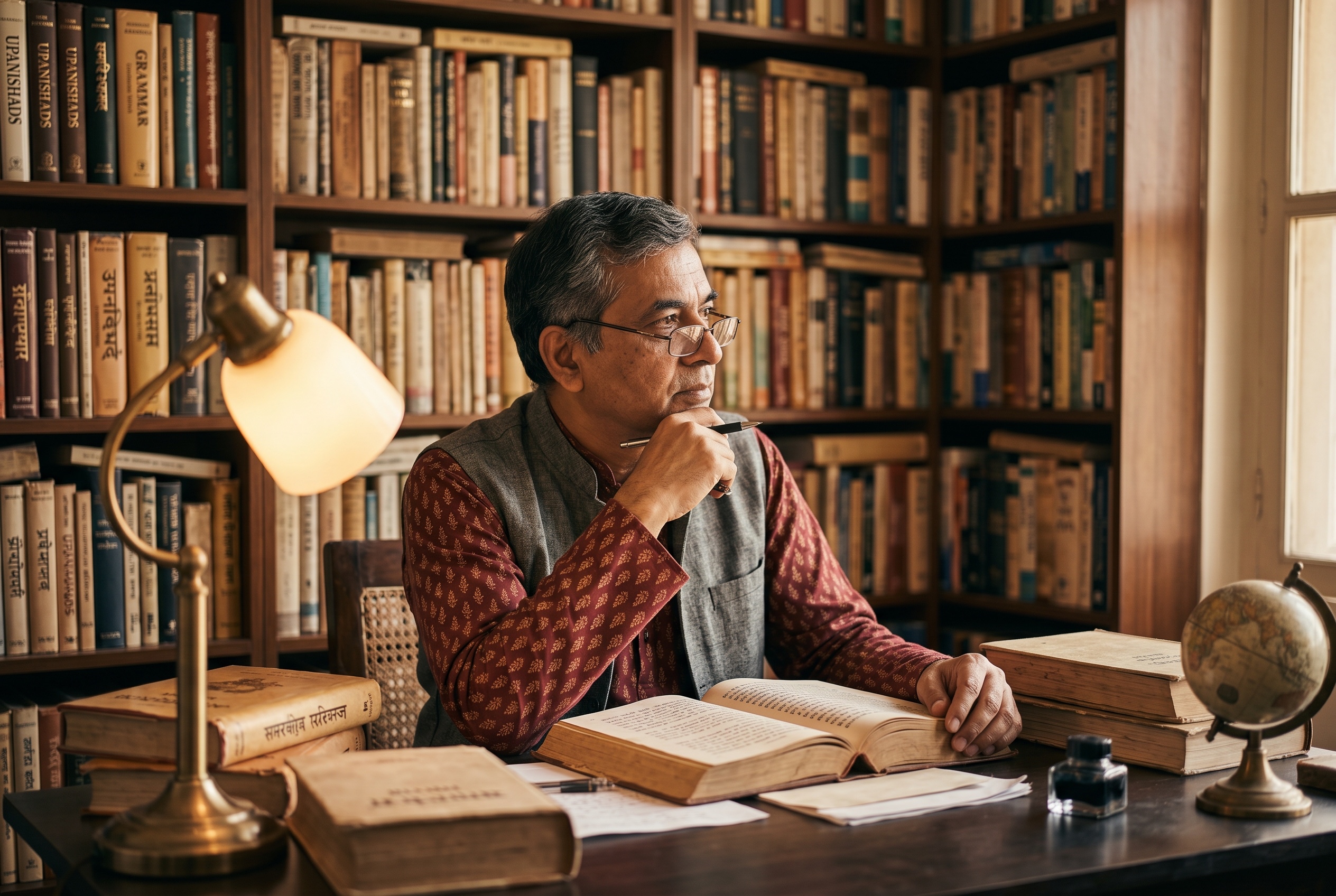
Your instructors
Vedic Sanskrit tutors for private lessons & classes
The tutors below tend to be the most specialized on our Sanskrit roster: some trained in traditional Vedic lineages with formal recitation credentials, some hold graduate degrees in Indology or comparative Indo-European philology, several have taught Vedic Sanskrit at the university level. Every one of them was met and vetted by Strommen directly before being listed, because a Vedic track depends on a tutor who reads the corpus and knows the accent system.
Filter by location, age, or price, read the bios, then book a 30-minute free trial with whoever feels right.
Below are the Strommen tutors who teach Vedic Sanskrit. Photos, ratings, and rates are real. Click any card to read the tutor's background and book a free 30-minute trial.
I want to learn…
Every tutor, personally met. — founder-vetted since 2006, in Los Angeles and online worldwide.
Get a personalized plan
Pick your language — a language advisor will match you with the right tutor and map out your path.


Bachelor of arts (Hindi) · Bachelor of arts (Hindi)
Master Hindi with Ritu: Fun, Culture, and Success in Every Lesson - over 1000 classes taught
Specialties
Bachelor of arts (Hindi) · Bachelor of arts (Hindi)
Master Hindi with Ritu: Fun, Culture, and Success in Every Lesson - over 1000 classes taught
Specialties

वेदाः — corpus & oral tradition
5 things every Vedic Sanskrit reader meets early
These are the corpus-level and structural anchors that recur across the Vedic literature. Knowing what each one is, and what it is doing on the page, makes the first months of reading less mysterious.
-
01
ऋग्वेदः · the Rigveda
The oldest of the four Vedas, a collection of roughly 1,028 hymns in about 10,500 verses, organized into ten books (mandalas). Composed in archaic Vedic Sanskrit somewhere between roughly 1500 and 1000 BCE and orally transmitted with high fidelity ever since. Most Vedic study begins here; the other three Vedas presuppose familiarity with the Rigvedic register.
e.g. Tutors typically start beginners in the simpler hymns of the family books (mandalas 2 through 7).
-
02
स्वरः · the three-pitch accent
Vedic Sanskrit marks three pitches: udatta (high, the inherited Indo-European acute), anudatta (low, immediately preceding), and svarita (falling, immediately following). The accent is phonemic at the Vedic stage and essential for correct ritual recitation. Classical Sanskrit silently dropped it; Vedic texts preserve it in the notation.
e.g. अ̱ग्निमी̍ळे agnimīḷe ("I praise Agni," Rigveda 1.1.1), with low and high marks.
-
03
गायत्री · the Gayatri meter
A 24-syllable meter in three lines of eight syllables each, used in the Gayatri mantra itself (Rigveda 3.62.10) and in many other hymns. Vedic poetry counts syllables, and the principal meters (Gayatri, Anushtubh, Trishtubh, Jagati) shape both the rhythmic identity of the hymns and the chant patterns used for recitation.
e.g. Trishtubh, at 44 syllables in four eleven-syllable lines, is the most common Rigvedic meter.
-
04
पदपाठः · pada-patha
The word-by-word recitation pattern in which each word of a verse is recited separately, with sandhi undone, so that the boundaries between words are unambiguous. Part of the oral-transmission apparatus that preserved the Vedas through more than two millennia. Krama and ghana are interlocking patterns that recite each syllable in multiple sequenced positions, as redundant error-checking.
e.g. Pada-patha is taught alongside samhita-patha (continuous recitation) from early in the traditional curriculum.
-
05
ब्राह्मणानि · the Brahmanas and Aranyakas
The prose ritual exegeses (Brahmanas) attached to each Veda, and the transitional Aranyakas ("forest texts") that bridge ritual into the philosophical inquiry of the Upanishads. The grammar is later and somewhat closer to classical Sanskrit, and these texts are often where serious students consolidate their Vedic reading before moving back into the Samhitas.
e.g. The Aitareya Brahmana (associated with the Rigveda) and the Shatapatha Brahmana (Yajurveda) are the most-studied.
About Vedic Sanskrit
The most archaic layer of the Indo-Aryan tradition
Vedic Sanskrit is not a slightly older version of the Sanskrit of the Bhagavad Gita. The two share an alphabet, a root system, and a large core of vocabulary, but they sit roughly a thousand years apart and differ enough in grammar, accent, and lexicon that a student fluent in classical Sanskrit still has real work to do when they open a page of the Rigveda. Verbal morphology is richer: Vedic preserves a fuller set of tense and mood forms (the subjunctive, the injunctive, several aorist types) that the classical grammarians later regularized away. The accent is tonal and notated, with three distinct pitches (udatta, anudatta, svarita) that classical Sanskrit silently dropped. Syntax is freer and often more elliptical. And the high-poetry vocabulary of the Vedic hymns reaches into a semantic field largely outside everyday classical use. None of this makes Vedic inaccessible; it makes it its own project, with its own pedagogy, its own reference works, and its own pace.
The people who come to Strommen for Vedic Sanskrit are a small and disproportionately serious group. Some are graduate students in Indology, comparative philology, or the history of religions who need primary-source access to the oldest Indo-European corpus that survives in continuous transmission. Some are scholars of comparative Indo-European linguistics for whom the Rigveda sits alongside Homer and the Avesta as one of three irreplaceable archaic witnesses. Some are practitioners and priests trained in a traditional Vedic lineage who want to deepen the textual side of an oral practice they already perform. A few are students of yoga and Vedanta who have moved beyond the classical-era texts into the Upanishads (which sit at the late Vedic stage) and want to read the Aranyakas, the Brahmanas, and the Samhitas behind them. Tutors calibrate the first lesson to which doorway brought you here.
The four Vedas form the corpus. The Rigveda is the oldest layer, a collection of about a thousand hymns in roughly ten thousand verses, addressed to the deities of the Vedic pantheon (Indra, Agni, Soma, Varuna, and the rest). The Samaveda is largely a remixed selection of Rigvedic verses, set to melodic patterns for liturgical singing. The Yajurveda gives the prose mantras and ritual formulae used by the priestly officiants, in two main recensions (Krishna and Shukla). The Atharvaveda is the latest and the most heterodox, with hymns ranging from cosmological speculation to domestic charms and medical incantations. Each Veda has its associated Brahmanas (ritual exegeses in prose), Aranyakas (forest texts, transitional), and Upanishads (the philosophical conclusion of the Vedic corpus). A serious student moves between these layers rather than within just one, because the language and concerns shift across them.
The accent system is one of the things that most distinguishes Vedic study from classical study. Vedic texts mark three pitches on the syllables: the udatta (the high pitch, the linguistic equivalent of the stressed syllable), the anudatta (the lower pitch immediately preceding it, marked with a horizontal stroke below the line), and the svarita (a falling pitch following the udatta, marked with a vertical stroke above the syllable). This is not decorative. The accent is phonemic at the Vedic stage (an accent shift can change the meaning of a word), it is essential to correct ritual recitation, and it preserves an inherited Indo-European feature that survived in archaic Greek and a few other branches before being lost almost everywhere else. Tutors teach the accent early and treat it as foundational rather than as advanced trim.
The meters are the other Vedic specialty. Vedic poetry counts syllables, and the principal meters (Gayatri at 24 syllables per verse in three eight-syllable lines, Anushtubh at 32 in four eight-syllable lines, Trishtubh at 44 in four eleven-syllable lines, Jagati at 48, and the longer Brihati and Pankti) define both the rhythmic identity of the hymns and the chant patterns that go with them. Reading a Rigvedic hymn well means feeling the meter, not just parsing the grammar. Tutors point this out early because it is genuinely part of how the texts mean.
The oral-transmission tradition deserves a paragraph of its own. The Vedas were transmitted orally for more than two and a half millennia before being widely committed to writing, and the techniques the priestly lineages developed for guaranteeing zero-error memorization (the pada-patha word-by-word recitation, the krama and ghana interlocking patterns that recite each syllable in multiple sequenced positions, the svara markers that preserve the accent) are widely considered among the most sophisticated mnemonic systems in human history. The result is that scholars regard the surviving Rigveda as substantially preserved from a recension at least two thousand years older than its earliest manuscripts. A tutor with traditional lineage training brings part of this oral tradition into the lesson.
The standard reference apparatus for Vedic work is the Macdonell Vedic Grammar (and his Vedic Reader for Students as a graded entry), Whitney's Sanskrit Grammar for the cross-references back to classical norms, Geldner's German translation of the Rigveda and the Jamison-Brereton English translation for parallel reading, and the Monier-Williams Sanskrit-English Dictionary supplemented by Grassmann's Worterbuch zum Rig-Veda for Vedic-specific vocabulary. Tutors will introduce these as the reading demands them rather than handing them to you on day one.
Strommen has been teaching languages in Los Angeles since 2006, and the Vedic Sanskrit track is among the smallest and most specialized on our roster. Every tutor below was met and vetted by us in person. There is no marketplace here. Lessons run online for students worldwide and in person for those near Los Angeles. Most students begin with a free 30-minute trial so the tutor can see where your reading sits and what your goal actually is.
What you'll cover
Lessons & classes tailored to Vedic Sanskrit
The Vedic accent system
The three pitches (udatta, anudatta, svarita), the notation in standard printed editions, and the phonemic role the accent plays at the Vedic stage. Tutors treat the accent as foundational rather than as advanced trim, because it is essential for correct ritual recitation, it preserves an inherited Indo-European feature that survived almost nowhere else, and it cannot be safely added in later if skipped at the start.
Archaic verbal morphology
The fuller Vedic verb system: the subjunctive (which classical Sanskrit lost), the injunctive (a tense-neutral form whose function is debated and crucial to Rigvedic interpretation), the multiple aorist formations, the preserved augment-less imperfect forms, and the broader range of root-class formations. Lessons map these against the simpler classical norms tutors expect students already know, so the differences become a reading skill rather than a memorization burden.
Vedic meters and the rhythm of recitation
The principal Vedic meters (Gayatri, Anushtubh, Trishtubh, Jagati, Brihati, Pankti), how to scan a verse, and how the meter shapes both the rhythm of reading and the chant patterns used in traditional recitation. Reading a Rigvedic hymn well means feeling the meter, not just parsing the grammar, and tutors point this out early because it is part of how the texts mean.
Reading actual Vedic text together
From early lessons, you read actual Vedic passages alongside the tutor. A typical first path runs from accessible Rigvedic hymns (the early hymns of mandalas 2 through 7, the Purusha Sukta, the Nasadiya Sukta) into selected Brahmana prose passages, then into the principal Upanishads (Isha, Kena, Katha, Mundaka, Mandukya, and the longer Brihadaranyaka and Chhandogya). Tutors lean on Macdonell's Vedic Reader and the Jamison-Brereton Rigveda translation as the reading demands.
FAQ
About Vedic Sanskrit lessons & classes
Why study Vedic Sanskrit instead of just Classical Sanskrit?
Because they are different projects. Classical Sanskrit is the Panini-defined standard of the post-Vedic literature: the epics, the Gita, the philosophical sutras, the classical poetry and drama. Vedic Sanskrit is the older and more archaic layer of the Vedas, the Brahmanas, the Aranyakas, and the early Upanishads. If your goal is the Hindu philosophical or literary tradition, Classical is usually the right starting point. If your goal is the Vedas themselves, the comparative Indo-European philological tradition, or the deepest layers of the priestly liturgical corpus, Vedic is what you actually need. Most serious students do Classical first and then add Vedic; doing them in the opposite order is uncommon.
Is Vedic Sanskrit a living language?
Not as a community vernacular, no. It has not been a spoken everyday language for at least three thousand years. But it remains in continuous ritual and liturgical use in priestly traditions across India, with active oral transmission lineages that preserve the accented recitation. It is also taught at universities in India and abroad as a scholarly research language. The honest description is that it is a ritual and scholarly language rather than a dead one, but it is not used for everyday conversation.
How important is learning the svara accent system?
Essential. The accent is phonemic at the Vedic stage, meaning an accent shift can change the meaning of a word, and it is foundational to correct ritual recitation in any of the traditional lineages. Reading Vedic text without the accent is reading half of it. Tutors teach the three pitches (udatta, anudatta, svarita) and their notation early in the course rather than treating it as advanced material to add later. The accent is also what makes Vedic such an important witness for comparative Indo-European linguistics, since it preserves features lost in almost every other branch.
Do I need Classical Sanskrit before starting Vedic?
Strongly recommended. Vedic Sanskrit assumes a working command of the script, the case system, sandhi, and the basic verb classes that classical-track lessons cover. Starting Vedic from absolute zero is possible with a patient tutor but inefficient, because most of the reference grammars (Macdonell, Whitney) and most of the published readers assume Classical as the baseline. If you have not yet done Classical, see our main Sanskrit track first, or start with our beginner course and work up.
Can a Vedic student handle the Upanishads, or do they need a separate track?
Vedic reading skills cover the Upanishads well. The principal Upanishads (Isha, Kena, Katha, Prashna, Mundaka, Mandukya, Aitareya, Taittiriya, Chhandogya, Brihadaranyaka) sit at the late Vedic stage and are typically taught within a Vedic course, often after a season of Rigvedic and Brahmana reading. Some later Upanishads sit closer to classical Sanskrit, but the major ones are firmly in the Vedic register.
Are your tutors from traditional Vedic lineages or academic backgrounds?
Both, depending on the tutor. Some have trained in traditional priestly lineages with formal recitation credentials and bring the oral-transmission tradition into the lesson alongside the textual work. Some hold graduate degrees in Indology, Sanskrit, or comparative Indo-European philology from Indian or Western universities. Several have taught at both. If you want a tutor whose background matches your own goals, tell us at the trial and we can match accordingly.
Ready for Vedic Sanskrit lessons or classes?
Book a free 30-minute trial with one of our personally vetted tutors. Private lessons or small-group classes — your choice.