Job posts ask for “B2 Spanish.” Course listings start at “A2.” But how do you actually know your level? Most people guess, and most guess wrong: too high for speaking and too low for reading.
This guide walks you through exactly what happens in a proctored CEFR test, step by step, with a sample question your examiner might ask at each level. Then it covers three other ways to check your level, from a free 2-minute self-check to a free online test.
New to the scale? Start with our guide to what the CEFR and ILR levels mean.
The CEFR levels in one minute
-
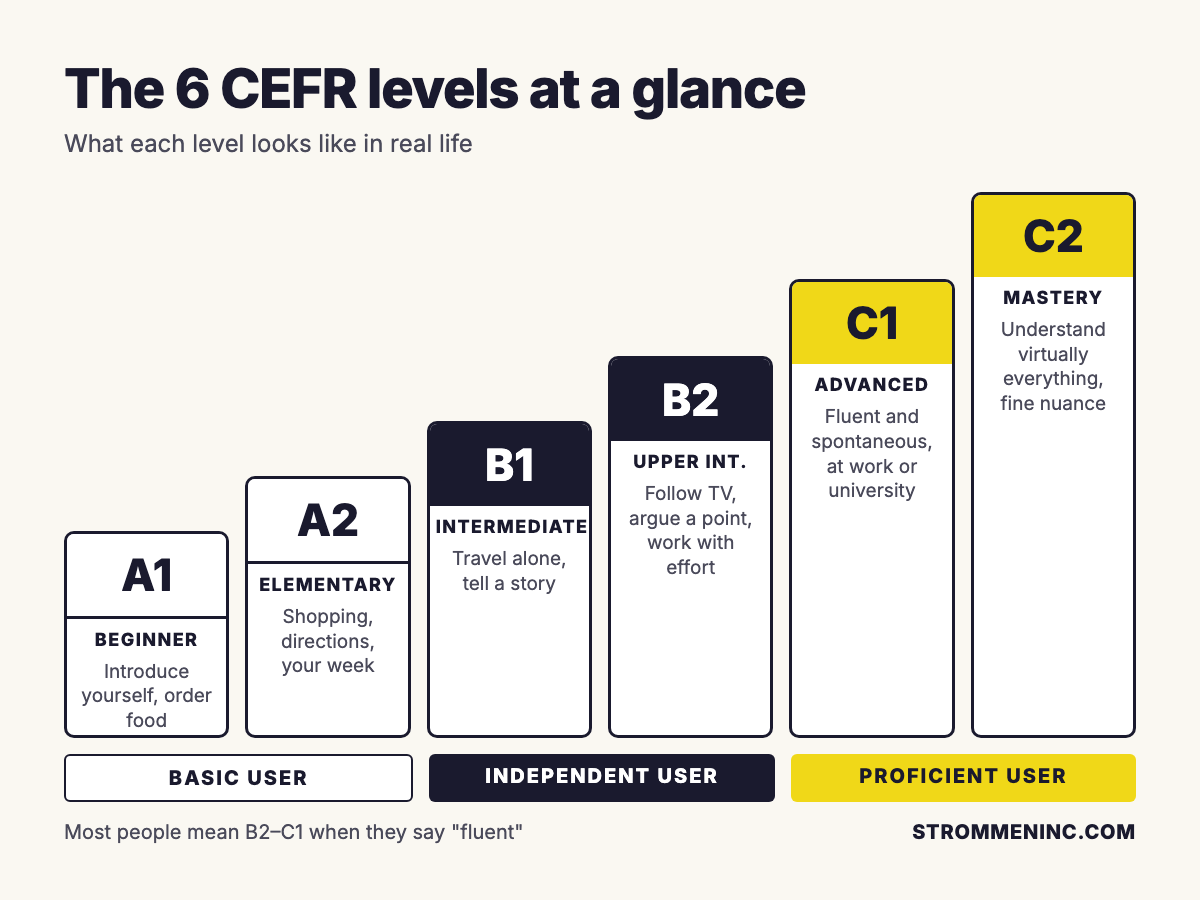
A1, beginner. You can introduce yourself, order food and ask simple questions slowly.
-
A2, elementary. You can handle routine tasks: shopping, directions, talking about your week.
-
B1, intermediate. You can travel on your own, tell a story and explain an opinion simply.
-
B2, upper intermediate. You can follow most conversations and TV, argue a point and work in the language with some effort.
-
C1, advanced. You speak fluently and spontaneously and can use the language for work or study.
-
C2, mastery. You understand virtually everything and can express fine shades of meaning.
What to expect in a proctored CEFR test, step by step
A proctored test sounds scary. It isn’t. Here’s exactly how ours works, so you know what’s coming.
-
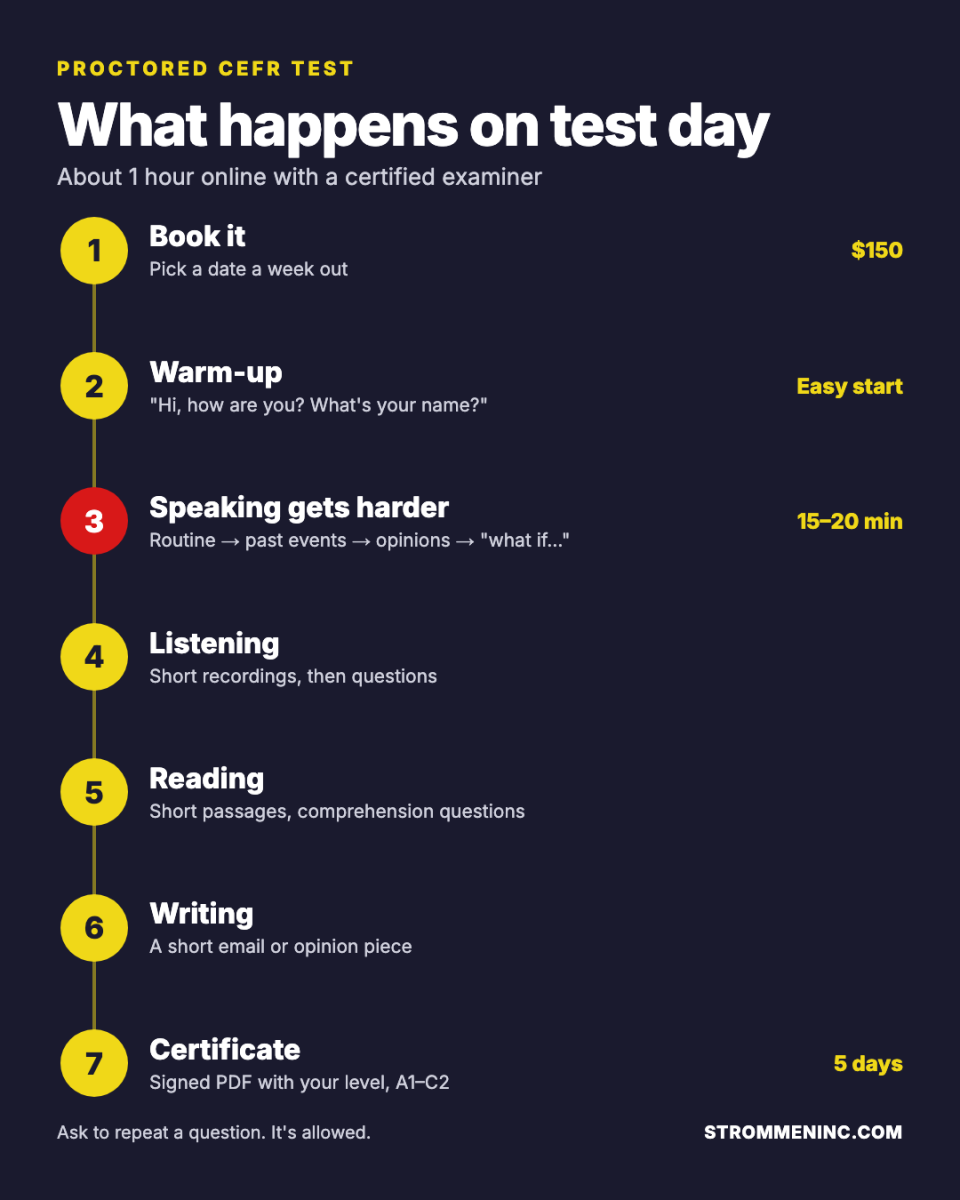
Step 1: Book it. Pick a date at least a week out and pay $150 when you book. We match you with a certified examiner for your language and time zone.
-
Step 2: Warm-up. You meet your examiner over video. It starts like any conversation: “Hi, how are you? What’s your name? Where are you from?” These easy questions are there to settle your nerves, not to grade you.
-
Step 3: The questions get harder. The speaking interview lasts 15 to 20 minutes, and each question is a little more demanding than the last. You’ll go from your daily routine, to describing something that happened, to giving and defending an opinion, to “what would you do if…” questions. The examiner keeps raising the bar until you start to struggle. That’s on purpose: it’s how they find your ceiling.
-
Step 4: Listening. You hear short recordings, like a conversation or an announcement, and answer questions about them.
-
Step 5: Reading. You read short passages and answer comprehension questions.
-
Step 6: Writing. You write a short response that fits your level. At A2 that might be a message inviting a friend to dinner, at B1 an email about a recent trip, at B2 an email arguing for or against a change at work, and at C1 a structured opinion piece. It’s graded on range, accuracy and how well it holds together.
-
Step 7: Your certificate. The whole session takes about an hour. Within 5 business days you get a signed PDF certificate with your CEFR level, A1 to C2, and detailed feedback from your examiner.
Sample questions at each level
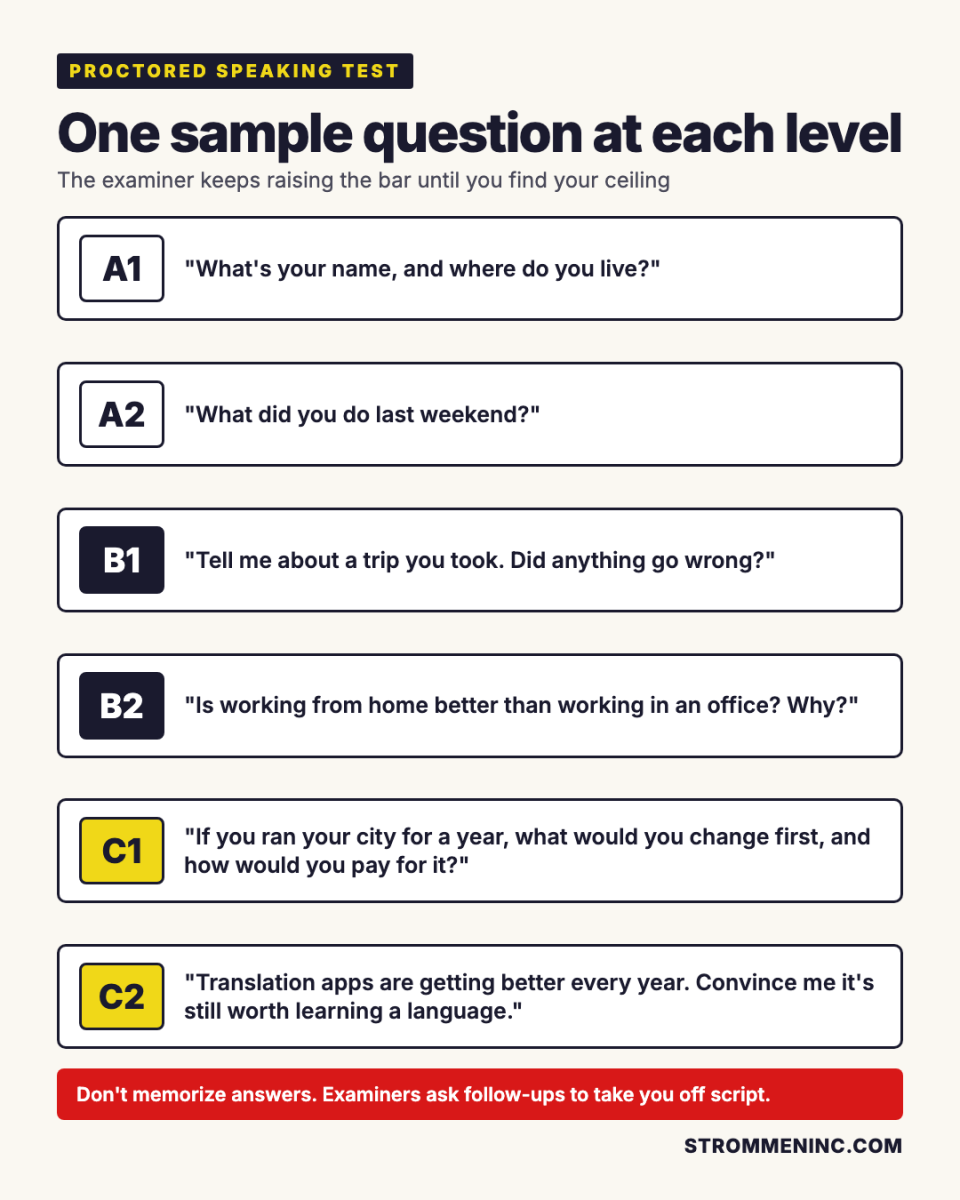
The examiner doesn’t read from a fixed list. They start easy and raise the bar with each question until you start to struggle. Here’s one example per level so you know the kind of question to expect:
-
A1. “What’s your name, and where do you live?”
-
A2. “What did you do last weekend?”
-
B1. “Tell me about a trip you took. Did anything go wrong?”
-
B2. “Is working from home better than working in an office? Why?”
-
C1. “If you ran your city for a year, what would you change first, and how would you pay for it?”
-
C2. “Translation apps are getting better every year. Convince me it’s still worth learning a language.”
Please don’t memorize answers to these. They’re examples, not the test. Your examiner will pick different topics and ask follow-up questions to take you off script, and a rehearsed speech usually scores lower than a natural answer with a few mistakes.
How the examiner decides your level
Your level isn’t based on one great sentence. The examiner is listening for the highest level you can keep up comfortably across several questions. Roughly, this is what they listen for:
-
A1 and A2. Short answers, familiar phrases and simple sentences. You can talk about yourself and your routine, with pauses.
-
B1 and B2. Connected sentences. You can tell a story in the past, explain why something happened, and give and defend an opinion. You make mistakes, but they don’t get in the way.
-
C1 and C2. Longer, well-organized answers on abstract topics and “what if” questions. You rephrase on the fly and correct yourself without being asked.
When your answers start to break down, with long pauses, switching to English or falling back on simpler sentences, the examiner has usually found your ceiling. Your level is the last one you handled consistently.
A few tips for test day: don’t memorize speeches, because examiners notice and steer you off script. It’s fine to ask them to repeat a question. And when you hit a question you can’t answer, say so in the language. Handling that moment well counts in your favor.
Other ways to check your level
Not ready to book a test, or just want a rough idea first? Start with one of these.
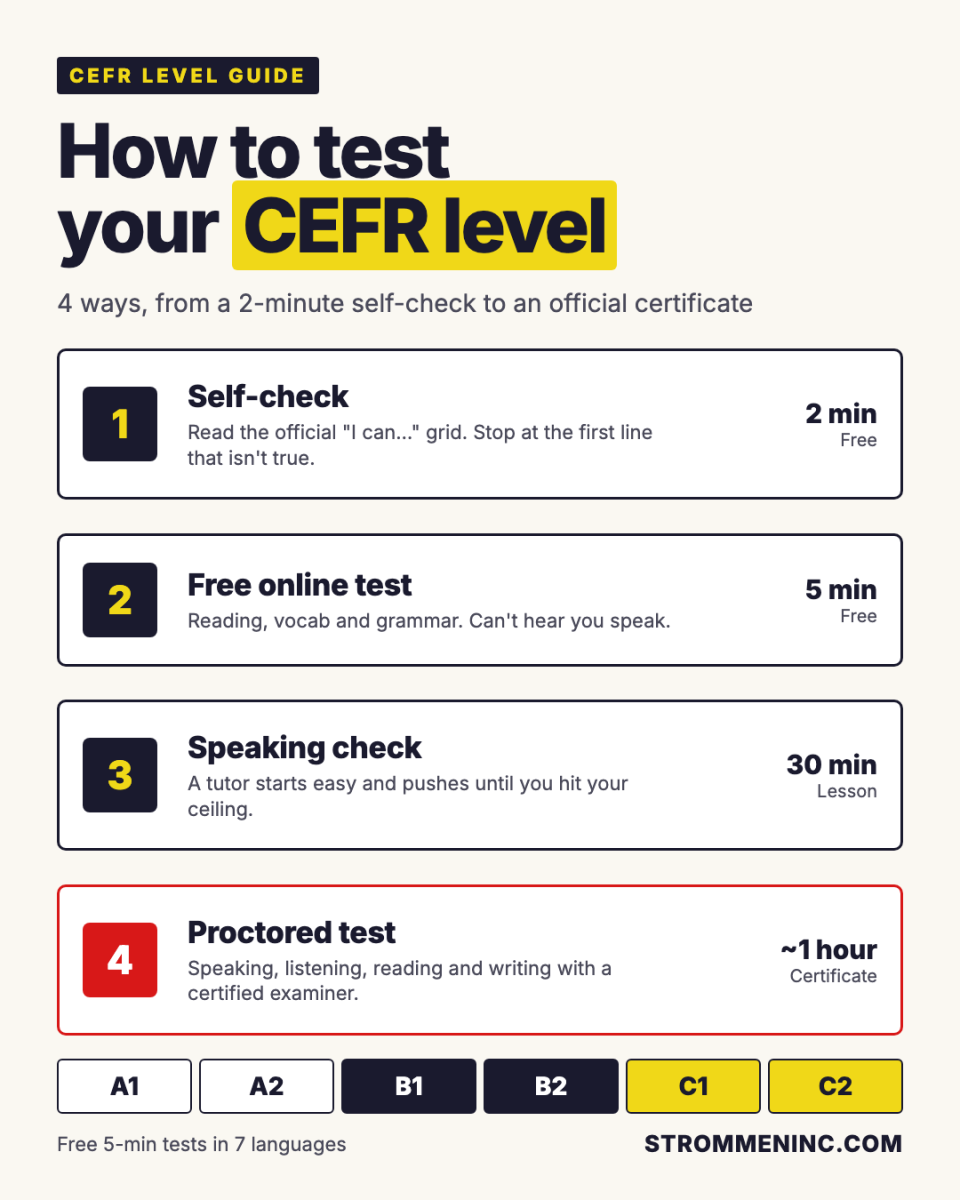
1. Check yourself against the CEFR grid (2 minutes, free)
The Council of Europe publishes a self-assessment grid: short “I can…” statements for listening, reading, conversation, speaking and writing at every level. Read each column from A1 up and stop at the first row that isn’t true for you.
It’s a good starting point, but be honest with yourself. Most people rate their speaking too high and their reading too low, and your level can differ from skill to skill. That’s normal.
2. Take a free CEFR test online (5 minutes, free)
Our free CEFR level tests cover Spanish, French, English, Italian, German, Mandarin and Japanese. Each takes about 5 minutes, needs no sign-up and gives you a shareable certificate at your level.
Use it to pick the right class or package, and retake it every few months to see your progress. Just remember what it can’t do: an online test checks reading, vocabulary and grammar, but it can’t hear you speak.
3. Get a speaking check from a tutor (30 minutes)

Speaking is the skill that matters most and the one online tests miss. A trained tutor can place you in about 15 minutes of conversation by starting easy and pushing until you reach your ceiling.
Book a lesson with one of our tutors and ask them to place you at the start. You’ll leave knowing your real speaking level, the gaps holding you back and where to begin. Many of our tutors offer a free 30-minute first lesson.
4. Take an official language proficiency test
When an employer, university or government needs proof, you need a certificate. These are the main exams by language:
-
Spanish. DELE (one exam per level, A1 to C2) or SIELE (one exam, scored A1 to C1). See our guide to Spanish exams.
-
French. DELF (A1 to B2) and DALF (C1 to C2), or the TCF and TEF, which score you across levels in one sitting.
-
German. Goethe-Zertifikat, telc or ÖSD, A1 to C2.
-
Italian. CILS, CELI or PLIDA, A1 to C2. Applying for citizenship? Read our B1 Italian citizenship test guide.
-
English. Cambridge English, IELTS and TOEFL all map to CEFR. Compare them in our guide to English tests.
-
Japanese and Chinese. The JLPT (N5 to N1) and HSK (levels 1 to 9) use their own scales, not CEFR. See HSK vs CEFR.
Don’t book a level-specific exam like the DELE or DELF until a free test and a tutor both put you at that level. Failing by one level is an expensive surprise.
Need a certificate faster, or for a language without a big national exam? Our proctored CEFR language test covers 50+ languages with a certified examiner, and your certificate arrives within 5 business days.
Which way should you test your level?
-
Just curious? Do the self-check, then take our free test.
-
Choosing a class or package? Take the free test and get a speaking check from a tutor.
-
Need proof for a job, visa or university? Take an official exam or our proctored test, after the first three.
Frequently Asked Questions (FAQ)
How can I test my CEFR level for free? Start with the Council of Europe’s self-assessment grid, then take a free online CEFR test like ours, which takes about 5 minutes and covers seven languages. Free tests are estimates and don’t count as official certificates.
What is the difference between a CEFR test and a language proficiency test? A CEFR test reports your result on the CEFR scale, A1 to C2. “Language proficiency test” is the broader term and includes exams on other scales, like ACTFL, ILR, the JLPT or HSK.
What CEFR level is fluent? Most people mean B2 or C1 when they say fluent. At B2 you can hold your own in most conversations. At C1 you speak spontaneously and can use the language for work.
Is an online CEFR test accurate? It’s a good estimate for reading, vocabulary and grammar, but it can’t measure speaking. For an accurate overall level, add a speaking check with a tutor or take a proctored test.
What questions are asked in a CEFR speaking test? It starts with easy personal questions like your name and where you live, then moves to past events, opinions and hypothetical “what would you do if” questions. The examiner keeps raising the difficulty until you reach your ceiling.
How long does a proctored CEFR test take? Ours takes about an hour: a 15 to 20 minute speaking interview, then listening, reading and writing tasks.
Can I retake a CEFR test? Yes. For our proctored test we recommend waiting 60 days between attempts so you have time to improve.
Know your level? Let’s move it up.
Tell us your goals and we’ll match you with a tutor or group class at the right level. Get in touch.