



Personally vetted instructors
Dutch for Kids tutors, lessons & classes
Dag The warm Dutch hello (and goodbye) every Dutch child grows up hearing.
Personally vetted Dutch tutors who specialize in teaching kids. Patient, playful, native-level fluent, and calibrated to your child's age and attention span — whether they're preparing for a Dutch-language school or holding onto a heritage Dutch from a Dutch or Flemish parent.
Your instructors
Dutch for Kids tutors for private lessons & classes
Strommen teaches Dutch to kids across every age and goal: expat families preparing for a Dutch-language school, heritage families holding onto a Dutch or Flemish parent's language, and international-school families wanting their child to integrate into Dutch life outside the classroom. Every tutor below was met and vetted by us in person or via thorough video interview. No marketplace. No automated profile-creation. Real teachers with real backgrounds in child Dutch instruction.
Filter by location, age, or price. Then book a 30-minute free trial.
Below are the Strommen tutors who specialize in teaching Dutch to children. Photos, ratings, and rates are real. Click any card to read their bio and book a free 30-minute trial.
I want to learn…
Every tutor, personally met. — founder-vetted since 2006, in Los Angeles and online worldwide.
Get a personalized plan
Pick your language — a language advisor will match you with the right tutor and map out your path.


I have a Master's degree in Communication Sciences
From Amsterdam's Heart to Global Fluency, Eser Offers Experience-Driven Coaching!
Specialties
I have a Master's degree in Communication Sciences
From Amsterdam's Heart to Global Fluency, Eser Offers Experience-Driven Coaching!
Specialties
Spelend leren — learning through play
5 things parents should look for in a Dutch-for-kids tutor
These are the small signals that separate a tutor who knows Dutch from one who knows how to teach Dutch to a child. Screenshot for the trial lesson.
-
01
Nijntje
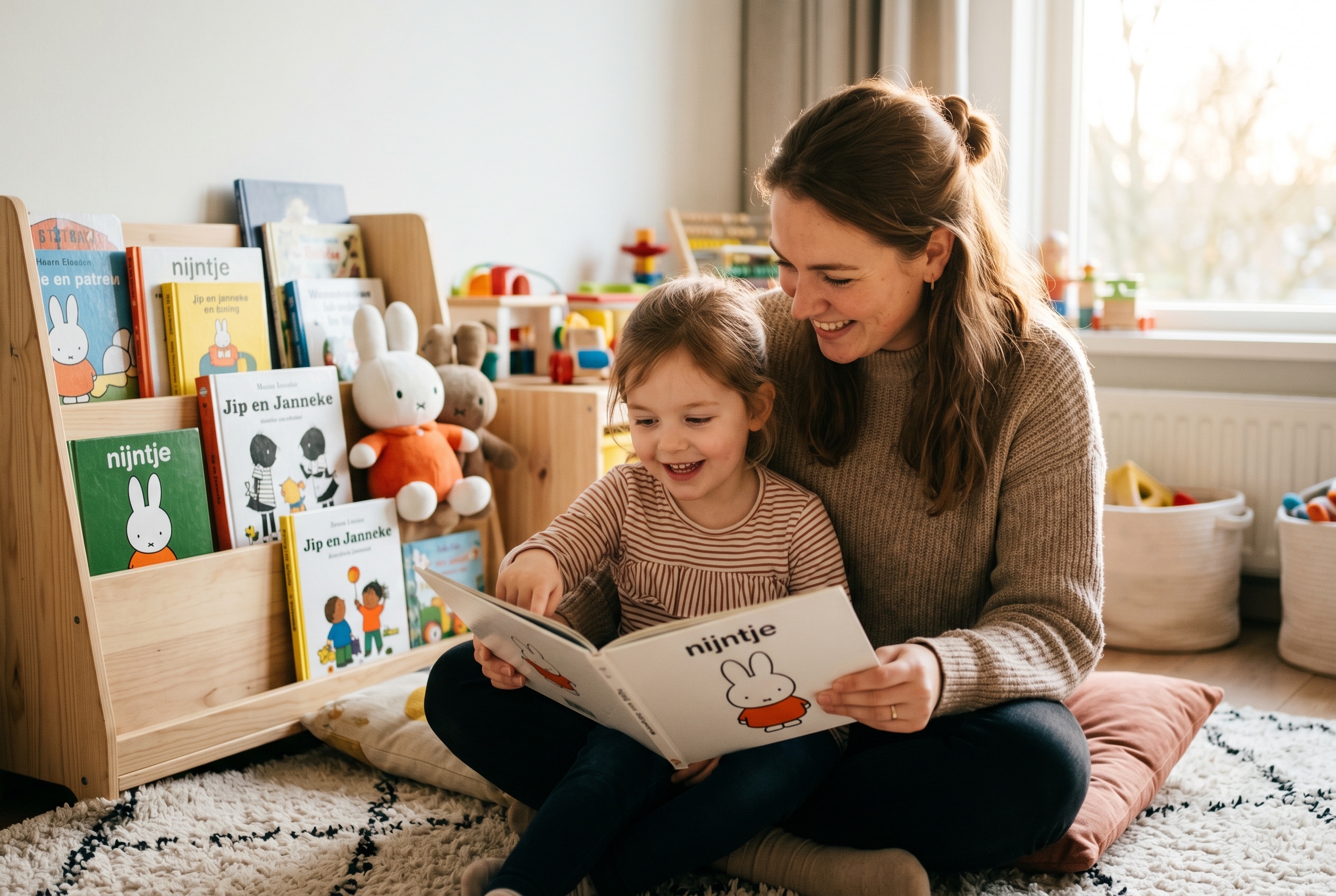
Miffy, the white rabbit drawn by Dick Bruna in 1955, is the canonical first reading material for Dutch children. The books are written in deliberately constrained vocabulary with four-line rhymed stanzas and primary-color illustrations. A tutor who weaves Nijntje into early lessons is teaching language and Dutch culture at the same time. Official Nijntje site.
e.g. Vandaag lezen we Nijntje in de speeltuin.
-
02
Sinterklaas en Kerstmis
Sinterklaas (December 5th, the eve of St. Nicholas Day) is the major Dutch and Flemish gift-giving holiday, distinct from Kerstmis (Christmas), which is more religious and family-focused. The Sinterklaas vocabulary alone is its own world: pakjesavond, strooigoed, chocoladeletter, kruidnoten. A good tutor will weave the seasonal vocabulary into lessons in the right month.
e.g. Sinterklaas komt op vijf december, dan krijgen we cadeautjes!
-
03
Hop hop hop, paardje in galop
A traditional Dutch children's song about a horse galloping, sung while bouncing a child on a parent's lap. Part of the canon of Dutch nursery rhymes alongside "Slaap kindje slaap" and "In de maneschijn." Any tutor working with under-eights should know these songs and use them; they're how Dutch toddlers absorb early phonology and rhythm.
e.g. Hop hop hop, paardje in galop, over de heg in een vliegtuig met pek!
-
04
Het alfabet
The Dutch alphabet is the same 26 letters as English, but with a different pronunciation system. The vowels and several consonants sound noticeably different from English. The Dutch alphabet song teaches your child the spelling-out pronunciation that they'll need every time they spell their name or address aloud. Worth nailing in the first month.
e.g. A is van appel, B is van bal, C is van cake...
-
05
Kleuren en cijfers
Colors and numbers, the universal first-month foundation for kid Dutch. Rood, blauw, geel, groen, oranje, paars, zwart, wit. Een, twee, drie, vier, vijf, zes, zeven, acht, negen, tien. Combined with basic family vocabulary (mama, papa, broer, zus, oma, opa), these give a child enough Dutch to start sentence-building within four weeks.
e.g. Mijn favoriete kleur is blauw, en ik ben zeven jaar.
About Dutch for Kids
Dutch for kids, taught by tutors who like kids
Parents who reach out about Dutch for kids usually fall into one of three patterns. Most common is the expat family relocating to the Netherlands or Belgium, often for a job at a multinational based in Amsterdam, Eindhoven, the Hague, or Antwerp, where the child is enrolled in a Dutch-language school and needs serious preparation before day one. Close behind is the bilingual or heritage family, where a Dutch or Flemish parent (or grandparent) speaks the language at home but the child is growing up mostly in English, and the family wants to keep that Dutch thread alive and active. A third group is the international-school family already living in the Netherlands or Belgium, where the child attends an English-medium school but parents want their child to integrate into Dutch life, make Dutch friends, and reach functional Dutch outside the classroom.
All three are legitimate, and all three need a different kind of tutor than an adult learner needs. A six-year-old will not sit through a grammar drill on de versus het. A nine-year-old who's been told Dutch is hard will close down within five minutes of a lesson that opens with the V2 word order rule. Kids learn Dutch the way they learn any language: through repetition wrapped in something fun. Songs. Picture books. Stories. The Nijntje books (Miffy, the rabbit drawn by Dick Bruna that has become a Dutch cultural export second only to van Gogh and Vermeer). Sinterklaas vocabulary in December. Counting games. The Dutch educational system has its own long tradition of play-based early-childhood pedagogy (the term is spelend leren), and the best kid-focused Dutch tutors work in this tradition.
A word on the bilingual-kids question, because parents always ask it. Decades of research from Ellen Bialystok at York University and many others have established that growing up with two languages does not delay speech, confuse children, or harm school performance. The opposite is the consistent finding: bilingual kids show stronger executive function (the brain's ability to switch tasks and filter distraction) by school age. If your child mixes Dutch and English in the same sentence at age three, that's called code-switching and it's developmentally normal. They are not confused. They will sort it out. The bilingual research literature is one of the most robust in developmental psychology, and the answer is unambiguous: more language exposure is better, not worse, full stop.
Where a tutor adds value is in giving your child consistent, native-quality Dutch input outside the home. That input is what builds an accent that sounds Dutch or Flemish rather than American-doing-Dutch. It builds the vocabulary your child wouldn't get from one parent alone, especially in domains the family doesn't naturally use Dutch for (school, hobbies, friendship, sports, current events). And, especially for older kids, it builds the social context that makes Dutch feel like a real living language rather than a homework assignment. Our Dutch-for-kids tutors include native speakers from across the Netherlands and Flanders, plus longtime bilingual educators who've taught at international schools, weekend Dutch programs, and the Saturday Dutch schools that exist in many American cities with significant Dutch immigrant heritage.
What lessons actually look like depends on your child's age. With ages four to seven, expect lots of show-and-tell with toys, picture cards, short songs, and Nijntje books read aloud and discussed in Dutch. Ages eight to eleven move into structured vocabulary, the first written Dutch sentences, gentle introductions to de versus het through games rather than tables, and reading at the level of the Jip en Janneke stories (the beloved children's series by Annie M.G. Schmidt, written specifically at a young reader's vocabulary level). Ages twelve and up can handle a more traditional lesson structure, often built around what they're watching on YouTube or Netflix, the books they want to read, or preparing for the CNaVT Junior certification if that's a family goal.
The Dutch calendar of children's traditions is rich and your child will need the vocabulary for it. Sinterklaas, celebrated on December 5th (the eve of St. Nicholas Day), is the bigger gift-giving holiday in the Netherlands and Flanders, distinct from Kerstmis (Christmas) which is more religious and family-focused. The vocabulary for Sinterklaas alone is its own world: Sinterklaas, het paard (his horse), pakjesavond (gift evening), strooigoed (the candy traditionally scattered), chocoladeletter (the chocolate letter every child gets), kruidnoten and pepernoten (the spice cookies of the season). Kerstmis vocabulary is its own set. Koningsdag (King's Day, April 27th) is the national orange-clad celebration. Sint-Maarten, on November 11th, involves children with lanterns going door to door singing for candy. A Dutch tutor will weave the seasonal vocabulary into lessons in the relevant month, the same way Dutch teachers do at school.
Nijntje (known internationally as Miffy) deserves a paragraph of her own. The series of children's books drawn by Dick Bruna starting in 1955 has sold over 85 million copies in dozens of languages and is the canonical first reading material for Dutch children. The books are written in a deliberately constrained vocabulary, with four-line stanzas, simple rhyme, and bright primary-color illustrations. Reading Nijntje books aloud in Dutch with your child is one of the most effective ways to build their early vocabulary, and it's an experience Dutch parents have shared with their children for three generations. Most Dutch-for-kids tutors weave Nijntje into early lessons.
Numbers, colors, and basic family vocabulary form the predictable first-month curriculum for any age. Een, twee, drie, vier, vijf. Rood, blauw, geel, groen, oranje, paars. Mama, papa, broer, zus, oma, opa. Songs like "Hop hop hop, paardje in galop" (a traditional Dutch children's song about a horse galloping) and the alphabet song (which uses the Dutch pronunciation of the letters and is essential for spelling-out moments) are early staples. By month three, most kid students can confidently introduce themselves in Dutch, count to 100, name common objects, and hold a basic conversation about their day. By month six, conversational ease at A1 to A2 level is realistic for committed students with weekly lessons and regular at-home exposure.
For families relocating to the Netherlands or Belgium, the Dutch-language school system is the major variable. International schools (the British School in Brussels, the International School of the Hague, the European School of Brussels) teach in English and don't require Dutch for admission, though they may offer Dutch as an extra-curricular. Dutch-medium schools (the regular Dutch and Flemish school systems) teach in Dutch and absolutely require functional Dutch from day one for kids past kindergarten age. Most Dutch and Flemish public schools have a schakelklas or onthaalklas (welcome class) for newcomer children, which provides intensive Dutch immersion for one to two years before transitioning the child into the standard curriculum. A few months of preparation with a Dutch tutor before the move significantly reduces the shock and accelerates the welcome-class transition.
For heritage and bilingual families, the work is reinforcement rather than introduction. The tutor builds on the vocabulary your child already understands passively, pushes toward active production (the gap between understanding and speaking is the central heritage-learner challenge), and gives parents concrete prompts to use between lessons. The goal is your child speaking back in Dutch, not just understanding when spoken to. For older heritage kids, the CNaVT Junior certifications (Profiel Toeristische en Informele Taalvaardigheid, Profiel Maatschappelijke Taalvaardigheid) provide structure and external validation.
The Strommen Dutch for Kids roster includes native speakers from across the Netherlands (Amsterdam, Utrecht, Rotterdam, Groningen, Eindhoven) and Flanders (Antwerp, Ghent, Leuven, Brussels), plus longtime bilinguals based in the United States who have taught Dutch in weekend programs, international schools, and heritage-language classes. Each tutor's bio specifies their background, the age ranges they work best with, and whether they're aimed at expat-prep, heritage-activation, or general kid Dutch. For other Dutch specialties, our Conversational Dutch, Dutch for Beginners, and Dutch for Travel pages cover related programs, and the Dutch course page shows the full family. Browse the full tutor list, pick a tutor whose energy and approach feel right for your child, and book a 30-minute trial. The trial is free, you can sit in, and your child's reaction will tell you everything you need to know about whether this is the right tutor.
What you'll cover
Lessons & classes tailored to Dutch for Kids
Age-calibrated lesson plans
A five-year-old, a nine-year-old, and a fourteen-year-old need three completely different lessons even when the Dutch goal is the same. Your tutor builds the plan around your child's age, attention span, and current level. Younger kids get song-and-picture-card structure with frequent activity changes. Older kids get sustained conversation, reading practice, and the first formal grammar introductions. We never run an adult lesson plan with a child.
Dutch-language school preparation
Families relocating to the Netherlands or Belgium where the child will enter a Dutch-medium school need accelerated, structured preparation. Tutors coordinate where possible with the receiving school's curriculum, prioritize classroom-relevant vocabulary, and build the listening confidence your child will need in the schakelklas or onthaalklas welcome-class period. A few months of pre-move tutoring significantly shortens the school adjustment.
Heritage and bilingual family support
If Dutch is already in the home through a parent or grandparent, the tutor's job is reinforcement, not introduction. We build on the vocabulary your child already passively understands, push toward active production, and give parents concrete prompts to use between lessons. The goal is your child speaking back in Dutch, not just understanding when spoken to. For older kids, the CNaVT Junior certifications provide structure.
Pronunciation that sounds Dutch, not American
Kids pick up pronunciation faster than adults. A native or near-native tutor can give your child the hard or soft G, the long and short vowels, the UI and EI diphthongs, and the SCH cluster early, while their ears are still flexible. By age twelve those sounds get harder to acquire cleanly. Lessons include short listening-and-mimic drills with native audio, so your child hears Dutch from voices beyond the tutor's.
FAQ
About Dutch for Kids lessons & classes
How young can my child start Dutch lessons?
We've taught kids as young as four. Below that age, the practical issue is attention span rather than language readiness; a four-year-old can absorb Dutch fine, but they'll need a parent in the room and a tutor experienced with the toddler bracket. Most of our kid students start between ages five and ten. Lessons are typically 30 or 45 minutes for younger children rather than the standard hour. The earlier a child starts, the more native-like their accent tends to be in the long run.
Is the Dutch-language school in the Netherlands harder or easier than the English-medium international school?
It depends on your child's age, personality, and pre-arrival Dutch level. Dutch-medium schools are typically much cheaper than international schools (most are free, since they're part of the Dutch public system), produce stronger Dutch fluency, and integrate your child socially into Dutch life. International schools are easier for the child's immediate transition, preserve English as the primary academic language, and produce a smoother academic record for kids who may move again. Many families start in the international school and transition to the Dutch system once the child's Dutch is solid; others go straight into the Dutch system with a few months of tutor prep.
Will my child learn Dutch faster than I will?
Almost certainly. The child language acquisition window is real and powerful. Kids absorb pronunciation, intonation, and grammatical intuition faster than adults, especially under age 12. A child immersed in Dutch through school plus a few hours of weekly tutoring typically reaches functional fluency in 12 to 18 months. The same adult would typically take 2 to 4 years with similar exposure. This is one of the reasons many expat families prioritize the child's Dutch lessons even when their own Dutch is still slow.
Will learning Dutch confuse my child if they already speak English at home?
No. This is the most common parent worry and the research is unambiguous. Studies by Ellen Bialystok at York University and many others have shown that growing up bilingual does not delay speech, harm school performance, or cause lasting confusion. If your child mixes Dutch and English in one sentence at age three, that's called code-switching and it's developmentally normal. They will sort the two languages out as they get older, and they may show stronger executive function as a side benefit.
Are your Dutch-for-kids tutors native speakers?
Most are native Dutch speakers from the Netherlands or Belgium. Some are longtime bilinguals who grew up in Dutch-speaking households outside Europe and have taught at international schools, weekend Dutch programs, or heritage-language classes in the United States. Each tutor's bio specifies their background and regional accent. If your family speaks Flemish at home, we'll match you to a Flemish tutor so your child's accent stays consistent.
What does a typical kid Dutch lesson look like?
It depends entirely on your child's age. A five-year-old's 30-minute lesson might include a song, picture cards for ten new words, a Nijntje book read aloud, and a short game. A ten-year-old's hour might include conversation in Dutch about their week, vocabulary review, a Jip en Janneke story, and a small writing exercise. A teenager's lesson can look much closer to an adult lesson but stays connected to what they're actually interested in: YouTube, music, games, books, or pre-relocation curriculum.
Can my child prepare for a Dutch youth language certification?
Yes. The CNaVT Junior offers several profile certifications at A2 and B1 levels designed for kids and teens. The Staatsexamen NT2 is available for older teens at B1 or B2 level. Many Dutch and Flemish weekend programs use these certifications as milestones. Several of our tutors have prepared students for both, with mock exams included in prep. Plan on 3 to 6 months of consistent lessons before sitting the exam, depending on starting level.
How long until my child is conversational in Dutch?
Honest answer: it depends on starting level, lesson frequency, and how much Dutch they hear outside lessons. A child with no Dutch exposure, taking one 45-minute lesson a week, will be able to hold a simple conversation in 6 to 9 months. A child with a Dutch-speaking parent at home, supplementing lessons with daily exposure, can get there in 3 to 4 months. A child enrolled in a Dutch-medium school with weekly tutoring will typically reach functional conversational fluency within 12 to 18 months. Your tutor sets concrete short-term goals at the trial and updates them monthly.
Ready for Dutch for Kids lessons or classes?
Book a free 30-minute trial with one of our personally vetted tutors. Private lessons or small-group classes — your choice.