



Personally vetted instructors
Flemish tutors, lessons & classes
Goeiendag, alles goed? How Flanders opens a conversation, softer and slower than its northern neighbor.
Personally vetted tutors of Flemish, the Dutch spoken in Belgium. Mutually intelligible with Netherlands Dutch but distinct in vocabulary, accent, and feel. The everyday language of Antwerp, Ghent, Bruges, and Belgian Limburg.
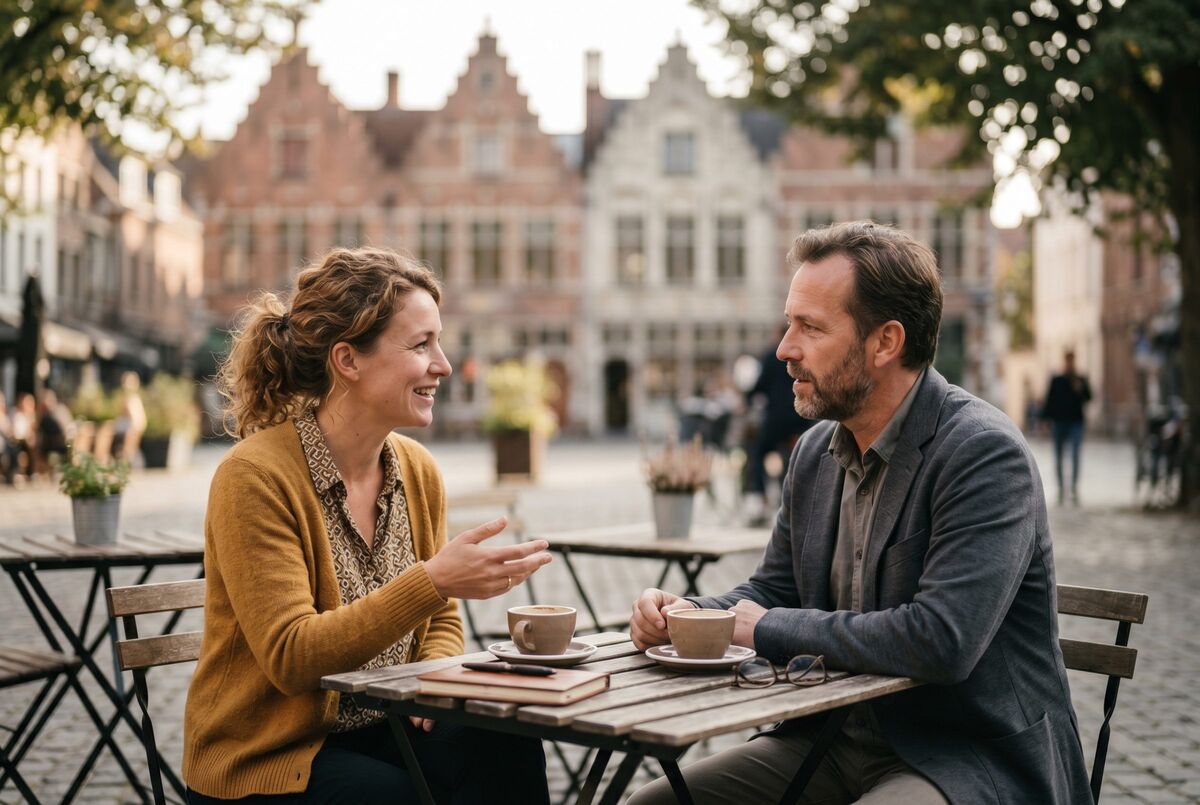
Your instructors
Flemish tutors for private lessons & classes
Strommen teaches Belgian and Netherlands Dutch as separate specializations because students who want one usually don't want the other. Every Flemish tutor below was met and vetted by us. No marketplace. No automated profile-creation. Real Flemish speakers with documented backgrounds.
Filter by location, age, or price. Then book a 30-minute free trial.
Below are the Strommen tutors who specialize in Flemish. Photos, ratings, and rates are real. Click any card to read their bio and book a free 30-minute trial.
I want to learn…
Every tutor, personally met. — founder-vetted since 2006, in Los Angeles and online worldwide.
Get a personalized plan
Pick your language — a language advisor will match you with the right tutor and map out your path.


I have a Master's degree in Communication Sciences
From Amsterdam's Heart to Global Fluency, Eser Offers Experience-Driven Coaching!
Specialties
I have a Master's degree in Communication Sciences
From Amsterdam's Heart to Global Fluency, Eser Offers Experience-Driven Coaching!
Specialties
Vlaamse koek — culture & expressions
5 phrases that mark you as someone who knows Flanders
These won't be in a generic Dutch textbook. They're Flemish, and they're how Belgians spot someone who's learned the language their way. Screenshot them. Then book a tutor for the rest.
-
01
Allez
Used constantly in Flemish conversation. Borrowed from French, used as a filler word equivalent to "come on," "well," "so," or "let's go" depending on context. Pure Belgian.
e.g. Allez, we gaan!
-
02
Goesting
"Desire," "craving," "appetite for something." One of the most-loved Flemish words. Netherlands Dutch would say zin in. Goesting is purely Belgian and one of the words that won Flemish-vocabulary popularity polls.
e.g. Ik heb goesting in friet.
-
03
Een tas koffie
"A cup of coffee." Netherlands Dutch says een kopje koffie. Tas is purely Belgian (from French tasse). Saying een tas in the Netherlands marks you instantly as someone from south of the border.
e.g. Een tas koffie en een chocolade-koffiekoek, alstublieft.
-
04
Het is gezegd geweest
"It has been said." Flemish uses a double past tense construction (geweest after the participle) that Netherlands Dutch doesn't. Sounds normal in Antwerp, weird in Amsterdam.
e.g. Het is gezegd geweest, dus we doen het zo.
-
05
Smos
A Belgian-style sandwich with multiple toppings. Pure Flemish food vocabulary. Locals will not stop arguing about which bakery makes the best one.
e.g. Ik neem een smos met kaas en ham, graag.
About Flemish
Dutch, but with a Belgian soul
Flemish is Dutch as spoken in Belgium. Roughly 6.5 million people speak it across Flanders, the northern half of Belgium, plus another half-million Flemish speakers in Brussels (which is officially bilingual French and Dutch). The technical name for the standard form is Belgian Dutch (Belgisch Nederlands). The informal name, used by speakers themselves and recognized internationally, is Flemish (Vlaams).
Flemish and Netherlands Dutch are mutually intelligible. A Flemish speaker from Antwerp and a Dutch speaker from Amsterdam can hold a complex conversation without difficulty. But the two varieties have meaningfully diverged. Flemish has softer pronunciation, slower cadence, distinct vocabulary in everyday domains, French loanwords the Dutch don't use, and a different register sensibility (Flemish speakers tend to use formal language more often than Netherlands Dutch speakers do). To a trained ear, the differences are obvious within seconds.
There are also strong regional dialects within Flanders. West Flemish (spoken in West Flanders around Bruges and Kortrijk) is famously hard for other Dutch speakers to understand, with its own preserved older Germanic features. East Flemish (Ghent and surroundings) is softer and more melodic. Antwerps is the urban dialect of Antwerp and the surrounding province, with its own characteristic sound and vocabulary. Limburgs (Belgian Limburg, eastern Flanders) shares features with the Limburg dialect of the Netherlands and is sometimes treated as a separate language altogether.
If you're learning Flemish specifically (as opposed to general Dutch), you almost certainly have a Belgian reason. Family ties to Flanders. A move to Antwerp, Ghent, or Brussels for work. A Flemish partner. Engagement with the Belgian cultural scene, which has produced some of Europe's most acclaimed contemporary art, film (the Dardenne brothers, Jaco Van Dormael), and literature (Hugo Claus, Tom Lanoye, Stefan Hertmans). Or you've been told by Dutch teachers that you'll "just learn Dutch" and you want a tutor who actually knows Belgium.
Our Flemish tutors are native speakers from Antwerp, Ghent, Bruges, Leuven, Brussels, and the Limburg region. Most teach the standard register (Standaardnederlands as used in Flanders) plus introduce you to the regional dialect of their home area. Lessons cover the sound system, vocabulary that diverges from Netherlands Dutch, the social register sensibilities of Flemish, and the cultural framework: Flemish identity within Belgium, the language politics that shape daily life, the history of the Flemish Movement, and the contemporary cultural output that makes Flanders one of Europe's most interesting small cultural regions.
If you already speak any Germanic language, you have a head start. German speakers tend to find Dutch the easiest second Germanic language to learn. English speakers also do well because of the shared vocabulary and grammatical similarities. If you're coming in with a Romance-language background or no Germanic at all, the path takes longer but is absolutely doable.
What you'll cover
Lessons & classes tailored to Flemish
The Flemish sound system
Lessons focus on what makes Flemish sound Flemish: softer g sound (the Dutch hard guttural g is replaced by a softer sound in Flanders), slower cadence, distinct intonation. Real audio from Flemish speakers across regions, plus feedback that helps you hear and reproduce the Belgian Dutch sound profile rather than the Netherlands one.
Vocabulary that diverges from Netherlands Dutch
Hundreds of everyday words differ between Flemish and Netherlands Dutch. Some are French loanwords Flemish uses and Dutch doesn't (camion, salon, fourchette). Others are different Germanic choices (kuisen vs. schoonmaken for cleaning, beenhouwer vs. slager for butcher). We teach these in coherent fields so you build a Flemish-aligned vocabulary, not a Dutch one.
Regional dialects of Flanders
West Flemish (Bruges, Kortrijk, Ostend) sounds different from East Flemish (Ghent), which sounds different from Antwerps (Antwerp province), which sounds different from Limburgs (Belgian Limburg). Tell us which region matters to you and we'll match accordingly. Most students start with standard Flemish and add a regional flavor based on where they're going.
Belgian cultural framework
Flanders has produced disproportionate cultural output for a small region: medieval Flemish painters, Hugo Claus's novels, the Dardenne brothers' films, the Antwerp Six fashion designers, contemporary writers like Tom Lanoye and Stefan Hertmans. Optional but most students want it: lessons covering Flemish cultural history, the politics of Belgian federalism, and the contemporary Flanders that has become one of Europe's quietly important cultural centers.
FAQ
About Flemish lessons & classes
Is Flemish a separate language from Dutch?
Linguistically, no. Flemish is a variety of Dutch (Belgian Dutch) and is mutually intelligible with Netherlands Dutch. Politically and culturally, many Flemish speakers consider Flemish to have its own identity. The two share a standard written form but diverge in spoken vocabulary, pronunciation, and register sensibilities.
Should I learn Flemish or Netherlands Dutch?
Depends on your destination. If you're going to Belgium (Antwerp, Ghent, Bruges, Brussels), learn Flemish. If you're going to the Netherlands (Amsterdam, Rotterdam, Utrecht), learn Netherlands Dutch. The two are mutually intelligible, so you can cross over later. But starting in the variety of your destination saves you accent and vocabulary recalibration.
Can I take Flemish lessons online or only in person?
Both. Most of our Flemish tutors teach online via Zoom or Jitsi, available globally. A few teach in person around Los Angeles. The booking widget on each tutor's profile shows their formats.
How fast can I get conversational in Flemish?
If you already speak English, German, or another Germanic language, conversational comfort takes most students 4 to 6 months at one or two lessons a week with self-study. From zero with no Germanic background, more like 8 to 12 months. Reading comfortably with novels and news takes longer. Your tutor sets realistic weekly goals at the trial.
Will learning Flemish help me understand Netherlands Dutch?
Yes, almost completely. The two are mutually intelligible. After learning Flemish you'll understand Netherlands Dutch with minor adjustment, mostly to faster pace and harder g sounds. You may not speak with a Dutch accent, but comprehension transfers directly.
Is West Flemish really that different?
Yes, it's the most divergent of the Flemish dialects, with preserved features other Dutch varieties have lost. Some linguists consider it a separate language. Standard Flemish speakers from elsewhere in Flanders sometimes struggle with thick West Flemish. We can teach it if you have a specific connection to West Flanders, but most students start with standard Flemish.
Do Belgians actually speak Flemish at home or do they use a dialect?
Most Belgians speak a regional dialect at home and use standard Flemish in formal contexts (work, media, school). The diglossia is similar to Switzerland's, though less stark. Younger Belgians and urban speakers tend toward a dialect-flavored standard Flemish rather than full traditional dialect.
Ready for Flemish lessons or classes?
Book a free 30-minute trial with one of our personally vetted tutors. Private lessons or small-group classes — your choice.