



Personally vetted instructors
Hindi for Beginners tutors, lessons & classes
नमस्ते namaste Namaste, the safest "hello" in Hindi, usable with anyone.
Personally vetted Hindi tutors who teach absolute beginners. Lessons that start with the script, the sounds, and the survival vocabulary, then build toward real conversation.
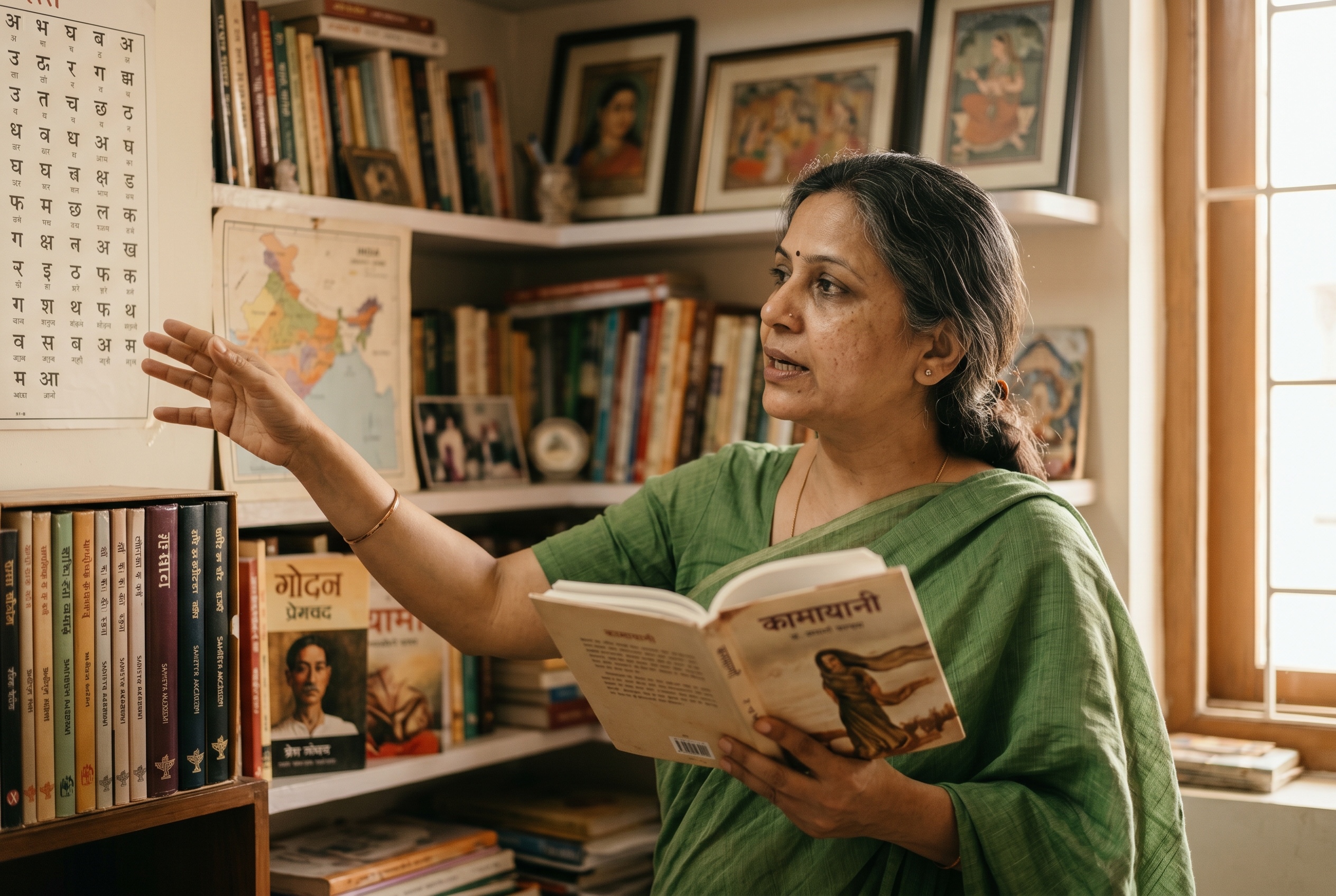
Your instructors
Hindi for Beginners tutors for private lessons & classes
Strommen is a curated boutique language school, not a marketplace. Hindi is one of our smaller rosters, and the teacher below was met and vetted by us before they ever taught a lesson. If their schedule does not fit yours, send a note via the trial form and we will reach into our wider Hindi network to match you. There is no automated profile-creation here, no anonymous listings.
Read the bio, then book a 30-minute free trial.
Below is the Strommen tutor who specializes in teaching Hindi to beginners. Photo, ratings, and rates are real. Click the card to read the bio and book a free 30-minute trial.
I want to learn…
Every tutor, personally met. — founder-vetted since 2006, in Los Angeles and online worldwide.
Get a personalized plan
Pick your language — a language advisor will match you with the right tutor and map out your path.


देवनागरी — script & first phrases
5 things every Hindi beginner needs in week one
These are the survival items a good tutor gives you in your first sessions. Screenshot them, then book a tutor to learn the rest.
-
01
नमस्ते namaste
"Hello." The most flexible greeting in Hindi, religion-neutral in practice, usable with anyone of any age. Often paired with palms pressed together. The fuller, more respectful form is नमस्कार (namaskār), reserved for elders or formal occasions.
e.g. नमस्ते, आप कैसे हैं? namaste, āp kaise hain? ("Hello, how are you?")
-
02
धन्यवाद dhanyavād
"Thank you." The neutral, slightly formal way to say it. In casual speech शुक्रिया (shukriya), borrowed from Urdu, is just as common and lands warmer between friends. Both are understood everywhere Hindi is spoken.
e.g. बहुत धन्यवाद bahut dhanyavād ("thank you very much")
-
03
आप कैसे हैं? āp kaise hain?
"How are you?" in the formal आप register. To a woman the adjective shifts: आप कैसी हैं? (āp kaisī hain?). Hindi marks gender on adjectives, so the question itself changes depending on who you are addressing. Friends would use the तुम form: तुम कैसे हो? (tum kaise ho?).
e.g. नमस्ते जी, आप कैसे हैं? namaste jī, āp kaise hain? ("Hello sir/ma'am, how are you?")
-
04
देवनागरी devanāgarī
The script Hindi is written in. Eleven vowels, thirty-three consonants organized in a grid by mouth position, plus the matra system of vowel-marks that attach to consonants. Reads left to right. Looks intimidating from the outside, gets orderly fast once a tutor walks you through the grid.
e.g. क ka, का kā, कि ki, की kī, कु ku, कू kū (one consonant with five vowel matras)
-
05
आप / तुम / तू āp / tum / tū
The three Hindi words for "you," each with its own verb endings. आप is formal and respectful, used with elders, strangers, and anyone you want to show deference to. तुम is familiar, used with friends and equals. तू is intimate, used inside the family or between very close friends and read as rude almost anywhere else. Choosing the right one is built into every Hindi sentence.
e.g. आप क्या करते हैं? (formal) vs तुम क्या करते हो? (familiar)
About Hindi for Beginners
Where a Hindi beginner actually starts
Hindi sits in the top tier of world languages by speaker count, with the Central Hindi Directorate (केन्द्रीय हिन्दी निदेशालय) listing it as the official language of the Union alongside English and the literary tongue celebrated by the Sahitya Akademi every year, yet most adults outside South Asia who set out to learn it stall in the first weeks. The reason is almost never that Hindi is too hard. It is that the early lessons were sequenced badly. The Devanagari script, the unfamiliar consonant set, the everyday survival vocabulary, the tiny particles that carry so much grammatical weight, and the verb conjugations all have to arrive in the right order, and they almost never do in self-study.
A Hindi beginner course done right starts with the script. The Devanagari alphabet (देवनागरी) is more orderly than the Roman one once you see how it is laid out. You learn the vowels first, eleven of them with paired short and long forms, then the consonants, organized in a grid by where in the mouth each sound is made. Then you learn the matras, the vowel-modifier marks that attach to consonants to form syllables. Within a few weeks of patient lessons most adults can read short words and street signs. None of this is mysterious. It just has to be taught by someone watching your hand and your mouth.
The sounds are where a tutor earns the lesson fee. Hindi has a series of distinctions that English does not mark. Aspirated consonants are paired with their unaspirated partners (क ka and ख kha, त ta and थ tha, प pa and फ pha), and the difference is a strong puff of breath on the aspirated letter. Retroflex consonants (ट ट ड ण) are made with the tongue curled back, and they are not the same as the dental versions (त थ द न), which sit at the teeth. To an untrained ear the pairs sound identical. To a Hindi speaker they distinguish entirely different words. A tutor isolates each pair and drills it in real time, which is the part an app cannot do.
After script and sound, the third early piece is a survival vocabulary tuned to what you actually want to do. Greetings, introductions, numbers, asking prices, ordering food, telling a rickshaw driver where to turn. Most beginners benefit from learning these words inside short, useful sentences rather than as flashcards, so the grammar comes in with the word from day one.
The fourth piece is what beginners almost never see coming: Hindi grammar runs on small words doing big work. Hindi is a postpositional language, meaning where English uses prepositions before nouns (in the house, to the market), Hindi uses postpositions after nouns (घर में ghar mein, बाज़ार को bāzār ko). The case-marking particle ने ne attaches to the subject of certain past-tense verbs and is one of the first things that throws learners who arrived via European languages. None of these are difficult ideas in isolation. They simply work nothing like English, and a good tutor frames them as a new operating system rather than a translated one.
The fifth piece, verb conjugations, opens up once the small words are in place. Hindi marks verbs for tense, aspect, gender, and number. The verb agrees with the subject in some constructions and with the object in others. Again, this is patterned rather than chaotic, and a good first three months covers present, future, and one past tense with enough sample sentences that you can actually use them.
And then there is the register question, which beginners often do not realize they are about to encounter. Hindi has a three-way pronoun split for "you": आप āp (formal, for elders, strangers, anyone you want to show respect to), तुम tum (familiar, for friends and equals), and तू tū (intimate, used inside the family or between very close friends, and read as rude or condescending almost anywhere else). The verb endings change with each pronoun, so the choice is not optional politeness — it is built into every sentence you say. A tutor calibrates which one you use with whom and walks you through the verb forms that go with each.
One more orientation point. Spoken Hindi and spoken Urdu are, at the conversational level, the same language: a single grammar, a shared core vocabulary, and a long literature collectively called Hindustani in the sociolinguistic literature. The differences sit at the edges. Hindi uses Devanagari and reaches into Sanskrit for higher-register words; Urdu uses the Nastaliq Perso-Arabic script and reaches into Persian and Arabic. A beginner studying Hindi can carry on a comfortable conversation with an Urdu speaker about everyday things long before reading either literary register fluently. Worth knowing because Bollywood, the easiest source of input you will find, mixes both registers freely.
The tutors below teach Hindi from absolute zero. Anyone weighing private lessons against a group setting can compare both on the main Hindi page.
What you'll cover
Lessons & classes tailored to Hindi for Beginners
The Devanagari script, from the first letter
Eleven vowels, thirty-three consonants arranged in the orderly grid by point of articulation, and the matra system of vowel marks that attach to consonants to form syllables. Lessons cover the conjuncts (joined consonants), the inherent vowel rule, and the visarga and anusvara marks that confuse self-learners. Tutors watch your handwriting as it forms and correct it in real time, which is the part an app cannot do.
Aspirated, retroflex, and the sounds English does not have
Direct drilling on the consonant pairs that distinguish Hindi words from each other. Aspirated versus unaspirated (क ka and ख kha, त ta and थ tha), and retroflex versus dental (ट versus त, ड versus द, ण versus न). These are not optional polish. They distinguish meaning, so tutors isolate them in week one and do not let students paper over them with English approximations.
Postpositions, case particles, and the small words doing big work
Hindi grammar runs on tiny words placed after nouns rather than before them. में mein for "in," को ko for "to," से se for "from," का / की / के for possession. Plus ने ne, the ergative case marker that attaches to subjects of certain past-tense verbs. These are unfamiliar to English speakers and central to making any Hindi sentence work. Lessons frame them as a new operating system, not a translation puzzle.
Verb conjugations and the आप / तुम / तू register
Present, future, and one past tense in the first three months, with the verb agreements that go with each pronoun set. Beginners learn the three-way "you" split (formal आp, familiar तुम, intimate तू) alongside the verb endings each one takes, because the choice is built into every sentence rather than added as politeness on top. Tutors calibrate which register you use with whom.
FAQ
About Hindi for Beginners lessons & classes
Do I really need to learn the Devanagari script, or can I use transliteration?
You need the script, and starting it is part of the first lessons. Roman transliteration of Hindi is a useful crutch for the first couple of weeks, but it is inconsistent across sources, cannot represent the aspirated and retroflex distinctions cleanly, and slows everything down once you try to read anything authentic. Devanagari has only 44 letters and is laid out in a logical grid by mouth position, so most beginners are reading short words within a few weeks of lessons. A tutor watches your handwriting form and corrects it as you go, which is why this goes much faster with a teacher than alone.
What is the difference between Hindi and Urdu, and does it matter for a beginner?
At the spoken conversational level, Hindi and Urdu are essentially the same language, often called Hindustani in the sociolinguistic literature. They share the same grammar and a large core vocabulary. The differences sit at the edges: Hindi uses the Devanagari script and draws on Sanskrit for higher-register words, while Urdu uses the Nastaliq Perso-Arabic script and draws on Persian and Arabic. A Hindi beginner can hold a comfortable everyday conversation with an Urdu speaker long before either of you can read the other's literary register. Worth knowing because Bollywood, the easiest source of listening practice, mixes both freely.
Are your tutors native Hindi speakers?
Hindi is one of our smaller rosters. The tutor below is a native speaker, vetted by us in person before teaching a Strommen lesson. Each bio specifies background, training, and the regional variety they speak. If the schedule does not match yours, send a note through the trial form and we will reach into our wider Hindi network to find a match.
Can I take Hindi lessons online, or only in person?
Both. Our Hindi tutor teaches online via Zoom or Jitsi and is available to students anywhere. In-person lessons in the Los Angeles area are possible by arrangement. The booking widget on the tutor profile shows available formats, and the trial form is the fastest way to confirm.
How long until I can hold a basic conversation in Hindi?
It depends on your hours, your starting point, and how regularly you practice between lessons. With one or two lessons a week plus consistent self-study, most beginners reach simple functional conversation in roughly 4 to 8 months: greetings, introductions, prices, directions, ordering food, telling someone where you live. Solid reading comfort with newspaper or literary Hindi takes longer, often a year or more. Your tutor sets concrete weekly goals at the trial and adjusts as you go.
I tried learning Hindi before from an app and stalled. Will lessons be different?
Usually yes, and the reason is structural. Most app-only learners stall because they picked up scattered vocabulary without ever working through the script, the aspirated and retroflex sound distinctions, or the postposition system that makes Hindi grammar tick. A tutor diagnoses where the earlier attempt went sideways and rebuilds from there. The 30-minute trial is largely a diagnostic conversation, so come prepared to say what you tried and where it stopped working.
What does a beginner Hindi lesson actually look like?
Lessons are one-on-one and built around your goals. An early-stage hour might mix script practice, drilling on the aspirated or retroflex sound pairs, a small grammar point like postpositions or the आप / तुम / तू split, and survival phrases tied to whatever you want to be able to do in Hindi. Tutors plan each lesson around the student rather than running a fixed curriculum, so two beginners with different goals get different lessons.
Is Hindi a good entry point if I eventually want to learn another South Asian language?
Often, yes. Hindi and Urdu share spoken grammar and vocabulary almost entirely, so a Hindi foundation gives you a head start on Urdu, particularly if you later add the Nastaliq script. Hindi and Punjabi share a great deal of vocabulary and similar grammatical patterns. Other Indo-Aryan languages like Marathi, Gujarati, and Bengali share grammatical structure, though scripts and vocabulary diverge more. Dravidian languages such as Tamil and Telugu are structurally quite different and do not transfer in the same way. Your tutor can sketch the lay of the land at the trial if you have a longer-term plan in mind.
Ready for Hindi for Beginners lessons or classes?
Book a free 30-minute trial with one of our personally vetted tutors. Private lessons or small-group classes — your choice.