



Personally vetted instructors
Korean for Travel tutors, lessons & classes
안녕하세요 Annyeonghaseyo. The polite "hello" every traveler to Korea needs first.
Personally vetted Korean for Travel tutors. Lessons calibrated to the actual situations a traveler hits in Seoul, Busan, and Jeju: the subway, the cafe counter, the restaurant menu, and the small social moments that decide how a foreign visitor is received.
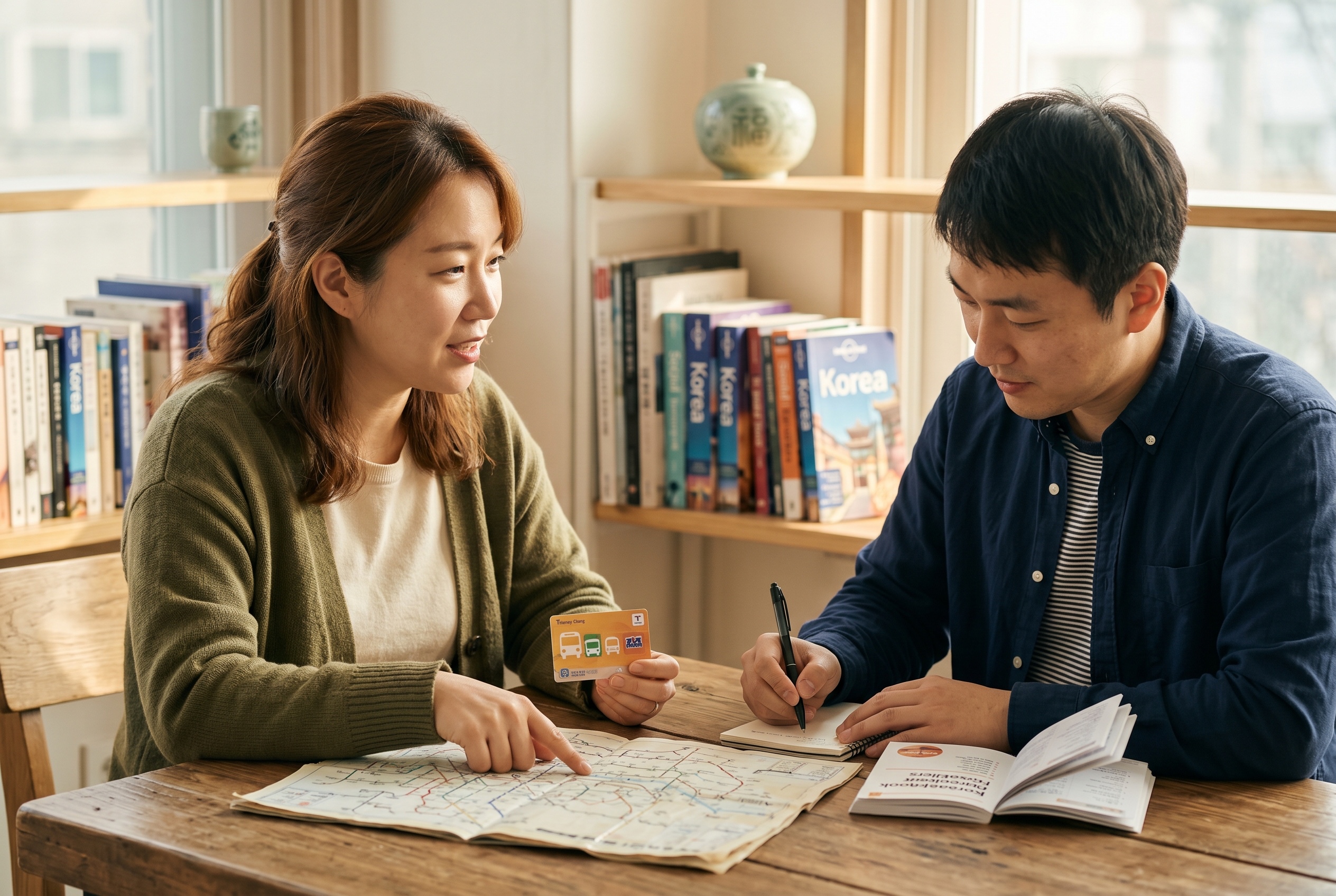
Your instructors
Korean for Travel tutors for private lessons & classes
Strommen has been teaching Korean since well before the current wave of travel interest in Korea, and travel-focused study has always drawn a particular kind of student: someone with a trip on the calendar and a specific list of things they want to handle on the ground. Strommen is a curated practice rather than an open marketplace. Every teacher below was met and vetted by us, and each bio is the tutor's own account of their background.
Filter by location, age, or price. Then book a 30-minute free trial and bring your travel dates.
Below are the Strommen tutors who specialize in Korean for Travel. Photos, ratings, and rates are real. Click any card to read a bio and book a free 30-minute trial.
I want to learn…
Every tutor, personally met. — founder-vetted since 2006, in Los Angeles and online worldwide.
Get a personalized plan
Pick your language — a language advisor will match you with the right tutor and map out your path.



Master of Arts (M.A.) in Education from the University of the People (US)Bachelor of Arts (BA) in Teaching Korean as a Second Language from the Korean Education Bank (Korea)Bachelor of Arts (BA) in International Commerce and Logistics from Seoul Cyber... · Level 2 Certificate of Korean Language Teaching
Multilingualism, Specialized Education, Extensive Experience, Target Audience, Practical Skills
Personally vetted · Strommen’s note
Sanghoon teaches Chinese, English, and Korean out of Hangzhou, pulling material from work with students across very different backgrounds.
Specialties
Master of Arts (M.A.) in Education from the University of the People (US)Bachelor of Arts (BA) in Teaching Korean as a Second Language from the Korean Education Bank (Korea)Bachelor of Arts (BA) in International Commerce and Logistics from Seoul Cyber... · Level 2 Certificate of Korean Language Teaching
Multilingualism, Specialized Education, Extensive Experience, Target Audience, Practical Skills
Specialties
Personally vetted · Strommen’s note
Sanghoon teaches Chinese, English, and Korean out of Hangzhou, pulling material from work with students across very different backgrounds.
Masters' degree in Adult Education · New York State Professional teaching Korean language for K7-12
Learn Korean language from a cerfitied teacher!
Personally vetted · Strommen’s note
Twenty years teaching Korean, NYC-based and certified, and Nari still builds lessons around whatever culture-embedded material actually fits the student.
Specialties
Also speaks: English
Masters' degree in Adult Education · New York State Professional teaching Korean language for K7-12
Learn Korean language from a cerfitied teacher!
Specialties
I also speak: English
Personally vetted · Strommen’s note
Twenty years teaching Korean, NYC-based and certified, and Nari still builds lessons around whatever culture-embedded material actually fits the student.

Bachelor's degree · Chinese learning, Certified Korean language teacher
Light, Learning, Growth your languages.
Personally vetted · Strommen’s note
Jihoon starts with pronunciation basics, tongue position included, before moving into grammar. He teaches Chinese and Korean both, out of Bogotá.
Specialties
Also speaks: Japanese
Bachelor's degree · Chinese learning, Certified Korean language teacher
Light, Learning, Growth your languages.
Specialties
I also speak: Japanese
Personally vetted · Strommen’s note
Jihoon starts with pronunciation basics, tongue position included, before moving into grammar. He teaches Chinese and Korean both, out of Bogotá.
bachelor
Korean teacher fluent in Chinese and English
Specialties
bachelor
Korean teacher fluent in Chinese and English
Specialties

여행 한국어 — travel Korean
5 things a traveler to Korea actually needs to know
These are not vocabulary lists. They are the cultural defaults and small habits that decide how a foreign visitor is received in Korea. Save the card and book a tutor to drill the language that goes with each.
-
01
T-money 티머니 transit card
The single most useful purchase a visitor makes at Incheon Airport. It works on every Seoul subway line, every city bus, most intercity buses, and a great many cabs, with reload kiosks in every station and convenience store. A traveler with a T-money card moves through Korean cities without ever standing at a ticket machine, which is a substantial quality-of-life upgrade for a short trip.
e.g. Buy a T-money card at the AREX counter at Incheon Airport, top up 30,000 won, tap in on the subway, and you're set for a week of normal movement around Seoul.
-
02
주세요 (juseyo)
The polite request ending, the rough Korean equivalent of "please give me" attached to a noun. 물 주세요 (water please), 메뉴 주세요 (menu please), 계산서 주세요 (the bill please), 이거 주세요 (this one please, while pointing). A traveler who controls 주세요 has solved the largest single category of useful Korean for the trip, because almost every transactional request collapses into the same construction.
e.g. At a cafe counter: 아이스 아메리카노 한 잔 주세요. ("One iced Americano please.")
-
03
Bow vs head-nod
A small head bow is the polite default for thanks, hello, and goodbye, and is appropriate almost everywhere a traveler will be. A deep bow is reserved for formal situations and elders, and a tourist does not generally need it. A handshake is common in business, often combined with a small bow. The bigger traveler mistake is not bowing too little but standing too close, talking too loud in transit, or failing to step back when an elder is moving toward a seat.
e.g. Receiving change from a shop clerk, a small head bow plus 감사합니다 is the right register. A 90-degree bow would read as overdone.
-
04
Spicy-level negotiation (안 매워요 / 조금 덜 매워요)
Korean food runs spicier than the baseline many travelers are used to, and the standard ways to soften an order are 안 매워요 (an maewoyo, not spicy please) and 조금 덜 매워요 (jogeum deol maewoyo, a little less spicy please). The request is heard and adjusted, though the cultural baseline is high, so a dish billed as mild may still register as moderately spicy to a non-spicy eater. Worth saying anyway.
e.g. Ordering 떡볶이 (tteokbokki, spicy rice cakes): 안 매운 걸로 주세요. ("Please make it not spicy.")
-
05
Convenience-store (편의점) culture
CU, GS25, 7-Eleven, and Emart24 are everywhere in Korean cities, open 24 hours, and stocked with hot meals, banking services, package pickup, and a wide range of everyday infrastructure a visitor leans on hard. They are also a low-stakes place to practice ordering, since staff are used to non-Korean speakers and the transactions are short. A traveler who can read enough Hangul to navigate the shelves at 2am has a much easier trip.
e.g. Late-night meal at a GS25: read the labels on the 도시락 (dosirak, lunchbox) shelf, microwave it at the counter, eat at the standing table.
About Korean for Travel
Korean for the trip, not the textbook
Korean for Travel is its own kind of preparation. A traveler does not need to write a Korean essay, pass TOPIK, or unpack the wa-versus-ga distinction. A traveler needs to land in Incheon, get through immigration without freezing on the polite greeting, navigate the Seoul subway without standing on the wrong side of the platform, order at a cafe counter without panicking when the staff answers in fluent Konglish, eat at a restaurant where the menu is entirely in Hangul, and read the social cues around bowing, thanking, and stepping back to let an elder pass. The grammar a traveler needs is a small subset of the standard beginner syllabus. The vocabulary is highly situational. The politeness register is non-negotiable and concrete. A tutor who teaches Korean for travel teaches that subset deliberately rather than running a tourist through an academic course they will not finish.
The first thing worth knowing, honestly, is that Seoul is very navigable in English. Subway signage is bilingual in Hangul, English, and often Chinese. Most major attractions have English information. Younger Koreans, especially those working in cafes and at airport counters, speak functional English and will often answer your halting Korean in fluent English to be efficient. None of that means Korean is unnecessary. It means the use case is different. Korean on a trip is not survival language; it is the difference between being a foreign tourist who is politely accommodated and a foreign guest who shows up with the courtesy of having learned a few essentials. Koreans notice, the social temperature changes, and the trip is better for it. A traveler who can open with 안녕하세요, say 감사합니다 properly, and ask for the bill in Korean reads as someone who took the country seriously.
The politeness layer is where a travel-focused tutor spends real time. Korean encodes hierarchy in the grammar in ways English does not, and a tourist who tries to say "please" by translating the word will produce a sentence that does not exist. The Korean equivalent is the verb ending -주세요 (juseyo), attached to a request: 물 주세요 (mul juseyo, please give me water), 메뉴 주세요 (please give me the menu), 계산서 주세요 (please give me the bill). A traveler who controls 주세요 has solved the largest single category of useful Korean for the trip. Around it sit the polite -요 form for any statement to a stranger, the formal 합니다 endings for set phrases like 감사합니다 and 죄송합니다, and a strong cultural default toward addressing service staff with respect rather than the curt tone an English speaker might fall into out of habit. The polite register is the safe default in every traveler situation. There is no traveler context in Korea where casual 반말 is appropriate, and a tutor will be clear about that.
The bow-or-not-bow question gets asked at every trial lesson. The short answer: a small head bow is the polite default for thanks, hello, and goodbye, and is appropriate almost everywhere a traveler will be. A deep bow is reserved for formal situations and elders, and a traveler does not generally need it. A handshake is increasingly common in business, often combined with a small bow, but a tourist will rarely be in that situation. The bigger mistake travelers make is not bowing too little but standing too close, talking too loud in transit, or failing to step back when an elderly person is moving toward a seat. A tutor walks through the situations a tourist actually hits and names the social cue for each, which is faster than learning rules in the abstract.
Transit is one of the most reliable places a traveler needs Korean. The T-money 티머니 transit card is the single most useful purchase a visitor makes at the airport. It works on every Seoul subway line, every city bus, most intercity buses, and a great many cabs, and reload kiosks are everywhere. The line numbers are color-coded and the announcements are in Korean, English, and often Chinese and Japanese, but the directional signage inside stations relies on knowing the next major stop, which is in Hangul. A travel-focused tutor teaches a learner to read enough Hangul to recognize their station and the next one in either direction, which closes the largest navigation gap for an English-speaking visitor. Korean cabs are honest, metered, and easy, and a learner who can say their destination in Korean rather than fumbling at a map gets a smoother ride. KakaoTaxi, the dominant ride-hailing app, runs in English and handles the language barrier when it matters.
Food is the other category where a small amount of Korean unlocks the whole experience. Korean restaurants almost always have menus in Hangul, frequently without pictures and sometimes without English translations, and a traveler who cannot read Hangul is reduced to pointing at what neighboring tables have ordered. Learning to recognize the major categories (찌개 jjigae for stews, 구이 gui for grilled meats, 면 myeon for noodles, 밥 bap for rice dishes, 반찬 banchan for the side dishes that arrive automatically) is enough to make a menu legible. The spicy-level question is real and worth knowing in advance. Korean food runs spicier than Japanese or Chinese for many travelers, and the standard ways to soften an order are 안 매워요 (an maewoyo, not spicy please) or 조금 덜 매워요 (jogeum deol maewoyo, a little less spicy please). These do not always result in a dish a non-spicy-eater would call mild, since the cultural baseline is high, but the request is heard and adjusted. A cafe in Korea works much like one anywhere else, with the small difference that an iced Americano is the national default drink and the line moves fast, so a learner who can order in Korean before reaching the counter does the line a favor.
The 24-hour convenience-store culture is the other thing worth flagging for travelers. CU, GS25, 7-Eleven, and Emart24 are everywhere in Korean cities, open continuously, and stocked with hot meals, banking services, package pickup, and the kind of well-organized everyday infrastructure a visitor leans on hard. A traveler who can read enough Hangul to find what they want at 2am on day three is in a much better position than one who has to wait until morning. Convenience stores are also a fine low-stakes place to practice ordering, since the staff are used to non-Korean speakers and the transactions are short.
Most travelers who book Korean for travel lessons are heading to Korea within a few weeks or months and want a focused short course rather than a year of language study. A tutor builds the lesson plan around the trip itself: what cities, what arrangements, what kind of accommodation, whether the traveler is solo or with a Korean-speaking host, whether there is a family meal or a business introduction on the agenda. A two-week trip to Seoul is a different lesson plan from a month traveling Seoul, Busan, and Jeju, which is different again from a longer stay studying or interning. The tutor calibrates and prioritizes accordingly. For students whose interest in Korea extends past the trip, the path opens into our conversational Korean work, the broader Korean classes, and the wider Strommen tutor directory for ongoing study.
Our Korean for Travel tutors include native speakers from Seoul, Busan, and other Korean cities, alongside longtime bilingual teachers who have walked many travelers through exactly this short course. They know which phrases matter, which can be skipped, and how to teach Hangul fast enough to be useful for the trip without overpromising what a traveler will retain. You can read each tutor's background in their bio and book a 30-minute free trial. Bring the dates of your trip and any specific situations you want to be ready for, and the tutor will structure the lesson plan from there.
What you'll cover
Lessons & classes tailored to Korean for Travel
Hangul fast enough to be useful on day one
Hangul is alphabetic and was designed for fast learning. The standard system has 14 consonants and 10 vowels, and a focused learner can read syllabically within one or two lessons. Travel-focused lessons teach Hangul as a recognition skill first: enough to read your subway station, the next station in either direction, restaurant menu categories, and the major signs you will hit at the airport, the cafe, and the convenience store. Fluency in reading comes later. Functional recognition arrives quickly.
The polite register and the 주세요 set
Lessons drill the polite -요 form for any statement to a stranger, the formal 합니다 endings for set phrases like 감사합니다 and 죄송합니다, and the 주세요 request ending that handles almost every transactional moment. There is no traveler context in Korea where casual 반말 is appropriate, and a tutor will be clear about that. The polite register is the safe default in every situation a tourist will hit.
Transit, cafes, restaurants, and convenience stores
The lesson plan tracks the actual situations the traveler will be in: getting through Incheon arrivals, buying and topping up the T-money card, navigating Seoul subway lines and bus stops, ordering at cafes and restaurants, reading Hangul menus, handling spice levels, paying and tipping (Korea does not tip), and using the 24-hour convenience-store infrastructure. Phrases are taught in context rather than as lists, and the tutor builds in the cultural defaults around bowing, addressing service staff, and reading the room.
Calibrated to the actual trip
A two-week trip to Seoul is a different lesson plan from a month traveling Seoul, Busan, and Jeju, which is different again from a longer stay studying or interning. Travelers heading to a Korean-speaking family meal need different prep from travelers going solo for food and museums. The tutor asks at the trial what the trip looks like and structures the work from there. For students who decide to continue Korean past the trip, the path opens into our conversational Korean tutors and the broader Korean classes for ongoing study.
FAQ
About Korean for Travel lessons & classes
Do I really need Korean for a trip to Seoul?
Strictly, no. Seoul is one of the most navigable major cities in Asia for an English speaker. Subway signage is bilingual, most attractions have English information, and younger Koreans in cafes and at airport counters speak functional English. The reason travelers learn some Korean anyway is not survival; it is courtesy. A visitor who can open with 안녕하세요, say 감사합니다 properly, and order a coffee in Korean is received differently than one who cannot. The trip itself is better for it, and the prep is genuinely short.
How do I order food in a Korean restaurant without offending anyone?
Korean restaurant etiquette is forgiving for travelers and the few rules are easy. Wait to be seated unless the place is a small noodle counter where you seat yourself. Order with 주세요 attached to what you want. Side dishes (반찬) arrive automatically and are refilled free. Pour drinks for the person across from you rather than for yourself, and receive drinks with two hands if someone older is pouring. Pay at the counter, not the table. Korea does not tip, and trying to leave one can confuse staff.
What's the bow-or-not-bow rule?
A small head bow is the polite default for thanks, hello, and goodbye, and it is appropriate almost everywhere a traveler goes. A deep bow is reserved for formal situations and elders, and a tourist will rarely need it. A handshake is increasingly common in business contexts, often combined with a small bow, but a leisure traveler will mostly be in head-nod territory. The bigger mistake travelers make is not bowing too little but standing too close, talking too loud in transit, or not stepping back when an elder is moving toward a seat.
Is the T-money 티머니 card worth getting?
Yes, almost without exception. T-money works on every Seoul subway line, every city bus, most intercity buses, and a great many cabs, and reload kiosks are in every station and convenience store. A traveler with a T-money card moves through Korean cities without ever standing at a ticket machine, which on a short trip is a meaningful quality-of-life upgrade. Buy one at the AREX counter or any convenience store the moment you arrive.
How do I navigate a Korean cafe or coffee shop order?
The line moves fast and the standard order is short. Decide before you reach the counter, order with 주세요 attached to your drink (아이스 아메리카노 한 잔 주세요, one iced Americano please), pay by card or phone, take a buzzer, and wait. Iced Americano is the national default and on the menu everywhere. Sizing is tall, grande, venti or small, medium, large, in English on the menu. Most cafes have outlets, fast Wi-Fi, and unwritten norms about how long you can stay, which a tutor can name in advance.
How much Hangul can I actually learn before the trip?
More than most travelers expect. Hangul was designed for fast learning, and the basic system (14 consonants, 10 vowels) is accessible in one or two focused lessons. A traveler does not need to read fluently. They need to recognize their subway station, the next station in either direction, restaurant menu categories, and the major signs at the airport, the cafe, and the convenience store. That level of functional recognition is achievable in a few weeks of light study, and it changes the trip noticeably.
Are your Korean for Travel tutors native speakers?
Most are native speakers from Seoul, Busan, and other Korean cities. A few are longtime bilingual teachers who have walked many travelers through exactly this short course. Each tutor's bio specifies background and teaching experience. For travel-focused work the relevant question is whether the tutor knows which phrases will actually come up on the ground in Korea today and can calibrate the lesson plan to your specific trip, which is a teaching skill in its own right.
Can I take Korean for Travel lessons online?
Yes. Most of our Korean for Travel tutors teach online via Zoom or Jitsi worldwide, which fits this specialty well since travelers are often booking from outside Los Angeles in the weeks leading up to a trip. Several tutors also teach in person around LA for students who prefer the format. The booking widget on each tutor profile shows available formats. The Strommen tutor directory and the Korean classes page are good places to compare options.
Ready for Korean for Travel lessons or classes?
Book a free 30-minute trial with one of our personally vetted tutors. Private lessons or small-group classes — your choice.