



Personally vetted instructors
Andean Spanish tutors, lessons & classes
¿Cómo está, hermano? The way the highlands actually say "hi."
Personally vetted Andean Spanish tutors. Lessons that respect the way Spanish is actually spoken across the highland regions of Peru, Bolivia, Ecuador, Colombia, northern Chile, and northwestern Argentina.
Your instructors
Andean Spanish tutors for private lessons & classes
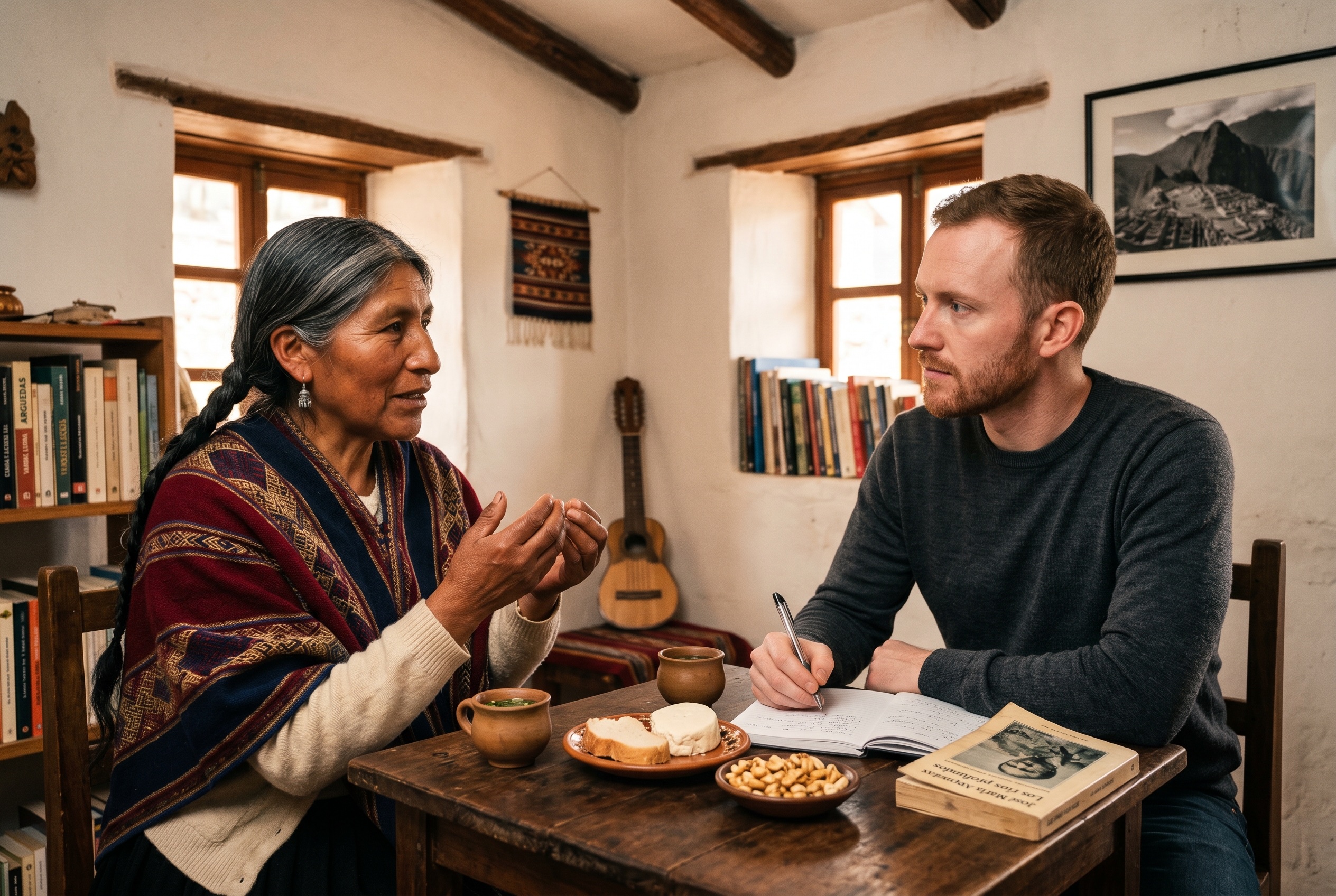
Strommen has been teaching Spanish in this city since 2006. Andean Spanish has always been a real demand: anthropology and indigenous-rights research, travel Spanish for Peru-Bolivia-Ecuador trips, family-connection Spanish for second-generation Andean-Americans, and academic Spanish for students of Quechua, Aymara, and Andean cultures. Every tutor below was met and vetted by us in person or via thorough video interview. No marketplace. No automated profile-creation. Real teachers with real backgrounds, which you can read about in their bios.
Filter by location, age, or price. Then book a 30-minute free trial.
Below are the Strommen tutors who specialize in Andean Spanish. Photos, ratings, and rates are real. Click any card to read their bio and book a free 30-minute trial.
I want to learn…
Every tutor, personally met. — founder-vetted since 2006, in Los Angeles and online worldwide.
Get a personalized plan
Pick your language — a language advisor will match you with the right tutor and map out your path.




Advertising - San Ignacio de Loyola Institute - ISIL -(Technique):- Creative Direction and Management - ISIL - (Certification)- Advertising Direction and Digital Media - ISIL - (Certification)- Direction and Graphic Management - ISIL - (Certificatio
Your Spanish Tutor from Lima, Peru, with a Passion for Languages, Sports, and Cultural Exploration!
Specialties
Advertising - San Ignacio de Loyola Institute - ISIL -(Technique):- Creative Direction and Management - ISIL - (Certification)- Advertising Direction and Digital Media - ISIL - (Certification)- Direction and Graphic Management - ISIL - (Certificatio
Your Spanish Tutor from Lima, Peru, with a Passion for Languages, Sports, and Cultural Exploration!
Specialties
Translator degree (Spanish-English), English-Spanish), Bachelor's degree in linguistics, ELE diploma (Spanish as a Second or Foreign Language) · ELE diploma (Spanish as a Second or Foreign Language), Translator degree (Spanish-English)
Learn Spanish with an Experienced Chilean Spanish Tutor Passionate About Language and Culture!
Specialties
Translator degree (Spanish-English), English-Spanish), Bachelor's degree in linguistics, ELE diploma (Spanish as a Second or Foreign Language) · ELE diploma (Spanish as a Second or Foreign Language), Translator degree (Spanish-English)
Learn Spanish with an Experienced Chilean Spanish Tutor Passionate About Language and Culture!
Specialties

Andino — culture & language
5 ways to sound like you actually speak Andean Spanish
These aren't textbook expressions. They're the everyday words that separate tourists from people who've actually spent time in the highlands — from Cusco to La Paz to Quito. Screenshot the infographic, then book a tutor to learn the rest.
-
01
Wawa
Baby, small child. From Quechua. Used across Andean Spanish in Peru, Bolivia, Ecuador, and southern Colombia. The substrate vocabulary that marks Andean Spanish as a real regional dialect rather than just "Spanish from the mountains."
e.g. La wawa está dormida, no hagas ruido.
-
02
Chompa
Sweater. Andean Spanish across Peru, Bolivia, Ecuador, and the highland regions of Colombia and northern Argentina. Different from Mexican suéter or Spanish jersey. The single most reliable vocabulary marker that you're hearing Andean rather than coastal South American Spanish.
e.g. Hace frío arriba, llévate una chompa.
-
03
Yapa
An extra or freebie. When you buy something at a market and the vendor adds a little more for goodwill, that's the yapa. From Quechua. Lives in Andean commercial culture as a small ritual of generosity that distinguishes market relationships from supermarket transactions across all five Andean countries.
e.g. Le compré dos panes y me regaló una yapa.
-
04
Andean ustedeo
Not a single word but a register. In Andean Spanish, usted can signal warmth and respect rather than formal distance. Children address parents with usted, friends use it reciprocally. Using tú where usted is expected can read as cold even when you mean warmth. The single most distinctive grammatical feature of Andean Spanish.
e.g. Mamita, ¿usted ya tomó desayuno?
-
05
Pachamama
Earth mother, in Quechua and Aymara cosmology. Lives in everyday Andean Spanish far beyond religious contexts: invoked before construction or harvest, in business openings, in cultural celebrations. The word carries weight that no English equivalent quite matches, even when used casually.
e.g. Antes de empezar, una ofrenda a la Pachamama.
About Andean Spanish
Highland Spanish across five countries
Andean Spanish is the highland Spanish dialect spoken across the Andean mountain regions of South America: Peru, Bolivia, Ecuador, the highlands of Colombia, northern Chile, and northwestern Argentina. Roughly 30 million people speak it as a first or primary language, with millions more switching between Andean Spanish and the indigenous languages (Quechua, Aymara, and others) that share these regions. Among Spanish dialects, Andean is genuinely transnational. The Spanish spoken in Cusco, La Paz, Quito, Pasto (southern Colombia), and Jujuy (northwestern Argentina) shares more linguistic features with itself than with the coastal or lowland Spanish of the same countries. If your goal is highland South American Spanish broadly, whether for travel, anthropology, indigenous-rights work, or family connection, Andean Spanish is the variety to learn.
The sound first. Andean Spanish is generally measured, conservative, and clear, with crisp consonants and a slower pace than coastal Caribbean or Pacific lowland Spanish. S's stay strong at the end of syllables, with no Caribbean s-dropping. The j sound is gentler than Castilian. The intonation has a distinctive sing-song quality that reflects substrate influence from Quechua and Aymara, which have very different prosodic patterns from Spanish. Vowel pronunciation in some speakers shifts toward the three-vowel system of Quechua, making i and e (or u and o) blur slightly. The pace is deliberate, with pauses that reflect highland conversational rhythm. The unifying acoustic feature is clarity: Andean Spanish is the variety most international Spanish-speakers find easiest to understand precisely because of these features.
What makes Andean Spanish a real dialect rather than just "Spanish from the mountains" is the substrate. Quechua, spoken by roughly 8 million people across the Andes, and Aymara, spoken by 2 million more concentrated in Bolivia and Peru, have shaped highland Spanish for five centuries. Vocabulary borrowings appear in every region: wawa (baby, Quechua), chacra (small farm, Quechua), chompa (sweater, widespread Andean Spanish), chaski (messenger, from Quechua, historic and modern usage), pachamama (earth mother, Quechua/Aymara), apu (mountain spirit), chuño (freeze-dried potato), quinua (the grain), charango (the small stringed instrument), llajwa (Bolivian hot sauce, Quechua/Aymara). Some words are universal across the Andean region; others vary. The substrate also shapes grammar: Andean Spanish often uses verb-final word order in some constructions (influenced by Quechua syntax), uses le for both direct and indirect objects (leísmo), and uses double possessives ("su casa de él") that don't appear in coastal Spanish. For broad Spanish foundations our 1,000 most common Spanish words list is a useful supplement.
The register feature most distinctive to Andean Spanish is the use of usted. In Mexican, Castilian, or Argentinian Spanish, usted signals formality and social distance. In Andean Spanish, usted often signals warmth, intimacy, and respect. Children may address parents with usted, friends use usted reciprocally, grandmothers address grandchildren with usted. This Andean ustedeo is one of the most reliable markers that you're hearing highland speech. The opposite, using tú with someone who expects usted as a sign of warmth, can read as cold even when you mean closeness. Lessons drill this social calibration alongside the grammar.
The transnational nature of Andean Spanish carries cultural weight. The Inca empire stretched across the modern borders of Peru, Bolivia, Ecuador, and parts of Chile and Argentina, and pre-colonial cultural patterns continue to shape highland identity in ways that cut across modern nationality. Pachamama offerings before construction or harvest. Coca leaves chewed for altitude and offered as social courtesy. Andean weaving traditions, charango music, the Wiphala (the rainbow checkered flag of Andean indigenous identity). The geographic anchors (Cusco, Machu Picchu, Lake Titicaca, Tiwanaku, Otavalo, Salar de Uyuni) sit within different modern countries but belong to a shared Andean cultural region. Andean Spanish carries this regional identity in vocabulary, in cultural references, in the way speakers from Cusco and La Paz and Quito recognize each other as part of the same cultural world even when they've never met. Our blog post on Spanish dialect comparison sketches the broader landscape these dialects sit in.
Specific things American students miss when learning Andean Spanish, all fixable with attention. Andean Spanish is not just Peruvian Spanish. Bolivian, Ecuadorian Sierra, and southern Colombian highland Spanish are equally part of the family, each with its own regional character. The ustedeo is the next stumbling block; using tú with someone who expects usted as a marker of warmth reads as cold. Pace matters as well. Andean Spanish rewards measured speech, and speaking with Mexican or Cuban speed sounds disrespectful in highland contexts even when it isn't meant that way. Vocabulary swaps work in your favor. Asking for a suéter in Cusco is fine, but asking for a chompa shows you've spent time there. And finally, the indigenous substrate. Wawa, chompa, yapa, chacra are not exotic ornaments. They are everyday speech for millions of Andean Spanish speakers, and learning to use them naturally is what separates a visitor from someone who's lived in the highlands.
Between lessons, immerse with Andean-made media. La teta asustada (Claudia Llosa, 2009) is a strong entry point to highland Peruvian Spanish with Quechua substrate. Madeinusa by the same director. Wiñaypacha (2017) is a remarkable Aymara-language Bolivian-Peruvian co-production. Roma isn't Andean but the Cuarón film carries indigenous-Spanish themes worth comparing. For music, Susana Baca for Afro-Peruvian voices, Renata Flores for Quechua-Spanish contemporary bilingual rap, Los Kjarkas for Bolivian folk tradition, Inti-Illimani for Chilean Andean folk. For reading, José María Arguedas's Los ríos profundos is the canonical Andean Spanish novel; Mario Vargas Llosa for broader Peruvian context; Edmundo Paz Soldán for contemporary Bolivian highland fiction. The pattern is the same as for any specialty: pick something you'd watch, listen to, or read in English anyway, and do it in Andean Spanish instead.
The Strommen Andean Spanish roster includes native Andean Spanish speakers from Peru, Bolivia, Ecuador, and other highland regions, plus longtime bilinguals fluent in the substrate vocabulary and cultural context. The teachers familiar with Cusco or La Paz bring the substrate-heavy highland cadence and direct knowledge of Quechua or Aymara terminology as it appears in everyday speech. Other teachers cover Ecuadorian Sierra or southern Colombian highland Spanish depending on which Andean region you care about. Each tutor's bio says where they're from, where they've taught, and which student profile they fit best. You can match yourself to a teacher whose accent fits the specific Andean region you care about, or learn a more neutral pan-Andean register that works across all five countries. For specific country focus, our Bolivian Spanish, Ecuadorian Spanish, and Colombian Spanish specialty pages cover the closest national varieties.
Lessons calibrate to your actual goal. Travel Spanish for a Cusco or La Paz trip is a different curriculum from anthropology Spanish for indigenous-rights research, which is different again from learning to read Arguedas or to follow a Quechua-Spanish bilingual conversation. We don't run a generic Spanish course. Each lesson is one-on-one, your tutor plans it around your week, and the trial is free. Existing Spanish is a head start. The most common adjustments for students arriving with Mexican or Castilian Spanish are the Andean ustedeo, the substrate vocabulary, and the measured highland cadence. For a head-start before lessons begin, our 5 most common embarrassing mistakes in Spanish covers errors learners make across all dialects, and the broader Spanish course page shows the family of related programs. Or just browse the full tutor list and book a trial. Find a voice you want to imitate. Put in the hours. That covers most of what actually works.
What you'll cover
Lessons & classes tailored to Andean Spanish
The transnational Andean dialect
Andean Spanish is spoken across Peru, Bolivia, Ecuador, the highlands of Colombia, northern Chile, and northwestern Argentina. Roughly 30 million speakers as first language, plus millions more in bilingual indigenous-language households. The dialect cuts across national borders, with Cusco, La Paz, Quito, and Pasto sharing more linguistic features with each other than with coastal Spanish of the same countries.
Quechua and Aymara substrate
Quechua (8M speakers) and Aymara (2M speakers) have shaped highland Spanish for five centuries. Vocabulary borrowings appear across all regions: wawa, chacra, chompa, chaski, pachamama, apu, chuño, quinua, llajwa, yapa. The substrate also shapes grammar: verb-final word order in some constructions, double possessives, widespread leísmo. We teach the most useful 30-50 substrate words plus the grammatical patterns they bring.
Andean ustedeo: usted as warmth, not distance
The most distinctive grammatical feature of Andean Spanish. Usted signals warmth, respect, and intimacy rather than formal distance. Children address parents with usted, friends use it reciprocally, grandmothers address grandchildren with usted. Using tú where usted is expected can read as cold even when you mean closeness. Lessons drill the social calibration alongside the grammar.
Cultural codes: Pachamama, coca, transnational Andean identity
The Inca empire stretched across five modern countries, and pre-colonial cultural patterns continue to shape highland identity in ways that cut across modern nationality. Pachamama offerings, coca leaves as daily presence, Andean weaving traditions, charango music, the Wiphala flag. The geographic anchors (Cusco, Lake Titicaca, Machu Picchu, Tiwanaku, Otavalo) belong to a shared Andean cultural region across borders.
FAQ
About Andean Spanish lessons & classes
How is Andean Spanish different from Mexican, Argentinian, or Castilian Spanish?
Mutually intelligible with all of them. The two big differences: Andean Spanish carries strong Quechua and Aymara substrate vocabulary that other varieties don't have (wawa, chompa, yapa, pachamama, chacra), and it uses usted as a register of warmth rather than formality. Mexican is faster and crisper. Argentinian uses voseo and sheísmo. Castilian uses vosotros. Expect the first few lessons to focus on substrate vocabulary and the ustedeo register.
Is Andean Spanish the same in Peru, Bolivia, Ecuador, and Colombia?
Same family, with regional variations. Cusco Peruvian, La Paz Bolivian, Quito Ecuadorian, and southern Colombian (Nariño) highland Spanish all share the substrate, the ustedeo register, and the measured pace, but each region has its own vocabulary nuances and cultural references. A speaker from Cusco can converse with one from La Paz without confusion; both will sound recognizably Andean to a speaker from Lima or Bogotá.
Are your tutors native Andean Spanish speakers?
Most are. Our roster includes native Andean Spanish speakers from Peru, Bolivia, Ecuador, and other highland regions, plus longtime bilinguals fluent in Andean Spanish and the substrate context. Each tutor's bio specifies where they're from and where they've taught.
Can I take Andean Spanish lessons online or only in person?
Both. Most of our Andean Spanish tutors teach online via Zoom or Jitsi, available globally. Several also teach in person around Los Angeles. The booking widget on each tutor's profile shows their available formats and locations.
I already speak some Spanish. Should I start over?
No. Existing Spanish is a head start. Most students begin with a 30-minute free trial where the tutor calibrates to where you actually are. From there you build toward the Andean register: the ustedeo, substrate vocabulary, and either a regional accent (Cusco, La Paz, Quito) or a more neutral pan-Andean register that works across all five countries.
Why does the Andean ustedeo work that way?
Two main theories. One: Andean Spanish was learned by indigenous Quechua and Aymara speakers as a second language, and they imposed their own pragmatic patterns on Spanish. Quechua doesn't have a tú-usted distinction the same way, so usted became a marker of any addressee rather than a formality marker. Two: colonial-era social hierarchies preserved usted as the standard address in domestic life and never inverted to informal tú the way coastal Spanish did. Probably both, plus other factors. Practically: it's a real living feature of Andean Spanish that learners need to internalize.
How fast can I expect to progress?
Depends on the time you put in between lessons, your starting level, and your specific goal. For students arriving with intermediate Mexican or Castilian Spanish, transitioning to Andean Spanish takes most students 4 to 8 weeks at one or two lessons a week. From-scratch beginners reach travel-conversational comfort in three to six months at the same pace.
Ready for Andean Spanish lessons or classes?
Book a free 30-minute trial with one of our personally vetted tutors. Private lessons or small-group classes — your choice.