



Personally vetted instructors
Bolivian Spanish tutors, lessons & classes
¿Cómo está, hermano? The way La Paz actually says "hi."
Personally vetted Bolivian Spanish tutors. Lessons that respect the way Spanish is actually spoken in La Paz, Sucre, Santa Cruz, Cochabamba, and across the Andean and lowland regions of Bolivia.
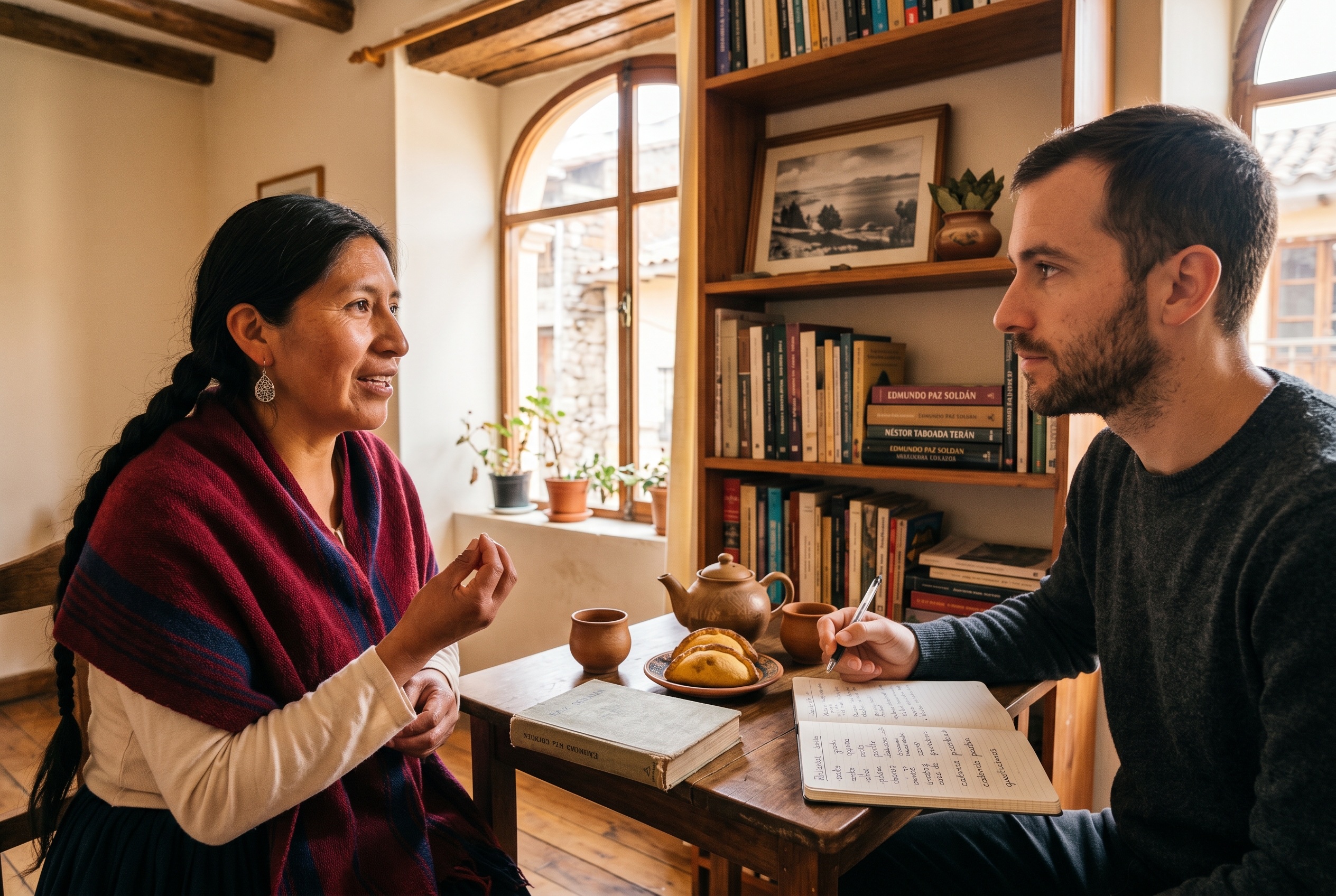
Your instructors
Bolivian Spanish tutors for private lessons & classes
Strommen has been teaching Spanish in this city since 2006. Bolivian Spanish has always been a real demand: film and television training, family-connection Spanish for second-generation Bolivian-Americans, travel Spanish for La Paz or Salar de Uyuni trips, and academic Spanish for students of Andean languages and cultures. Every tutor below was met and vetted by us in person or via thorough video interview. No marketplace. No automated profile-creation. Real teachers with real backgrounds, which you can read about in their bios.
Filter by location, age, or price. Then book a 30-minute free trial.
Below are the Strommen tutors who specialize in Bolivian Spanish. Photos, ratings, and rates are real. Click any card to read their bio and book a free 30-minute trial.
I want to learn…
Every tutor, personally met. — founder-vetted since 2006, in Los Angeles and online worldwide.
Get a personalized plan
Pick your language — a language advisor will match you with the right tutor and map out your path.



Título terciario (maestría) · Profesor de Educación Especial
Profesor certificado de niños, jóvenes y profesor ELE (Español Lengua Extranjera)
Personally vetted · Strommen’s note
A certified ELE tutor from Argentina, Pablo teaches a genuinely rare set of dialects: Paraguayan, Uruguayan, and Bolivian Spanish among them.
Specialties
Título terciario (maestría) · Profesor de Educación Especial
Profesor certificado de niños, jóvenes y profesor ELE (Español Lengua Extranjera)
Specialties
Personally vetted · Strommen’s note
A certified ELE tutor from Argentina, Pablo teaches a genuinely rare set of dialects: Paraguayan, Uruguayan, and Bolivian Spanish among them.

I have a Law degree from Buenos Aires university. · Spanish as a Foreign Language certification from International House Buenos Aires
¡Muy buenas! Your Argentinian Spanish sherpa here.
Specialties
I have a Law degree from Buenos Aires university. · Spanish as a Foreign Language certification from International House Buenos Aires
¡Muy buenas! Your Argentinian Spanish sherpa here.
Specialties

Aymara y Quechua — culture & language
5 ways to sound like you actually speak Bolivian Spanish
These aren't textbook expressions. They're the everyday words that separate tourists from people who've actually spent time in La Paz or Cochabamba. Screenshot the infographic, then book a tutor to learn the rest.
-
01
Wawa
Baby, small child. From Quechua. Used across Andean Spanish but particularly common in Bolivia. Crosses class lines, heard everywhere from rural villages to La Paz offices. The substrate vocabulary that makes Bolivian Spanish feel rooted in Andean identity.
e.g. La wawa está durmiendo, no hagas ruido.
-
02
Llajwa
The Bolivian hot sauce made with locoto pepper, tomato, and quirquiña herb. Found on every Bolivian table. Also used as slang for "spicy" or to describe an intense situation. The most distinctively Bolivian culinary-vocabulary item.
e.g. Pásame la llajwa, por favor.
-
03
Chompa
Sweater. Andean Spanish across Bolivia, Peru, Ecuador, and parts of Colombia. Different from Mexican suéter or Spanish jersey. The word lives across all registers, from rural villages to urban offices.
e.g. Hace frío en El Alto, ponete la chompa.
-
04
Yapa
An extra or freebie. When you buy something at a market and the vendor adds a little more for goodwill, that's the yapa. Quechua origin. Lives in Andean commercial culture as a small ritual of generosity that distinguishes market relationships from supermarket transactions.
e.g. Compré dos panes y me dieron una yapa.
-
05
Pucha
Soft exclamation of frustration, surprise, or mild disappointment. Closer to "darn" or "oh man" than to a stronger interjection. Used across age groups and registers. Pairs naturally with everyday Bolivian conversation.
e.g. ¡Pucha, se me olvidó la billetera!
About Bolivian Spanish
Spanish with Aymara and Quechua roots
Bolivian Spanish covers roughly 10 million speakers across Bolivia, plus a substantial diaspora in Argentina, Brazil, Spain, and the United States. Among Spanish dialects, Bolivian sits firmly in the Andean family alongside Peruvian and Ecuadorian highland Spanish, with a distinctive lowland eastern variety (camba) that pulls toward Paraguayan and Argentinian Spanish. What makes Bolivian Spanish genuinely distinct is the depth of indigenous-language influence. Bolivia officially recognizes 36 indigenous languages alongside Spanish in its 2009 constitution, more than any other Latin American country, and Quechua and Aymara substrate vocabulary lives in everyday Spanish speech across the highlands. If your goal is to speak Spanish as it's actually spoken in La Paz, in Andean villages, or in the Bolivian diaspora, learning Bolivian Spanish means learning that substrate alongside the grammar.
The sound first. Andean Bolivian Spanish (the highland variety spoken in La Paz, Sucre, Cochabamba, Potosí, Oruro) is generally clear, measured, and conservative. S's stay crisp at the end of syllables, with no Caribbean s-dropping. The pace is slower than Mexican or Argentinian Spanish. The j sound is softer than in Castilian. Vowel pronunciation shows Quechua and Aymara influence in some speakers, with vowels staying closer to the three-vowel system of those substrate languages. Eastern Bolivian Spanish, called camba, is the variety spoken in Santa Cruz, the Beni, and Pando, and sounds noticeably different: faster, with some s-aspiration and a sing-song cadence that overlaps with Paraguayan and Argentinian patterns. Lessons can match you to either the highland kolla variety or the lowland camba variety depending on which region you care about.
Grammar carries some Andean signatures. The use of usted in Andean Bolivian Spanish doesn't always signal formality the way it does in Mexican or Castilian Spanish. In the highlands, usted often appears as a register of warmth, respect, or solidarity rather than distance: a grandmother addressing a grandchild with usted, friends using usted reciprocally, even children addressed with usted in some families. This Andean ustedeo is a feature shared with Colombian Spanish in the highlands but particularly strong in Bolivia. The opposite pattern, eastern camba Bolivian Spanish, uses voseo (vos sos, vos tenés) in informal contexts, similar to the Argentinian pattern. The result is that Bolivia contains both registers, depending on region.
Vocabulary is where Bolivian Spanish carries its most distinctive identity. Quechua and Aymara substrate words live in everyday speech across all social classes. Wawa means baby (from Quechua, used across Andean Spanish). Llajwa is the Bolivian hot sauce made with locoto pepper, also used as slang for "spicy." Chompa means sweater across Andean Spanish, different from the Mexican suéter or Spanish jersey. Yapa means an extra or freebie: when you buy something at the market and the vendor adds a little extra, that's the yapa. Achachila refers to a mountain spirit in Aymara, and also lives as an exclamation. Pucha is a soft exclamation of frustration or surprise. Allinchu, imaynalla, and other Quechua greetings appear in Spanish conversation in Quechua-speaking regions. Chacra means a small farm, charango is the small Andean stringed instrument, chuño is freeze-dried potato (the original Inca preservation technique). None of these are taught in classroom Spanish; all are everywhere in Bolivia. For broader Spanish foundations our 1,000 most common Spanish words list is a useful supplement.
Cultural codes shape Bolivian Spanish in ways that make the language feel different to outsiders. Pachamama, the earth mother of Andean cosmology, appears in everyday speech and ritual: offerings to Pachamama before construction, before harvest, on the first of August every year. Coca leaves are a daily presence in the highlands, chewed for altitude adjustment and offered as a social courtesy. The kollas vs cambas regional split (highland Andean vs lowland eastern) carries cultural weight: different food, different music, different identity, different Spanish. Tiwanaku ruins, Lake Titicaca, and Salar de Uyuni, the geographic anchors of Andean identity, sit in Bolivia. Music carries the substrate too: Los Kjarkas, Savia Andina, Luzmila Carpio: the Andean folk tradition lives in Bolivian Spanish through song lyrics that move between Spanish and Quechua. Our blog post on Spanish dialect comparison sketches the broader landscape these dialects sit in.
Things American students tend to trip over with Bolivian Spanish, where a few lessons make a real difference. Bolivia isn't one accent. La Paz Andean Spanish and Santa Cruz camba Spanish sound different enough that locals identify each other in the first sentence; pretending it's one variety misses the point. The Andean ustedeo is the next stumbling block. Using tú with someone who expects usted as a sign of respect can land as cold or distant, even when you mean warmth. Vocabulary substitutions matter too. Asking for a suéter in a Bolivian market works but sounds foreign; asking for a chompa sounds like you've been there. Quechua and Aymara borrowings carry cultural weight, so rushing through them or treating them as exotic tokens shows. And one more thing: treating Bolivian Spanish as a quirky version of Peruvian Spanish. They share the Andean substrate, but Bolivia has its own identity, particularly in the camba-speaking eastern lowlands.
Between lessons, immerse with Bolivian-made media. La nación clandestina (1989), Cuestión de fe (1995), and the more recent Hospital Obrero are entry points to Bolivian film. Mi socio by Paolo Agazzi captures highland kolla speech well. The music of Los Kjarkas, Savia Andina, and the Camilo Vega-led contemporary scene carries the substrate vocabulary. For reading, Edmundo Paz Soldán is the most internationally-recognized contemporary Bolivian novelist, with prose that reflects La Paz urban Spanish. Néstor Taboada Terán for earlier-era Andean Spanish. The Quechua-Spanish poet Elvira Espejo Ayca for poetry that moves between languages. The pattern is the same as for any specialty: pick something you'd watch, listen to, or read in English anyway, and do it in Bolivian Spanish instead.
The Strommen Bolivian Spanish roster includes native Bolivians, longtime Andean Spanish speakers, and bilinguals based across South America and the United States. The teachers familiar with highland Bolivian Spanish bring the slower, more measured Andean cadence, the ustedeo register, and direct knowledge of Quechua and Aymara substrate vocabulary as it appears in everyday speech. The lowland-familiar teachers can shift toward camba speech if your goal is Santa Cruz or the eastern regions. Each tutor's bio says where they're from, where they've taught, and which student profile they fit best. You can match yourself to a teacher whose accent fits your goal: highland Andean for La Paz or Sucre, lowland camba for Santa Cruz, or a more neutral pan-Bolivian register that works across the country. For other Spanish dialect comparisons, our Colombian Spanish and Argentinian Spanish specialty pages cover related varieties with overlapping features (Colombian highland Spanish shares much with Andean Bolivian; Argentinian voseo overlaps with camba Bolivian).
Lessons calibrate to your actual goal. Travel Spanish for a La Paz trip is a different curriculum from family-connection Spanish for second-generation Bolivian-Americans, which is different again from learning to read Edmundo Paz Soldán in the original or to follow a Quechua-Spanish bilingual conversation. We don't run a generic Spanish course. Each lesson is one-on-one, your tutor plans it around your week, and the trial is free. Existing Spanish is a head start. The most common adjustments for students arriving with Mexican or Castilian Spanish are the Andean ustedeo register, the substrate vocabulary, and the slower-paced cadence of highland Spanish. For a head-start before lessons begin, our 5 most common embarrassing mistakes in Spanish covers errors learners make across all dialects, and the broader Spanish course page shows the family of related programs. Or just browse the full tutor list and book a trial. Find a voice you want to imitate. Put in the hours. That covers most of what actually works.
What you'll cover
Lessons & classes tailored to Bolivian Spanish
Andean kolla vs lowland camba Bolivian Spanish
The two main Bolivian dialect zones. Kolla highland Spanish (La Paz, Sucre, Cochabamba, Oruro, Potosí) is measured, conservative, with strong Quechua and Aymara substrate. Camba lowland Spanish (Santa Cruz, Beni, Pando) is faster, with some s-aspiration and voseo that overlaps with Paraguayan and Argentinian patterns. Lessons can target either region depending on your goal.
Quechua and Aymara substrate vocabulary
Wawa, llajwa, chompa, yapa, pucha, chuño, charango, achachila, allinchu. The Quechua and Aymara words that crossed into everyday Bolivian Spanish at every level. Plus the broader Andean substrate that links Bolivian, Peruvian, and Ecuadorian highland Spanish. We teach when each fits and how to read the room.
Andean ustedeo: usted as warmth, not formality
In highland Bolivian Spanish (and Andean Spanish generally), usted often signals warmth, respect, or solidarity rather than distance. A grandmother addresses her grandchild with usted, friends use usted reciprocally. Using tú where usted is expected can read as cold even when you mean warmth. Lessons drill the social calibration alongside the grammar.
Cultural codes: Pachamama, coca, kolla-camba identity
Pachamama earth-mother offerings in everyday ritual. Coca leaves as daily presence in highland culture, social courtesy, and altitude adjustment. The deep kolla-camba regional split that shapes everything from food to politics to dialect. Tiwanaku, Lake Titicaca, Salar de Uyuni as Andean cultural anchors. Music (Los Kjarkas, Savia Andina) as substrate carrier. Lessons cover these directly so you can navigate Bolivian contexts like someone who's spent time there.
FAQ
About Bolivian Spanish lessons & classes
How is Bolivian Spanish different from Mexican / Argentinian / Castilian?
Mutually intelligible with all of them. The two big differences: Andean Bolivian Spanish carries strong Quechua and Aymara substrate vocabulary that other varieties don't have (wawa, llajwa, chompa, yapa, achachila), and the highland Spanish uses usted as a register of warmth rather than formality. Lowland camba Bolivian Spanish (Santa Cruz region) uses voseo similar to Argentinian. Mexican is faster and crisper. Castilian uses vosotros. Expect the first few lessons to focus on substrate vocabulary and the ustedeo register.
What's the difference between kolla and camba Bolivian Spanish?
Kolla refers to highland Andean Bolivian Spanish (La Paz, Sucre, Cochabamba, Potosí, Oruro). Camba refers to lowland eastern Bolivian Spanish (Santa Cruz, Beni, Pando). The two sound noticeably different: kolla is measured, conservative, with strong Andean substrate; camba is faster, with some s-aspiration and voseo. The kolla-camba split carries cultural weight beyond language: different food, different music, different identity. We can match you to either tradition.
Are your tutors native Bolivians?
Most are. Our Bolivian Spanish roster includes native Bolivians teaching from inside Bolivia or other South American countries where Andean Spanish is spoken, plus longtime bilinguals fluent in Bolivian Spanish from the diaspora. Each tutor's bio specifies where they're from, where they've taught, and which student profile they fit best.
Can I take Bolivian Spanish lessons online or only in person?
Both. Most of our Bolivian Spanish tutors teach online via Zoom or Jitsi, available globally. Several also teach in person around Los Angeles. The booking widget on each tutor's profile shows their available formats and locations.
I already speak some Spanish. Should I start over?
No. Existing Spanish is a head start. Most students begin with a 30-minute free trial where the tutor calibrates to where you actually are. From there you build toward the Bolivian register: the Andean ustedeo, Quechua and Aymara substrate vocabulary, and either highland kolla or lowland camba speech depending on your goal.
How does Quechua and Aymara substrate vocabulary work in everyday Bolivian Spanish?
Naturally and unobtrusively. Wawa, chompa, llajwa, chuño, yapa, and dozens of other Quechua- and Aymara-derived words appear in everyday Bolivian Spanish across class lines. Bolivians may not be aware which words come from substrate languages; they're simply part of the Spanish vocabulary. Lessons cover the most useful 30-50 substrate words plus the social cues for when they fit.
How fast can I expect to progress?
Depends on the time you put in between lessons, your starting level, and your specific goal. For students arriving with intermediate Mexican or Castilian Spanish, transitioning to Bolivian Spanish takes most students 4 to 8 weeks at one or two lessons a week. From-scratch beginners reach travel-conversational comfort in three to six months at the same pace.
Ready for Bolivian Spanish lessons or classes?
Book a free 30-minute trial with one of our personally vetted tutors. Private lessons or small-group classes — your choice.