



Personally vetted instructors
Berlinerisch (Berlin Dialect) tutors, lessons & classes
Na, wie jeht's? How Berlin actually says hi, with the city's signature g-to-j shift.
Personally vetted tutors of Berlinerisch, the working-class dialect of Berlin. The German you'll hear on the U-Bahn, in the Kneipen, and from every grandmother who's lived through three German political systems.
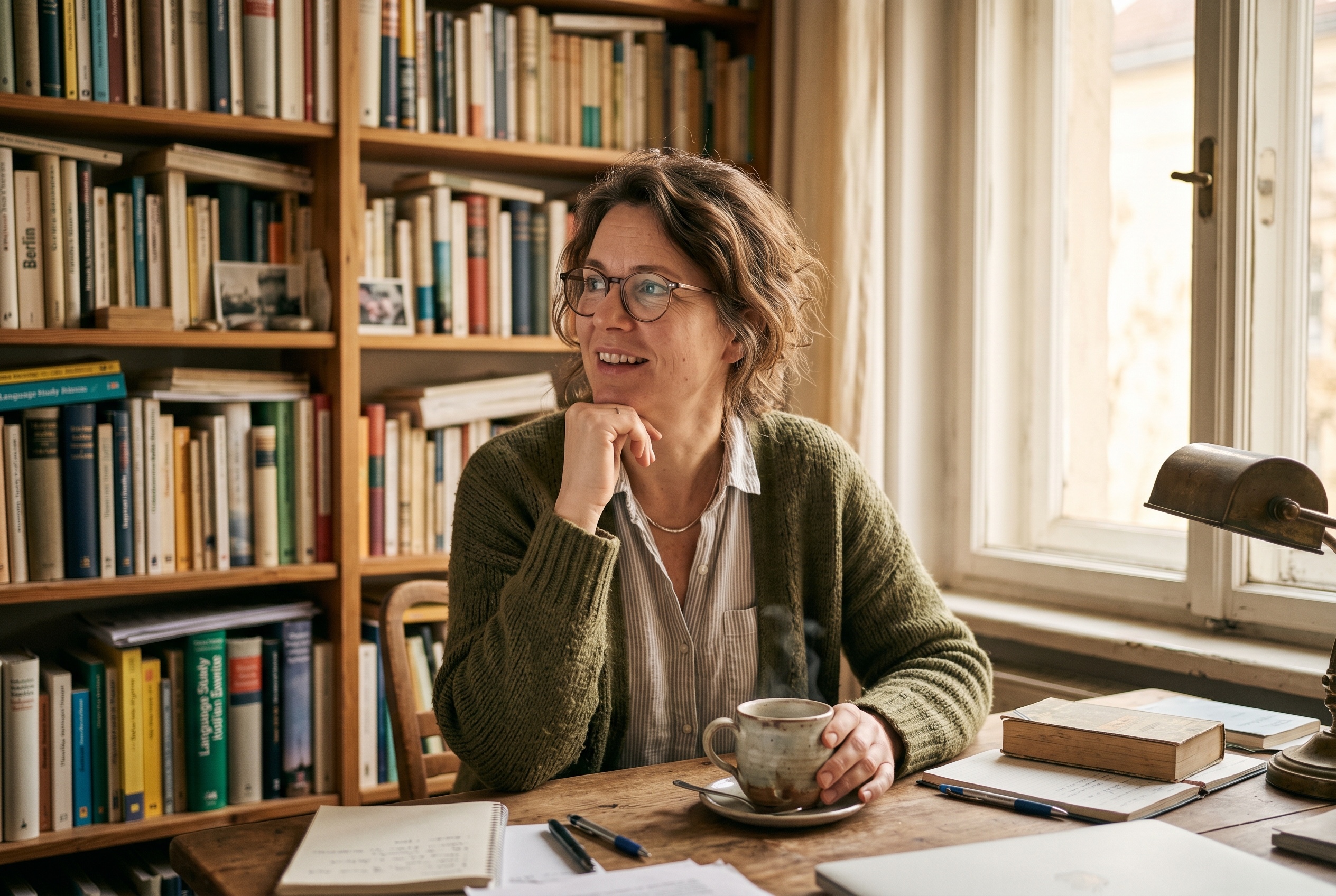
Your instructors
Berlinerisch (Berlin Dialect) tutors for private lessons & classes
Strommen teaches dialects alongside standard languages because students who want a specific dialect deserve specialists, not generalists. Every Berlinerisch tutor below was met and vetted by us. No marketplace. No automated profile-creation. Real Berliners with real backgrounds, which you can read about in their bios.
Filter by location, age, or price. Then book a 30-minute free trial.
Below are the Strommen tutors who specialize in Berlinerisch. Photos, ratings, and rates are real. Click any card to read their bio and book a free 30-minute trial.
I want to learn…
Every tutor, personally met. — founder-vetted since 2006, in Los Angeles and online worldwide.
Get a personalized plan
Pick your language — a language advisor will match you with the right tutor and map out your path.


PhD, BSc
PHD with Degree in Swedish and German Linguistics - Arctic researcher, PHD in Biology offering fun and interactive Swedish and German lessons
Personally vetted · Strommen’s note
Carola is a PhD biologist and Arctic researcher with a separate degree in Swedish and German linguistics. She brings that same field rigor into lessons.
Specialties
PhD, BSc
PHD with Degree in Swedish and German Linguistics - Arctic researcher, PHD in Biology offering fun and interactive Swedish and German lessons
Specialties
Personally vetted · Strommen’s note
Carola is a PhD biologist and Arctic researcher with a separate degree in Swedish and German linguistics. She brings that same field rigor into lessons.

Berliner Schnauze — culture & expressions
5 expressions that say "yes, I know Berlin"
These won't be in your German textbook. They're Berlin-specific and they're how Berliners spot each other from a hundred meters. Screenshot them. Then book a tutor to learn the rest.
-
01
Icke
Berliner version of ich ("I"). Pure dialect identity. The famous parody "Icke bin ein Berliner" plays on this.
e.g. Icke wohn in Kreuzberg, du?
-
02
Det / dit
Berliner version of das ("that" / "it"). Used constantly. If you can switch from das to det naturally, your Berliner accent gets real.
e.g. Det jeht so, danke.
-
03
Wat los?
"What's up?" The Berlin compression of "was ist los." Casual and very local.
e.g. Na, Alter, wat los heute?
-
04
Knorke
"Great, cool, neat." An older Berliner word that's making a comeback. Standard German would say toll or super. Knorke is purely Berlin.
e.g. Det neue Café in Neukölln is knorke.
-
05
Schrippe
A Berliner bread roll. Standard German speakers say Brötchen and get politely corrected when they're in Berlin. Walk into a bakery in Mitte and ask for two Schrippen, and you've made your point.
e.g. Zwei Schrippen, bitte.
About Berlinerisch (Berlin Dialect)
Standard German is one thing. Berlin is another.
Berlinerisch is the urban dialect (a Stadtdialekt, technically) of Berlin, with roots in Low German and Brandenburgisch grafted onto a layer of High German that came in with the Prussian court. The mix is what gives it its character: blunt, fast, often funny, occasionally crude, and famously direct. Berliners themselves call it Berlinisch or Berlinerisch and treat it as a badge of identity, the linguistic stamp of someone who's actually from here, not someone who moved in from Schwabenland for a startup job.
The sound is the first thing you'll notice. The g at the start of words becomes a j: gut becomes jut, gehen becomes jehen, ganz becomes janz. The ch in ich softens into something close to ick (Icke bin ein Berliner, as the dialect's most famous self-parody goes). Diphthongs flatten: auch becomes ooch, kein becomes keen. Final n sometimes drops. The result is a sound profile that's instantly recognizable, the way Cockney is instantly recognizable in English.
Vocabulary is the second giveaway. Standard German has Brötchen for a bread roll. Berliners say Schrippe. Standard German pancakes are Pfannkuchen, but in Berlin a Pfannkuchen is a jelly donut (what the rest of Germany calls a Berliner, in a delightful regional irony). A Berliner kid is a Gör; a guy is a Macker; trouble is Stress, casually applied. There's also the legendary Berlin directness, the Berliner Schnauze, where rudeness shades into affection and complaining is a civic art form.
If you're learning Berlinerisch, you probably already know some German. Maybe you're moving to Berlin, have a Berlin partner, are doing research, work in the city's tech or arts scene, or want to understand the Berlin films and music that have shaped your sense of the place (Berlin Alexanderplatz, Good Bye Lenin, Babylon Berlin, Rio Reiser, Element of Crime). Maybe your grandparents were Berliners and you want to recover the sound of how they spoke.
Our Berlinerisch tutors are native Berliners, most of them West or East Berlin born and raised, with backgrounds that span the city: Kreuzberg, Friedrichshain, Wedding, Pankow, Neukölln, Charlottenburg. Lessons cover the phonology, vocabulary, and the cultural framework. Expect Berlin humor, Berlin history (the dialect carries the city's working-class and political history in its bones), and a working understanding of when to switch into standard German and when Berlinerisch is the right register. Most students come in with B1 or higher standard German and treat Berlinerisch as a specialization. If you're starting lower, we'll build the German foundation first, then layer the dialect.
We also teach the boundary between Berlinerisch and adjacent varieties: Brandenburgisch (the surrounding rural dialect), Sächsisch (the dialect of Saxony, which Berliners famously mock), and Hochdeutsch (the standard, which everyone uses in formal settings). You'll learn when to code-switch.
What you'll cover
Lessons & classes tailored to Berlinerisch (Berlin Dialect)
The Berlinerisch sound system
Lessons drill the specific phonological features that mark the dialect: g-to-j (gut → jut), ch-to-ck (ich → ick), au-to-oo (auch → ooch), and the flattening of various standard-German diphthongs. We use audio recordings of Berliners across generations so you hear the dialect as it's actually spoken, not as it's transcribed in a textbook.
Berliner vocabulary
The hundred-odd Berlinerisch words and expressions that signal local identity: Schrippe, Pfannkuchen-as-donut, Gör, Macker, Buletten (meatballs, where standard German says Frikadellen), and the loanwords from Yiddish, French, and Russian that the city's history dropped into everyday speech. We also cover the slang of specific neighborhoods, where the dialect texture varies.
Code-switching between dialect and Hochdeutsch
Most Berliners use Hochdeutsch at work and shift to Berlinerisch with family, friends, and at the Kneipe. We teach the social rules: when full dialect signals warmth and when it signals disrespect, how to dial it up and down, and how to read other speakers' register so you can match it. This is the skill that separates a learner from someone who actually fits in.
The Berlin cultural framework
Berlin's dialect is inseparable from its history: working-class Berlin, the divided city, the squatting culture of the 80s, the post-Wende re-mixing of East and West. Optional but most students want it: lessons covering Berliner films, music (Rio Reiser, Ideal, Element of Crime, the Berlin techno scene), literature (Berlin Alexanderplatz, Christa Wolf), and political history. The dialect makes way more sense once you know the city.
FAQ
About Berlinerisch (Berlin Dialect) lessons & classes
Is Berlinerisch a real dialect or just an accent?
Both, depending on how strict your linguistic definitions are. Most linguists classify Berlinerisch as a metrolect or urban dialect, with phonological, lexical, and some grammatical features that distinguish it from standard German. In everyday terms, Berliners treat it as a dialect, and so do most German speakers.
Will learning Berlinerisch confuse my standard German?
No, as long as you keep them separate in your mind. Most Berliners are fully bilingual in dialect and standard. The skill we teach is code-switching, not replacing standard German with dialect. Many students find their standard German actually improves because the dialect work forces them to hear German more attentively.
Do younger Berliners still speak Berlinerisch?
Less than older generations, but yes. Berlinerisch has weakened as Berlin has become more internationalized and gentrified, but it's still alive, especially among working-class and longtime resident families. The dialect also undergoes constant renewal as new generations adapt it. Active speakers number in the low millions across Berlin and Brandenburg.
Can I take Berlinerisch lessons online or only in person?
Both. Most of our Berlinerisch tutors teach online via Zoom or Jitsi, available globally. A couple teach in person around Los Angeles, mostly when a student has an ongoing project that benefits from face-to-face. The booking widget shows formats.
I'm at A2 in standard German. Is it too early for Berlinerisch?
Usually yes, but it depends. If your only goal is to function in Berlin, we can introduce some dialect features alongside your standard German work, particularly the high-frequency items (icke, det, wat). Full Berlinerisch fluency typically waits until B1 or B2 in standard German, when your foundation is solid enough to absorb a dialect layer.
How different is Berlinerisch from Sächsisch or Bavarian?
Very different, in different directions. Berlinerisch is a northern Central German urban dialect with Low German substrate. Sächsisch (Saxon, see our Sächsisch tutors page) is a different East Central German dialect group with its own distinct phonology. Bavarian belongs to the Upper German family, much further south, and is closer to Austrian and Swiss varieties. A speaker of one usually understands the others with effort, but they're not interchangeable.
Is Berlinerisch useful for work in Berlin or do I just need standard German?
For work, standard German is what you'll use in offices, meetings, and most professional settings. Berlinerisch is a social and cultural skill: it builds rapport, signals respect for the city, and unlocks a layer of humor and intimacy you'd otherwise miss. Many of our students learn it as the second phase of their German study, after they have professional competence in Hochdeutsch.
Ready for Berlinerisch (Berlin Dialect) lessons or classes?
Book a free 30-minute trial with one of our personally vetted tutors. Private lessons or small-group classes — your choice.