


Personally vetted instructors
Hebrew for Beginners tutors, lessons & classes
שלום Shalom, the universal Hebrew greeting and the first word every beginner learns.
Personally vetted Hebrew tutors who teach beginners from the alefbet up. Lessons that start with the letters, the sounds, and the first survival phrases, then build toward real reading and conversation.
Your instructors
Hebrew for Beginners tutors for private lessons & classes
Strommen is a curated boutique language school, not a marketplace. Every tutor below was met and vetted by us before they ever taught a lesson. There is no automated profile-creation here, no anonymous listings, just teachers we chose because they are good with absolute beginners, a stage of Hebrew that needs real patience and a clear plan.
Filter by location, age, or price, read the bios, then book a 30-minute free trial with whoever feels right.
Below are the Strommen tutors who specialize in teaching Hebrew to beginners. Photos, ratings, and rates are real. Click any card to read their bio and book a free 30-minute trial.
I want to learn…
Every tutor, personally met. — founder-vetted since 2006, in Los Angeles and online worldwide.
Get a personalized plan
Pick your language — a language advisor will match you with the right tutor and map out your path.

BFA
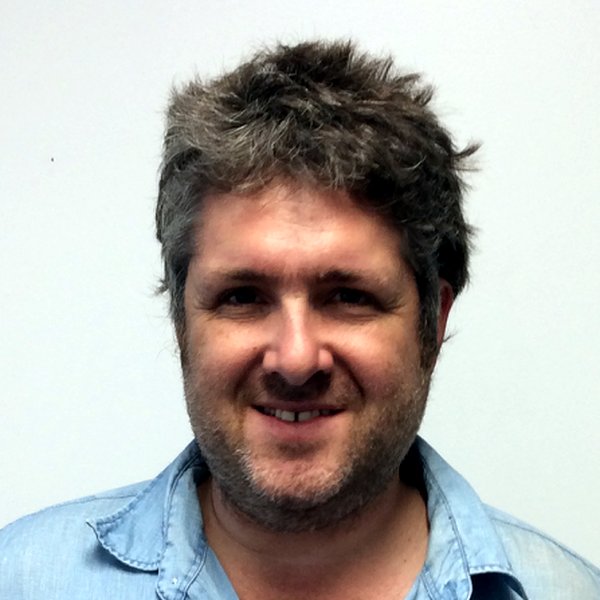
Discover Hebrew with Adam: Tel Aviv-Born Artist and Former Bezalel Academy Teacher!
Specialties
BFA
Discover Hebrew with Adam: Tel Aviv-Born Artist and Former Bezalel Academy Teacher!
Specialties



Bachelors of ArtsHispanic Languages and Cultures; Psychology · Mann Prize for Outstanding Achievements in the Romance Languages
Hispanic Literatures and Cultures graduate with extensive teaching experience
Personally vetted · Strommen’s note
A Hispanic Literatures and Cultures graduate who also teaches trombone, Ari brings vocabulary back at just the right moment in Hebrew and Spanish lessons.
Specialties
Also speaks: English
Bachelors of ArtsHispanic Languages and Cultures; Psychology · Mann Prize for Outstanding Achievements in the Romance Languages
Hispanic Literatures and Cultures graduate with extensive teaching experience
Specialties
I also speak: English
Personally vetted · Strommen’s note
A Hispanic Literatures and Cultures graduate who also teaches trombone, Ari brings vocabulary back at just the right moment in Hebrew and Spanish lessons.

אלפבית — the alefbet & first reading
5 things every Hebrew beginner meets in the first month
These are the building blocks of the language. Knowing what each one is, before you start, makes the early lessons feel less like decoding and more like building.
-
01
אלפבית · alefbet (22 letters)
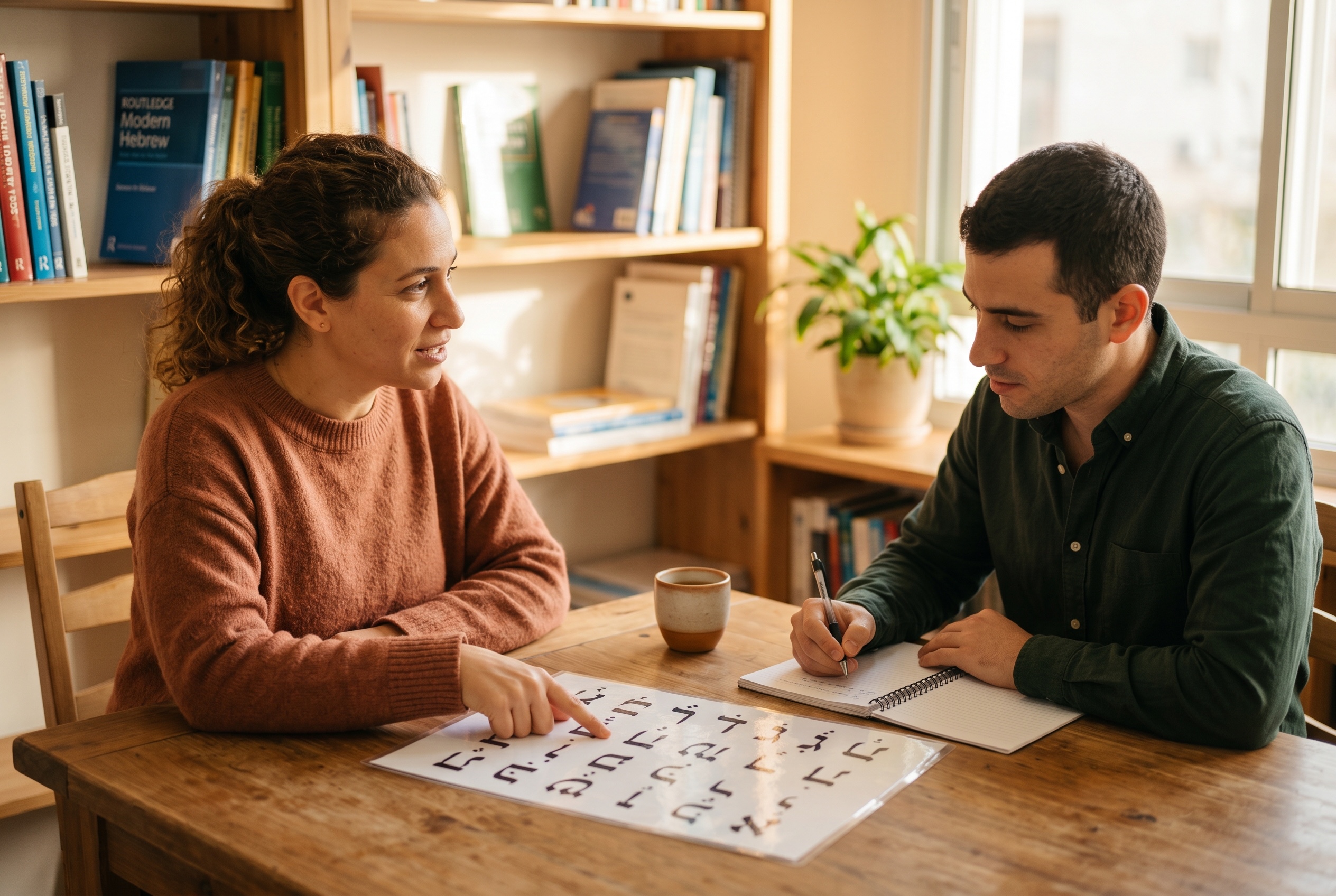
The Hebrew alphabet has 22 consonants, written right to left, and an alefbet song that every Israeli kindergartener learns. Mastering the letters and their sounds is the first job of any beginner course, and most students get there in 2 to 4 weeks of daily practice with a tutor watching the handwriting form.
e.g. א ב ג ד ה ו ז ח ט י ... the alefbet runs from alef to tav.
-
02
אותיות סופיות · final letters
Five letters take a different shape when they sit at the end of a word: kaf ך, mem ם, nun ן, pe ף, tzadi ץ. They are pronounced the same as their non-final forms but written differently, and recognizing them quickly is part of reading fluency. The mnemonic is the made-up word "כמנפץ" (kamnafetz), which spells them in order.
e.g. מים (mayim, water) ends in final mem ם.
-
03
ימין לשמאל · right to left
Hebrew reads and writes right to left. Numbers inside a Hebrew sentence still run left to right, and modern Hebrew text mixed with Latin script (English words, brand names) handles the directional shift on the fly. Most beginners adapt to the directional switch within the first week of reading practice.
e.g. The book opens from what an English reader would call the back.
-
04
ניקוד · niqqud (vowel marks)
Vowels are written as small dots and dashes under and around the consonants. Textbooks and children's books print them; adult writing and signage usually does not. Beginners read vocalized text for the first several months and graduate to unvocalized text once their pattern recognition is strong enough to infer the vowels from context.
e.g. שָׁלוֹם is shalom, with the vowel marks shown.
-
05
דגש · dagesh
A small dot placed inside a letter that changes its sound or doubles its consonant force. The most common case for beginners is the dot that distinguishes ב (vet, v sound) from בּ (bet, b sound), or כ (khaf, kh sound) from כּ (kaf, k sound), or פ (fe, f sound) from פּ (pe, p sound). Three letter pairs, one small dot, fully learnable in a single lesson.
e.g. בית (bayit, house) has a dagesh in the first letter, so it is read as bet not vet.
About Hebrew for Beginners
Where a beginner actually starts
Most adults who set out to learn Hebrew quit within the first three months, and the reason is almost never that Hebrew is too hard. It is that they were taught in the wrong order, often by an app or by a religious-school curriculum from childhood that did not stick. Hebrew is a language with a small number of moving parts that all need to be introduced in a specific sequence, and when they are, the early weeks are genuinely manageable. When they are not, the alphabet, the vowel system, the root structure, and the spoken-versus-written gap all collide at once, and a motivated beginner stalls without knowing why.
A good first lesson tells you what you are actually signing up for. Modern Hebrew uses an alphabet of 22 consonants, written right to left, five of which take a different shape when they fall at the end of a word (the so-called final letters: ך ם ן ף ץ). Vowels are written as small marks under and around the consonants, a system called niqqud, but here is the twist: niqqud is only used in textbooks, in children's books, in poetry, in the Tanakh, and occasionally to clarify an ambiguous word. Adult Israelis read and write without vowel marks all day, inferring the vowels from context and pattern. This is the single biggest psychological hurdle for a beginner, and a tutor will tell you plainly that it gets easier than it sounds. You learn to read vocalized text first, build your pattern recognition, and graduate to unvocalized text within a few months.
The sounds are mostly approachable for an English speaker. Hebrew has a few consonants that take practice. The guttural ח (chet) and the back-of-the-mouth כ/ך (khaf) both make a throaty sound that English does not have, and the ר (resh) is rolled or trilled depending on the regional pronunciation tradition (modern Israeli ר is more often a uvular trill, closer to the French r than to the Spanish one). Two letters, the silent א (alef) and the ע (ayin), function more as vowel-carriers than as full consonants in modern pronunciation, even though ע once represented a deep throat sound that lives on in some Mizrahi and Yemenite pronunciations. None of this is hard. It just needs a tutor watching your mouth in the first few lessons so you do not lock in bad habits.
The root system, the shoresh, is where Hebrew starts to feel less foreign and more like an architecture. Three-consonant roots carry a core idea — ל-מ-ד (l-m-d) the field of teaching and learning, כ-ת-ב (k-t-v) the field of writing — and the binyanim, the seven verbal patterns, generate verbs and nouns by running the root through fixed templates. A beginner who internalizes this finds that vocabulary compounds: once you know the root ל-מ-ד, you start to recognize talmid (student), lomed (learner / is learning), milammed (teaches), beit-midrash (study hall), and limudim (studies) as one family rather than five separate words. A beginner who learns vocabulary as random strings reads slowly indefinitely.
Who actually shows up for our beginner Hebrew track is a varied group, and the first lesson tends to calibrate around which one you are. Some students are preparing for a first trip to Israel and want enough to function. Some are dating or married into a Hebrew-speaking family and want to be more than a guest at the Shabbat table. Some are converting to Judaism and want Hebrew alongside the rest of the tradition. Some are returning olim or heritage learners whose Hebrew school years left them with the alefbet and a few prayers but no working conversation. Some are simply curious about a language with a 3,000-year written record and a 140-year-young modern revival. All of these are legitimate starting points, and the tutors below calibrate the first lesson to yours.
A practical question that comes up early: print or cursive first? Hebrew has two main handwritten forms. Print (block letters, the same as printed text) is what you read in books and on signs. Modern Hebrew cursive is a separate alphabet that Israelis use for handwriting, with letter shapes that look quite different from the print forms. The standard pedagogical answer is print first for reading, and cursive can wait until you actually need to write by hand in a real-world Israeli context. Most adult beginners learning Hebrew for travel, family, or reading purposes do fine staying with print indefinitely. If you plan to live in Israel or to write extensively, the cursive forms become a worthwhile second pass.
The other early question is whether to learn Modern Hebrew or to focus on the Hebrew of prayer and the Tanakh. The honest framing is that they are related projects, not one project. Modern Hebrew is a living, spoken language with a 140-year history, and it is what 9 million people speak in Israel today. Biblical and prayer Hebrew share the alphabet, the root system, and a large core of vocabulary, but the grammar, the verb tenses, and many of the everyday words diverge. If your goal is Israel, conversation, family, or modern reading, start with our Hebrew for Beginners track here. If your goal is the Tanakh, start with Biblical Hebrew instead. Many serious students eventually do both.
Strommen has been teaching Hebrew in Los Angeles since 2006, and the beginner track is the most popular Hebrew specialty we offer. Every tutor below was met and vetted by us in person before they ever taught a lesson. There is no marketplace here, no automated profile-building. These are real teachers chosen because they are good with absolute beginners, which is a stage of Hebrew that needs real patience and a clear plan. Lessons run online for students worldwide and in person for those near Los Angeles, and most students begin with a free 30-minute trial.
What you'll cover
Lessons & classes tailored to Hebrew for Beginners
The alefbet, from the first letter
The 22 consonants of the Hebrew alphabet, with their five final forms, written right to left. Tutors work through the letters in a sensible reading order rather than alphabetical order, pair each one with its sound, and watch your handwriting form so you do not lock in the wrong stroke direction. Most beginners can read simple words within 2 to 4 weeks of daily practice with a tutor.
Niqqud and the path to unvocalized reading
The masoretic vowel-pointing system, niqqud, is what makes Hebrew approachable for a beginner: the text is vocalized, so you are never guessing at pronunciation. Lessons start with fully vocalized text and graduate to partial and then unvocalized text over the first several months, building the pattern recognition that lets you infer vowels the way a native reader does. This is the single biggest transition in early Hebrew learning, and it gets dedicated lesson time.
First survival vocabulary and grammar
Greetings, introductions, numbers, days of the week, asking for things, ordering food, asking for directions, the early survival phrases that let a beginner function on a first trip. Alongside: the present-tense verb forms (which are the simplest of the Hebrew tenses and the right place to start), basic gendered nouns and adjectives, and the prepositions and pronouns that hold sentences together. Lessons drill these in real conversational context, not in vocabulary-list form.
The root-and-binyan system, made visible early
Hebrew vocabulary is built from three-consonant roots run through verbal patterns. Tutors signpost this system from the early weeks, so that when a beginner meets a new word they can usually place it inside a family they already know. This is what makes Hebrew compound rather than pile up. The pattern is not fully usable in the first months, but seeing it early is what separates beginners who progress steadily from beginners who get stuck.
FAQ
About Hebrew for Beginners lessons & classes
How long does it take to learn the alefbet?
Most beginners can read simple vocalized words within 2 to 4 weeks of daily practice with a tutor. The full alphabet has 22 letters, plus the 5 final forms, plus the dagesh dots that change a few letter sounds. The letters themselves are not difficult; the harder part is reading at speed, which builds over the following months as you read more text. A tutor watching your handwriting in the first weeks is what prevents the bad habits that slow people down later.
Should I learn print or cursive first?
Print first. Print (block letters, the same shapes you see in books and on signs) is what you need for reading anything, and it is the standard pedagogical starting point. Modern Hebrew cursive is a separate alphabet that Israelis use for handwriting, with shapes that look quite different from print. Adult learners who want Hebrew for travel, family, or reading purposes can stay with print indefinitely. Cursive becomes worth the second pass if you plan to live in Israel or to write Hebrew by hand regularly.
What if I am secular vs religious? Does it change what I learn?
It changes the framing more than the content. The alphabet, the vowel system, and the basic grammar are the same regardless of your background. What differs is which texts and vocabulary you build around. A secular student preparing for travel or family conversation will lean into modern everyday speech, news Hebrew, and the practical phrases of contemporary Israel. A religious student may want to weave in prayer-language vocabulary, blessings, and eventually Biblical or Mishnaic Hebrew alongside. Many tutors handle both starting points and will calibrate at the trial.
Why is there no E in some words I see written?
Because Hebrew vowels are usually written as small marks (niqqud) rather than as full letters, and adult Hebrew writing typically omits the marks entirely. So a word like ספר can be read as sefer (book), sapar (barber), sippur (story), or other possibilities depending on context and the implied vowels. This is the unvocalized reading problem, and it sounds harder than it is in practice: native readers infer the vowels from context and from the word patterns they recognize. Beginners read vocalized text for the first months and graduate to unvocalized text as the patterns become familiar.
Do I need niqqud (vowel marks) forever?
No. Most Hebrew text in the real world (newspapers, websites, signs, emails, novels) is unvocalized. Beginners use vocalized text for the first several months because it removes the guessing and lets you read aloud accurately while you build your vocabulary. As your pattern recognition and word-family awareness grow, you stop needing the vowel marks for common words, and within a year of steady learning most students can read everyday text unvocalized.
Should I learn Modern or Biblical Hebrew?
Pick by goal. Modern Hebrew is the living language of Israel, what 9 million people speak today, and the right starting point for travel, conversation, family communication, and contemporary reading. Biblical Hebrew is a related but distinct project: same alphabet and root system, different verb morphology, higher-register vocabulary, focused on the Tanakh. If your goal is the Hebrew Bible, start with our Biblical Hebrew track. If your goal is Israel or conversation, this is the right track. Many serious students eventually do both.
Are your tutors native speakers from Israel?
Most are native speakers who grew up in Israel. A few are longtime fluent teachers with extensive in-country experience. Each tutor's bio specifies where they are from and what they most enjoy teaching, including whether they prefer to start with print only, with reading alongside speaking, or with conversation-first. You can match yourself to a teaching style that fits how you learn best.
Can I take Hebrew lessons online or only in person in LA?
Both. Many of our Hebrew tutors teach online via Zoom or Jitsi and are available to students anywhere. Several also teach in person around Los Angeles, especially in the Westside, Pico-Robertson, and the Valley. The booking widget on each tutor's profile shows their available formats. Beginner Hebrew lessons work very well online because so much of the early work is reading text on a shared screen.
Ready for Hebrew for Beginners lessons or classes?
Book a free 30-minute trial with one of our personally vetted tutors. Private lessons or small-group classes — your choice.