



Personally vetted instructors
Business Hebrew tutors, lessons & classes
בוקר טוב Boker tov, the morning hello in any Israeli office.
Personally vetted Business Hebrew tutors who teach the Hebrew of Israeli tech, finance, and the workplace. Lessons that move from boardroom etiquette into the email, meeting, and WhatsApp registers that actually run a Tel Aviv office.
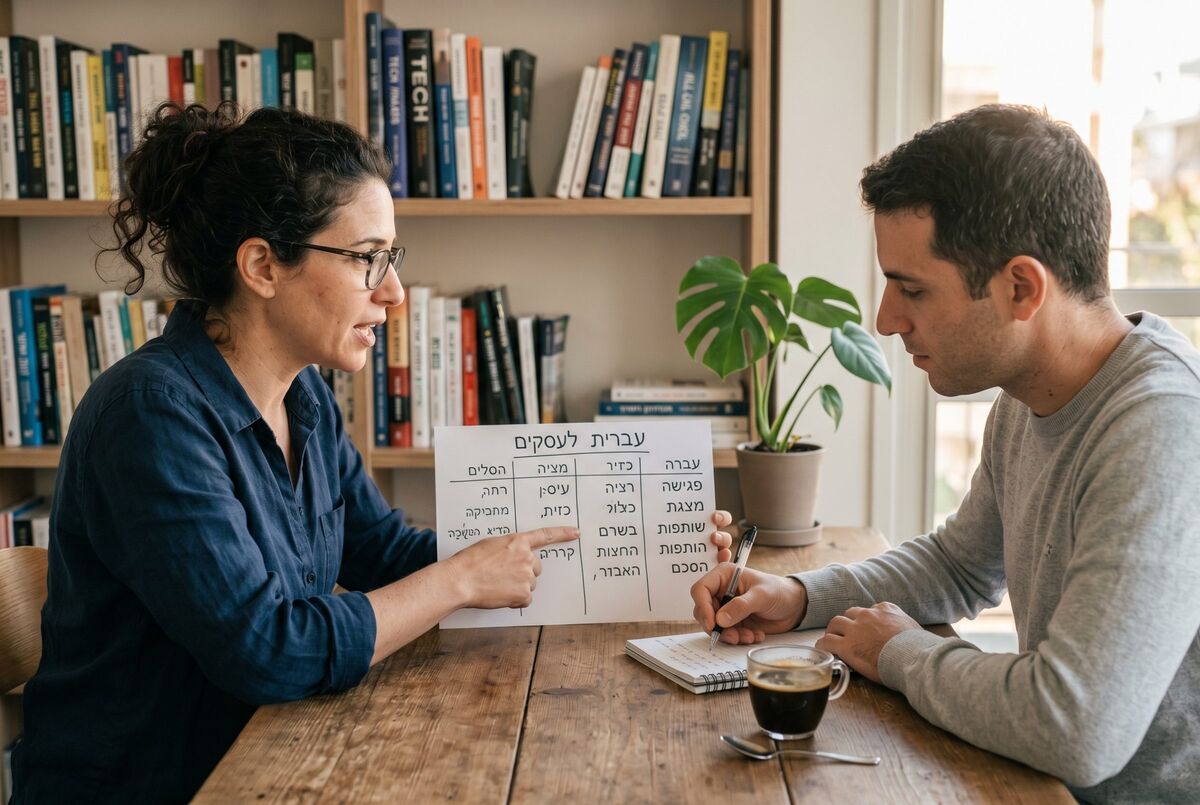
Your instructors
Business Hebrew tutors for private lessons & classes
Some of the tutors below have spent years inside Israeli tech and finance, some have taught executives at Tel Aviv companies, all of them know the gap between textbook Hebrew and the working register that runs an Israeli office. Every one of them was met and vetted by Strommen directly before being listed, because a Business Hebrew track depends on a tutor who has actually been in the meetings.
Filter by location, age, or price, read the bios, then book a 30-minute free trial.
Below are the Strommen tutors who teach Business Hebrew. Photos, ratings, and rates are real. Click any card to read a tutor's background and book a free 30-minute trial.
I want to learn…
Every tutor, personally met. — founder-vetted since 2006, in Los Angeles and online worldwide.
Get a personalized plan
Pick your language — a language advisor will match you with the right tutor and map out your path.


BFA
Discover Hebrew with Adam: Tel Aviv-Born Artist and Former Bezalel Academy Teacher!
Specialties
BFA
Discover Hebrew with Adam: Tel Aviv-Born Artist and Former Bezalel Academy Teacher!
Specialties

Dugri — workplace culture & register
5 working norms of the Israeli office
Less about grammar, more about the unwritten rules a foreign professional needs in week one. Read it, then book a tutor to learn the rest.
-
01
דוגרי · dugri
The Israeli direct-speech norm, originally borrowed from Arabic and Turkish, meaning "straight" or "to the point." In a business setting it means colleagues will disagree with you openly, push back in meetings, and skip the cushioning language that softens disagreement in American offices. It is not aggression; it is the default register.
e.g. תגיד לי דוגרי, מה אתה חושב? ("Tell me straight, what do you think?")
-
02
יאללה · yalla
"Let's go," borrowed from Arabic, lives in Hebrew as the all-purpose closer and opener. It ends meetings, starts sprints, prompts decisions, and signals "we are done discussing this." Foreign professionals usually adopt it within their first month in any Israeli office.
e.g. יאללה, נסגור על זה אחר הצהריים. ("Alright, let's close this in the afternoon.")
-
03
קפה שחור · kafe shchor
Turkish-style espresso, the office ritual that doubles as the social glue. The mid-morning coffee break is when real decisions actually get worked out in many Israeli offices, especially the smaller ones. Joining the kafe shchor circle is faster than any onboarding doc.
e.g. בוא נדבר על זה ליד הקפה. ("Let's talk about it over coffee.")
-
04
צבא · tzava (the post-army dynamic)
Three years of compulsory military service for most Israelis means many of your colleagues have already managed people, run operations, and held real responsibility by age 22. Seniority gets read from competence and ownership, not strictly from age, and team norms often echo the unit cultures of elite military programs.
e.g. A 25-year-old team lead is unremarkable in Israeli tech.
-
05
וואטסאפ · WhatsApp
A primary working channel in Israeli business in a way it is not in most other markets. Internal threads, vendor coordination, and even client conversations frequently run through WhatsApp groups, with a faster turnaround expectation than email. Voice notes (sherutei kol) are common at the management level.
e.g. תשלח לי בוואטסאפ. ("Send me on WhatsApp.")
About Business Hebrew
How Startup Nation actually communicates
Working in an Israeli office is a culture shock before it is a language challenge, and that is the part most foreign professionals are unprepared for. The country is small, the tech sector is dense, the average colleague did three years of compulsory army service before college, and the communication norm is dugri (דוגרי) — direct, fast, often interruption-tolerant, with a tolerance for disagreement that can read as combative if you are calibrated to American or British office manners. None of this is rudeness. It is the default register of the country, and Hebrew carries it. A Business Hebrew tutor is teaching you to function inside this norm: to give and receive feedback the way Israelis do it, to read the difference between disagreement and conflict, to write the kind of clipped, action-oriented email a manager actually responds to.
The people who come to Strommen for this track are usually one of a few profiles. Some are foreign hires at Israeli tech companies (Wix, Monday.com, Check Point, the wider startup ecosystem) who joined an office where the all-hands runs in Hebrew even though one-on-ones can be in English. Some are American or European executives whose company opened an Israeli R&D center and who need to operate credibly with their Tel Aviv counterparts. Some are diplomats and trade professionals working with Israeli partners. Some are returning olim, immigrants who grew up speaking some Hebrew at home but never operated in a working environment in the language. The tutors below calibrate to that profile. A foreign hire learning enough to follow the standup is a different lesson plan from a returning oleh polishing email etiquette, and both are different from an executive prepping for board-level conversations.
The early weeks of a serious Business Hebrew course are register-driven. You learn the working vocabulary of meetings, deadlines, scope, deliverables, blockers, the kind of words that come up in any office in any language but that carry a specifically Israeli flavor in Hebrew. You learn the meeting verbs (לתאם letaem to coordinate, לסגור lisgor to close, להעביר leha'avir to forward or hand off) and the project nouns (יעד ya'ad target, דד-ליין deadline, יעדים יעדים the goals you missed last quarter). You learn the diminutives and casual contractions that Hebrew uses freely even in professional speech: דקה (daqa) a minute, but רגע (rega) literally a moment in the sense of "hang on," or שניה (shniya) a second when you actually mean it. You learn that the same word changes formality between speech and email, and that Hebrew written register is generally less formal than English written register, which trips up writers calibrated to American email norms.
The cultural items matter as much as the vocabulary. Yalla (יאללה) is borrowed from Arabic but lives in Hebrew as the all-purpose "let's go" that closes meetings and starts sprints. Kafe shchor (קפה שחור), Turkish-style espresso, is the office ritual that doubles as the social glue. The post-army age dynamic shapes hierarchy: a 25-year-old engineer in Israel has often already managed people in the military, so seniority is read from competence and ownership rather than from age alone. The chutzpah communication style is widely misunderstood. It is not aggression; it is a willingness to push back, to disagree with the boss, to take initiative without permission, and a Business Hebrew tutor will tell you plainly when you are reading a normal disagreement as a personal attack.
Writing is where most foreign professionals stumble first, and it is where the right tutor pays for themselves quickly. Hebrew email is shorter than American email, more direct in its asks, less ceremonial in its openings and closings. The Hebrew language itself is written right to left without daily vowel pointing, so a working email reader has to recognize words from their consonant skeleton plus context. WhatsApp is a primary work channel in Israeli business, more than in most other markets, and the WhatsApp register is even more compressed: abbreviations, voice notes, emoji, fast turnaround expected. A tutor walks you through real-world examples (with names redacted) and shows you what good looks like in each medium.
The spoken side has its own rhythms. Hebrew is fast, and Israeli speech is faster than the textbook speed any course recording prepares you for. Real meetings have overlapping speakers, mid-sentence topic shifts, and a steady undercurrent of English loanwords that a textbook will not show you. "Push to production," "sprint," "OKRs," "escalate," "alignment," "call," "deck" all appear inside Hebrew sentences without translation. Tutors prepare you for this hybrid speech by working with real audio: recorded Israeli tech podcasts, conference talks, internal-style video, sometimes recordings the student brings in from their own work (with appropriate confidentiality). Listening at real speed is a separate skill from speaking, and it is the one most students underestimate.
A practical note that comes up often: the level needed to actually function in an Israeli tech office is roughly B2 working comprehension, with B1 speaking acceptable for many roles because English is a working second language across the sector. That is reachable for a motivated adult in 9 to 18 months of steady lessons plus immersion. Lower than B1 and you will struggle to follow even slowed-down meetings. Higher than C1 starts to mark you as someone genuinely operating in Hebrew rather than as a foreigner doing well. The tutors below will tell you honestly where you sit at the trial and what target makes sense for your timeline. Strommen has been teaching Hebrew in Los Angeles since 2006, and the Business track draws a specific kind of student: professionally motivated, schedule-pressed, and serious about the gap between textbook Hebrew and the version that runs an actual office. Every tutor below was met and vetted by us in person. Lessons run online for students worldwide and in person for those near LA, and most students begin with a free 30-minute trial so the tutor can hear where your speaking actually sits before recommending a plan.
What you'll cover
Lessons & classes tailored to Business Hebrew
Meeting and project vocabulary
The working verbs and nouns of Israeli office life: לתאם (coordinate), לסגור (close), להעביר (forward or hand off), יעדים (targets), דדליין (deadline), בלוקרים (blockers, English loanword), משימה (task). Lessons drill the words in real meeting context, not in vocabulary-list form, so they arrive ready to use. Standups, syncs, retros, and one-on-ones each have their own register, and tutors work through them in order of what your week actually contains.
Email, Slack, and WhatsApp register
Israeli business writing is shorter, more direct, and less ceremonial than American business writing, and matching that register is half the credibility battle. Tutors work through real-world examples (anonymized): how to open and close an email, when to switch to WhatsApp, how to keep a Slack thread on-task in Hebrew, when a voice note is appropriate and when it is not. Writing right to left without daily vowel pointing also has to become second nature, and that is part of the practice.
Dugri, chutzpah, and the post-army workplace
The cultural literacy that makes the language make sense. Why an Israeli colleague will push back on your idea in a Tuesday standup and have coffee with you on Wednesday like nothing happened. Why the 25-year-old team lead is normal here. How feedback gets given and received, when to push back and when to defer, and how to read the difference between a real disagreement and the everyday Israeli rhythm of testing ideas out loud. Tutors who have worked inside Israeli companies bring this to the lesson.
Real-audio listening at Israeli speed
Israeli speech is faster than any textbook recording prepares you for, and real meetings layer in English loanwords, half-sentences, and mid-thought topic shifts. Lessons use real audio: tech podcasts (Geektime, Calcalist conference recordings), executive interviews, sometimes recordings students bring in from their own work with appropriate confidentiality. Listening at real speed is a separate skill from speaking, and it gets its own dedicated practice.
FAQ
About Business Hebrew lessons & classes
What Hebrew level do I need to work in an Israeli tech office?
Realistically, B2 working comprehension is the threshold for following meetings, internal Slack, and most written communication. B1 speaking is acceptable for many roles because English functions as a working second language across the Israeli tech sector, so your colleagues will often switch for you in a one-on-one. Below B1 you will struggle to follow even slowed-down meetings; at C1 and above you start to operate as a real native-adjacent participant rather than as a foreigner doing well. Your tutor will assess you at the trial and tell you honestly what target makes sense for your timeline.
Is the Israeli workplace really as direct as people say?
Yes. The dugri norm is real and it is not personal. Colleagues will disagree with you openly in meetings, push back without softening, and skip the cushioning language that American offices use. The flip side is that disagreements stay in the meeting and rarely become personal afterward, which can be a relief once you adjust. A Business Hebrew tutor will tell you plainly when you are reading a normal disagreement as a personal attack, which is the single most common adjustment foreign professionals make.
Do I need to know army slang?
It helps. Most Israelis served three years of compulsory military service, so army acronyms and slang surface in everyday office speech: terms for ad-hoc planning, for chain-of-command shortcuts, for the difference between formal and informal authority. You do not need to memorize military vocabulary, but having a tutor flag the army-derived terms as they come up gives you the cultural footing to laugh at the right moments and not look lost.
Email vs WhatsApp etiquette in Israeli business?
WhatsApp is more central in Israeli business than in most other markets, and the etiquette is its own thing. Internal teams, vendors, sometimes clients live on WhatsApp groups with faster turnaround expectations than email. Voice notes are common at the management level. Email tends to be reserved for things that need a paper trail (contracts, formal proposals, external counterparties), and even there the register is shorter and more direct than American email. Lessons cover both channels with real examples.
Are your tutors native speakers from Israel?
Most are native speakers who grew up in Israel, and the ones who teach this specialty tend to have professional backgrounds inside Israeli companies: tech, finance, legal, consulting. A few are longtime fluent teachers with extensive in-country experience. Each tutor's bio specifies their background, so you can match yourself to someone whose sector lines up with yours.
Can I take lessons online or only in person?
Both. Many of our Business Hebrew tutors teach online via Zoom or Jitsi and work with executives and professionals worldwide. Several also teach in person around Los Angeles. The booking widget on each tutor's profile shows their available formats, and most students settle on weekly or twice-weekly hour-long lessons.
How long until I can run a meeting in Hebrew?
It depends on your starting point and the hours you put in between lessons. A motivated learner starting at A2 with one or two lessons a week plus self-study can usually run a routine internal meeting in Hebrew within 12 to 18 months. Holding your own in a fast-moving cross-functional sync is a longer arc, often 18 to 24 months for someone working full time. Your tutor sets concrete milestones at the trial and adjusts as you go. The numbers above assume regular practice; skip the between-lesson work and they stretch significantly.
Will my Yiddish (or Ladino) help with Business Hebrew?
A little, but less than people expect. Yiddish shares vocabulary with Hebrew through religious and Jewish-life terminology, and a Yiddish speaker often recognizes Hebrew loanwords inside Yiddish, which gives an emotional foothold. But Yiddish is a Germanic language with Slavic and Hebrew elements, structurally different from Modern Hebrew, so the grammatical knowledge does not transfer. Ladino, the Judeo-Spanish of Sephardic communities, is even further structurally. Both can be cultural advantages but neither shortcuts the language work.
Ready for Business Hebrew lessons or classes?
Book a free 30-minute trial with one of our personally vetted tutors. Private lessons or small-group classes — your choice.