



Personally vetted instructors
German Dialect Coach tutors, lessons & classes
Grüß Gott The Bavarian and Austrian greeting (literally "God greet you") that immediately signals a southern German-speaking character.
Personally vetted German dialect coaches for actors and voice-over artists. Script-led phonetic and cultural prep for Hochdeutsch, Bavarian, Austrian, Swiss German, Saxon, Berlin, Hamburg, and the German-diaspora and German-American registers for film, TV, theater, and games.
Your instructors
German Dialect Coach tutors for private lessons & classes
Strommen has coached German dialect work for film, TV, theater, and voice productions for many years, with the roster expanding as international casting has shifted toward authentic regional German representation. Our coaches range from native speakers across the German-speaking world to second-generation heritage coaches and specialists for German-accented English work. Every tutor below was met and vetted by us in person or via thorough video interview. No marketplace. No automated profile-creation. Real coaches with real on-set, on-stage, and in-booth credits.
Filter by location, age, or price. Then book a 30-minute free trial.
Below are the Strommen tutors who specialize in German dialect coaching for actors. Photos, ratings, and rates are real. Click any card to read their bio and book a free 30-minute trial.
I want to learn…
Every tutor, personally met. — founder-vetted since 2006, in Los Angeles and online worldwide.
Get a personalized plan
Pick your language — a language advisor will match you with the right tutor and map out your path.


none · German as a second language at the Caritas Academy of Graz
Certified and experienced German teacher
Personally vetted · Strommen’s note
Vienna-based, Dora is certified to teach German at every level: Telc, TestDaF, and Goethe exam prep all covered, conversation-first in the room.
Specialties
none · German as a second language at the Caritas Academy of Graz
Certified and experienced German teacher
Specialties
Personally vetted · Strommen’s note
Vienna-based, Dora is certified to teach German at every level: Telc, TestDaF, and Goethe exam prep all covered, conversation-first in the room.

Auf der Bühne — dialect & culture
5 features that separate one German dialect from another
Five phonological, lexical, and prosodic fingerprints. Each one places a character in a specific region and decade, the kind of detail a coach marks up on the first read.
-
01
Maken vs Machen: the second Germanic consonant shift
The defining phonological division within German is the second Germanic consonant shift, which High German underwent and Low German did not. Low German (the speech of Hamburg, Bremen, and most of northern Germany historically) keeps maken (to make) where High German has machen, Appel where High German has Apfel, wat where High German has was. The shift placed t→ts, p→pf, k→ch across most positions. Northern German characters in period work often need Low German markers.
e.g. Low German: "Ik kann wat maken." High German: "Ich kann was machen."
-
02
Berlin's g-to-j shift
Berlin German famously realizes initial g as a j sound: jut instead of gut, Jeld instead of Geld, Junge with a distinct realization. Combined with strong vowel raising (ick instead of ich), Berlin German has a distinctive urban register heard in Berlin-set film and TV consistently. An actor playing a Berlin character without the j-shift sounds like a German from elsewhere visiting the city.
e.g. Berlin: "Ick hab keen Jeld." Standard: "Ich habe kein Geld."
-
03
Austrian and Bavarian diminutives (-erl, -l)
Austrian German uses the -erl diminutive (Bürscherl for a small lad, Hunderl for a small dog) and Bavarian uses -l. These appear constantly in everyday Austrian and Bavarian speech and signal regional grounding immediately. A character from Vienna or Munich without diminutives sounds linguistically displaced; a German character from anywhere else using them sounds wrong too.
e.g. Austrian: "Magst a Schalerl Kaffee?" Bavarian: "Mogst a Wiesn-Brez'n?" Standard: "Möchtest du eine Tasse Kaffee?"
-
04
Swiss German is not Standard German with an accent
Swiss German varies across cantons and is not mutually intelligible with Standard German for most speakers. Swiss characters in international productions usually speak Standard German with Swiss accent and vocabulary markers (Velo for Fahrrad, Trottoir for Bürgersteig) rather than full Swiss German. Coaches with Swiss background distinguish the two carefully based on the production's intent.
e.g. Standard: "Ich fahre mit dem Fahrrad zur Arbeit." Swiss-accented standard: "Ich fahre mit dem Velo zur Arbeit."
-
05
Austrian vocabulary that signals region
Austrian German has many vocabulary differences from German German that signal Austrian background immediately: Jänner (January) instead of Januar, Feber (February) instead of Februar, Marillen (apricots) instead of Aprikosen, Topfen (curd cheese) instead of Quark, Erdäpfel (potatoes) instead of Kartoffeln, Karfiol (cauliflower) instead of Blumenkohl. A Viennese character using German German vocabulary sounds like a German visiting Vienna.
e.g. Vienna: "Im Jänner essen wir Marillenknödel." Berlin: "Im Januar essen wir Aprikosenklöße."
About German Dialect Coach
German is a spectrum, not a single dialect
German dialect coaching at Strommen begins with the same question that opens our Italian and Arabic coaching: which German? The casting note will say "German character, must speak German credibly," and that is often most of what arrives. But the German of a Berlin schoolteacher in 2010 is not the German of a Munich brewery owner in 1985, which is not the German of an Austrian opera singer in 1960s Salzburg, which is not the German of a Swiss banker in 2020s Zurich, which is not the German of a 1940s Hamburg dockworker, which is not the German of an East German factory worker in 1985 Leipzig. These are recognizably different languages or registers to native ears, and a coach who tries to deliver "German" without specifying the variety is probably about to teach a Hochdeutsch newsreader accent that will read as wrong for almost any specific role except a German-language news broadcast. The first conversation with a Strommen German dialect coach is about which regional variety the role actually requires, why, and what the production knows or does not know about that distinction yet.
The German-language landscape is a dialect continuum spanning Germany, Austria, Switzerland, Liechtenstein, Luxembourg, and parts of Belgium, Italy (South Tyrol), and historic German-speaking communities across central and eastern Europe. The major divisions matter. Standard German (Hochdeutsch or Standarddeutsch) is the codified literary and broadcast register, written across the German-speaking world and spoken with regional variation. Bavarian (Boarisch) is the dominant variety of Bavaria and includes Austro-Bavarian shared with much of Austria; the differences between Munich Bavarian and Viennese Austrian are subtle but real. Austrian German (Österreichisches Deutsch) is the Austrian standard, with characteristic vocabulary (Jänner for January, Feber for February, Marillen for apricots) and pronunciation features that distinguish it audibly from German German. Swiss German (Schwiizerdütsch) is genuinely a separate language at the spoken level; Swiss German speakers write Standard German but speak dialects that are not mutually intelligible with the speech of Berlin or Munich. Saxon (Sächsisch) is the variety of Saxony, with its distinctive flat vowels and the cultural association with East German speech that became politically charged after reunification. Berlin (Berlinerisch) has its own urban dialect with strong vowel raising and characteristic grammatical features. Hamburg and the broader Low German (Plattdüütsch) of the north is a Low German variety distinct from the High German varieties to the south.
The phonological and grammatical differences are substantial. The phonological feature that most distinguishes High German from Low German is the second Germanic consonant shift, which Low German did not undergo: maken (Low German, to make) versus machen (High German), Appel (Low German, apple) versus Apfel (High German), wat (Low German, what) versus was (High German). Bavarian and Austrian preserve features that northern German lost, including specific case usages, certain verb constructions, and a richer use of diminutive endings (-erl in Austrian, -l in Bavarian). Swiss German has its own vowel system with distinctive long monophthongs where standard German has diphthongs (Huus instead of Haus). Berlin shows strong vowel raising and the famous Berlin g-to-j shift (jut instead of gut). Saxon has flat unrounded vowels and a characteristic prosodic feel that German audiences recognize immediately. None of these are minor; an actor coaching for a specific role has to work the right variety.
The Hollywood and global-cinema German role landscape. Recent decades have produced significant German-language and German-character work. Das Boot, Run Lola Run, Goodbye, Lenin!, The Lives of Others, Toni Erdmann, the Babylon Berlin series, Dark on Netflix, the recent All Quiet on the Western Front remake, and dozens of others have set high bars for German-language authenticity in international productions. The casting and prep on these productions typically uses German actors directly or German-speaking actors with dialect coaching. Hollywood productions with German characters (the Tarantino films Inglourious Basterds and Once Upon a Time in Hollywood, the Indiana Jones franchise, various WWII films, The Reader, The Counterfeiters) routinely use German dialect coaches for the German-language scenes and the German-accented English scenes. Strommen's roster operates inside this evolving production standard.
German-accented English is its own coaching specialty within the broader German dialect work. The phonological features of German-accented English are predictable and well-documented: voicing of final consonants (the famous "vat" for "what"), th-substitution ("zis" or "dis" for "this"), the German v-and-w confusion ("vill" for "will," "wery" for "very"), specific vowel substitutions, and the prosodic features that German speakers carry into English. The coaching for German-accented English is distinct from coaching German-language work directly. Strommen coaches handle both, with some specialists in the German-accented English register for roles where the character speaks English with a German accent (most Hollywood German characters in English-language productions).
The heritage and German-American calibration. Many actors auditioning for German-speaking roles in the US grew up in households with German-speaking grandparents or parents, often from specific waves of German immigration (the 19th century waves to the Midwest, the post-WWII Lutheran and Mennonite communities, the more recent professional and academic immigration). The heritage German from these communities is often a specific regional variety preserved across generations (Pennsylvania Dutch is the most prominent example, derived from Palatine and Alemannic dialects) and may differ from contemporary Standard German in vocabulary and grammar. A heritage German-American actor cast as a contemporary Berlin character has the wrong variety; a heritage actor cast as a 1920s German immigrant scene has the right variety. Coaches who understand the heritage-vs-learned distinction work with both.
The Swiss German question deserves its own paragraph because it is the most common source of casting confusion. Swiss German is not a dialect of Standard German in the sense that Bavarian or Saxon are; spoken Swiss German varies across Swiss cantons and is not mutually intelligible with Standard German for most speakers. Swiss film productions in dialect (Bestseller works like Heidi in its various versions, Die Schweizermacher, the modern Swiss series) use Swiss German throughout, with German subtitles required for German audiences. Swiss characters in international productions usually speak Standard German with Swiss accent and vocabulary markers (Velo instead of Fahrrad, Trottoir instead of Bürgersteig, the distinctive Swiss intonation) rather than full Swiss German, since full Swiss German would be unintelligible to most viewers. Coaches with Swiss background handle both the full dialect and the Swiss-accented standard.
Observations from coaches on what trips up actors stepping into German dialect work. Defaulting to a generic German newsreader accent is the most common error, usually because the actor learned Standard German in college and assumes the broadcast register works for any German-speaking role. It almost never does outside of actual broadcast scenes. Conflating Bavarian with Austrian (close but not identical), or Austrian with Swiss (related historically but not the same), is the next pattern. Producing English-style intonation patterns in German lines; German has its own characteristic sentence-level prosody, and English speakers carry their intonation across without realizing. The German r-sound (uvular fricative in the south, more tongue-tap in the north, often realized as a vocalized schwa-like sound after vowels) is highly regional and easy to get wrong. And the broader stylistic surprise is that German-speaking audiences pay close attention to regional dialect markers in a way that often surprises Anglophone productions; getting it right opens doors with German-language press and the substantial German-speaking film and TV audience.
Between sessions, the coach sends a curated reference list calibrated to the role. The Babylon Berlin series for 1920s-30s Berlin German; Das Boot (original and remake) for 1940s naval-context German; Goodbye, Lenin! for late-East-German Berlin; The Lives of Others for 1980s East German formal register; Toni Erdmann for contemporary professional German; Heimat (Edgar Reitz's series) for Rhineland-Palatinate German across the 20th century; the Werner Herzog catalog for Bavarian German across multiple eras; the Christoph Waltz catalog for Austrian-tinged German and German-accented English; Heidi in its various versions for Swiss-accented standard German; the recent All Quiet on the Western Front for German military register. Watch with subtitles to track dialect markers, then watch without. For broader German foundations the German course page covers the program family. For an actor without prior German, foundation work runs alongside the dialect work; you do not wait until your German is conversational to start coaching for a specific role.
The Strommen German dialect coaching roster includes native speakers from Berlin, Munich, Hamburg, Vienna, Salzburg, Zurich, Leipzig, Cologne, and elsewhere, plus second-generation diaspora coaches with deep heritage fluency and several coaches with direct on-set credits on prestige German-language productions and Hollywood productions with German characters. Each tutor's bio specifies regional background, dialect specialties, and student profile fit (film/TV, theater, voice-over, dubbing, German-accented English). Pricing reflects experience and credit list. You can match yourself to a Berlin-born coach for Berlin German, a Munich-born coach for Bavarian, a Vienna-born coach for Austrian, a Zurich-born coach for Swiss German, or a Saxon coach for East German register. Our Conversational German page covers the roster from a learner angle; this page is the actor-craft entry point. Or just browse the full tutor list and book a trial. Bring the script. Tell us the role. We start with which German.
What you'll cover
Lessons & classes tailored to German Dialect Coach
Regional dialects: Hochdeutsch, Bavarian, Austrian, Swiss, Saxon, Berlin, Hamburg, and more
Native or near-native coaches across the German-speaking landscape. Standard German (Hochdeutsch) for broadcast register and pan-German productions. Bavarian for Munich and Bavaria-set work. Austrian German for Vienna, Salzburg, and Austrian productions. Swiss German for Swiss-set work (both full Schwiizerdütsch and Swiss-accented Standard German). Saxon for East German and Leipzig-Dresden register. Berlin for urban Berlin productions. Hamburg and Low German for northern productions and historical naval-context work.
Script-led phonetic and lexical mapping
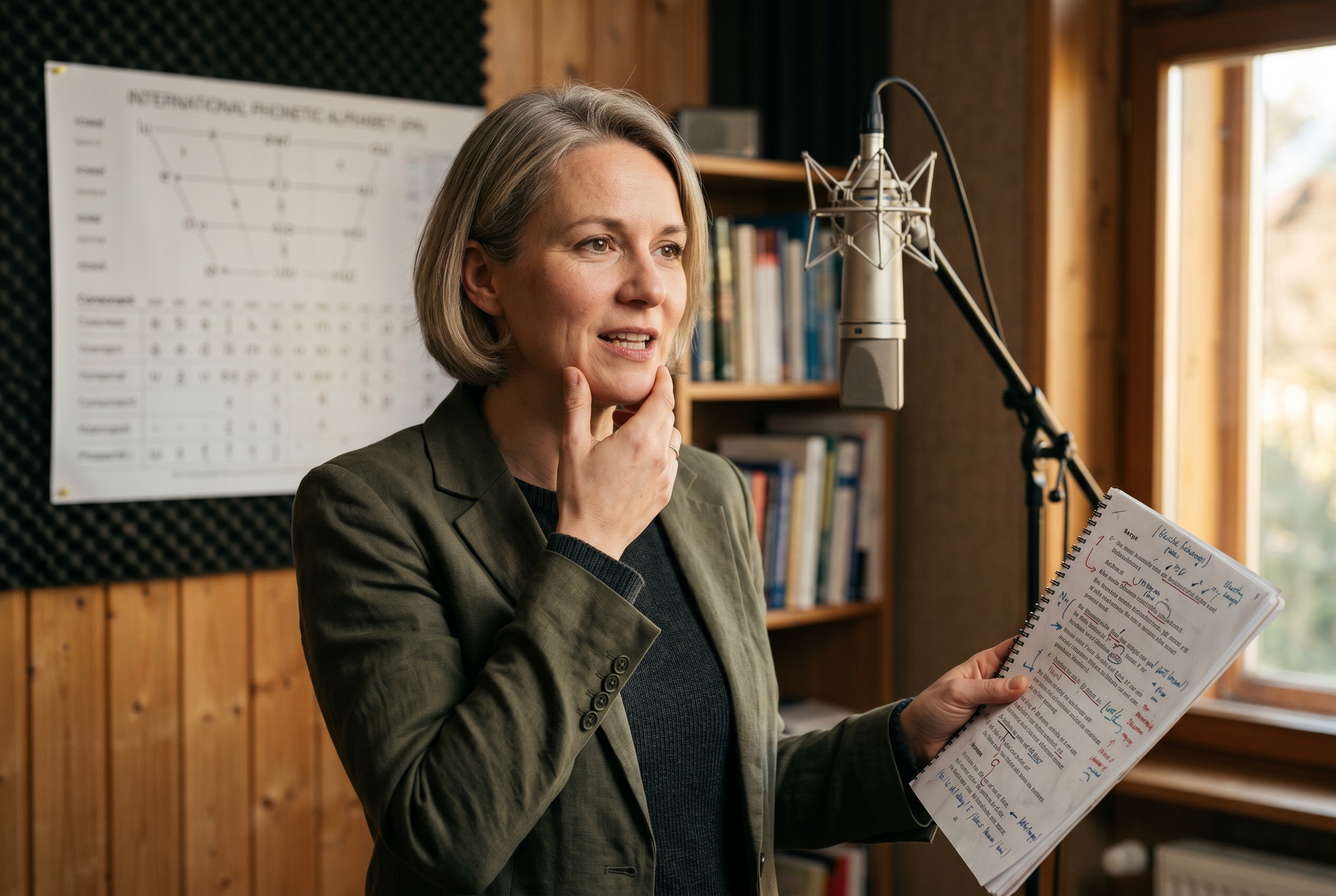
The coach reads the script with the actor, identifies the regional and generational specifics of the character (where from, what decade, what class, what political context for German history-set work), and builds the phonetic and lexical map: which sounds and vocabulary are dialect-distinctive, which the actor lands cleanly, which need drilling. Foundation step for any role-specific German dialect work, especially for actors switching between Standard German and a regional variety.
German-accented English work
Distinct coaching specialty for roles where the character speaks English with a German accent (most Hollywood German characters in English-language productions). The phonological features (final consonant voicing, th-substitution, v-and-w confusion, vowel substitutions, prosodic patterns) are predictable and well-documented. Some coaches specialize specifically in this register; others handle both German-language and German-accented English work.
On-set, on-Zoom, and cultural-consultant support
For shoot weeks, coaches can be available on-set or on-Zoom for emotional-scene work where dialect tends to drop under pressure. Many German dialect coaches also serve as cultural consultants on questions about gesture, costume, food, religious practice, German history-specific context (Weimar, Third Reich, GDR, contemporary), and what reads as authentic for German-speaking audiences. For the broader German programs see our Conversational German page.
FAQ
About German Dialect Coach lessons & classes
The casting note just says "German character speaks German." What questions should I ask before booking a coach?
What country and region (Germany, Austria, Switzerland, or elsewhere) is the character from. What city. What decade. What class background. What education level. Whether the production wants colloquial regional dialect, Standard German with regional accent, or German-accented English. If you don't have answers, the coach can help you ask your representation or the production directly. The dialect choice depends entirely on those answers, and no coach can deliver authentic German without them.
I studied German in college. Will that work for the role?
Depends on the role and the production's intent. College German typically teaches Standard German with broadcast pronunciation, which works for some roles (a German news anchor character, a contemporary urban professional in a Berlin or Munich scene) and not for others (anything regional, anything historical, anything Austrian or Swiss). The coach reads the script and calibrates. For most roles, college German is a useful foundation that needs regional and register-specific coaching on top.
What's the difference between Bavarian and Austrian German?
Closely related but not identical. Bavarian (Boarisch) and Austro-Bavarian share substantial vocabulary, similar phonology, and the diminutive system (-l in Bavarian, -erl in Austrian). The differences are real: Austrian has its own standardized vocabulary (Jänner, Feber, Marillen, Topfen), distinctive intonation patterns, and a more polite or indirect prosodic feel. An actor cast as Viennese should not use Munich Bavarian; the audience will hear the geographic displacement immediately. Coaches who specialize in one or the other distinguish carefully.
Can you coach Swiss German specifically?
Yes, with caveats. Full Swiss German (Schwiizerdütsch) varies across cantons and is not mutually intelligible with Standard German for most speakers. For Swiss-language productions (in dialect, with German subtitles), coaches with Swiss background handle the full dialect work. For international productions with Swiss characters, the usual choice is Standard German with Swiss accent and vocabulary markers rather than full Swiss German. The trial conversation identifies which level of Swiss specificity the production wants.
Can you coach German-accented English instead of German-language dialogue?
Yes, and this is the more common request for Hollywood productions with German characters. The phonological features of German-accented English (final consonant voicing, th-substitution, v-and-w patterns, specific vowel substitutions) are well-documented and coachable. Several roster coaches specialize specifically in this register. Tell us in the trial whether your part is German-language or German-accented English; the right coach for one is not necessarily the right coach for the other.
Do you support on-set coaching during production?
Yes. For lead roles in feature films, prestige TV, or theater productions with extended runs, on-set or on-Zoom coaching during shoot is common, especially for emotional scenes where dialect tends to drop or for last-minute script changes. Rates and availability for on-set work are arranged per project; the trial conversation scopes it. We have staffed productions in Los Angeles, New York, Berlin, Vienna, Zurich, and on location internationally.
I don't speak any German. Can I still take coaching for a German role?
Yes. For non-German-speaking actors with a part that requires German-language dialogue, the foundation work runs alongside the dialect work rather than before it. The coach builds out the specific lines and sounds the part requires, while the actor picks up enough German phonetics, vocabulary, and grammar to support the performance. Many actors with no prior German have delivered credible dialect work on screen this way.
What does the trial cover?
30 minutes, free, with the coach you select. Bring the script if you have one. The coach will read or listen, ask the questions about the character that need answering, identify the highest-impact prep areas, and propose a study plan calibrated to your audition, shoot, or rehearsal date. Most actors continue with their trial coach; if the fit is not right, swapping is easy.
Ready for German Dialect Coach lessons or classes?
Book a free 30-minute trial with one of our personally vetted tutors. Private lessons or small-group classes — your choice.