



Personally vetted instructors
Dutch for Beginners tutors, lessons & classes
Hallo The universal first greeting every Dutch beginner learns.
Personally vetted Dutch tutors who specialize in absolute beginners. Patient, methodical, and calibrated to get you from zero to your first real Dutch sentences without the textbook overwhelm.
Your instructors
Dutch for Beginners tutors for private lessons & classes
Strommen has Dutch tutors who specialize in working with absolute beginners — the moment when patience, pronunciation modeling, and steady vocabulary building matter more than anything else. Every tutor below was met and vetted by us in person or via thorough video interview. No marketplace. No automated profile-creation. Real teachers with real backgrounds in adult beginner instruction.
Filter by location, age, or price. Then book a 30-minute free trial.
Below are the Strommen tutors who specialize in teaching Dutch to absolute beginners. Photos, ratings, and rates are real. Click any card to read their bio and book a free 30-minute trial.
I want to learn…
Every tutor, personally met. — founder-vetted since 2006, in Los Angeles and online worldwide.
Get a personalized plan
Pick your language — a language advisor will match you with the right tutor and map out your path.


I have a Master's degree in Communication Sciences
From Amsterdam's Heart to Global Fluency, Eser Offers Experience-Driven Coaching!
Specialties
I have a Master's degree in Communication Sciences
From Amsterdam's Heart to Global Fluency, Eser Offers Experience-Driven Coaching!
Specialties
Eerste woorden — first foundations
5 Dutch foundations every beginner needs in the first month
These are the building blocks that separate a beginner who's making real progress from one who's spinning on Duolingo. Screenshot for the trial lesson.
-
01
De en het
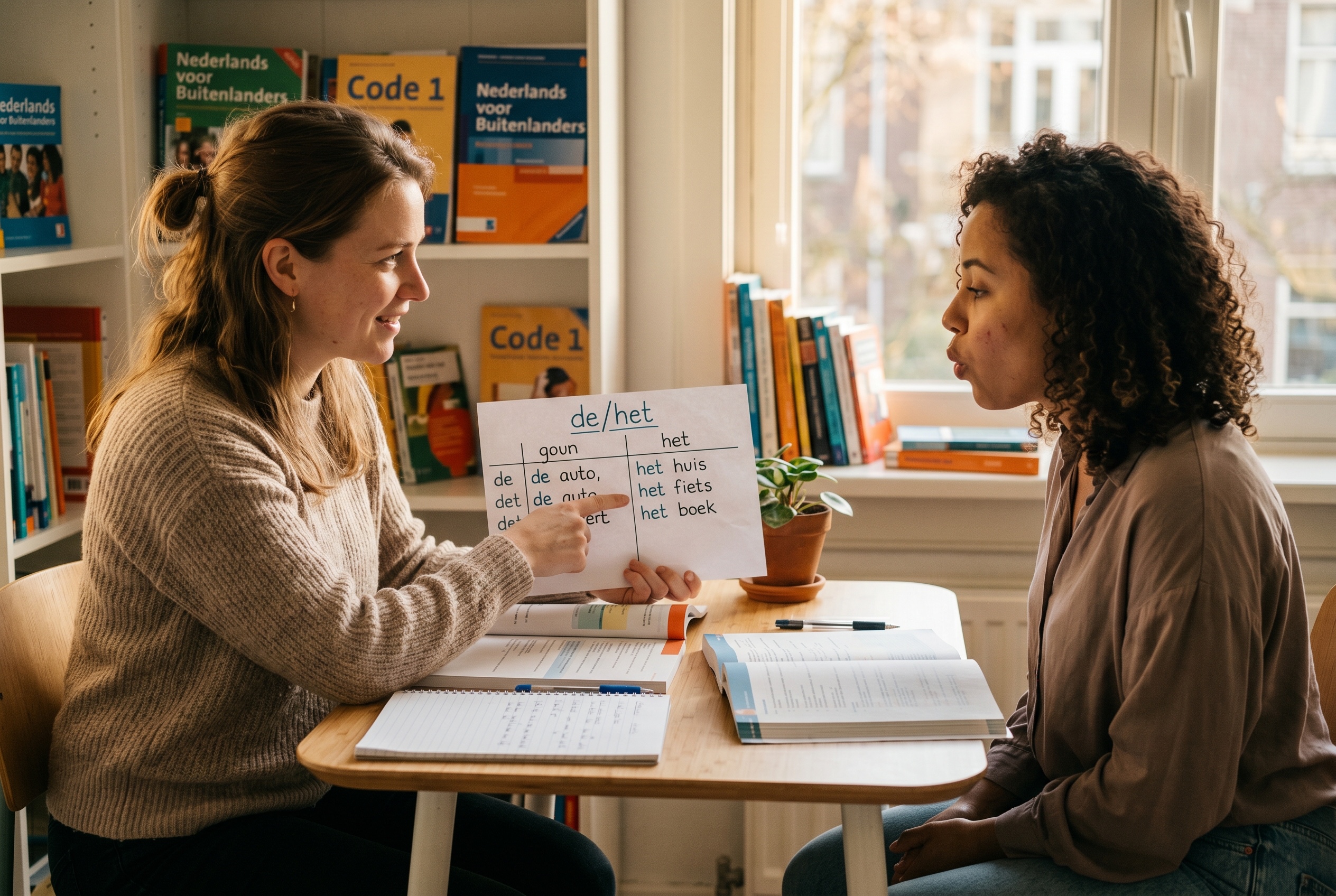
Dutch has two articles. De covers roughly 75 percent of nouns; het covers the rest. There are some helpful patterns (diminutives always take het, plurals all take de), but many common het-words have to be memorized. Good tutors teach articles with vocabulary from day one, never in isolation.
e.g. De man, het boek, de vrouw, het kind, het huis.
-
02
De harde G
The famous hard Dutch G, a scraping sound at the back of the throat with no English equivalent. It appears in everyday words like goedemorgen, graag, and genoeg. Easier in the south of the Netherlands and in Flemish Belgium, where the same letter is pronounced as a softer palatal fricative. Don't aim for perfection in week one; just hear it and attempt it.
e.g. Goedemorgen! Graag gedaan.
-
03
Scheveningen
A seaside town near The Hague whose name combines the S with the famous hard SCH cluster. Used by the Dutch resistance during WWII as a shibboleth: Germans couldn't pronounce it cleanly. Today it's the friendly stress test every beginner attempts. Your tutor will probably have you try it within the first month.
e.g. Ik ga naar Scheveningen vandaag.
-
04
Diminutives -je / -tje
Dutch loves diminutives. Adding -je or -tje to a noun makes it small, cute, or just a softer version of itself. Een biertje is a beer (literally a little beer). Een kopje koffie is a cup of coffee. Een meisje is a girl. Every diminutive automatically takes het, which is one of the most useful gender rules in the language.
e.g. Wil je een biertje of een kopje koffie?
-
05
Hollandic versus Flemish G
The G sound varies across the Dutch-speaking world. The hard, scraping G of Amsterdam, Rotterdam, and the Randstad is the textbook standard. The soft, palatal G of Limburg, Brabant, and all of Flemish Belgium is gentler and easier on a beginner's throat. Neither is wrong. Your tutor will help you pick the variety that matches your goals, whether you're aiming for Amsterdam or Antwerp.
e.g. Same word, two sounds: graag (Amsterdam hard, Antwerp soft).
About Dutch for Beginners
From zero to your first real Dutch sentence
Starting Dutch from zero is, for most English speakers, an easier project than starting French, German, or Spanish from zero. Dutch is one of the closest living relatives of English (along with Frisian), both descended from the West Germanic branch of the language family. Recognizing this resemblance is the fastest motivation boost a beginner can get. Het is koud vandaag is intuitive. Ik drink water is intuitive. Mijn broer woont in Amsterdam is almost identical to its English counterpart in word order and recognizable vocabulary. The cognates run deep: huis is house, boek is book, melk is milk, water is water, open is open, winter is winter, nacht is night. You arrive at lesson one already knowing several hundred Dutch words you didn't realize you knew.
That said, beginner Dutch has its own challenges, and a good tutor in the first three months saves you from the bad habits that plague self-taught learners. The famous hard Dutch G, the de/het article problem, the V2 word order rule, the diminutive endings, and the casual-versus-formal pronoun choice are all foundational, and all easier to learn correctly the first time than to retrofit later.
The first thing every beginner Dutch tutor will introduce is the alphabet and pronunciation. The Dutch alphabet is the same 26 letters as English with a few additions in writing (the IJ digraph is treated as a single letter for many purposes), but several sounds have no English equivalent. The hard G, written as G or sometimes CH, is the famous scraping sound at the back of the throat that Dutch speakers themselves call de harde g. It appears in everyday words like goedemorgen (good morning), graag (please), and genoeg (enough). It softens considerably in the south of the Netherlands and in Flemish Belgium, where the same letter is pronounced as a softer palatal fricative more like a heavy English H. The famous SCH cluster (in words like Scheveningen, the seaside town used as a Dutch shibboleth during WWII) combines an S followed by the hard G followed by a vowel. Don't worry about perfecting it in week one. Just hear it, attempt it, and let your tutor calibrate.
The second beginner foundation is the two articles. Every Dutch noun is either a de-word or a het-word. Roughly 75 percent of nouns are de-words (the common gender, which historically merged the old masculine and feminine), and the remaining 25 percent are het-words (the neuter). There are rules that help — diminutives ending in -je or -tje always take het, plurals all take de, abstract nouns ending in -heid all take de, verbs used as nouns (the gerund-like form) all take het — but a substantial chunk of common het-words just have to be memorized. Het huis. Het boek. Het kind. Het meisje (note: this is a diminutive of meid, which is why "the girl" takes neuter het even though girls are not grammatically neuter in any meaningful sense). The good news for beginners is that getting the article wrong rarely blocks comprehension. The bad news is that fluent-sounding Dutch eventually requires getting it right, so we drill articles with vocabulary from day one rather than introducing them later.
The third foundation is the verb zijn (to be) and the verb hebben (to have). These two verbs carry the highest weight of any single grammar item in your first month. Ik ben, jij bent, hij/zij is, wij zijn, jullie zijn, zij zijn. Ik heb, jij hebt, hij/zij heeft, wij hebben, jullie hebben, zij hebben. Once these two are automatic, you can construct an enormous percentage of basic sentences: introductions, descriptions, possessions, ages, professions, locations. Regular verb conjugation in the present tense is straightforward and compact, with the famous Dutch V2 rule placing the conjugated verb in the second position of the main clause. Once zijn and hebben are solid, regular verbs slot in beside them with very little additional cognitive load.
The fourth foundation is the polite-versus-casual pronoun choice: je/jij versus u. This is looser than the equivalent distinction in German or French, especially in the Netherlands, where je has been gaining ground for decades. In casual contexts, with peers, with younger people, in most workplaces, je is standard. With anyone over about 50, in a formal first-contact email, with a doctor or lawyer, with shop owners in Belgium, u is safer. Flemish Belgium holds onto u more strongly than the Netherlands does. We teach beginners to default to u in any first contact and switch to je when invited or when the other person uses je first. Better to be slightly more polite than slightly less.
A beginner Dutch lesson in this specialty typically structures around vocabulary expansion, pronunciation work, and basic conversation. A typical first month covers greetings and farewells, introducing yourself, numbers 1 to 100, days of the week and months, basic family vocabulary, basic verbs of being and having, the present tense, and roughly 100 to 150 high-frequency words. By month three, most beginners can hold a basic conversation about themselves, their family, their work, their day, and order food and drinks confidently. By month six, conversational ease at A2 level is realistic for committed students with weekly lessons and 20 to 30 minutes of daily exposure.
Dutch is easier than German for English speakers in some specific ways. The case system is dramatically simpler (Dutch has essentially lost its case marking on nouns and articles, retaining only fossilized expressions like te paard or op den duur). Adjective endings are simpler. Word order, while still V2 in main clauses and verb-final in subordinate clauses, is somewhat less rigid than German. Vocabulary overlap with English is slightly greater. The pronunciation is generally easier for English speakers to approximate, with the famous exceptions of the hard G and the SCH cluster. None of this makes Dutch trivial, but it does mean that English speakers who tried German and bounced off often have a smoother experience with Dutch.
Between lessons, beginner-friendly resources include the Duolingo Dutch course (a fine warm-up but not a substitute for real speaking practice), the Dutch Grammar website (great free reference), the News in Slow Dutch-style podcast Buurtaal, and children's TV programs like Sesamstraat or short clips from Het Klokhuis. The Goethe-Institut equivalent for Dutch is the Taalunie's Het Begint met Taal framework and the CNaVT certifications, which are useful goals for committed beginners once they reach A2.
The Strommen Dutch for Beginners roster includes native Dutch teachers from across the Netherlands and Flanders, plus longtime bilinguals based in the United States who specialize in beginner work. Beginner-specific teaching is a skill of its own; the patience to repeat de and het for the tenth time, the ear for the specific pronunciation point a student is missing, the instinct for when to push vocabulary versus consolidate. Each tutor's bio specifies their background and which student profile they fit best. Pricing reflects experience. For other Dutch specialties, our Conversational Dutch, Dutch for Travel, and Dutch for Business pages cover related programs, and the Dutch course page shows the full family.
Lessons calibrate to your specific situation. A leisurely beginner pace for someone curious about Dutch heritage looks different from an accelerated beginner sprint for someone moving to Utrecht in three months. Both look different from beginner inburgering prep for someone working toward Dutch residency requirements. Each lesson is one-on-one, your tutor plans around your week, and the trial is free. Browse the full tutor list, pick a tutor whose teaching style feels approachable, and book a 30-minute trial. There is no faster way to find out whether Dutch will click for you than an hour with a real Dutch teacher.
What you'll cover
Lessons & classes tailored to Dutch for Beginners
Pronunciation foundations from day one
The hard G, the SCH cluster, the rolled and unrolled R variants, the long and short vowels, the diphthongs (UI, EI, OU). Lessons include short listening-and-repeat drills with native audio, so your ear builds alongside your speaking. Beginner Dutch pronunciation is best learned correctly the first time, not corrected later, which is why we frontload it.
The de/het problem, handled the right way
We teach articles with vocabulary from day one: never boek, always het boek. Patterns where they exist (diminutives, plurals, abstract nouns) get explained and drilled. The chunk of het-words that just have to be memorized gets folded into your active vocabulary through repetition, not flashcards in isolation. Most beginners reach reliable de/het instinct by month four.
Zijn, hebben, and your first 150 words
The two foundational verbs (to be and to have) plus 100 to 150 high-frequency nouns and verbs in the first month cover the majority of the basic sentences you'll want to make. Family, food, daily routine, work, hobbies, time, location. Once these are automatic, regular present-tense verb conjugation slots in with very little additional friction.
Beginner-friendly between-lesson resources
Your tutor will recommend specific resources calibrated to your level: Duolingo Dutch for warm-up reps, the Buurtaal podcast for slow Dutch, Sesamstraat clips for kid-level immersion, the Dutch Grammar website for grammar reference. Twenty to thirty minutes of daily exposure outside lessons is the single biggest accelerator for beginners.
FAQ
About Dutch for Beginners lessons & classes
How do I actually master the famous Dutch G sound?
Hear it first, then approximate. The hard G is produced at the back of the throat, with the tongue pulled back and a scraping airflow. Most English speakers find a soft Scottish-loch CH a useful starting point. The good news: if you're aiming for southern Netherlands or Flemish Belgium, the soft palatal G is much easier and is fully acceptable Dutch. We tell beginners to attempt the G, not stress about it, and let it develop over the first six months. Communicative success doesn't depend on a textbook-perfect G.
When do I use de versus het?
Roughly 75 percent of Dutch nouns are de-words and 25 percent are het-words. Useful rules: all diminutives (-je, -tje endings) take het; all plurals take de; abstract nouns ending in -heid all take de; verbs used as nouns all take het. Beyond the rules, many common het-words have to be memorized: het boek, het huis, het kind, het water, het meisje. Good tutors drill articles together with vocabulary from your first lesson onward.
Is Dutch easier than German for English speakers?
In most ways, yes. Dutch has lost almost all of its case marking on nouns and articles (German has four cases still in active use), adjective endings are simpler, vocabulary overlap with English is slightly higher, and pronunciation is generally easier to approximate (the hard G and SCH cluster being the famous exceptions). Word order is similar in both languages: V2 in main clauses, verb-final in subordinate clauses. Many English speakers who tried German and bounced off find Dutch much more approachable.
How long until I can hold a basic conversation in Dutch?
From zero, weekly hour-long lessons plus 20 to 30 minutes of daily exposure (podcasts, apps, Dutch media) typically produces functional A2 conversation within 6 to 9 months. That means introducing yourself, ordering food, talking about your day, basic small talk. Conversational comfort at B1 (the inburgering exam target) usually takes another 6 months at the same pace. Faster timelines are possible with more intensive schedules; slower timelines are normal for learners with less time.
What does a typical beginner Dutch lesson look like?
A first-month lesson runs about an hour and typically includes 10 minutes of warm-up conversation in Dutch (even halting), 15 minutes of new vocabulary with pronunciation drill, 15 minutes of grammar in context (a single point introduced through example sentences), 10 minutes of listening practice with a short audio clip, and 10 minutes of structured role-play or guided conversation. Homework is light and primarily listening-focused. No two lesson plans are identical; your tutor calibrates based on what's clicking and what isn't.
Do I need to know any German or other language before starting Dutch?
No. English is more than enough background. Cognates between English and Dutch are abundant from day one. Knowing German can be a slight head start on word order and verb conjugation patterns, but it can also create interference (German speakers default to German vocabulary or German case markings that don't exist in Dutch). We've taught Dutch beginners with zero language background besides English with consistent success.
Should I worry about the difference between Dutch in the Netherlands and Flemish in Belgium?
Not in the first six months. The written language is identical and the spoken differences are mostly about accent, intonation, and a handful of vocabulary preferences. Focus first on building a usable Dutch base, then refine toward the Netherlands or Belgium variety based on your specific goals. Beginners who try to learn both at once tend to get confused; pick one as your default and absorb the other through exposure over time.
What's the trial lesson like for a complete beginner?
30 minutes, free, with the tutor you select. For absolute beginners, the trial is half assessment and half preview: the tutor will introduce themselves in Dutch and English, gauge what you already know (even passive cognate recognition counts), explain the typical first-month roadmap, and answer your questions about lesson cadence and goals. You'll leave with a sense of whether this specific tutor's approach feels right for you. If not, swap is easy.
Ready for Dutch for Beginners lessons or classes?
Book a free 30-minute trial with one of our personally vetted tutors. Private lessons or small-group classes — your choice.