



Personally vetted instructors
Japanese History tutors, lessons & classes
Welcome. What an academic seminar actually says before the first reading is opened.
Personally vetted tutors who teach Japanese history as an academic subject: chronology, primary sources, historiography, and the longer arcs from the Heian court through Tokugawa Edo into the Meiji transformation and the postwar Showa decades.
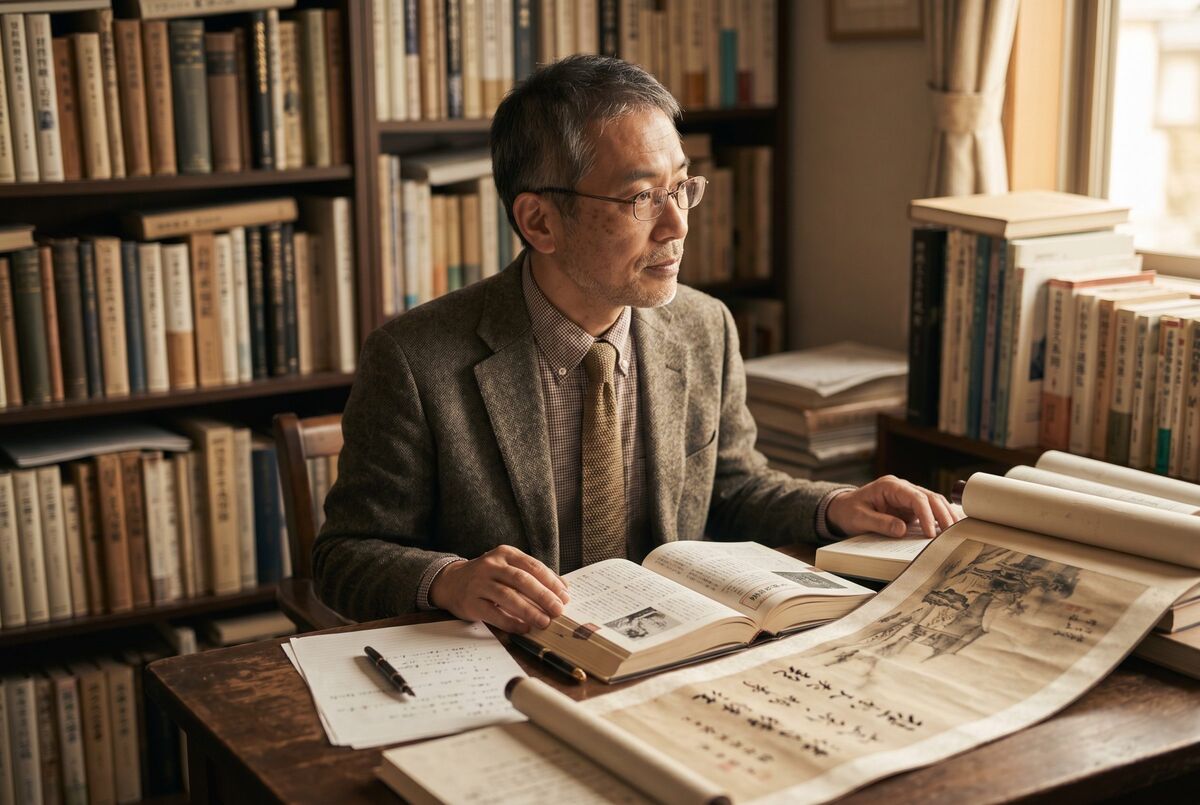
Your instructors
Japanese History tutors for private lessons & classes
Some of the tutors below hold PhDs in Japanese history from US graduate programs; some teach Japanese history as instructors and lecturers in the LA-area university and college network; all of them read the historiography as their working field. That tends to show up in how they teach a period. Filter by location, age, or price, then book a free 30-minute trial to talk through which period and which texts you want to work on.
Below are the Strommen tutors who teach Japanese History. Photos, ratings, and rates are real. Click any card to read a tutor's background and book a free 30-minute trial.
I want to learn…
Every tutor, personally met. — founder-vetted since 2006, in Los Angeles and online worldwide.
Get a personalized plan
Pick your language — a language advisor will match you with the right tutor and map out your path.




High school degree
Japanese Tutor in Tokyo
Personally vetted · Strommen’s note
One of Elisa's students held a ten-minute conversation entirely in Japanese after three months; another passed the JLPT. Tokyo-based, Kansai-ben included.
Specialties
Also speaks: English, History, Kids, Music, Other, Spanish, Yoga
High school degree
Japanese Tutor in Tokyo
Specialties
I also speak: English, History, Kids, Music, Other, Spanish, Yoga
Personally vetted · Strommen’s note
One of Elisa's students held a ten-minute conversation entirely in Japanese after three months; another passed the JLPT. Tokyo-based, Kansai-ben included.



Linguistic high school diploma
Stop memorising, start understanding!
Personally vetted · Strommen’s note
Veronika taught Japanese on other platforms for five-plus years before Strommen. Her pitch is structure over memorization, JLPT prep included.
Specialties
Also speaks: English, German, Italian, Spanish
Linguistic high school diploma
Stop memorising, start understanding!
Specialties
I also speak: English, German, Italian, Spanish
Personally vetted · Strommen’s note
Veronika taught Japanese on other platforms for five-plus years before Strommen. Her pitch is structure over memorization, JLPT prep included.

Nihonshi — periods & sources
5 periods that anchor a Japanese history reading list
These are the periods every introductory Japanese history syllabus passes through, and the ones a tutor will use to orient your first months of reading. Knowing what each one is, and where it sits, helps you talk with a tutor about where to start.
-
01
Heian (794-1185)
The aristocratic court culture centered at present-day Kyoto, dominated politically by the Fujiwara regents and culturally by the development of vernacular Japanese literature. Produced the world's first novel in Murasaki Shikibu's Genji monogatari, the pillow-book essay tradition in Sei Shonagon's Makura no soshi, and the Buddhist Tendai and Shingon schools. Read alongside Ivan Morris's The World of the Shining Prince.
e.g. Genji monogatari (c. 1010) is the foundational text of Heian literary culture.
-
02
Kamakura and Muromachi (1185-1573)
The shogunate-led centuries when warrior government replaced court authority, Zen Buddhism arrived from China and reshaped Japanese aesthetics, and the Onin War (1467-1477) tipped Japan into the sengoku warring-states period. The cultural inheritance includes Noh drama, the tea ceremony, ink-wash painting, and the Heike monogatari chronicle of the Genpei War.
e.g. Heike monogatari, the foundational warrior chronicle, in Royall Tyler's English translation.
-
03
Edo (1603-1868)
The Tokugawa peace, when the shogunate enforced sakoku, urbanized Edo into the largest city in the world, and produced the Genroku cultural flowering of Ihara Saikaku, Chikamatsu Monzaemon, and Matsuo Basho. Two and a half centuries of relative peace built the social and economic foundations the Meiji transformation would later modernize. Conrad Totman's Japan Before Perry is the standard one-volume reference.
e.g. Basho's Oku no hosomichi (Narrow Road to the Deep North) is the central Edo travel-literature text.
-
04
Meiji (1868-1912)
The restoration of imperial authority and the transformation of Japan into a modern industrial state in a generation. Constitutional government, Western military and educational institutions adapted to Japanese needs, rapid industrialization, victory in the Sino-Japanese War (1894-95) and the Russo-Japanese War (1904-05). Marius Jansen's The Making of Modern Japan and Carol Gluck's Japan's Modern Myths are standard reference reading.
e.g. The Meiji Constitution of 1889 marks the formal establishment of constitutional government.
-
05
Showa, Heisei, and Reiwa (1926-present)
The early Showa years of militarism and the Asia-Pacific War, the catastrophic defeat of 1945, the Allied occupation, the postwar economic recovery and the bubble decades, the post-1990 stagnation, the Heisei (1989-2019) and Reiwa (2019-) reigns. John Dower's War Without Mercy and Embracing Defeat are essential reading for the wartime and immediate postwar decades; Andrew Gordon's A Modern History of Japan anchors the longer arc.
e.g. Dower's Embracing Defeat won the 1999 Pulitzer Prize for its account of the Allied occupation.
About Japanese History
Japanese history as a subject, not a language class
Japanese history is one of the world's longest continuously documented national histories, and a serious student is reading across roughly fifteen hundred years of written record. The arc begins with the eighth-century compilations Kojiki (712) and Nihon Shoki (720), the foundational texts of the Yamato court that combined origin myth, dynastic genealogy, and historical chronicle into a single narrative for the emerging Japanese state. It runs through the Heian aristocratic culture (794-1185) that produced the world's first novel in Murasaki Shikibu's Genji monogatari and Sei Shonagon's Makura no soshi, through the Kamakura and Muromachi shogunates and the warring-states sengoku period of the sixteenth century, into the long Tokugawa Edo peace (1603-1868) and the Meiji restoration (1868) that transformed Japan into a modern industrial state in a generation, through the imperial expansion of the early twentieth century into the Asia-Pacific War, and onward through the postwar Showa, Heisei, and Reiwa decades. A student studying Japanese history with a tutor is being taught to read across that arc with the apparatus that the academic field of nihonshi (Japanese history) has developed over the past century and a half, in dialogue with the English-language Japanology tradition built by scholars like Edwin Reischauer, Marius Jansen, Carol Gluck, and Andrew Gordon.
This page is a subject-tutoring specialty rather than a language one. Tutors teach the historical material in English by default, and language preparation is a separate track on the broader Japanese classes roster. A reading knowledge of Japanese is helpful for advanced work with primary sources but is not assumed for most students, and the Anglophone scholarly literature is deep enough to carry an undergraduate or general-reader student through the major periods without it. Where students do read Japanese, tutors can work bilingually on selected primary texts, on excerpts from the major chronicles, on Meiji-era political writings, or on contemporary historiography. The standard reference English-language overview is Andrew Gordon's A Modern History of Japan; the major reference encyclopedia is the Cambridge History of Japan in six volumes; the standard biographical reference is the Iwanami Nihonshi jiten.
The periodization the field uses, and the one a tutor will introduce in the first weeks, runs as follows. The Asuka (538-710) and Nara (710-794) periods, when the centralized Yamato state took shape under heavy borrowing from Tang China: Buddhism arrives, the Taika reforms restructure landholding, the Kojiki and Nihon Shoki are compiled, the capital is built at Nara on a Chinese grid. The Heian period (794-1185), when the court moved to present-day Kyoto and the Fujiwara regents dominated politics: court culture flourished, vernacular Japanese literature emerged, Buddhism developed the Tendai and Shingon schools, and the warrior class began to consolidate. The Kamakura (1185-1333) and Muromachi (1336-1573) shogunates, when warrior government replaced court authority, Zen Buddhism arrived from China, and the Onin War (1467-1477) tipped Japan into the warring-states sengoku period. The Azuchi-Momoyama era of unification under Oda Nobunaga, Toyotomi Hideyoshi, and Tokugawa Ieyasu (1568-1603). The Tokugawa Edo period (1603-1868), when the shogunate enforced sakoku (the closed-country policy), urbanized Edo into the largest city in the world, and produced the Genroku cultural flowering of Saikaku, Chikamatsu, and Basho. The Meiji period (1868-1912), when the restoration of imperial authority opened the country to Western institutions and Japan industrialized at unprecedented speed. The Taisho (1912-1926) and early Showa years, when democratic experiment gave way to militarism and the Asia-Pacific War. The postwar Showa (1945-1989), Heisei (1989-2019), and Reiwa (2019-present) decades, when Japan rebuilt under Allied occupation, became an economic power, weathered the post-1990 stagnation, and entered the present.
A serious reading list for an undergraduate-level tutorial runs across that arc with depth in two or three chosen areas. Heian aristocratic culture rewards a student with Murasaki Shikibu's Genji monogatari (in Royall Tyler or Dennis Washburn's English translations, or in the original for advanced students), Sei Shonagon's Makura no soshi, and Ivan Morris's The World of the Shining Prince for the cultural background. Medieval warrior culture is anchored by Heike monogatari (the Tale of the Heike, the chronicle of the Genpei War, translated by Royall Tyler), Karen Brazell's edition of the Noh drama tradition, and Andrew Goble's work on the Kamakura period. Tokugawa Edo opens through Conrad Totman's standard one-volume Japan Before Perry, through David Howell's work on social order, through Mary Elizabeth Berry's work on Hideyoshi, and through Eiko Ikegami's The Taming of the Samurai. The Meiji transformation runs through Marius Jansen's The Making of Modern Japan, through Carol Gluck's Japan's Modern Myths on the construction of imperial ideology, and through Albert Craig's work on Choshu. The wartime decades open through John Dower's War Without Mercy and Embracing Defeat, both essential reading. Postwar Japan is anchored by Andrew Gordon's A Modern History of Japan and by Sheldon Garon's work on social management. For a one-volume entry across the whole arc, Conrad Totman's A History of Japan, second edition, is the standard general-reader option.
The historiographical traditions a serious student should know about run in two streams. The Japanese-language nihonshi tradition built up across the modern period in the historical departments of the imperial universities (especially Tokyo and Kyoto) and the postwar reconstruction of historical writing under figures like Ishimoda Sho and Toyama Shigeki. The English-language Japanology tradition built by Edwin Reischauer at Harvard, Marius Jansen at Princeton, Carol Gluck at Columbia, Andrew Gordon at Harvard, John Dower at MIT, and the broader postwar generation of American Japanologists trained partly through the Allied occupation. A tutor in this specialty will name the historiographical schools as they come up, point out where a particular interpretation comes from a particular tradition, and help a student read primary sources with the appropriate critical apparatus rather than as standalone documents.
Most students who come to Japanese history tutoring at Strommen fall into a few recognizable groups. Undergraduates preparing for or supplementing a course in Japanese history at a US college. Graduate students in adjacent fields (literature, religion, art history, political science, international relations) building reading depth in Japanese historical context as background for their primary work. General readers with serious interest in a particular period (often Edo, often the Meiji transformation, often the wartime years, often Heian aristocratic culture), who want a tutor to walk them through a sequenced reading list rather than navigating the literature alone. AP World History and high school students preparing for advanced placement or for college-application portfolios. Independent scholars writing books or articles in adjacent fields who need historiographical depth on a particular Japanese chapter. Each of these arrives with different background and different goals, and a working tutor calibrates the syllabus to the student in front of them.
A few honest tutor observations on where Anglophone students typically stall in Japanese history. Names and dates do not come up first; the field has reasonable overview literature in English and most students arrive with chronological scaffolding. The deeper friction tends to come from three places. The first is the assumption that pre-modern Japan can be read through Western categories: feudalism, the early modern, the renaissance. The categories sometimes fit and often do not, and a tutor spends real time disentangling what the field has decided about each. The second is the discontinuous record on certain topics (popular culture in the Tokugawa period, women's history before the modern era, the experience of non-elite populations in any period), where the sources are thinner and the historiography is younger. The third is the difficulty of reading wartime and immediate postwar history without prior framing: the field has had decades of revisions, controversy is alive, and the primary sources require careful contextualizing. And one pleasure rather than a trap: Japanese history has produced some of the finest narrative history writing of the last fifty years in any language, and a reader who reaches Dower or Gordon or Jansen finds work of real literary quality.
The Strommen Japanese history tutors include PhDs and ABDs in Japanese history from US graduate programs, current college instructors and lecturers teaching Japanese history in the LA-area university and college network, Japan-trained academics with degrees from Tokyo, Kyoto, or other major Japanese universities working in Los Angeles, and one or two specialists in particular periods (Heian literature, Tokugawa social history, Meiji intellectual history, the wartime years) who teach this material as part of their professional practice. Each tutor's bio describes their training, their period of specialization, and what they most like to teach. Most students begin with a free 30-minute trial so the tutor can see what they have already read, what they want to read, and what level of engagement they are bringing to the work.
What you'll cover
Lessons & classes tailored to Japanese History
Sequenced reading across the periods
Rather than handing you a syllabus, your tutor builds a reading path around your starting point and what you actually want to study. A typical undergraduate-level track moves from a one-volume overview (Gordon, Totman) into period-specific reading on the two or three areas you care most about. Graduate-level and serious-reader tracks go deeper into the primary sources and into the historiographical literature.
Primary sources and the apparatus to read them
Where students engage primary sources (Kojiki, Nihon Shoki, Heian diaries, Heike monogatari, Tokugawa political writings, Meiji-era polemics, wartime documents), tutors work alongside through the textual apparatus the field has built around each: standard editions, scholarly translations, commentary traditions. For students reading Japanese, bilingual work on selected passages is available. For students working in English, the major translations are mapped at the start.
Historiography and the schools of interpretation
A serious student of Japanese history is also being introduced to the historiographical traditions: the Japanese-language nihonshi tradition built at Tokyo and Kyoto and reconstructed in the postwar decades, and the English-language Japanology tradition from Reischauer through Jansen, Gluck, Gordon, and Dower. A tutor names the schools as they come up, so a student reads a particular interpretation knowing where it comes from rather than as a standalone fact.
Exam preparation, course support, and writing work
For students in formal coursework, lessons can be calibrated to a specific syllabus, to AP World History (the Japan chapters specifically), or to upper-division undergraduate or graduate exam preparation. For students writing on Japanese history (papers, theses, articles), tutors can advise on source selection, on the secondary literature, on the historiographical positioning of an argument, and on common interpretive pitfalls. The deliverable shapes the curriculum.
FAQ
About Japanese History lessons & classes
Do I need to know Japanese to study Japanese history with a tutor?
No. Most students who come to this specialty are reading in English, and the English-language scholarly literature on Japanese history is deep enough to carry an undergraduate or general-reader student through every major period. Where students do read Japanese, tutors can work bilingually on selected primary texts. If your goal is to read Japanese-language historical sources directly, language preparation is a separate track on our broader Japanese classes roster, and a tutor on this specialty can help you sequence the two side by side.
Which period should I start with?
A standard introductory sequence runs chronologically with depth in two or three chosen periods. Many students start with a one-volume overview (Gordon's A Modern History of Japan for the modern arc; Totman's Japan: A History for the longer arc) and then go deeper into the period that most interests them. The most common deep-dive choices we see are Heian aristocratic culture, the Tokugawa Edo period, the Meiji transformation, and the wartime and immediate postwar decades. Your tutor sets the starting point at the trial based on what you have read already and what you want to read next.
Is this tutoring for undergraduates, graduate students, or general readers?
All three. The roster includes tutors comfortable with first-year undergraduate survey work, with upper-division and graduate seminar work, and with serious general readers who want to be guided through the literature without academic enrollment. A few tutors also work with AP World History and high school students preparing for advanced placement or for college-application portfolios. Tell us your level and your goal at the trial; we match you to the tutor whose teaching practice fits.
Can a tutor help me write a paper or a thesis on a Japanese history topic?
Yes, within standard academic integrity boundaries. Tutors can advise on source selection, on the secondary literature, on the historiographical positioning of an argument, on the standard scholarly translations of primary texts, and on common interpretive pitfalls in your chosen period. The deliverable in this kind of work is your understanding of the field and your independently written argument, not the writing itself.
Are your Japanese history tutors academics?
Most are. The roster includes PhDs and ABDs in Japanese history from US graduate programs, current instructors and lecturers in the LA-area university and college network, Japan-trained academics with degrees from major Japanese universities working in Los Angeles, and one or two period specialists who teach this material as part of their professional practice. Each bio specifies training, period of specialization, and what the tutor most likes to teach.
Can I take Japanese history tutoring online or only in person?
Both. Most of our Japanese history tutors teach online via Zoom or Jitsi and work with students worldwide. Reading-and-discussion lessons translate well to a screen, since most of the lesson is spent on a shared text or a sequence of arguments. Several tutors also teach in person around Los Angeles. The booking widget on each tutor's profile shows the available formats.
I want to focus on one specific period or topic. Can lessons concentrate there?
Yes. A focused topic (Heian women's literature, Tokugawa urban culture, the Meiji Restoration as institutional transformation, the wartime decades and historical memory, the postwar economic miracle and its critics) is exactly the kind of brief these tutors handle well. The tutor will usually suggest lead-in reading at the right level first, then build the lessons around the period or theme you came for. Tell us the topic at the trial.
How does this specialty differ from Japanese language tutoring?
This is subject tutoring in history; Japanese language tutoring is a separate track on our broader Japanese roster. The historical material here is taught in English by default. Language tutors teach Japanese as a language: hiragana, katakana, kanji, grammar, conversation, JLPT preparation, business Japanese. Several students run the two tracks side by side, and tutors on each specialty can recommend the other when the student's goals call for it.
Ready for Japanese History lessons or classes?
Book a free 30-minute trial with one of our personally vetted tutors. Private lessons or small-group classes — your choice.