



Personally vetted instructors
German for Beginners tutors, lessons & classes
Guten Tag The universal polite greeting every beginner learns on day one.
Personally vetted German tutors who specialize in absolute beginners. Patient, structured, and built around the three things that decide whether German clicks for you in the first 90 days.
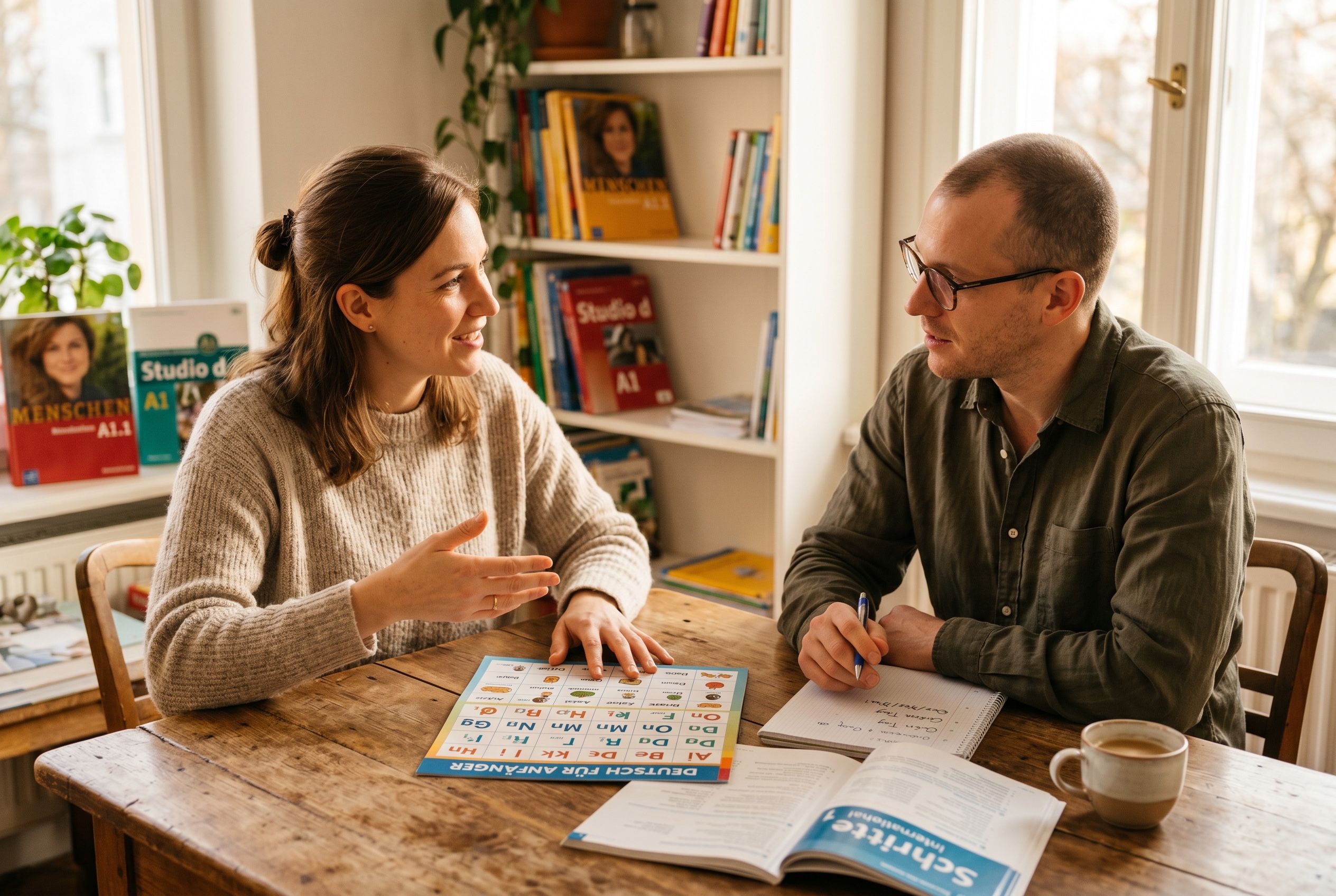
Your instructors
German for Beginners tutors for private lessons & classes
Strommen has German tutors who specialize in working with absolute beginners. That's its own craft: pronunciation modeling, patient article drilling, the right pace on the case system, and steady vocabulary building with every noun introduced alongside its der, die, or das. Every tutor below was met and vetted by us in person or via thorough video interview. No marketplace. No automated profile-creation. Real teachers with real backgrounds in adult beginner instruction.
Filter by location, age, or price. Then book a 30-minute free trial.
Below are the Strommen tutors who specialize in teaching German to absolute beginners. Photos, ratings, and rates are real. Click any card to read their bio and book a free 30-minute trial.
I want to learn…
Every tutor, personally met. — founder-vetted since 2006, in Los Angeles and online worldwide.
Get a personalized plan
Pick your language — a language advisor will match you with the right tutor and map out your path.




Bachelor of Business Administration (specialized in International Relations) · DELF Examiner, DALF C2, Goethe Zertifikat C1/B2, DELE B1
Join me on your language learning adventure!
Personally vetted · Strommen’s note
Bangalore-based, Yvanka teaches French and German after years at Alliance Française. She started, unusually, as an English teacher in France.
Specialties
Also speaks: English, Italian, Spanish
Bachelor of Business Administration (specialized in International Relations) · DELF Examiner, DALF C2, Goethe Zertifikat C1/B2, DELE B1
Join me on your language learning adventure!
Specialties
I also speak: English, Italian, Spanish
Personally vetted · Strommen’s note
Bangalore-based, Yvanka teaches French and German after years at Alliance Française. She started, unusually, as an English teacher in France.

MFA (Cal-Arts), Matura B (Literargymnasium Zürich Rämibühl)
Swiss German Tutor from Zurich with a Deep Appreciation for Germanic Literature!
Personally vetted · Strommen’s note
Zurich-trained with seven years of Latin behind him, Cyril splits every German lesson cleanly into two tracks: travel German or Goethe-reading German.
Specialties
MFA (Cal-Arts), Matura B (Literargymnasium Zürich Rämibühl)
Swiss German Tutor from Zurich with a Deep Appreciation for Germanic Literature!
Specialties
Personally vetted · Strommen’s note
Zurich-trained with seven years of Latin behind him, Cyril splits every German lesson cleanly into two tracks: travel German or Goethe-reading German.
Master German with Emanuel: Published Author Fluent in German, French, and English with a Rich Cultural Background
Personally vetted · Strommen’s note
Emanuel is a published author fluent in three languages, and he's been teaching German with us since 2011.
Specialties
Master German with Emanuel: Published Author Fluent in German, French, and English with a Rich Cultural Background
Specialties
Personally vetted · Strommen’s note
Emanuel is a published author fluent in three languages, and he's been teaching German with us since 2011.
B.A. (MIT)
Native trilingual
Personally vetted · Strommen’s note
Trilingual since age seven and raised between Mexico City and Düsseldorf, Klaus coaches Spanish and German dialects the way he learned them: by talking.
Specialties
B.A. (MIT)
Native trilingual
Specialties
Personally vetted · Strommen’s note
Trilingual since age seven and raised between Mexico City and Düsseldorf, Klaus coaches Spanish and German dialects the way he learned them: by talking.
MSc · N/A
Austrian teaching my native language German
Personally vetted · Strommen’s note
Austrian-born, Thomas teaches native German alongside math. Calculus and trigonometry sit right next to German grammar on his schedule.
Specialties
MSc · N/A
Austrian teaching my native language German
Specialties
Personally vetted · Strommen’s note
Austrian-born, Thomas teaches native German alongside math. Calculus and trigonometry sit right next to German grammar on his schedule.
PhD, BSc
PHD with Degree in Swedish and German Linguistics - Arctic researcher, PHD in Biology offering fun and interactive Swedish and German lessons
Personally vetted · Strommen’s note
Carola is a PhD biologist and Arctic researcher with a separate degree in Swedish and German linguistics. She brings that same field rigor into lessons.
Specialties
PhD, BSc
PHD with Degree in Swedish and German Linguistics - Arctic researcher, PHD in Biology offering fun and interactive Swedish and German lessons
Specialties
Personally vetted · Strommen’s note
Carola is a PhD biologist and Arctic researcher with a separate degree in Swedish and German linguistics. She brings that same field rigor into lessons.

I am currently in my sixth semester of my Philosophy & Theater, Film, Media science Bachelor
German and Spanish Native Speaker
Personally vetted · Strommen’s note
A native German and Spanish speaker based in Vienna, Sophie mixes grammar, readings, and conversation deliberately, to keep lessons from repeating.
Specialties
I am currently in my sixth semester of my Philosophy & Theater, Film, Media science Bachelor
German and Spanish Native Speaker
Specialties
Personally vetted · Strommen’s note
A native German and Spanish speaker based in Vienna, Sophie mixes grammar, readings, and conversation deliberately, to keep lessons from repeating.

Bachelor of Education (B.Ed.) and pursuing a degree in Aerospace Engineering. · I have a TEFL certification | Certifications in Adobe Graphic Design (Level 1 & 2) for interactive presentations and educational materials.
English, German, and Arabic classes
Personally vetted · Strommen’s note
Arabic, English, and German sit alongside AP Calculus and AP Physics on Omar's schedule, a genuinely rare tutor who crosses from language straight into STEM.
Specialties
Also speaks: French, Italian, Spanish
Bachelor of Education (B.Ed.) and pursuing a degree in Aerospace Engineering. · I have a TEFL certification | Certifications in Adobe Graphic Design (Level 1 & 2) for interactive presentations and educational materials.
English, German, and Arabic classes
Specialties
I also speak: French, Italian, Spanish
Personally vetted · Strommen’s note
Arabic, English, and German sit alongside AP Calculus and AP Physics on Omar's schedule, a genuinely rare tutor who crosses from language straight into STEM.

Bachelor English and Psychology · TEFL, Oxford Aviation Train-the-Trainer Certificate
I love Deutsch
Specialties
Bachelor English and Psychology · TEFL, Oxford Aviation Train-the-Trainer Certificate
I love Deutsch
Specialties
B.M. in Vocal Performance, Augsburg College, Minneapolis, MNM.M. in Classical Voice, Manhattan School of Music, New York, NY · CELTA Certification, Teaching English as a Foreign Language to Adults, University of Cambridge/Hamburg School of English, Hamburg, GermanyDaF Unterrichten, teaching German as a Foreign Language, Goethe-Institut, München, GermanyGoethe-Zertifikat C2 Gro...
Your anchor on the stormy seas of German learning.™
Personally vetted · Strommen’s note
Nicole calls herself, trademark and all, 'your anchor on the stormy seas of German learning.' Sixteen years teaching, Goethe exam prep included.
Specialties
B.M. in Vocal Performance, Augsburg College, Minneapolis, MNM.M. in Classical Voice, Manhattan School of Music, New York, NY · CELTA Certification, Teaching English as a Foreign Language to Adults, University of Cambridge/Hamburg School of English, Hamburg, GermanyDaF Unterrichten, teaching German as a Foreign Language, Goethe-Institut, München, GermanyGoethe-Zertifikat C2 Gro...
Your anchor on the stormy seas of German learning.™
Specialties
Personally vetted · Strommen’s note
Nicole calls herself, trademark and all, 'your anchor on the stormy seas of German learning.' Sixteen years teaching, Goethe exam prep included.

Bachelor’s degree in German as a Foreign/Second LanguageDiploma thesis in the field of German language teachingQualified DaF/DaZ teacher with BAMF certification · BAMF Certificate, ÖIF Certificate, Diploma in German Language Pedagogy
Certified German Tutor (A1–B2) | 26+ Yrs Exp. including multi-year work experience in Germany
Specialties
Bachelor’s degree in German as a Foreign/Second LanguageDiploma thesis in the field of German language teachingQualified DaF/DaZ teacher with BAMF certification · BAMF Certificate, ÖIF Certificate, Diploma in German Language Pedagogy
Certified German Tutor (A1–B2) | 26+ Yrs Exp. including multi-year work experience in Germany
Specialties

Erste Schritte — first foundations
5 German foundations every beginner needs in the first month
These are the building blocks that decide whether your first 90 days of German build into real momentum or stall out in textbook frustration. Screenshot for the trial lesson.
-
01
Der, die, das
Every German noun has one of three genders. Der is masculine, die is feminine, das is neuter. The gender is largely unpredictable from meaning, with some patterns: words ending in -ung, -heit, -keit are feminine; diminutives in -chen are neuter; days, months, seasons are masculine. Beyond the patterns, common nouns just have to be memorized with their article from day one.
e.g. Der Tisch, die Lampe, das Buch, der Mann, die Frau, das Kind.
-
02
Umlauts (ä, ö, ü) and ß
The four extra letters German adds to the standard alphabet. The umlauts are not optional decoration. Schön and schon are different words. Für and fur are different. Möhre (carrot) and Mohre would mean different things. The eszett ß represents a double-s sound after a long vowel and shows up in everyday words like Straße and weiß.
e.g. Heißen, schön, für, müssen, Größe.
-
03
Compound nouns
Famous German compound nouns are real and entirely predictable once you know the parts. Geschwindigkeitsbegrenzung is speed-limitation, the speed limit. Krankenversicherungsgesellschaft is sick-insurance-company, a health insurance company. Beginners learn to decompose long words into their parts rather than memorize them whole. Once the habit clicks, German vocabulary expansion accelerates dramatically.
e.g. Haus + Tür = Haustür (front door). Hand + Schuh = Handschuh (glove).
-
04
All nouns capitalized
Every noun in German is capitalized, not just proper nouns. Das Auto, der Hund, die Schule, das Essen. Lowercase nouns in German writing read as immediately wrong. The side benefit: German text is easier to parse because the nouns visually pop out, which speeds reading once you start working with real German materials.
e.g. Ich gehe heute mit meinem Hund in den Park.
-
05
V2 word order
In main clauses, the conjugated verb sits in the second position, regardless of what comes first. Ich gehe heute zur Arbeit, Heute gehe ich zur Arbeit, Zur Arbeit gehe ich heute: all three are correct and the verb stays second. Subordinate clauses (introduced by weil, dass, wenn) send the verb to the end. This feels alien to English speakers at first; consistent exposure internalizes it within a few months.
e.g. Heute habe ich keine Zeit. Weil ich heute keine Zeit habe.
About German for Beginners
From zero to your first real German sentence
Starting German from zero is a different project than starting French, Spanish, or Italian. German is a Germanic language, like English, and the family resemblance shows up in the vocabulary almost immediately. Haus is house, Buch is book, Milch is milk, Wasser is water, Mutter is mother, Vater is father, Bruder is brother, Schwester is sister. The verb to-be is similar (ich bin, English I-am), the verb to-have is similar (ich habe, English I-have), and basic syntax in short sentences lines up enough that beginners can produce real German sentences within a week or two. None of that is the hard part.
The hard part is the structural skeleton. German has three noun genders (masculine der, feminine die, neuter das) that are largely unpredictable from meaning. Das Mädchen is the girl, grammatically neuter. Der Löffel is the spoon, grammatically masculine. Die Gabel is the fork, grammatically feminine. Das Messer is the knife, grammatically neuter. There are some patterns (most words ending in -ung, -heit, -keit, -schaft, -tion are feminine; most diminutives ending in -chen or -lein are neuter; most days, months, and seasons are masculine), but a large chunk of common vocabulary just has to be memorized with its article from the start. Beginner tutors who know what they're doing teach every noun with its article from day one, never the bare noun. Das Haus, not Haus. Die Straße, not Straße. This habit, learned in the first month, saves you years of retrofitting.
The second structural piece is a preview of the case system. German has four cases (Nominativ for the subject, Akkusativ for the direct object, Dativ for the indirect object, Genitiv for possession), and articles, adjectives, and pronouns all change form depending on case. Der Mann in the nominative becomes den Mann in the accusative, dem Mann in the dative, des Mannes in the genitive. Beginner lessons don't drill the full case system in month one; that's a grammar specialty. What they do is introduce the concept (so you're not blindsided when it shows up in week three or four), teach the most common case-triggered patterns (the accusative after haben, the dative after certain prepositions like mit and bei), and build the habit of noticing case markers as you encounter them. Most beginners reach reasonable case instinct by month four to six. The case system is the famous wall in German learning; getting properly oriented to it in month one keeps the wall from collapsing the rest of your progress later.
The third structural piece is verb conjugation and word order. Regular German verbs in the present tense conjugate in a compact pattern: ich gehe, du gehst, er geht, wir gehen, ihr geht, sie gehen. The verbs sein (to be) and haben (to have) are irregular and carry an outsized portion of the conversational weight in the first month. Ich bin, du bist, er ist, wir sind, ihr seid, sie sind. Ich habe, du hast, er hat, wir haben, ihr habt, sie haben. Once those two are automatic and you have a handful of regular verbs alongside them (gehen, kommen, machen, sagen, essen, trinken, wohnen, arbeiten), you can construct an enormous percentage of basic sentences. Word order in German main clauses follows the V2 rule: the conjugated verb sits in the second position, no matter what comes first. Ich gehe heute zur Arbeit, Heute gehe ich zur Arbeit, Zur Arbeit gehe ich heute: all three are correct and the verb stays second. Subordinate clauses send the verb to the end, which feels alien to English speakers and just takes consistent exposure to internalize.
The fourth piece is the alphabet, the umlauts, and pronunciation. German uses the same 26 letters as English plus the umlauts ä, ö, ü and the eszett ß (which represents a double-s sound after a long vowel or diphthong). Vowels in German are pure: the German o doesn't drift into a diphthong the way American English o does. Consonants are crisp and largely consistent with their letters, with a few specific cases beginners drill: the ch sound after front vowels (the soft ich-sound) versus after back vowels (the harder ach-sound), the rolled or uvular r, the w pronounced as English v, the v pronounced as English f, the z pronounced as a sharp ts, the s at the start of a word pronounced as English z. The umlauts deserve real attention from week one: schön versus schon, für versus fur, böse versus bose are not subtle distinctions and beginners who learn the umlaut sounds correctly in the first month save themselves a steady stream of comprehension mistakes later.
The fifth piece is capitalization. Every noun in German is capitalized, not just proper nouns. Das Haus, der Hund, die Schule, das Auto, der Tisch, die Lampe. This is not a stylistic option; it's a rule. Lowercase nouns in German writing read as immediately wrong to native eyes. A side benefit of the rule is that German written text is genuinely easier to parse: you can see at a glance what the nouns in a sentence are, which speeds reading once you start working with German texts.
A typical first-month curriculum covers greetings and farewells across the casual-formal spectrum, the alphabet and pronunciation drills with focus on umlauts, the verbs sein and haben in present tense, numbers 1 to 100, days and months, basic family vocabulary, basic food and drink vocabulary, present-tense regular verb patterns, the V2 word order rule, the three articles and the gender problem, and roughly 150 to 200 high-frequency words taught with their articles. By month three, most beginners can hold a basic conversation about themselves, their family, their day, and order food and drinks. By month six, A2-level conversational comfort is realistic for committed students with weekly lessons and 20 to 30 minutes of daily German exposure.
Between lessons, beginner-friendly resources include Deutsche Welle's Nicos Weg (free, video-based, A1 through B1 progression, taught entirely in German with English support), Easy German on YouTube for slowed-down real conversations, the Duolingo German tree for warm-up reps (not a substitute for real lessons), the website German.net for grammar reference, and Coffee Break German for the structured audio approach. Twenty to thirty minutes of daily German exposure is the single biggest accelerator for beginners.
The Strommen German for Beginners roster includes native German teachers from across Germany, Austria, and Switzerland, plus longtime German-American bilinguals based in the US who specialize in beginner work. Beginner-specific teaching is its own skill: the patience to drill der, die, das for the tenth time, the ear for the specific umlaut a student is missing, the instinct for when to introduce the case system and when to keep it offstage a little longer. Several of our beginner tutors hold Goethe-Institut teaching credentials. Each tutor's bio specifies background, teaching style, and which student profile they fit best. For related German programs, our Hochdeutsch (Standard German), Conversational German, and German Grammar specialty pages cover what comes next, and the German course page shows the full family.
Lessons calibrate to your specific situation. A relaxed beginner pace for someone curious about German heritage looks different from an accelerated beginner sprint for someone moving to Berlin in three months, which is different again from beginner Goethe A1 prep for someone working toward a residence-permit requirement. Each lesson is one-on-one, your tutor plans around your week, and the trial is free. Browse the full tutor list, pick someone whose teaching style feels approachable, and book a 30-minute trial. The fastest way to find out whether German will click for you is to try a real lesson with a real teacher.
What you'll cover
Lessons & classes tailored to German for Beginners
Articles, genders, and the first 200 words
We teach every noun with its article from day one. Never Tisch, always der Tisch. Patterns where they exist (the -ung/-heit/-keit/-schaft feminine cluster; -chen/-lein diminutive neuters; days, months, and seasons masculine) get explained and drilled. The 150 to 200 highest-frequency German words get folded into your active vocabulary through repetition with their articles, not flashcards in isolation. Most beginners reach reliable article instinct on familiar vocabulary by month four.
Sein, haben, present tense, and V2 word order
The two foundational verbs (to be and to have), the regular present-tense conjugation pattern, and the V2 main-clause word order in the first month cover the majority of basic sentences you'll want to make. Family, food, daily routine, work, hobbies, time, location. Once these are automatic, modal verbs (können, müssen, wollen, sollen) and the perfect tense slot in with much less friction in months two and three.
Pronunciation foundations from day one
Umlauts (ä, ö, ü), the eszett ß, the ich-sound and ach-sound, vowel purity, the German w as English v, the German z as English ts. Lessons include short listening-and-repeat drills with native audio so your ear builds alongside your speaking. Beginner German pronunciation is best learned correctly the first time, not corrected later, which is why we frontload the most distinctive sounds.
Case-system preview and Goethe A1 pathway
We don't drill the full case system in month one; that's a grammar specialty. We do introduce the concept so you're oriented when it shows up, teach the highest-frequency case-triggered patterns (accusative after haben, dative after mit and bei), and build the habit of noticing case markers as you encounter them. For students aiming at Goethe A1 certification (often required for German residence permits), the curriculum maps to the exam's four modules with mock practice in the final weeks before the test.
FAQ
About German for Beginners lessons & classes
Is German actually as hard as everyone says?
Honestly, the first 3 to 6 months feel harder than other European languages because of the case system, the three genders, and the V2 word order. After that, German becomes easier than many learners expect. The rules are highly logical, vocabulary is largely Germanic and predictable, and once the case system clicks the whole language opens up. Most students who push through the initial grammar wall find German genuinely rewarding. Spanish-style "sounds great after three months" isn't German's profile; German is more of a long slope that levels out into stable progress.
How do I memorize all the noun genders?
Three things at once. First, always learn nouns with their article from day one: das Haus, not Haus. The article becomes part of the word in your memory. Second, learn the patterns where they exist (-ung/-heit/-keit feminine, -chen/-lein neuter, days/months/seasons masculine). Third, accept that a chunk of common das and der words just have to be drilled until they're automatic. We weave article drills into vocabulary work rather than treating them as a separate exercise. Most beginners reach reliable instinct on familiar vocabulary by month four.
When do I start learning the four cases?
We introduce the concept in week 1 or 2 so you're not blindsided when case markers start appearing in your vocabulary. We drill the most common case-triggered patterns (accusative after haben, dative after mit) progressively starting month two. The full four-case system gets dedicated focus in months three through six. Trying to absorb the full case system in week one is the most common reason beginners burn out. Progressive exposure works better.
How long until I can hold a basic conversation in German?
From zero, weekly hour-long lessons plus 20 to 30 minutes of daily German exposure typically produces functional A2 conversation within 6 to 9 months. That means introducing yourself, ordering food, talking about your family and your day, basic small talk. Conversational comfort at B1 (the level Goethe-Zertifikat B1 tests, and often the level required for German residence permits) usually takes another 6 to 9 months. Faster timelines are possible with more intensive schedules; slower timelines are normal for learners with less time.
Do I need to focus on German for Germany, Austria, or Switzerland?
Not in the first six months. Hochdeutsch (Standard German) is the foundation everyone learns, and it's universally understood across all German-speaking countries. The regional variation (Bavarian, Austrian, Swiss German) is an accent and vocabulary layer that comes after solid Hochdeutsch foundations. Beginners who try to learn a regional variant from scratch tend to get confused; pick Hochdeutsch as your base and absorb regional flavor through exposure once you're solid.
What does a typical beginner German lesson look like?
A first-month lesson runs about an hour and typically includes 10 minutes of warm-up conversation in German (even halting), 15 minutes of new vocabulary with pronunciation drill and articles, 15 minutes of grammar in context (a single point introduced through example sentences), 10 minutes of listening practice with a short audio clip, and 10 minutes of structured role-play or guided conversation. Homework is light and primarily listening-focused. No two lesson plans are identical; your tutor calibrates based on what's clicking and what isn't.
What's the trial lesson like for a complete beginner?
30 minutes, free, with the tutor you select. For absolute beginners, the trial is half assessment and half preview: the tutor will introduce themselves in German and English, gauge whatever you already know (even passive cognate recognition from English counts), explain the typical first-month roadmap, and answer your questions about cadence, expectations, and Goethe certification if relevant. You'll leave with a sense of whether this specific tutor's approach feels right. If it doesn't, switching is easy.
Ready for German for Beginners lessons or classes?
Book a free 30-minute trial with one of our personally vetted tutors. Private lessons or small-group classes — your choice.