



Personally vetted instructors
ASL for Beginners tutors, lessons & classes
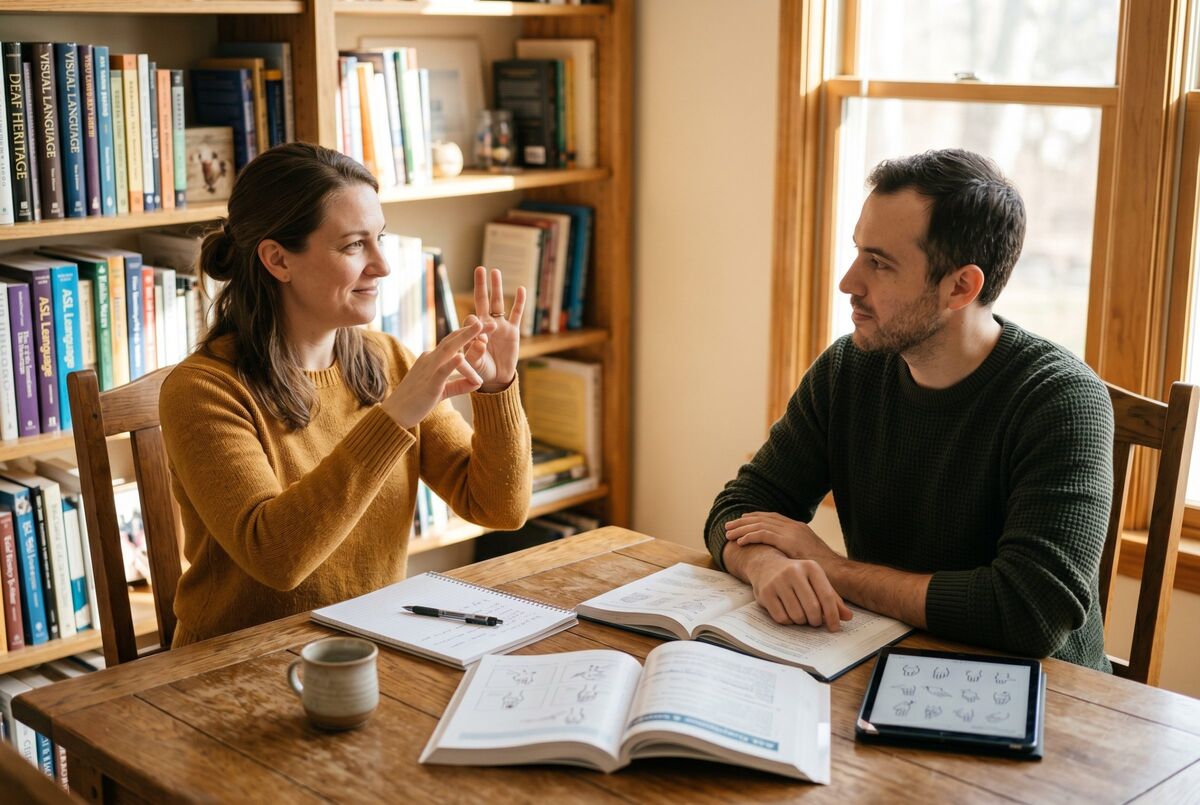
HELLO The waving-open-hand greeting any signer gives across a room, taught in the first ten minutes of any honest ASL beginner lesson.
Personally vetted American Sign Language tutors for absolute beginners. Lessons that start with the manual alphabet, basic everyday signs, and a clear introduction to Deaf culture from people who can teach the language as the living, full-grammar language it actually is.
Your instructors
ASL for Beginners tutors for private lessons & classes
Strommen runs a curated boutique practice, not a marketplace. Our ASL roster includes both Deaf and hearing tutors who teach ASL as the full, independent language it is. Each was met and vetted before they ever taught a Strommen lesson. The mix lets a beginner start with whichever fit feels right and build from there.
Read the bios, then book a 30-minute free trial.
Below are the Strommen tutors who teach ASL to beginners. Photos, ratings, and rates are real. Click any card to read the bio and book a free 30-minute trial.
I want to learn…
Every tutor, personally met. — founder-vetted since 2006, in Los Angeles and online worldwide.
Get a personalized plan
Pick your language — a language advisor will match you with the right tutor and map out your path.


I have a Bachelors degree
Immersion ASL Instructor from Gallaudet University from NY - I am passionate about your learning and making the classes fun and low pressure!
Personally vetted · Strommen’s note
Trained at Gallaudet University, the country's ASL powerhouse, Nadgie keeps immersion lessons deliberately low-pressure and fun.
Specialties
Also speaks: English
I have a Bachelors degree
Immersion ASL Instructor from Gallaudet University from NY - I am passionate about your learning and making the classes fun and low pressure!
Specialties
I also speak: English
Personally vetted · Strommen’s note
Trained at Gallaudet University, the country's ASL powerhouse, Nadgie keeps immersion lessons deliberately low-pressure and fun.

Deaf culture — language & community
5 things every ASL beginner should know in the first month
These are the orienting facts about ASL and Deaf culture that change how the early lessons make sense. Save the list and bring it to your trial.
-
01
Capital-D Deaf
The capital D signals cultural and linguistic membership in the Deaf community, distinct from lowercase "deaf" which describes audiological status alone. Most Deaf adults who sign use the capital D for themselves and consider Deafness a cultural identity rather than a disability. Hearing learners are welcomed into Deaf spaces with this framing baked in.
e.g. "I am Deaf" carries a cultural claim that "I am hearing-impaired" does not.
-
02
ASL is not signed English
ASL has its own grammar, syntax, and lexicon, with closer historical ties to French Sign Language than to English. Topic-comment word order, grammatical use of the face, and a fully independent vocabulary mean a fluent ASL speaker is using a complete language, not transcribing English onto their hands. Beginner lessons make this clear from day one.
e.g. English: "What is your name?" ASL: NAME YOU WHAT (with eyebrows furrowed on WHAT).
-
03
ASL vs BSL: not the same language
American Sign Language and British Sign Language share no common alphabet (one-handed vs two-handed), no common lexicon, and very little common grammar. A Deaf American and a Deaf Briton meeting in person will need to gesture or write. Sign languages cluster by their own history, not by the spoken language of the surrounding hearing population.
e.g. ASL clusters with LSF and LSQ; BSL clusters with Auslan and NZSL.
-
04
The manual alphabet
A one-handed fingerspelling system used in ASL for proper nouns, English-borrowed terms, and occasional emphasis. Beginners practice it heavily because it is the first concrete skill, but it is not the bulk of ASL communication. Real signing uses the lexicon of signs; the alphabet is a supporting tool, not the main act.
e.g. Spelling your name in your first lesson: M-A-R-I-A.
-
05
The face does grammar
Raised eyebrows mark yes-no questions, furrowed brows mark wh-questions, head shakes during a sign negate it, and various other facial markers carry meaning that English speakers do not expect from the face. Non-manual markers are part of the language, not optional decoration. Beginners practice them consciously for the first several months until they become automatic.
e.g. YOU HUNGRY (eyebrows up) = "Are you hungry?"
About ASL for Beginners
ASL is a full language, not a signed version of English
American Sign Language is a complete, independent language used by Deaf communities across the United States and most of English-speaking Canada. The most common misunderstanding new beginners arrive with is that ASL is somehow English put into hand shapes, or that it borrows English grammar with manual vocabulary substituted in. Neither is true. ASL has its own grammar, its own syntax, its own phonology built from handshape, location, movement, palm orientation, and non-manual markers (facial expression and body shift), and its own cultural and historical lineage that traces through the Hartford schoolhouse where Thomas Hopkins Gallaudet and Laurent Clerc founded the American School for the Deaf in 1817. The DNA of modern ASL is closer to Old French Sign Language than to any spoken language. Coming into the first lesson with this clear is the single biggest mindset shift a beginner can make.
A related misunderstanding worth setting aside early: ASL and British Sign Language are not mutually intelligible. They share no common alphabet (ASL uses a one-handed manual alphabet; BSL uses a two-handed one), no common lexicon, and very little common grammar. A Deaf American and a Deaf Briton meeting in person will need to gesture, write, or fall back on International Sign to communicate. This catches many hearing learners off guard because they assume sign languages cluster the way spoken languages do, with shared roots producing rough mutual comprehension. Sign languages do cluster, but the clusters run on their own history. ASL clusters with French Sign Language, Quebec Sign Language (LSQ), and several West African sign languages that were influenced by missionary work from Gallaudet-trained teachers. BSL clusters with Auslan and New Zealand Sign Language. Different families.
The Deaf community is identity-first, which shapes how an ASL beginner course is framed and taught. The capital-D in "Deaf" signals cultural and linguistic membership, not just an audiological status. A Deaf person who signs is a member of a vibrant culture with its own literature (Deaf poetry, ASL storytelling traditions, ASL theater), its own humor, its own historical heroes, its own institutions (Gallaudet University in Washington DC, the National Association of the Deaf founded in 1880, Deaf schools across the country), and its own ongoing political conversations. Hearing learners coming to ASL are welcomed warmly in most Deaf spaces, but the welcome is conditional on respecting that Deaf people are not learning ASL to accommodate hearing visitors. Hearing visitors are learning ASL to enter Deaf cultural space. The lesson plan in any thoughtful beginner course names this dynamic openly.
The first weeks of an ASL beginner course cover the manual alphabet (fingerspelling), the numbers one through one hundred, the most common everyday signs (HELLO, THANK-YOU, PLEASE, FINE, YES, NO, NAME, MEET, NICE, again, want, like, family, work, school, food, water, bathroom), and the basic syntax of an ASL sentence. ASL syntax is topic-comment by default: the topic of the sentence is established first, then the comment is signed about it. Word order is more flexible than English in many situations and stricter in others. The face does grammatical work that English speakers do not expect; raised eyebrows mark a yes-no question, furrowed brows mark a wh-question or a conditional, and a head shake during a sign reverses its polarity. This grammatical use of the face is not optional decoration. It is part of the syntax. Hearing beginners often have to consciously practice using their face for the first several months because the inhibition against expressive faces in many hearing-American contexts runs deep.
Fingerspelling, the manual alphabet, deserves a clear note. Beginners often assume that fingerspelling is the secret to ASL, that if they get good enough at the alphabet they can spell out anything they want to say. This is the wrong frame. Fingerspelling is one tool inside ASL, used primarily for proper nouns (names, places, brands), for English-borrowed technical terms with no established sign, and for occasional emphasis. The vast majority of ASL communication is signs, not spelled words. A beginner should learn the alphabet well, practice receiving fingerspelling at speed (which is much harder than producing it), and then move past it into the actual lexicon of ASL signs. Tutors will say this directly because it is a common stuck point.
The non-manual markers, the facial expressions and body shifts that carry grammatical meaning, are the part of ASL that most distinguishes a learner who has been with the language for a year from a learner who has been with it for a month. Raised eyebrows for yes-no questions. Pursed lips and a slight head shake for negation. A wrinkled nose for emphasis or close proximity. A puffed cheek for distance or large quantity. The shifted body position for role-shifting (when telling a story and indicating dialogue between two people). These are not gestures added on top of the signs; they are part of the signs themselves, the way pitch and intonation are part of spoken English. Beginners do not need to master all of them in the first months, but they need to start noticing them in fluent signers from the beginning. Tutors model them constantly.
Who actually learns ASL with us as a beginner. Strommen sees parents of newly identified Deaf or hard-of-hearing children, often working under time pressure to give the child a fluent home environment. We see partners and family members of late-deafened adults building shared signing capacity. We see medical, educational, and social-work professionals whose work brings them regularly into contact with Deaf clients. We see actors preparing for roles that require ASL competence. We see students taking ASL for college language credit. We see hearing children of Deaf adults (CODAs) who grew up signing but want formal lessons to refine grammar they have only absorbed. And we see the simply curious, hearing adults drawn to a language they have always wanted to know. Each of these has a different timeline and a different goal, and the first lesson calibrates accordingly.
A word about Deaf tutors versus hearing tutors. Both teach ASL, both can be excellent, and both bring different things to the table. A Deaf tutor brings native fluency, native grammatical intuition, and direct access to Deaf cultural context. A hearing tutor who is fluent in ASL often brings explicit awareness of where hearing beginners get stuck and a clearer ability to translate hearing-learner confusions into ASL-grammar explanations. The Strommen roster includes both. Most committed long-term ASL learners eventually work with at least one Deaf instructor, because the language was created by and belongs to the Deaf community, and learning it ultimately means learning to communicate inside that community. Beginners who want to start with a hearing tutor are welcome to do so, with the encouragement to plan a transition to a Deaf instructor by the time they are reaching intermediate proficiency.
Lessons run online over Zoom or Jitsi (ASL works well in video format since the language is visual; just make sure your lighting is good and your camera frames your hands and face) and in person around Los Angeles for tutors in the area. There is no national standardized beginner certification for ASL the way there is for spoken languages, though the American Sign Language Proficiency Interview (ASLPI) and the Sign Language Proficiency Interview (SLPI) are widely used by Gallaudet and by interpreter-training programs to assess fluency. For working interpreters, the Registry of Interpreters for the Deaf (RID) certification is the professional standard, though this is several years past beginner-level work. WASLI (the World Association of Sign Language Interpreters) is the international counterpart. None of this matters in your first month. Show up, learn the alphabet, learn HELLO, learn THANK-YOU, and let the language open from there.
What you'll cover
Lessons & classes tailored to ASL for Beginners
The manual alphabet and high-frequency signs
The first weeks cover the one-handed manual alphabet, numbers 1 through 100, and the working vocabulary of everyday life: greetings, family, work, school, food, places, and the politeness signs (PLEASE, THANK-YOU, SORRY, EXCUSE-ME). Beginners practice both production and reception, with the reception side typically harder and slower to build. Lessons drill receptive fingerspelling explicitly because it is the bottleneck for most beginners.
Topic-comment syntax and the face as grammar
ASL syntax is topic-comment by default and uses the face for grammatical work that English speakers do not expect: raised eyebrows for yes-no questions, furrowed brows for wh-questions and conditionals, headshakes for negation. These are not optional add-ons. They are part of the syntax. Beginners practice them deliberately until the facial work becomes natural alongside the hand signs.
Deaf culture as part of the curriculum
ASL is the language of the Deaf community, and learning it means entering a cultural space with its own history, literature, humor, and ongoing conversations. Beginner lessons fold in introductions to Gallaudet University, the founding of the American School for the Deaf, the cultural significance of names and name-signs, the etiquette of Deaf gatherings, and the difference between capital-D Deaf identity and lowercase-d audiological description. Cultural context is part of the language, not separate from it.
Receptive practice with real Deaf signers
The hardest skill for any ASL beginner is receptive: understanding fluent signing in real time, including fingerspelled names you have never seen before. Lessons include video of native Deaf signers at a range of speeds, with shadowing exercises and transcription drills. Most beginners are visibly faster at production than reception for the first six months, and tutors plan around that gap deliberately.
FAQ
About ASL for Beginners lessons & classes
Is ASL just English using hands?
No. ASL is a complete, independent language with its own grammar, its own vocabulary, and its own historical lineage going back to French Sign Language rather than English. ASL syntax is topic-comment, the face does grammatical work (raised eyebrows mark yes-no questions, for example), and the lexicon is entirely its own. A fluent ASL signer is using a real language, not pantomiming English. This is the single most important mindset shift for a beginner.
Is ASL the same as British Sign Language?
No. ASL and BSL share no common alphabet, no common lexicon, and very little common grammar. ASL uses a one-handed manual alphabet; BSL uses a two-handed one. Sign languages cluster by their own history rather than by the spoken language of the surrounding hearing population, and ASL is closer to French and Quebec Sign Language than to BSL. A Deaf American and a Deaf Briton meeting in person typically need to gesture, write, or use International Sign to communicate.
How long does it take to become conversational in ASL?
Most committed beginners reach functional conversational ASL in 12 to 18 months of weekly lessons with steady self-study and exposure to Deaf signers between lessons. Reaching fluency comparable to a long-time member of the Deaf community takes years, and most learners who get there have done it through ongoing immersion in Deaf social spaces, not just classroom hours. The Foreign Service Institute does not classify ASL by Category but informal estimates put it at roughly Category II to III difficulty for hearing learners.
Should I learn from a Deaf tutor or a hearing tutor?
Both can teach beginner ASL well. A Deaf tutor brings native fluency, native grammatical intuition, and direct access to Deaf cultural context. A fluent hearing tutor often brings explicit awareness of where hearing beginners get stuck and can translate confusions back into ASL-grammar terms. Most long-term learners eventually work with at least one Deaf instructor because the language belongs to the Deaf community. Strommen has both on the roster and the trial helps you find your fit.
Is ASL hard to learn?
It is a different kind of hard than learning a spoken language. The vocabulary is concrete and visual, which many learners find pleasant. The grammar is logical and consistent. The hard parts are unique to a visual language: building visual short-term memory for receptive comprehension, learning to use the face grammatically without inhibition, and getting comfortable with the spatial grammar that uses the area in front of your body to track referents and time. None of this is unmanageable. It just takes consistent practice.
Can I learn ASL online or do I need to be in person?
ASL works well over video because the language is visual. Good lighting and a camera that frames your hands and face are the technical requirements. Most Strommen ASL tutors teach online via Zoom or Jitsi. Several also teach in person around Los Angeles. Receptive practice with multiple Deaf signers benefits from exposure to in-person Deaf community events when you can attend them, which most cities including LA have on a regular schedule.
Will learning ASL help me communicate with Deaf people in other countries?
Partially. ASL is the working sign language across the United States and most of English-speaking Canada, and it is widely understood in parts of West Africa, the Philippines, and several other countries where ASL was historically taught. It is not understood in the UK, Australia, New Zealand (BSL family), or in countries with their own established sign languages (LSE in Spain, LSF in France, JSL in Japan). International Sign exists as a pidgin used at international Deaf gatherings, but it is not a complete language.
What is fingerspelling and how important is it?
Fingerspelling is the use of the manual alphabet to spell out English words letter by letter. ASL uses it primarily for proper nouns (names, places, brands), for English technical terms with no established sign, and for occasional emphasis. Beginners learn the alphabet thoroughly because it is the first concrete skill, and they practice receptive fingerspelling at speed because that is the bottleneck for most learners. The bulk of ASL communication is signs, not spelled words. Fingerspelling is a tool inside ASL, not the language itself.
Ready for ASL for Beginners lessons or classes?
Book a free 30-minute trial with one of our personally vetted tutors. Private lessons or small-group classes — your choice.