



Personally vetted instructors
Russian for Beginners tutors, lessons & classes
Здравствуйте zdravstvuyte The formal Russian "hello," and the one a beginner should learn before any other.
Personally vetted Russian tutors who teach the language from the first letter. Lessons that start with the Cyrillic alphabet, the sounds, and the early survival phrases, then move toward the real grammatical heart of Russian.
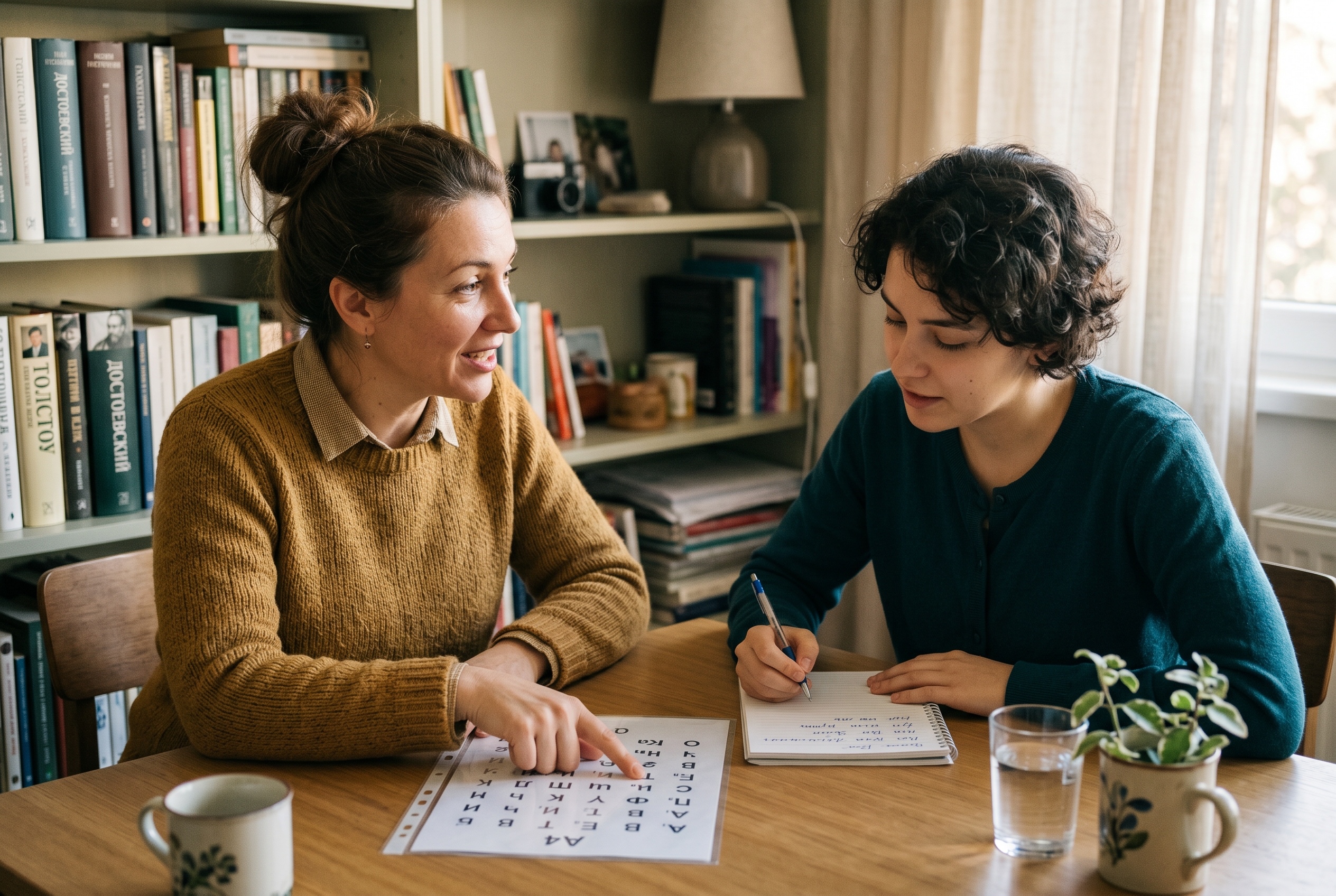
Your instructors
Russian for Beginners tutors for private lessons & classes
Strommen is a curated boutique language school, not a marketplace. Every tutor below was met and vetted by us before they ever taught a lesson, and we paid particular attention to the ones we route beginners toward, because the teacher who builds your first hundred hours of Russian sets habits you carry for years.
Filter by location, age, or price, read the bios, then book a 30-minute free trial with whoever feels like the right fit.
Below are the Strommen tutors who teach beginner-level Russian. Photos, ratings, and rates are real. Click any card to read the bio and book a free 30-minute trial.
I want to learn…
Every tutor, personally met. — founder-vetted since 2006, in Los Angeles and online worldwide.
Get a personalized plan
Pick your language — a language advisor will match you with the right tutor and map out your path.




Bachelor's · TEFL 120h (Graded A)
Damon, the ESL teacher
Personally vetted · Strommen’s note
Damon treats every student like someone he's building a long relationship with. He teaches Chinese, English, and Russian out of Bangkok.
Specialties
Bachelor's · TEFL 120h (Graded A)
Damon, the ESL teacher
Specialties
Personally vetted · Strommen’s note
Damon treats every student like someone he's building a long relationship with. He teaches Chinese, English, and Russian out of Bangkok.
Master’s Degree of Foreign Languages, Concentration in English and French. Minor in Theatre & Choreography. PHD of Linguistics and Literary Criticism & Comparative Linguistics.
Russian Language Teacher, Dialect Coach, Translator, ESL Teacher. 10+ years of experience.
Personally vetted · Strommen’s note
A Russian dialect coach, translator, and teacher rolled into one, Anastasia has ten-plus years in and treats English and Russian as one connected skill set.
Specialties
Master’s Degree of Foreign Languages, Concentration in English and French. Minor in Theatre & Choreography. PHD of Linguistics and Literary Criticism & Comparative Linguistics.
Russian Language Teacher, Dialect Coach, Translator, ESL Teacher. 10+ years of experience.
Specialties
Personally vetted · Strommen’s note
A Russian dialect coach, translator, and teacher rolled into one, Anastasia has ten-plus years in and treats English and Russian as one connected skill set.
MA in teaching International Culture and History
Russian teacher with MA in teaching International Culture and History - Experienced Russian Tutor in Mar Vista, CA
Personally vetted · Strommen’s note
Maria holds an MA in international culture and history and is based in Mar Vista. She custom-builds Russian curriculum around group dynamics as much as level.
Specialties
MA in teaching International Culture and History
Russian teacher with MA in teaching International Culture and History - Experienced Russian Tutor in Mar Vista, CA
Specialties
Personally vetted · Strommen’s note
Maria holds an MA in international culture and history and is based in Mar Vista. She custom-builds Russian curriculum around group dynamics as much as level.


BA and MA in Arabic Studies, PhD in Philology (Arabic & Hebrew Studies)
Polyglot tutor with 15 years’ experience in Armenian, Arabic, Hebrew, and Russian
Personally vetted · Strommen’s note
Alvina holds a BA and MA in Arabic Studies and has spent fifteen years teaching Arabic, Hebrew, Russian, and Armenian, genuinely rare range in one tutor.
Specialties
BA and MA in Arabic Studies, PhD in Philology (Arabic & Hebrew Studies)
Polyglot tutor with 15 years’ experience in Armenian, Arabic, Hebrew, and Russian
Specialties
Personally vetted · Strommen’s note
Alvina holds a BA and MA in Arabic Studies and has spent fifteen years teaching Arabic, Hebrew, Russian, and Armenian, genuinely rare range in one tutor.
University diploma, department of foreign languages, teacher of English and German languages · Cambridge Certificate of Teaching English on-line
Hi there! You're welcome to my entertaining, interactive and productive English lessons on-line!
Specialties
University diploma, department of foreign languages, teacher of English and German languages · Cambridge Certificate of Teaching English on-line
Hi there! You're welcome to my entertaining, interactive and productive English lessons on-line!
Specialties
BA in Russian Language and LiteratureBA in English LiteraturePh.D. in Comparative LiteratureCertificate in Teaching Russian as a Foreign LanguageCertificate in Teaching ESL / EFL to Speakers of Other LanguagesCertificate in Teaching Business ESL
Embark on Your Language Odyssey: Expert Guidance from Tatyana, Your Native Speaker & Ph.D
Specialties
BA in Russian Language and LiteratureBA in English LiteraturePh.D. in Comparative LiteratureCertificate in Teaching Russian as a Foreign LanguageCertificate in Teaching ESL / EFL to Speakers of Other LanguagesCertificate in Teaching Business ESL
Embark on Your Language Odyssey: Expert Guidance from Tatyana, Your Native Speaker & Ph.D
Specialties
Masters degree
Study hard - Get Results
Personally vetted · Strommen’s note
Teaching Russian out of Osogbo, Nigeria, Iyanu starts every lesson by gauging exactly where a student's level actually sits.
Specialties
Also speaks: English
Masters degree
Study hard - Get Results
Specialties
I also speak: English
Personally vetted · Strommen’s note
Teaching Russian out of Osogbo, Nigeria, Iyanu starts every lesson by gauging exactly where a student's level actually sits.
Specialization (5 years) at Blagoveshchensk State Pedagogical University Major - Chinese language teacher with an additional specialty as an English language teacher.Postgraduate studies at the Moscow State University of Management, Faculty of Philoso... · 1) Diploma from Blagoveshchensk State Pedagogical University, majoring in Chinese language teacher with an additional specialty as an English language teacher. 2) Certificate of advanced training issued by Moscow State Linguistic University, awarded f...
Chinese language, Mandarin, Chinese tutor, Mandarin tutor,
Specialties
Specialization (5 years) at Blagoveshchensk State Pedagogical University Major - Chinese language teacher with an additional specialty as an English language teacher.Postgraduate studies at the Moscow State University of Management, Faculty of Philoso... · 1) Diploma from Blagoveshchensk State Pedagogical University, majoring in Chinese language teacher with an additional specialty as an English language teacher. 2) Certificate of advanced training issued by Moscow State Linguistic University, awarded f...
Chinese language, Mandarin, Chinese tutor, Mandarin tutor,
Specialties

Masters in Linguistics · Masters in Linguistics, PFUR, Moscow, Russia, 2001
Native Russian Tutor with Over 20 Years of Experience
Personally vetted · Strommen’s note
A Russian native with a linguistics master's and more than twenty years teaching, Katya won't rush a student past where they're actually ready.
Specialties
Masters in Linguistics · Masters in Linguistics, PFUR, Moscow, Russia, 2001
Native Russian Tutor with Over 20 Years of Experience
Specialties
Personally vetted · Strommen’s note
A Russian native with a linguistics master's and more than twenty years teaching, Katya won't rush a student past where they're actually ready.

Кириллица — first letters & first sounds
5 first phrases every Russian beginner should learn
These are the survival lines a good tutor hands you in the first lessons. Cyrillic plus romanization for each, so you can read them as a beginner and as your script gets faster. Screenshot it, then book a tutor to learn the rest.
-
01
Здравствуйте zdravstvuyte
The formal Russian "hello," used with strangers, elders, in shops, in offices, on the phone, and in any context where you do not already know the person. The middle В is silent in fast speech, which is mercy. The first word of any polite Russian interaction.
e.g. Здравствуйте, как дела? zdravstvuyte, kak dela? ("Hello, how are things?")
-
02
Привет privet
The casual "hi," used between friends, family, classmates, anyone you are on first-name terms with. Switching from здравствуйте to привет with someone is a small social moment in Russian, the same kind of step as moving from вы to ты, and beginners should hold off on привет until they are clearly invited to use it.
e.g. Привет, как ты? privet, kak ty? ("Hi, how are you?")
-
03
Спасибо spasibo
"Thank you." Identical across every register, formal and informal, written and spoken, which makes it one of the safest first words to memorize. The reply you will hear is пожалуйста (pozhaluysta), which doubles as both "you are welcome" and "please," depending on the context.
e.g. Спасибо большое spasibo bolshoye ("thank you very much")
-
04
Пожалуйста pozhaluysta
A word that earns its keep twice over. It means "please" when you are asking for something, and "you are welcome" when someone has thanked you. Russians use it constantly, and a beginner who learns to drop it into requests sounds dramatically more polite than one who does not.
e.g. Кофе, пожалуйста kofe, pozhaluysta ("coffee, please")
-
05
Я не понимаю ya ne ponimayu
"I do not understand." The single most useful phrase for the early weeks, because you will say it often, and Russians respond well to learners who admit the gap clearly. Pair it with Повторите, пожалуйста (povtorite, pozhaluysta), "please repeat," and you have a working pair of repair phrases for any conversation.
e.g. Извините, я не понимаю izvinite, ya ne ponimayu ("sorry, I do not understand")
About Russian for Beginners
Where a Russian beginner actually starts
Almost every new Russian student arrives worried about the wrong thing. They expect the Cyrillic alphabet to be the hard part, and they expect the grammar to be a manageable second order of business. The reality is closer to the opposite. Cyrillic takes most beginners about two weeks of patient lessons to read at a basic level, because the script is phonetic and several letters look or sound like their Latin counterparts. The cases, the six grammatical cases that govern every noun and adjective and pronoun in Russian, are the part that genuinely takes time. A tutor who frames the early weeks honestly, scripts in two weeks, sounds in a month, cases for the rest of the year, tends to keep students with the language. A tutor who oversells the script and undersells the cases tends to lose them.
The alphabet itself is 33 letters, and the early lessons walk through it in groups. There are letters that look and sound roughly like English: А, К, М, О, Т. There are letters that look like English but sound completely different, which is where most beginners get tripped up: Р is rolled R, not P; Н is N, not H; В is V, not B; Х is the back-of-the-throat sound in Scottish "loch," not X; С is S, not C; У is OO, not Y. And there are letters with no Latin equivalent at all: Ж, Ш, Щ, Ы, Ъ, Ь, Я, Ю, Ё. Beginners often want to read Russian as if it were transliterated English, and the false-friend letters punish that habit fast. A tutor watching your pronunciation in real time corrects the habit before it sets, which is the part an app cannot do.
Once the script is readable, the sounds become the next focus. Russian has a handful of consonant features that English does not: a hard-soft distinction that runs through most consonants and changes meaning, palatalized versions of common consonants like Тʼ, Дʼ, Нʼ, the unstressed-vowel reduction that turns О into something closer to A in everyday speech, and the rolled Р, which is closer to Spanish or Italian than anything in English. None of these are unlearnable. They simply need a teacher isolating each sound and drilling it until it is automatic, because Russian listeners hear the difference between soft and hard consonants as plainly as English listeners hear the difference between B and P.
Stress is the other early-stage hurdle that often goes unmentioned in beginner materials. Russian word stress is unmarked in normal text, mobile within a word's grammatical paradigm, and meaningful: the words замо́к and за́мок are spelled identically but mean "lock" and "castle" depending on where the stress falls. Because unstressed vowels reduce, getting the stress wrong does not just produce an accent, it produces a different vowel sound and sometimes a different word. Good beginner tutors mark stress in writing during the first months and drill it audibly until students can hear it, since by the intermediate stage stress placement has to be internalized rather than checked against a dictionary every time.
Then the cases arrive, and this is where a beginner course either earns its keep or quietly fails. Russian has six grammatical cases, the nominative, accusative, genitive, dative, instrumental, and prepositional, and every noun, adjective, pronoun, and number in a Russian sentence carries a case ending that signals its role. The same word for "book" appears as книга, книгу, книги, книге, книгой, книге depending on whether it is the subject, the direct object, a possessor, an indirect object, an instrument, or the object of a preposition. English buries that information in word order and small function words; Russian wears it on the noun. The good news is that the case system is regular and learnable. The honest news is that automatic, fluent use of the cases is a project of months and years, not weeks, and a beginner tutor's job is to introduce them in a sensible order so the pattern becomes visible long before it becomes automatic. Most curricula start with the nominative and accusative, add the prepositional for talking about location, then layer in the genitive, dative, and instrumental.
Verb aspect is the second defining feature of Russian grammar and the one that often blindsides students who thought the cases were the hard part. Russian verbs come in pairs: an imperfective form, which describes an action in progress, repeated, or considered as a process, and a perfective form, which describes a completed, bounded action with a result. Писать and написать both translate to "write," but the first describes the activity of writing and the second describes the completion of a piece of writing. Every Russian verb a beginner learns has to be learned as a pair, and choosing the right aspect in a given sentence is closer to a separate grammatical decision than a vocabulary one. Most beginners need a year or more before aspect choice feels intuitive, and the work starts in the first months.
Russian sits inside the East Slavic branch of the Slavic language family, alongside Ukrainian and Belarusian, and within reach of West Slavic (Polish, Czech, Slovak) and South Slavic (Bulgarian, Serbian, Croatian) languages. A student who learns Russian to a high level acquires significant passive comprehension of other Slavic languages along the way, which is a real bonus for travelers and a serious advantage for students with academic or professional interests in the wider region. The shared Cyrillic script across Russian, Ukrainian, Belarusian, Bulgarian, Serbian, and several Central Asian languages multiplies that effect.
A few honest tutor observations on where American beginners tend to lose traction with Russian. Underestimating stress is one of the most common patterns, because beginners read transliterated Russian with their English instincts and then cannot understand spoken Russian when the vowels reduce. Skipping the cases by sticking to nominative-only sentences is another, and it produces students who can compose textbook phrases but cannot understand a single line of natural speech. Treating aspect as a vocabulary problem rather than a grammatical decision is a third pattern that quietly derails students around the six-month mark. Translating word-for-word from English instead of accepting Russian's much freer word order is another one, especially because Russian uses word order for emphasis rather than for grammatical role. And one more thing, the impulse to memorize endings in tables rather than to encounter them in real sentences leaves students with case literacy on paper and case paralysis in conversation. A good beginner tutor watches for each of those patterns and intervenes before any of them sets.
Russian in the US has a meaningful diaspora context that tutors often draw on. Significant Russian-speaking communities have formed in New York, Chicago, and the Los Angeles area, with several waves of arrival from the late 19th century onward, and Russian-speaking media, bookstores, and cultural institutions remain active in those cities. Many adult learners arrive at Russian through heritage routes, having grown up around the language but never having studied it formally, and beginner lessons in that case look slightly different: less new sound-recognition work, more focus on writing, grammar, and the gap between household register and educated Russian. Tutors with heritage students plan accordingly.
The canonical reference for the language itself is the work of the Vinogradov Russian Language Institute in Moscow (Институт русского языка имени В.В. Виноградова), the research arm of the Russian Academy of Sciences that maintains the descriptive standard for educated Russian usage. For learners who want a formal proficiency credential, the Pushkin State Russian Language Institute in Moscow administers the TORFL exams, known in Russian as ТРКИ, which are the recognized international standard for non-native speakers. The TORFL system runs from elementary (TORFL-A1) through six levels to the Fourth Certificate (C2), and several Strommen tutors prepare students for the appropriate level once a foundation is in place.
Motivations among beginner Russian students vary widely. Some are heading to a Russian-speaking country for study or work. Some have family on the other side of a language gap they want to close. Some are drawn in by the literary tradition, by Tolstoy, Dostoyevsky, Chekhov, and the more recent generations of Tatyana Tolstaya and Lyudmila Ulitskaya, and want to read in the original. Some come through Russian rock music, the songs of Виктор Цой and the bands that followed, and want to understand the lyrics rather than the rough English translations that float around online. Some are linguists or students of Slavic studies who want a rigorous foundation for academic reading. The tutors below teach all of those starting points and calibrate the first lesson to yours. Anyone weighing private lessons against a group setting can compare both on the main Russian page, and students who already have a foundation may prefer the conversational Russian roster instead. The full tutor directory also lists every Strommen teacher across languages.
The alphabet is the part everyone fears, and it is the part that takes the least time.
What you'll cover
Lessons & classes tailored to Russian for Beginners
The Cyrillic alphabet, from the first letter
The 33 letters of Russian Cyrillic, taught in groups: the letters that look and sound like English, the false friends that look like English but read completely differently (Р, Н, В, Х, С, У), and the letters with no Latin equivalent (Ж, Ш, Щ, Ы, Ъ, Ь, Я, Ю, Ё). Most beginners are reading basic words within two weeks of lessons. Tutors watch your handwriting and your pronunciation as the letters form, which is the part an app cannot replicate.
Sounds without an English equivalent
Direct drilling on the rolled Р, the throat-back Х, the hard-soft consonant pairs that change meaning, the palatalized Тʼ, Дʼ, Нʼ, and the unstressed-vowel reduction that turns О into something closer to A in real speech. These are not optional polish for a Russian accent, they are how Russian distinguishes words from each other, and tutors isolate them early so they become automatic rather than something a student paper-overs.
The six-case system, introduced in sensible order
Russian's defining grammatical feature, taught in the order that actually works for beginners. Nominative and accusative first, prepositional next so you can talk about where things are, then genitive, dative, and instrumental layered in over the following months. The goal of the first year is not automatic fluent case use, which takes longer than that, but case literacy: you see the ending, you understand what it is doing, and your output is accurate even if it is slow.
First survival conversation
Greetings, introductions, numbers, asking prices and directions, ordering food, navigating a polite request, switching between вы and ты as the relationship warrants. Beginners build a working set of phrases in parallel with the alphabet and the cases, so even the early lessons produce real conversational ability rather than a year of pure grammar before any speaking happens. Tutors plan around your specific goals, whether that is travel, family, literature, or a TORFL exam down the road.
FAQ
About Russian for Beginners lessons & classes
Is Cyrillic as hard as it looks?
No, and this is the most common misconception beginners arrive with. The Cyrillic alphabet is 33 letters, the script is phonetic, several letters are shared with Latin in form or sound, and most students are reading basic words within roughly two weeks of lessons. The harder part of Russian is the case system, which takes months and years to use fluently. A tutor who is honest about this distinction sets you up to stay with the language; one who oversells the script and undersells the cases is setting you up to quit in month three when the grammar arrives.
What are the six cases, and do I really have to learn all of them?
Russian has six grammatical cases: nominative (the subject), accusative (the direct object), genitive (possession, absence, and certain quantities), dative (the indirect object), instrumental (the means by which something is done), and prepositional (used after specific prepositions, usually about location). Yes, you have to learn all of them, because every noun and adjective in a Russian sentence carries a case ending that signals its role. The good news is that the system is regular, the endings are patterned, and beginners typically start with just nominative and accusative before adding the others over the first year of study.
Should I worry about the difference between вы and ты as a beginner?
Yes, and your tutor will introduce it in the first few lessons. Вы is the formal or plural "you," used with strangers, elders, in service settings, and in any professional context. Ты is the informal singular "you," used with friends, family, and people you have been invited to address that way. Russians take the distinction seriously, and using ты with the wrong person can read as rude. The safe default for a beginner is to use вы with anyone you do not know personally and let the other person move you to ты when they are ready.
Are your tutors native Russian speakers?
Most are native speakers, and the rest are longtime fluent teachers of the language with formal training. Each tutor's bio specifies where they are from, since regional accents do exist in Russian even though the standard register is fairly uniform across the country. Strommen is a curated school, so every tutor was met and vetted by us before teaching a single lesson, and you can read each bio before deciding.
Can I take Russian lessons online, or only in person?
Both. Many of our Russian tutors teach online via Zoom or Jitsi and are available to students globally. Several also teach in person. The booking widget on each tutor's profile shows their available formats, and you can sort the list to find what fits your schedule and location.
How long until I can hold a basic conversation in Russian?
It depends on your hours, your starting point, and the regularity of practice between lessons. With one or two lessons a week plus consistent self-study, most beginners reach simple, functional conversation in roughly 6 to 10 months: greetings, introductions, prices, directions, getting around, ordering food. Reading comfort with unadapted Russian text takes longer, usually a year or more, because the case endings have to become second nature. The Foreign Service Institute classifies Russian as a Category III language, meaning it takes more hours to working proficiency than Spanish or French but less than Arabic or Chinese.
I want to read Tolstoy and Dostoyevsky in the original. How realistic is that?
Realistic, but on a longer timeline than conversational Russian. Reading 19th-century Russian literature in the original is roughly a two to three year project for an adult student with consistent practice, partly because the language itself is morphologically rich and partly because the vocabulary of Tolstoy and Dostoyevsky reaches into older registers. Tutors who specialize in literary Russian often start students on shorter modern work first, Chekhov's short stories or contemporary authors like Tatyana Tolstaya and Lyudmila Ulitskaya, and build toward the longer 19th-century novels as the reading muscles develop.
What does a beginner Russian lesson actually look like?
Lessons are one-on-one and built around you. An early-stage hour might mix alphabet practice, pronunciation drills on the false-friend letters, a small grammar point introducing the first case, and survival phrases, with the balance shifting as you progress. Tutors plan each lesson rather than running a fixed curriculum, so two beginners with different goals get different lessons. Many students supplement with the free Russian textbook material on the site between sessions.
Ready for Russian for Beginners lessons or classes?
Book a free 30-minute trial with one of our personally vetted tutors. Private lessons or small-group classes — your choice.