



Personally vetted instructors
Hungarian for Beginners tutors, lessons & classes
Jó napot The everyday formal greeting Hungarians use from late morning onward.
Personally vetted Hungarian tutors who specialize in absolute beginners. Patient, methodical, and ready for the question every beginner asks: yes, there really are 18 noun cases, and yes, you can learn this.
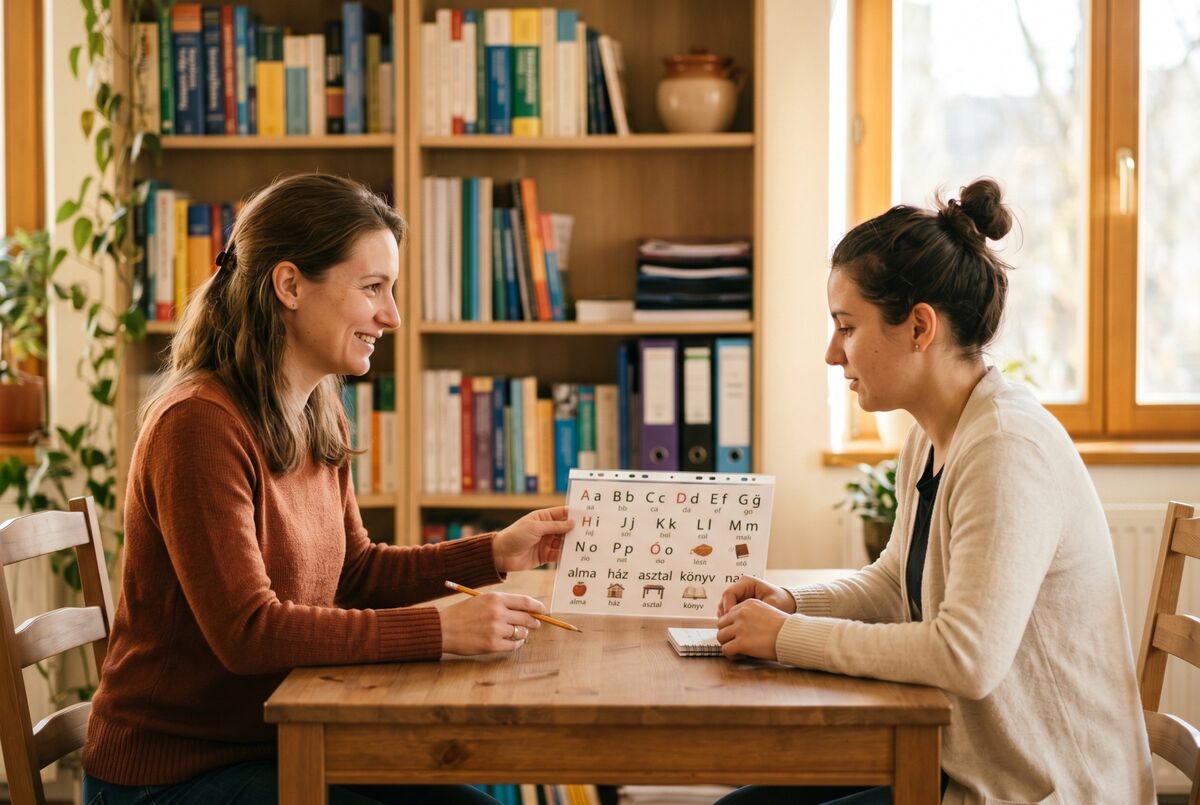
Your instructors
Hungarian for Beginners tutors for private lessons & classes
Strommen has Hungarian tutors who specialize in working with absolute beginners, the moment when patience, pronunciation modeling, and steady step-by-step grammar work matter more than anything else. Every tutor below was met and vetted by us in person or through a thorough video interview. No marketplace, no automated profile-creation. Real teachers with real backgrounds in adult beginner Hungarian instruction.
Filter by location, age, or price. Then book a 30-minute free trial.
Below are the Strommen tutors who specialize in teaching Hungarian to absolute beginners. Photos, ratings, and rates are real. Click any card to read a bio and book a free 30-minute trial.
I want to learn…
Every tutor, personally met. — founder-vetted since 2006, in Los Angeles and online worldwide.
Get a personalized plan
Pick your language — a language advisor will match you with the right tutor and map out your path.


German studeis Specialized translator
hungarian
Specialties
Also speaks: English, German, Spanish
German studeis Specialized translator
hungarian
Specialties
I also speak: English, German, Spanish
Első lépések — first foundations
5 Hungarian foundations every beginner needs in the first month
These are the load-bearing pieces. Get them right early and the rest of the language is buildable; skip them and every later lesson sits on a shaky base. Screenshot the list for the trial.
-
01
Vowel harmony
Hungarian vowels divide into two groups, back (a, á, o, ó, u, ú) and front (e, é, i, í, ö, ő, ü, ű), and almost every suffix has a back-vowel variant and a front-vowel variant. The word's vowel group decides which suffix attaches. Ház (house, back) takes -ban; kéz (hand, front) takes -ben. Get this ear early and the rest of Hungarian grammar stops sounding random.
e.g. Házban (in the house) vs. kézben (in the hand).
-
02
Agglutinative suffix stacking
Hungarian glues grammatical information onto the noun as a chain of small predictable suffixes in a fixed order. Házaimban is one word that means "in my houses": house + plural + my + the inessive case. The chains look intimidating until you see the slots, and once you see the slots they become almost mechanical.
e.g. Ház → házak → házaim → házaimban.
-
03
The 18 noun cases (yes, really)
Hungarian's famous case count is real, but most cases correspond to ideas English handles with prepositions: in, out of, into, onto, off of, at, to, from. You are learning the same spatial and temporal relationships you already use; they just attach to the noun as suffixes. Beginner programs introduce six cases in the first three months, not all 18 at once.
e.g. Budapesten (in Budapest, superessive); Budapestre (to Budapest, sublative); Budapestről (about Budapest, delative).
-
04
Definite vs. indefinite conjugation
Hungarian verbs conjugate one way when the object is indefinite ("I read a book") and a different way when the object is definite ("I read the book"). Beginners learn the indefinite conjugation first; the definite forms come in month three or four. The distinction has no English parallel and is one of the moments learners genuinely think in Hungarian.
e.g. Olvasok egy könyvet (I read a book) vs. olvasom a könyvet (I read the book).
-
05
Flexible SOV-tending word order
Hungarian word order is freer than English because the case suffixes carry the grammatical role. The slot immediately before the verb is the most emphasized position; moving an element there changes what the sentence highlights without changing its core meaning. Beginners can use a default subject-verb-object pattern for months and let the nuance emerge with exposure.
e.g. János enni akar (neutral) vs. enni akar János (emphasis on the eating).
About Hungarian for Beginners
From zero Hungarian to your first real sentence
Hungarian has a reputation. People who have never opened a textbook will tell you it is one of the hardest languages on earth, that it has 18 noun cases (true), that it shares no family resemblance with English, German, French, or Spanish (also true, mostly), and that Hungarian children supposedly take longer than most European children to start speaking their own language. The reputation is real, the difficulty is real, and the way through is real too. A good beginner tutor in the first three months saves you from the bad habits self-teachers inherit, walks you into the case system one piece at a time, and gets you to your first real Hungarian conversation faster than most beginners imagine possible.
A brief honest framing. Hungarian belongs to the Uralic family, distantly related to Finnish and Estonian and unrelated to the Indo-European languages of its neighbors. There are no helpful cognates with English, no shortcuts from a German background, almost nothing the way Italian or Spanish vocabulary opens up for a French speaker. You build Hungarian from the ground up, and what you build sits in your brain in a different way than a Romance language does. Many beginners describe it as more like learning a musical instrument than learning a typical European language, and that framing tends to set the right expectations.
The first foundation in any beginner Hungarian course is vowel harmony, which is the rule that governs almost every suffix the language attaches to a word. Hungarian vowels are divided into two groups: back vowels (a, á, o, ó, u, ú) and front vowels (e, é, i, í, ö, ő, ü, ű). A word with back vowels takes back-vowel suffixes; a word with front vowels takes front-vowel suffixes. Ház (house) is a back-vowel word, so the plural is házak and "in the house" is házban. Kéz (hand) is a front-vowel word, so the plural is kezek and "in the hand" is kézben. The rule has subcategories (rounded front vowels take their own suffix variant) and exceptions for loanwords, but the basic principle is consistent enough that within a few weeks of regular practice your ear starts catching when something sounds wrong before you can explain why. Vowel harmony is not optional grammar trivia; it is the connective tissue of the language.
The second foundation is the agglutinative grammar, which is the linguist's term for the way Hungarian stacks suffix after suffix onto a single root word. Where English uses prepositions and articles and separate words to signal grammatical relationships, Hungarian glues those signals onto the noun itself. "In my houses" is one Hungarian word: házaimban. House (ház) plus plural (-ai) plus my (-m) plus the inessive case ending (-ban). The suffix chain follows a strict order, and once you internalize the order the long words stop looking intimidating and start looking like a stack of small predictable pieces. Beginners who try to memorize each long form as a separate vocabulary item are doing it the hard way; the productive method is learning the suffix slots and how they assemble.
The third foundation, the famous one, is the case system. Hungarian noun cases. Yes, 18 of them, sometimes counted as 17 or 24 depending on which grammarian you ask, but the number is the right ballpark. Before any beginner panics, the case system is less terrifying than the number suggests because most of the cases correspond directly to ideas English handles with prepositions: in (inessive), out of (elative), into (illative), onto (sublative), off of (delative), at (adessive), to (allative), from (ablative). You are not memorizing 18 abstract grammatical relationships; you are learning roughly the same set of spatial and temporal ideas you already use in English, just attached to the noun as suffixes instead of standing in front of it as prepositions. The traditional textbook order introduces about six cases in the first three months, another five or six by month six, and the remaining specialist cases (terminative, sociative, causal-final, formal) when they actually come up in real reading and conversation. No serious beginner program tries to drill all 18 at once.
The fourth foundation is word order, which is more flexible than English but less arbitrary than it looks at first. Hungarian word order signals emphasis and topic-focus structure rather than grammatical role (because the suffixes already do that job). The element immediately before the verb is the most emphasized; moving it changes what the sentence is highlighting without changing what it strictly means. János enni akar is "János wants to eat" with neutral emphasis. Enni akar János shifts the spotlight to the eating versus some other activity. Beginners can ignore the fine grain of this for the first few months and use a default subject-verb-object order; the nuance comes with exposure.
The fifth foundation is the verb system and the famous definite versus indefinite conjugation. Hungarian verbs conjugate one way when the object of the sentence is indefinite ("I read a book") and a different way when the object is definite ("I read the book"). Beginners learn the indefinite conjugation first and add the definite forms in month three or four. It is a real distinction with no English parallel, and once it clicks you start hearing the difference everywhere in spoken Hungarian.
A typical first month with a beginner tutor covers the alphabet (44 letters including digraphs and trigraphs like sz, zs, ty, gy, ny, dzs), pronunciation basics, vowel harmony, the present tense of the verbs van (to be) and nincs (the dedicated negative of "to be"), numbers 1 to 100, greetings, introducing yourself, basic family vocabulary, and roughly 100 to 150 high-frequency words. By month three, most beginners can hold a basic conversation about themselves, their family, their work, and order at a café or restaurant. By month six, conversational ease at A2 level is realistic for committed students with weekly lessons and 20 to 30 minutes of daily exposure.
Between lessons, beginner-friendly resources include the Pimsleur Hungarian course (excellent for pronunciation foundations), HungarianPod101, the children's program Süsü a sárkány for slow accessible spoken Hungarian, the Magyar Akadémia free grammar reference, and folk songs sung clearly, which are an underrated tool for vowel harmony intuition. The ECL Hungarian language exam and the Origó exam are the two recognized certification tracks for committed beginners aiming at A2 or B1 down the road.
The Strommen Hungarian roster for beginners includes native speakers from Budapest, Debrecen, Szeged, and from the Hungarian diaspora in the United States. Beginner-specific teaching is its own skill: the patience to drill vowel harmony for the tenth time, the ear for which case ending a student is consistently swapping, the willingness to explain agglutinative suffix chains five different ways until one of them clicks. Each tutor bio specifies their background and which student profile they fit best. Pricing reflects experience. The trial is free, 30 minutes, and the fastest way to find out whether Hungarian will click for you is to spend that 30 minutes with a real Hungarian teacher. Browse the full tutor list, pick someone whose teaching style feels approachable, and book.
What you'll cover
Lessons & classes tailored to Hungarian for Beginners
Vowel harmony and pronunciation from day one
Hungarian's 44-letter alphabet, the long-vowel marks (á, é, í, ó, ő, ú, ű) that genuinely change meaning, the digraphs (sz, zs, ty, gy, ny) that look like clusters but represent single sounds, and vowel harmony as the connective tissue of the grammar. Tutors drill these with short listening-and-repeat exercises using native audio. Beginner pronunciation is best learned correctly the first time, not corrected later, which is why we frontload it.
The case system, introduced in the right order
We do not throw 18 cases at a beginner in week one. The traditional textbook progression introduces nominative, accusative, and the most common location cases (inessive, illative, elative, superessive, sublative, delative) in months one to three; instrumental, dative, and the temporal cases by month six; the specialist cases when they come up in real reading. By the time a student has internalized the first six, the remaining cases land as predictable variations on a familiar pattern.
Van, nincs, and your first 150 words
The verb van (to be) and its dedicated negative nincs, plus 100 to 150 high-frequency nouns and verbs in the first month, covers the majority of basic sentences you will want to make. Family, food, daily routine, work, the small talk of greetings and weather. Once these are automatic, the regular present tense slots in with very little additional cognitive load and the definite-indefinite conjugation distinction can be introduced cleanly.
Beginner-friendly between-lesson resources
Your tutor will recommend specific resources calibrated to your level: Pimsleur Hungarian for pronunciation drills, HungarianPod101 for graded listening, Süsü a sárkány and other children's programs for slow accessible spoken Hungarian, the Magyar Akadémia online grammar reference for self-study. Twenty to thirty minutes of daily exposure outside lessons is the single biggest accelerator for beginners, regardless of language.
FAQ
About Hungarian for Beginners lessons & classes
Is Hungarian really one of the hardest languages?
It is genuinely hard for an English speaker, and the FSI categorizes it among the harder language groups for native English speakers (roughly 1,100 class hours to professional fluency, compared to about 600 for Spanish or French). The difficulty is real but not mysterious: no cognate vocabulary, agglutinative grammar, vowel harmony, the case system, the definite-indefinite verb distinction. None of these are insurmountable; they just have to be learned from scratch rather than borrowed from an existing language background. Most beginners reach functional A2 in 6 to 9 months with weekly lessons and steady daily exposure.
Do Hungarians really have 18 noun cases?
Yes, depending on which grammarian is counting. Some sources say 17, some say up to 24 if you include marginal cases. The number is real but less terrifying than it sounds because most cases correspond directly to ideas English handles with prepositions: in, out of, into, onto, off of, at, to, from. You are not learning 18 abstract grammatical concepts; you are learning the same set of spatial and temporal relationships you already use in English, just attached to the noun as suffixes. Beginners learn six cases in the first three months and the rest gradually.
How is Hungarian related to other European languages?
Barely. Hungarian belongs to the Uralic family, distantly related to Finnish and Estonian and unrelated to the Indo-European languages spoken by all of its geographic neighbors. There are no helpful cognates with English, no shortcuts from German, French, or Spanish. The vocabulary is built from a different root stock entirely. A handful of loanwords from German, Slavic, Turkish, and Latin sit in the language, but the core feels genuinely foreign to anyone arriving from a Western European background.
What is vowel harmony and why does everyone mention it?
Vowel harmony is the rule that governs almost every suffix Hungarian attaches to a word. Vowels split into two groups (back: a, á, o, ó, u, ú; front: e, é, i, í, ö, ő, ü, ű), and a word's vowel group dictates which variant of a suffix it takes. Ház (house) takes back-vowel suffixes, so the plural is házak. Kéz (hand) takes front-vowel suffixes, so the plural is kezek. The rule has subcategories but is consistent enough that within weeks your ear starts catching mismatches automatically.
How long until I can hold a basic Hungarian conversation?
From zero, weekly hour-long lessons plus 20 to 30 minutes of daily exposure (podcasts, apps, Hungarian media) typically produce functional A2 conversation within 6 to 9 months. That means introducing yourself, talking about your day, ordering at a café, basic small talk. Conversational comfort at B1 (the level required for Hungarian citizenship) usually takes another 9 to 12 months at the same pace. Hungarian is a slower buildup than Spanish or French for English speakers, but the curve is real and predictable.
What does a typical beginner Hungarian lesson look like?
A first-month lesson runs about an hour and typically includes 10 minutes of warm-up conversation in Hungarian (even halting), 15 minutes of new vocabulary with vowel-harmony drill, 15 minutes of grammar in context (a single point introduced through example sentences), 10 minutes of listening practice with a short audio clip, and 10 minutes of structured role-play. Homework is light and primarily listening-focused. No two lesson plans are identical; your tutor calibrates based on what is clicking and what is not.
Should I learn Hungarian or Finnish first if I am interested in Uralic languages?
Hungarian and Finnish are the two best-known Uralic languages but they are very distantly related, far more distant from each other than English and Persian, so neither functions as a useful springboard for the other in any practical sense. Pick the one closer to your actual goal (Hungarian for Budapest, Hungarian heritage, EU work in Hungary; Finnish for Helsinki, Finnish heritage, Nordic work). Skills in one do not meaningfully accelerate the other for a beginner.
What is the trial lesson like for a complete beginner?
30 minutes, free, with the tutor you select. For absolute beginners, the trial is half assessment and half preview: the tutor will introduce themselves in Hungarian and English, gauge what you already know (even passive recognition counts), explain the typical first-month roadmap, and answer your questions about lesson cadence and goals. You will leave with a clear sense of whether this specific tutor's approach feels right for you. If not, swapping to another tutor is easy.
Ready for Hungarian for Beginners lessons or classes?
Book a free 30-minute trial with one of our personally vetted tutors. Private lessons or small-group classes — your choice.