



Personally vetted instructors
Hungarian for Kids tutors, lessons & classes
Szia The warm, casual hello (and goodbye) Hungarian kids say to everyone they know.
Personally vetted Hungarian tutors who teach children. Heritage families in the diaspora, mixed-language households, and parents who want their kids to keep grandma's Hungarian alive past the school-age slide.
Your instructors
Hungarian for Kids tutors for private lessons & classes
Strommen has Hungarian tutors who specialize in working with children, the energy and patience and child-development knowledge that heritage-language and beginner-Hungarian work with kids actually requires. Every tutor below was met and vetted by us in person or through a thorough video interview. No marketplace, no automated profile-creation. Real teachers, several of whom have classroom backgrounds working with young children in Hungary.
Filter by location, age, or price. Then book a 30-minute free trial.
Below are the Strommen tutors who specialize in teaching Hungarian to children. Photos, ratings, and rates are real. Click any card to read a bio and book a free 30-minute trial.
I want to learn…
Every tutor, personally met. — founder-vetted since 2006, in Los Angeles and online worldwide.
Get a personalized plan
Pick your language — a language advisor will match you with the right tutor and map out your path.


German studeis Specialized translator
hungarian
Specialties
Also speaks: English, German, Spanish
German studeis Specialized translator
hungarian
Specialties
I also speak: English, German, Spanish
Gyerekeknek — for kids
5 Hungarian children's traditions that make the language come alive
These are the cultural threads that turn a weekly Hungarian lesson from a chore into something a child looks forward to. Bring the list to the trial.
-
01
Lúdas Matyi and Mátyás király
Hungarian folk tales reward reading aloud and a good kids' tutor draws on the canonical stories every Hungarian child grows up knowing. Lúdas Matyi (the clever peasant boy who outwits the cheating lord, three times) and the tales of Mátyás király (the wise Renaissance king who travels in disguise) carry both language exposure and the moral fabric of Hungarian children's culture. Tutors read these aloud in lively Hungarian.
e.g. A jó tutor hetente felolvas egy Mátyás-mesét, és a gyerek észre sem veszi, hogy magyarul tanul.
-
02
Kodály-method folk songs
Zoltán Kodály's music-education method, invented in Hungary and now used worldwide, built around Hungarian folk songs as the foundation of children's musical training. A child who learns ten Hungarian folk songs by age seven (Süss fel, nap; Bújj, bújj, zöld ág; Lánc, lánc, eszterlánc; Ég a gyertya) carries the language in muscle memory in a way pure vocabulary drill cannot match.
e.g. Süss fel, nap, fényes nap, kertek alatt a ludaim megfagynak.
-
03
Nyelvtörők (tongue-twisters)
Hungarian tongue-twisters double as pronunciation drills disguised as games. Mit sütsz, kis szűcs, sós húst sütsz, kis szűcs? ("What are you frying, little furrier?") packed with distinctive Hungarian sibilants. Az ipafai papnak fapipája van ("The priest from Ipafa has a wooden pipe") works on the P-F alternation. Kids love them and they cement the harder sounds.
e.g. Mit sütsz, kis szűcs? Sós húst sütsz, kis szűcs?
-
04
The heritage-language window (ages 4 to 12)
The age range where heritage-language intervention is most effective. Children's language acquisition systems are still fluid enough that weekly structured exposure can hold Hungarian steady against the relentless gravity of English schooling. Starting at age 4 or 5 with a kind tutor produces a different teenager than waiting until age 12 to start formal lessons.
e.g. A kétnyelvű gyermekek nyelvfejlődése 4-12 éves korban a leghatékonyabban támogatható.
-
05
Süsü a sárkány and Hungarian children's animation
The lovable one-headed dragon (a Hungarian children's TV classic), the gorgeous illustrated Magyar Népmesék folk-tale animation series, and Pom Pom meséi are accessible online and meaningful passive-exposure supplements. Twenty minutes of native Hungarian cartoons a day reinforces what the lesson is building. The dubbed Disney movies are less recommended because the Hungarian register is uneven.
e.g. Süsü, a sárkány nem tüzet okád, hanem dalol és barátokat keres.
About Hungarian for Kids
Keeping magyar alive in the next generation
Hungarian for kids is, in nearly every family we work with, a heritage-language project. The parents are first or second-generation Hungarian-Americans, Hungarian-Canadians, Hungarian-Australians, or Hungarians married to non-Hungarian spouses raising children in a country where the dominant language is English. The grandparents speak fluent Hungarian. The parents speak Hungarian with varying degrees of comfort. The kids hear Hungarian at family gatherings, at FaceTime with relatives in Budapest or Debrecen or Cluj-Napoca, sometimes on summer trips to Lake Balaton, and the rest of their lives in English. The honest goal of weekly Hungarian lessons is not native fluency. It is sustaining the connection: enough Hungarian that the child can talk with grandma on the phone, sing the folk songs at family events, follow what is being said when relatives switch into Hungarian, and arrive in Hungary as a young adult ready to fall into the language rather than starting over.
The heritage-language slide is a real phenomenon, well documented in linguistic research and painfully familiar to every diaspora family. Children raised in mixed-language households often understand the heritage language passively but answer in English, then gradually lose the active vocabulary, then arrive at adolescence with limited Hungarian and significant family grief. The window where intervention is most effective is roughly ages 4 to 12, when children's language acquisition systems are still genuinely fluid and weekly structured exposure can hold the language steady against the relentless gravity of English schooling. Starting at age 4 or 5 with a kind tutor produces a different teenager than waiting until age 12 to start formal lessons.
Hungarian children's culture is genuinely rich, and a good kids' tutor draws from it heavily. The folk-tale tradition is enormous. Lúdas Matyi, the story of the clever peasant boy and the lord who tries to cheat him, is one of the canonical Hungarian children's stories every Hungarian child grows up knowing. Mátyás király (King Matthias Corvinus, the wise and clever Renaissance king) appears in dozens of folk tales as a justice-bringing figure who travels in disguise among ordinary people. A három kismalac (the three little pigs) and Piroska és a farkas (Little Red Riding Hood) appear in Hungarian versions with subtly different cadences and morals. Hungarian folk tales reward reading aloud; the rhythm of the language is part of the story, and a tutor reading Lúdas Matyi in lively Hungarian to a six-year-old transmits something the same story in English translation cannot.
The Kodály method of music education, invented in Hungary by Zoltán Kodály in the early 20th century and now used in elementary schools across the world, is a real teaching tool for Hungarian kids. Kodály built his approach around Hungarian folk songs as the foundation of children's musical and vocal training, with the conviction that singing the songs of one's own language is a foundational childhood experience. Hungarian children's tutors often build music into lessons: Süss fel, nap (sun song), Bújj, bújj, zöld ág (a circle game song), Lánc, lánc, eszterlánc (a chain game), Ég a gyertya (the candle is burning). A child who learns ten Hungarian folk songs by age seven carries the language in their muscle memory in a way pure vocabulary drill cannot match.
Nyelvtörők (tongue-twisters) are a Hungarian children's-language staple, and Hungarian's particular sound inventory makes for some genuinely delightful ones. Mit sütsz, kis szűcs, sós húst sütsz, kis szűcs? ("What are you frying, little furrier, are you frying salty meat, little furrier?") is the canonical example, packed with the distinctive Hungarian SZ and Sz-Sz consonants. Az ipafai papnak fapipája van ("The priest from Ipafa has a wooden pipe") works on the P-F alternation. Tongue-twisters double as pronunciation drills disguised as games, and most Hungarian kids' tutors use them weekly.
The lesson structure for younger kids (ages 4 to 8) differs significantly from the structure for older kids (ages 9 to 14). Younger lessons run shorter (30 to 45 minutes), include singing, picture-based vocabulary, simple story reading, and a great deal of repetition through games. The tutor stays mostly in Hungarian, uses gestures and pictures to fill comprehension gaps, and resists the impulse to translate every new word, which would slow the immersion advantage. Older lessons (45 to 60 minutes) introduce more explicit grammar discussion, reading of short children's books in Hungarian, simple writing exercises, and conversation about the child's actual life (school, friends, hobbies, what happened this week). The Hungarian remains the working language; English is the metalanguage when something needs to be explained.
Mixed-language family dynamics matter. The single most effective home pattern for heritage-language preservation is the one-parent-one-language rule, where one parent speaks only Hungarian to the child and the other speaks only the dominant language. This produces children with the cleanest separation between the two languages and the strongest Hungarian retention. When one or both parents are themselves second-language Hungarian speakers, the situation is more complex, and a good kids' tutor often coaches the parents alongside the children, helping them maintain Hungarian as a household language even when their own Hungarian is imperfect. Children with imperfect-Hungarian-speaking parents do better than children with no Hungarian-speaking parents at home, and significantly worse than children with one fully-Hungarian-speaking parent. The tutor cannot replace home exposure; the tutor can augment it.
For children with little or no Hungarian background, the path is slower but real. American or Canadian-born children with no Hungarian-speaking parents who start lessons because of a planned family move to Hungary, a deep grandparent connection, or simply parental conviction, typically reach conversational comfort at A2 in 12 to 18 months of weekly lessons with steady home practice. The trajectory differs from heritage-track children but the curriculum is similar: songs, stories, games, age-appropriate conversation, gradual introduction of the case system. Hungarian's notorious difficulty for adult learners is much less daunting for children, whose language-acquisition systems handle vowel harmony and agglutinative grammar with relative ease when they encounter them young.
A candid note on screen time. Hungarian children's media outside Hungary is limited but available. Süsü a sárkány (the lovable one-headed dragon), Magyar Népmesék (the gorgeous illustrated folk-tale animation series), and Pom Pom meséi are accessible online and a tutor will recommend specific clips calibrated to the child's level. Twenty minutes of Hungarian cartoons a day, even passively, is a meaningful supplement. We do not recommend the dubbed Disney movies as a primary tool because the dubbing quality is uneven and the Hungarian is sometimes oddly bookish; the native Hungarian children's animation library is the better source.
The Strommen Hungarian roster for children includes native speakers from Hungary, several of whom worked as elementary teachers or kindergarten teachers in Budapest or Debrecen, plus longtime bilinguals based in the United States who specialize in heritage-language work with diaspora kids. Pricing reflects experience and child-specific specialization. The trial is free, 30 minutes, and the right place to see whether a particular tutor clicks with your child. Browse the full tutor list, pick the tutor whose energy seems right for your child, and book.
What you'll cover
Lessons & classes tailored to Hungarian for Kids
Heritage-language preservation, not native fluency
The realistic goal of weekly Hungarian lessons for diaspora kids is sustaining the connection: enough Hungarian to talk with grandma on the phone, sing the folk songs at family events, follow what is being said when relatives switch into Hungarian, and arrive in Hungary as a young adult ready to fall into the language. Tutors calibrate the pace to the child's age, attention span, and home exposure level.
Stories, songs, and tongue-twisters as the curriculum
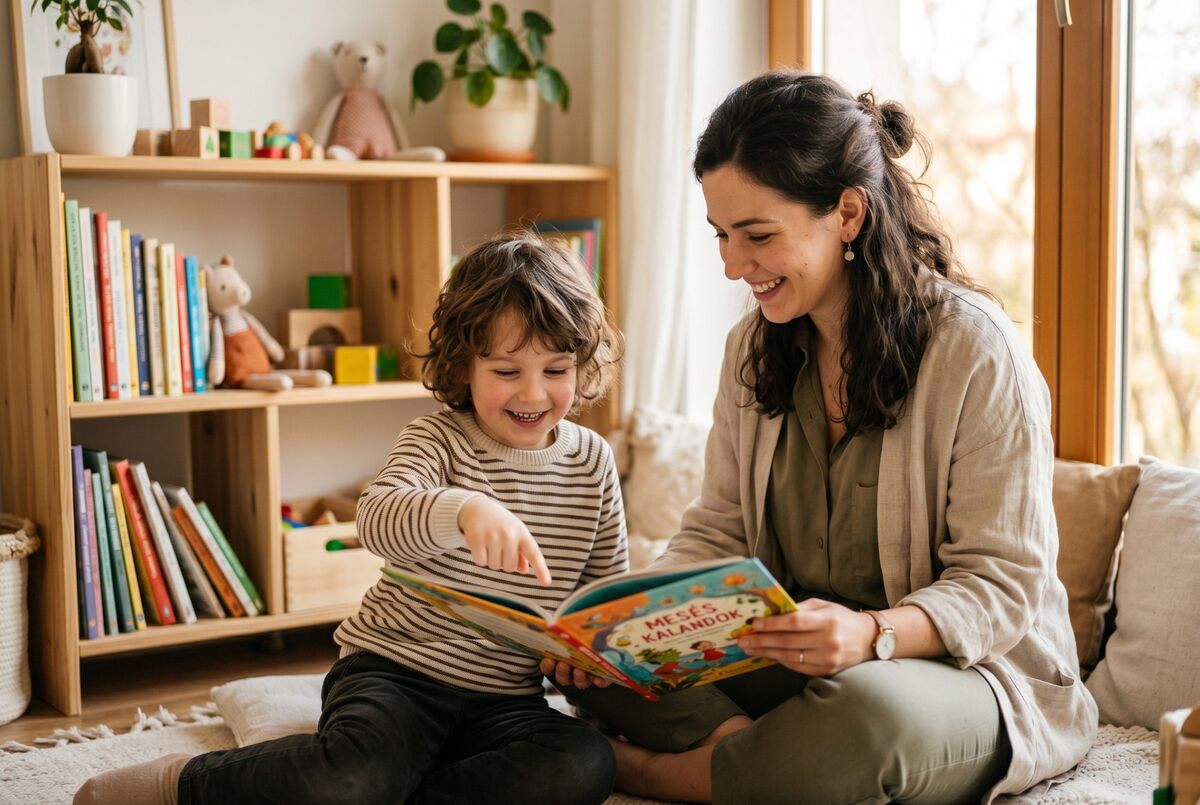
For younger kids (ages 4 to 8), lessons run 30 to 45 minutes and lean on Hungarian folk tales (Lúdas Matyi, Mátyás király), Kodály-method folk songs (Süss fel, nap, Lánc, lánc, eszterlánc), and tongue-twisters (Mit sütsz, kis szűcs?). The cultural material is the curriculum; vocabulary and grammar emerge from the stories and songs rather than being drilled in isolation.
Age-calibrated lesson structure
Younger lessons (ages 4 to 8) include singing, picture-based vocabulary, simple story reading, gestures and games. Older lessons (ages 9 to 14) introduce more explicit grammar discussion, reading of short Hungarian children's books, simple writing exercises, and conversation about the child's actual life. The Hungarian remains the working language throughout; English is the metalanguage when something needs to be explained.
Parent coaching for mixed-language households
The single most effective home pattern is one-parent-one-language. When one or both parents are themselves imperfect Hungarian speakers, the tutor often coaches the parents alongside the children, helping them maintain Hungarian as a household language. The tutor cannot replace home exposure; the tutor can augment it and give parents structure and confidence. For broader Hungarian study after the kid's foundation is solid, see our Conversational Hungarian and Hungarian for Beginners pages.
FAQ
About Hungarian for Kids lessons & classes
What age is best to start Hungarian lessons for a child?
Ages 4 to 5 is the sweet spot for heritage-language work. Children at that age have the language-acquisition system still fully online, the attention span for a 30-minute lesson with the right tutor, and several years of cumulative weekly exposure before adolescence narrows the window. Starting at age 7 or 8 is also fine; starting at age 12 is harder but real. For absolute beginner kids with no Hungarian background, age 6 or 7 is often the right start because the lessons can lean more on age-appropriate explanation.
Will my child end up fluent in Hungarian?
Native-fluency outcomes depend heavily on home exposure. Children with one fully Hungarian-speaking parent at home, plus weekly tutor lessons, often reach near-native conversational fluency by adolescence. Children with imperfect Hungarian at home plus weekly lessons typically reach functional conversational ability, enough for family conversations and a confident return to Hungary as a young adult. Children with no Hungarian at home but committed weekly lessons reach A2 to B1 over several years, enough to study Hungarian seriously as an adult.
How long are kids' lessons and how often?
Younger children (ages 4 to 8) typically do 30 to 45 minutes once a week; some families add a second weekly slot for kids who are clearly enjoying it. Older children (ages 9 to 14) typically do 45 to 60 minutes once or twice a week. Daily 5-to-10-minute home reinforcement (a song, a story, a video clip) accelerates everything. Tutors recommend the cadence at the trial based on the child's energy and the family's logistics.
What does a kids' Hungarian lesson actually look like?
For younger kids, a typical lesson includes 5 minutes of greetings and warmup conversation in Hungarian, 10 minutes of song or story (often the same folk tale read across several weeks), 10 minutes of picture-vocabulary or a game built around new words, 10 minutes of structured play in Hungarian (role play, simple board game, drawing with vocabulary), and 5 minutes of light review and goodbye. Older kids' lessons swap the picture-vocabulary for short reading and conversation about the child's week.
My child understands Hungarian but answers in English. What do we do?
Extremely common. The child has solid passive comprehension but the active-speaking habit defaults to English because that is what their peer environment requires. The intervention is gentle, structured, and tutor-led: weekly lessons where the only path forward in the lesson is speaking Hungarian, paired with home conventions that gently insist on Hungarian responses at specific moments (grandma calls, the dinner table, bath time, depending on what fits the family). Most kids who flip from passive to active do so in 3 to 9 months of consistent work.
Can my kids learn Hungarian if neither parent speaks it well?
Yes, slower but real. The realistic outcome is functional A2 to B1 over several years of consistent weekly lessons, with the tutor providing the bulk of the Hungarian exposure and the family providing whatever supplements they can manage (music in the car, cartoons in the morning, the occasional bedtime story read together). The child will not be a native speaker, but they will arrive at adulthood with a real foundation to build on. We have seen this work well; the key is consistency over years, not intensity over months.
Do you teach Hungarian to siblings together?
Often, yes. Sibling lessons work especially well for kids close in age (within 2 to 3 years) and similar in Hungarian level. The siblings keep each other engaged, can practice with each other between lessons, and benefit from the slightly larger talking pool than a solo lesson provides. Tutors who specialize in kids' work have plenty of experience managing the group dynamic. Pricing for sibling lessons is typically slightly higher than a solo lesson but lower than two separate lessons.
What is the trial lesson like for a child?
30 minutes, free, with the tutor you select. For kids' trials we recommend the parent stay nearby for the first few minutes and then give the tutor and child some space. The tutor introduces themselves warmly, gauges the child's existing Hungarian, plays a simple game or sings a familiar song, and answers your questions about cadence and approach at the end. The trial is genuinely about whether the tutor and child click; if not, swapping to another tutor is easy and we expect it sometimes.
Ready for Hungarian for Kids lessons or classes?
Book a free 30-minute trial with one of our personally vetted tutors. Private lessons or small-group classes — your choice.