



Personally vetted instructors
Early Language Learning tutors, lessons & classes
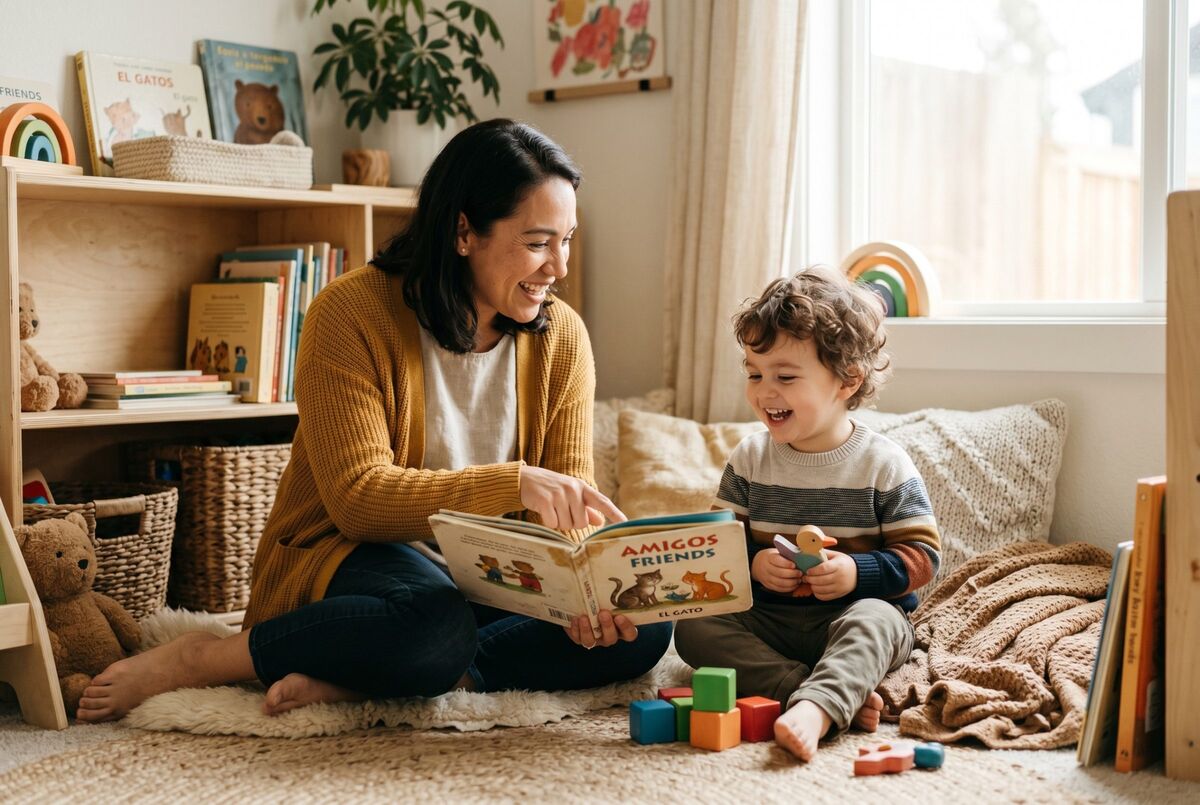
Mira, mira! How a tutor draws a two-year-old's attention before they have the language to ask.
Personally vetted early language learning tutors for ages 2 to 5. Immersive, play-based bilingual coaching with parent-as-co-teacher support, calibrated to what the critical-period research actually says.
Your instructors
Early Language Learning tutors for private lessons & classes
Strommen has run early language learning programs for children since 2006. The most common family profiles: heritage families maintaining the grandparents' language with the youngest grandchildren, non-heritage families giving their preschooler a second language as a developmental investment, multilingual households coordinating three languages, international relocations where the child's first language needs maintenance while English is acquired, and families preparing for dual-language elementary programs. Every tutor below was met and vetted by us in person or via thorough video interview. No marketplace. No automated profile-creation. Real educators with real early-childhood credentials.
Filter by location, age, or price. Then book a 30-minute free trial.
Below are the Strommen tutors who specialize in early language learning for children ages 2 to 5. Photos, ratings, and rates are real. Click any card to read their bio and book a free 30-minute trial.
I want to learn…
Every tutor, personally met. — founder-vetted since 2006, in Los Angeles and online worldwide.
Get a personalized plan
Pick your language — a language advisor will match you with the right tutor and map out your path.

Masters of Fine Art, Bachelor in Foreign Language and Literature.
Master English, French & Italian with a Published Literary Translator
Personally vetted · Strommen’s note
A published literary translator, Colombina teaches English, French, and Italian, plus SAT prep, college essay coaching, and learning-disability support.
Specialties
Masters of Fine Art, Bachelor in Foreign Language and Literature.
Master English, French & Italian with a Published Literary Translator
Specialties
Personally vetted · Strommen’s note
A published literary translator, Colombina teaches English, French, and Italian, plus SAT prep, college essay coaching, and learning-disability support.

MBA and AS in Recording Arts
Multi-Culti Polyglot Linguist and Sound Engineer
Personally vetted · Strommen’s note
Vanessa speaks seven languages, has a sound-engineering background, and has spent two decades teaching. Her lessons range from accent coaching to art for kids.
Specialties
Also speaks: Chinese, Physics
MBA and AS in Recording Arts
Multi-Culti Polyglot Linguist and Sound Engineer
Specialties
I also speak: Chinese, Physics
Personally vetted · Strommen’s note
Vanessa speaks seven languages, has a sound-engineering background, and has spent two decades teaching. Her lessons range from accent coaching to art for kids.

B.sc (Ed)
Top-Rated English, Math, ESL and Common Emtrance Exam Tutor | Helping Global Learners Achieve Fluency & Academic Excellence
Personally vetted · Strommen’s note
English and math come as a pair in Deborah's lessons out of Nigeria, SAT, ACT, IGCSE, and ISEE all covered for students prepping toward specific exams.
Specialties
B.sc (Ed)
Top-Rated English, Math, ESL and Common Emtrance Exam Tutor | Helping Global Learners Achieve Fluency & Academic Excellence
Specialties
Personally vetted · Strommen’s note
English and math come as a pair in Deborah's lessons out of Nigeria, SAT, ACT, IGCSE, and ISEE all covered for students prepping toward specific exams.

BSc
Professional ESL Teacher
Specialties
BSc
Professional ESL Teacher
Specialties

The window — pedagogy & home practice
5 truths about early language learning that change how families approach the work
These are not parenting-magazine talking points. They are the working principles educators apply with the youngest learners every week. Screenshot the infographic, then book a tutor to apply them to your family's bilingual journey.
-
01
The critical period is real but narrow
The brain's receptivity to native-like acquisition (especially of phonology and prosody) is highest in early childhood and closes substantially by the early teens. Adults can still learn languages well, but the parts that are easiest to acquire early are the parts that are hardest to acquire later. The 2-to-5 window is uniquely well suited to the phonological foundation; older windows can layer vocabulary and grammar on top.
e.g. A child who hears Mandarin tones daily from age 2 acquires native-like tone perception; an adult learner usually does not.
-
02
Parent as co-teacher
A weekly 45-minute lesson does not make a bilingual child. Daily exposure does. The tutor's role often includes coaching the parent on a sustainable home practice: which routines to anchor the language in, which books and songs to rotate, how to handle resistance phases. The strongest engagements are tutor plus committed parent, not tutor alone.
e.g. Spanish at bath time and bedtime stories, every night, beats Spanish for 45 minutes on Saturdays.
-
03
Receptive before expressive
Children understand the target language for months before they produce it. A toddler who clearly follows the tutor's instructions but does not yet speak the language is on a normal trajectory. Pushing for production too early can backfire; the production emerges when the child is ready and the receptive base is in place.
e.g. A 2.5-year-old who fetches the blue ball when asked in Italian but does not speak Italian is doing it right.
-
04
Immersion through play
Young children do not learn language from drilling vocabulary lists. They learn it from hearing it in motivated contexts and responding in motivated contexts. The working session looks like play with a thoughtful adult who narrates everything they are doing in the target language. The tutor follows the child's lead while gently introducing target vocabulary and structures.
e.g. Tutor narrates building the block tower: "Mettiamo il blocco rosso qui. Adesso il blocco blu. Aspetta, è caduto!"
-
05
Resistance phases are normal
Most bilingual children go through phases of resisting the target language, usually around age 3 to 4 when they realize the dominant-culture language carries more social weight. The phases pass if the family holds the practice and does not panic-quit. Tutors and parents who expect the resistance phase handle it without abandoning the bilingual goal.
e.g. Three-year-old refuses to speak Italian for two weeks. The family keeps using it. By the third week, she's back.
About Early Language Learning
Play first, vocabulary second
Early language learning is a different discipline from teaching language to older children or adults. A two-year-old has the cognitive architecture for native-like acquisition that an adult has lost; a four-year-old can absorb phonology, prosody, and grammatical patterns from immersive exposure that a teenager would have to drill into memory. Coaching on this page is for families who want their child to grow up bilingual or multilingual and who are looking for tutors who understand what the developmental window actually offers and how to use it without overformalizing the work. Strommen has run language programs for the youngest learners since 2006, and the tutors on this page are the educators we trust with the youngest students on our books.
The research on early bilingualism is consistent on the broad strokes and nuanced on the specifics. The critical-period hypothesis (Lenneberg's foundational formulation, refined by decades of subsequent research) is that the human brain is more receptive to native-like language acquisition in early childhood than at any later point. Native-like phonological acquisition (sounding like a native speaker in pronunciation and prosody) is the capacity that closes earliest, often by the early teens. Grammatical intuition is also acquired more easily in early childhood than later, though adults can still acquire complex grammar through effortful study. Vocabulary and reading skills can be acquired at any age. The practical implication is that the early years are uniquely well suited to acquiring the parts of a second language that are hardest to acquire later, especially the phonology. Patricia Kuhl's research at the University of Washington on infant phonological discrimination, Ellen Bialystok's work on the cognitive benefits of childhood bilingualism, and François Grosjean's writings on bilingual development are the working references in this field.
The parent's role is the part most early language learning programs underestimate, and it is the part that most determines outcome. A young child who hears the target language only during a weekly 45-minute lesson is unlikely to acquire native-like fluency in that language. A child who hears the target language daily, in real domestic contexts (mealtime, bath time, bedtime stories, car rides), from a parent or caregiver who is committed to the practice, will acquire it. The tutor's role in many early-language engagements is partly to coach the parent in a sustainable home practice: which routines to anchor the language in, which children's books and songs to add to the rotation, which vocabulary to build in which week, how to respond to the child's predictable resistance phases without abandoning the practice. This is the parent-as-co-teacher model, and it is the model that produces actual bilingual children rather than children who can count to ten in a second language.
The play-based methodology is the right pedagogical frame for ages 2 to 5. Young children do not learn language by drilling vocabulary lists; they learn it by hearing it in motivated contexts and responding to it in motivated contexts. A lesson that looks like a classroom does not work for a three-year-old; a lesson that looks like a play session with a thoughtful adult does. Working early-language tutors arrive with story books in the target language, simple puppets or props, songs and rhymes from the target culture, and an instinct for following the child's lead while gently introducing target vocabulary and structures. The pedagogical traditions that inform this work include Reggio Emilia's emphasis on the child as co-constructor of learning, Montessori's structured-but-self-directed materials, and the play-based curriculum philosophy that dominates the best early childhood programs in the US and abroad. The tutor's job is not to teach in the formal sense; it is to create conditions for absorption.
The immersive approach (target language used exclusively in the session) is the default for early language learning and works for almost all children even when their understanding starts at zero. Young children read context, gesture, intonation, and facial expression in addition to words; an immersive session with a warm tutor who narrates everything they are doing ("Now I'm picking up the red truck. Where should the truck go? Should the truck go to the box?") creates the conditions for acquisition the way the child's first language was acquired. One Parent One Language (OPOL) and Minority Language at Home (MLAH) are the two best-studied family bilingualism strategies; tutors can advise families on which strategy fits their situation and how to layer in the tutoring sessions accordingly.
The age bands inside the 2-to-5 window have meaningful differences. Two-year-olds are at the peak of vocabulary explosion in their first language and have the neural plasticity for parallel acquisition of a second language, but they have short attention spans (10 to 15 minutes of focused engagement is a long session at this age), limited expressive output, and need consistent caregivers more than novel ones. Three- and four-year-olds can sustain longer engagement (20 to 30 minutes is typical for a lesson, sometimes more), have more sophisticated play, and can begin to produce simple sentences in the target language with consistent input. Five-year-olds are entering the early reading window and can begin pre-literacy work in the target language alongside continued oral immersion. Tutors calibrate session length, activity complexity, and parent involvement to the developmental band.
The languages that families most often want for their young children at Strommen are Spanish (by a wide margin in the Los Angeles area), Mandarin, French, Italian, Korean, Japanese, ASL, and the heritage languages of multilingual families (Russian, Arabic, Hebrew, Vietnamese, Tagalog, Armenian, others). Tutors are matched to the family's target language and the family's situation: a Spanish-heritage family looking to maintain the grandparents' language, a non-heritage family hoping to give their child a second language as a developmental investment, a multilingual household balancing three languages, an international family relocating to LA whose child needs to keep up the first language while acquiring English. Each situation calls for different conversation in the first session.
A few patterns trip up serious families often enough to call them out. Expecting the child to speak the target language back early is the most common: receptive understanding precedes expressive production by months, and a child who clearly understands the tutor's instructions but does not yet speak the language is on a normal trajectory. Abandoning the practice during a resistance phase (the three-year-old who suddenly refuses the language for two weeks) is the second pattern; the resistance phases are normal and pass if the family does not panic-quit. Treating the tutoring sessions as the entire language exposure is the third; the sessions are the catalyst, but the daily home exposure is what determines outcome. Worrying about "language confusion" or delayed development is the fourth; the research is unambiguous that early bilingualism does not delay language development overall and that bilingual children temporarily look slower on some single-language measures while their two-language vocabulary outpaces their monolingual peers.
The Strommen early language learning roster includes native-speaker tutors with early childhood teaching credentials, dual-language preschool teachers with classroom experience, bilingual heritage speakers with formal pedagogical training, and Reggio- and Montessori-trained educators with language-acquisition specialization. Several tutors are parents themselves of bilingual or multilingual children and bring the lived experience of the home practice alongside their teaching credentials. Each tutor's bio specifies background, training, target language, and which student profile they fit best (heritage maintenance for the youngest learners, second-language acquisition for non-heritage families, multilingual household coordination, pre-K immersion preparation). Pricing reflects experience.
Lessons are one-on-one and built around the child's developmental stage and the family's bilingual goal. The first session is usually a meet-and-greet where the tutor reads the child's temperament, plays in the target language to gauge baseline comfort, and talks with the parent about the home routine and the bilingual strategy. The trial is free. The coaching arc is usually long: families committed to bilingualism work with a tutor across years, not months, and the relationship with the consistent tutor is part of what makes the practice work. For language-specific families, our Spanish for kids, Mandarin for kids, French for kids, and Italian for kids pages cover the language-specific tracks for slightly older children.
What you'll cover
Lessons & classes tailored to Early Language Learning
Play-based immersive sessions for ages 2 to 5
One-on-one sessions in the target language with developmentally calibrated activities: story books, simple puppets, songs and rhymes from the target culture, and an instinct for following the child's lead. Session length scales with age (10 to 15 minutes for two-year-olds, 20 to 30 minutes for three- and four-year-olds, longer for fives). The Reggio Emilia and Montessori traditions inform the pedagogical frame.
Parent coaching for sustainable home practice
Working with the parent on the home routine that anchors the language: which daily contexts to use the target language in, which books and songs to rotate, how to handle resistance phases without quitting, how to layer in the tutoring sessions with the broader exposure plan. OPOL (One Parent One Language) and MLAH (Minority Language at Home) strategy guidance for multilingual families.
Heritage language maintenance and multilingual coordination
Coaching for heritage families maintaining grandparents' language with grandchildren, including coordination across multiple languages in trilingual households. Tutors with the cultural background to bring authentic music, food references, holidays, and family conversation patterns into the work, not just decontextualized vocabulary.
Pre-K immersion preparation and dual-language program readiness
Preparation for families enrolling their child in dual-language elementary programs (Spanish-English, Mandarin-English, French-English, Korean-English DLI programs across LA), building the receptive vocabulary base that helps the child enter the program ready. Coordination with dual-language preschool transitions when the family is timing the move.
FAQ
About Early Language Learning lessons & classes
What age range is this really for?
The page is built for ages 2 to 5. Younger than 2 is possible with the right tutor and family setup, though the work is more like family coaching than child-facing tutoring at that age. Older than 5 moves into the language-for-kids and school-age tracks, where the pedagogy shifts toward structured early-literacy and grammar work. The 2-to-5 window has its own approach and its own developmental considerations, which is why it has its own page.
Will my child get confused by hearing two languages?
No. The research is unambiguous on this. Early bilingualism does not cause language confusion or delayed development. Bilingual children sometimes mix the two languages in early speech (code-switching), but this is normal and not a sign of confusion. The two-language vocabulary of bilingual children typically outpaces the single-language vocabulary of monolingual peers within a few years, even when one language temporarily looks behind by single-language measures.
How often should lessons be?
Once or twice a week is typical, with the understanding that the tutoring sessions are catalyst rather than total exposure. A single weekly 30-minute session with no daily home practice does not produce bilingualism; two weekly sessions with daily parent home practice can. The tutor will help the family design a realistic cadence at the first session that matches the family's bandwidth and goal.
What if my child resists the lessons?
Common, and the tutor expects it. Resistance phases happen for most bilingual children and pass if the family does not panic-quit. The tutor's job is partly to read the child's mood in any given session and adjust the activity to recover engagement. If the resistance is persistent across many sessions, the tutor may suggest a shorter session length, a different activity mix, or a temporary change of tutor; sometimes the right tutor-child fit takes one or two iterations.
Are your tutors native speakers?
Most are native speakers of the target language with early childhood teaching credentials. Several are heritage speakers raised bilingual in the US with strong professional pedagogical training. The native-versus-heritage question matters less than the tutor's instinct for the developmental stage and their reliability as a consistent adult in the child's life. The bios specify.
Will my child actually become bilingual?
If the family invests in daily home exposure across years, yes, almost always. If the tutoring is the only exposure and the home language is English-only, no. The realistic outcome of tutoring-only with no home practice is functional comprehension and early production in the target language, which is meaningful but is not bilingualism. Bilingualism requires the daily exposure that only the family can provide; the tutor is the partner, not the substitute.
What does the trial cover?
30 minutes, free, in person if local or via video. The tutor will meet your child, play briefly in the target language, and have a parent conversation about the home situation, the bilingual goal, and the realistic cadence. The trial is more relationship-and-fit than diagnostic at this age; the tutor needs to read your child's temperament and you need to feel comfortable with the tutor as a regular presence in your household. Most families continue with the tutor they trialed.
Ready for Early Language Learning lessons or classes?
Book a free 30-minute trial with one of our personally vetted tutors. Private lessons or small-group classes — your choice.