



Personally vetted instructors
Pronunciation Coaching tutors, lessons & classes
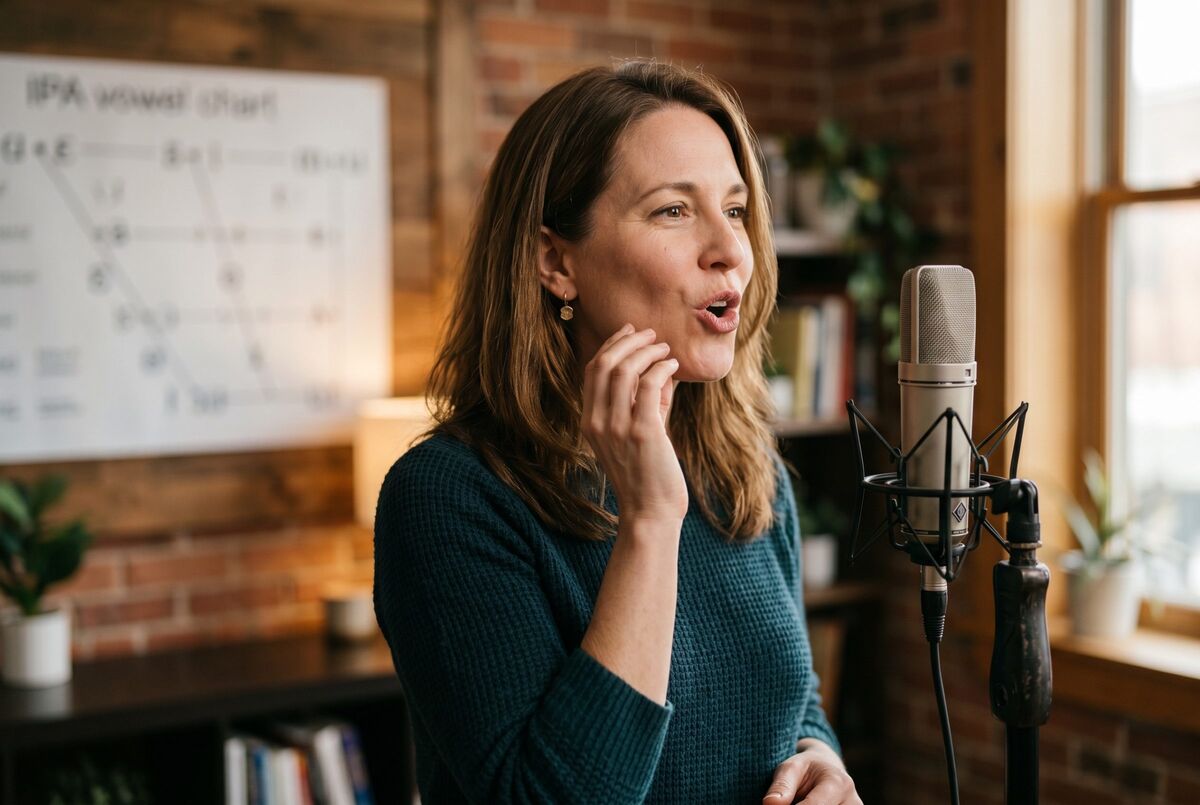
Read this aloud. How a working pronunciation diagnostic begins, before the conversation even starts.
Personally vetted English pronunciation coaches. IPA-based diagnostics, targeted drills on the sounds that actually mark non-native speech, and the prosody work that makes fluent English read as fluent.
Your instructors
Pronunciation Coaching tutors for private lessons & classes
Strommen has coached English pronunciation for fluent non-native speakers since 2006. The most common student profiles: executives whose fluent English carries a pronunciation layer that costs them in meetings and on calls, healthcare workers preparing for USMLE communications evaluations, broadcast and on-camera professionals adjusting pronunciation for international audiences, university students preparing for academic presentation, and professionals who have plateaued in general ESL and want to shift the pronunciation layer specifically. Every tutor below was met and vetted by us in person or via thorough video interview. No marketplace. No automated profile-creation. Real coaches with real credentials.
Filter by location, age, or price. Then book a 30-minute free trial.
Below are the Strommen tutors who specialize in English pronunciation coaching. Photos, ratings, and rates are real. Click any card to read their bio and book a free 30-minute trial.
I want to learn…
Every tutor, personally met. — founder-vetted since 2006, in Los Angeles and online worldwide.
Get a personalized plan
Pick your language — a language advisor will match you with the right tutor and map out your path.


PhD (in progress), Educational Technology – Walden University, Winter 2026PhD, Public Policy & Administration – Walden University, Nov 2019M.S., Education (eLearning & Online Teaching) – University of Wisconsin-Stout, Aug 2019M.A., Political Science &... · • Adult Basic Education (ABE) Certification – Hamline University, 2023• Communication Sciences Disorders – UW-Eau Claire, 2020• Phonetic English as a Second Language (PESL) Certification – Institute of Language and Phonology, 2017• TESOL & Young Learne...
Clear American English, Taught with Insight, Bridging Languages. Building Confidence!
Personally vetted · Strommen’s note
PhD-trained, Marshelle teaches English through psycholinguistics and Multiple Intelligences theory. Aviation English and speech therapy are both on the list.
Specialties
Also speaks: German, Russian
PhD (in progress), Educational Technology – Walden University, Winter 2026PhD, Public Policy & Administration – Walden University, Nov 2019M.S., Education (eLearning & Online Teaching) – University of Wisconsin-Stout, Aug 2019M.A., Political Science &... · • Adult Basic Education (ABE) Certification – Hamline University, 2023• Communication Sciences Disorders – UW-Eau Claire, 2020• Phonetic English as a Second Language (PESL) Certification – Institute of Language and Phonology, 2017• TESOL & Young Learne...
Clear American English, Taught with Insight, Bridging Languages. Building Confidence!
Specialties
I also speak: German, Russian
Personally vetted · Strommen’s note
PhD-trained, Marshelle teaches English through psycholinguistics and Multiple Intelligences theory. Aviation English and speech therapy are both on the list.
M.A. and Ph.D.
Former UCLA Italian Instructor with 16+ Years of Experience!
Personally vetted · Strommen’s note
A former UCLA Italian instructor with us since 2009, Marianna moves easily between Italian instruction and legal translation.
Specialties
M.A. and Ph.D.
Former UCLA Italian Instructor with 16+ Years of Experience!
Specialties
Personally vetted · Strommen’s note
A former UCLA Italian instructor with us since 2009, Marianna moves easily between Italian instruction and legal translation.
B.A. in Philosophy (Pomona College),MBA (Pepperdine University) · TEFL Certifications in English grammar, online instruction, teaching adults & children
Master American English with a Los Angeles Native: ESL Expert with Global Teaching Experience!
Personally vetted · Strommen’s note
Joanne is an adjunct professor at UWest who also teaches American English and ESL, and she's taught everyone from Japanese housewives to executives.
Specialties
B.A. in Philosophy (Pomona College),MBA (Pepperdine University) · TEFL Certifications in English grammar, online instruction, teaching adults & children
Master American English with a Los Angeles Native: ESL Expert with Global Teaching Experience!
Specialties
Personally vetted · Strommen’s note
Joanne is an adjunct professor at UWest who also teaches American English and ESL, and she's taught everyone from Japanese housewives to executives.

MBA and AS in Recording Arts · DALI, DELF, First Cert, SIZ Computer Science, Pro Tools, Dante
Multi-Culti Polyglot Linguist and Sound Engineer
Personally vetted · Strommen’s note
Vanessa speaks seven languages, has a sound-engineering background, and has spent two decades teaching. Her lessons range from accent coaching to art for kids.
Specialties
Also speaks: ASL American Sign Language, Chinese, Physics
MBA and AS in Recording Arts · DALI, DELF, First Cert, SIZ Computer Science, Pro Tools, Dante
Multi-Culti Polyglot Linguist and Sound Engineer
Specialties
I also speak: ASL American Sign Language, Chinese, Physics
Personally vetted · Strommen’s note
Vanessa speaks seven languages, has a sound-engineering background, and has spent two decades teaching. Her lessons range from accent coaching to art for kids.

Bachelor's degree · CELT-P (Certificate in English Language Teaching – Primary)
Native Chinese Tutor in Tianjin with C1 English level
Personally vetted · Strommen’s note
A native Chinese speaker in Tianjin with C1 English herself, Xin opens every lesson by asking flatly what's been giving the student trouble.
Specialties
Bachelor's degree · CELT-P (Certificate in English Language Teaching – Primary)
Native Chinese Tutor in Tianjin with C1 English level
Specialties
Personally vetted · Strommen’s note
A native Chinese speaker in Tianjin with C1 English herself, Xin opens every lesson by asking flatly what's been giving the student trouble.


Certified in Teaching English as a Foreign Language, International TEFL and TESOL Training (2021)BA, Honors Theatre Studies, University of Guelph (2021) · Teaching English as a Foreign Language (TEFL)
English, Italian and Spanish teacher, dialect coach and accent reduction coach
Personally vetted · Strommen’s note
Amy coaches Sicilian, Neapolitan, and Calabrese dialects alongside standard Italian and English. She's also taught Italian kids English from age three up.
Specialties
Certified in Teaching English as a Foreign Language, International TEFL and TESOL Training (2021)BA, Honors Theatre Studies, University of Guelph (2021) · Teaching English as a Foreign Language (TEFL)
English, Italian and Spanish teacher, dialect coach and accent reduction coach
Specialties
Personally vetted · Strommen’s note
Amy coaches Sicilian, Neapolitan, and Calabrese dialects alongside standard Italian and English. She's also taught Italian kids English from age three up.

Master in Communication and ManagementBritish Bachelor in Journalism · English testing exams (IELTS, TOEIC)
Learn French with me and it will be a piece of cake !
Personally vetted · Strommen’s note
Babbel-trained, Farah teaches French out of Nantes with a specialty in opera-singer diction and accent work. Her tagline promises: 'piece of cake.'
Specialties
Master in Communication and ManagementBritish Bachelor in Journalism · English testing exams (IELTS, TOEIC)
Learn French with me and it will be a piece of cake !
Specialties
Personally vetted · Strommen’s note
Babbel-trained, Farah teaches French out of Nantes with a specialty in opera-singer diction and accent work. Her tagline promises: 'piece of cake.'

BFA, MFA · MDH Breathing Coordination - Level 2 (currently held by 3 people in the US)
There is no index of character so sure as the voice.
Specialties
BFA, MFA · MDH Breathing Coordination - Level 2 (currently held by 3 people in the US)
There is no index of character so sure as the voice.
Specialties
BSc Computer Science,MFA Theatre Arts and Stagecraft
Harvard-trained tutor for English literature, voice, and dialects
Personally vetted · Strommen’s note
Harvard-trained in literature, voice, and dialect work, Lize covers everything from a Boston accent to full accent modification.
Specialties
BSc Computer Science,MFA Theatre Arts and Stagecraft
Harvard-trained tutor for English literature, voice, and dialects
Specialties
Personally vetted · Strommen’s note
Harvard-trained in literature, voice, and dialect work, Lize covers everything from a Boston accent to full accent modification.
M.A. in Foreign Languages (English/French) from the University of Calabria (Italy)B.A. in Renaissance and Baroque singing from the Conservatory of Venice. · DITALS: Diplome of Italian a a second language teaching
Italian language classes for Opera Singers - teacher specializing in helping Opera Singers with Pronunciation, Accent, Music and Meaning
Personally vetted · Strommen’s note
Simona has spent nineteen years specializing in Italian for opera singers and musicologists, pronunciation, diction, and the historical texts behind the music.
Specialties
Also speaks: English, French, Spanish
M.A. in Foreign Languages (English/French) from the University of Calabria (Italy)B.A. in Renaissance and Baroque singing from the Conservatory of Venice. · DITALS: Diplome of Italian a a second language teaching
Italian language classes for Opera Singers - teacher specializing in helping Opera Singers with Pronunciation, Accent, Music and Meaning
Specialties
I also speak: English, French, Spanish
Personally vetted · Strommen’s note
Simona has spent nineteen years specializing in Italian for opera singers and musicologists, pronunciation, diction, and the historical texts behind the music.

IPA — phonetics & prosody
5 pronunciation coaching moves that actually shift fluent non-native English
These are not the textbook tips that float through every ESL classroom. They are the working moves coaches drill on real fluent students every week. Screenshot the infographic, then book a tutor to apply them to your own speech.
-
01
Minimal pair drills
Sheep versus ship. Pool versus pull. Bat versus bet. Cart versus cut. Walk versus work. English distinguishes vowel pairs that most languages merge, and these pairs carry meaning load in everyday speech. The coach drills the minimal pairs explicitly until the student produces both members consistently and hears the distinction in fast speech. The drill is repetitive on purpose; the motor pattern needs reinforcement.
e.g. Coach: "Read these in random order. Ship, ship, sheep, ship, sheep, sheep, ship."
-
02
The interdental fricative
The /θ/ and /ð/ sounds (in think and this) do not exist in most languages and produce some of the most recognizable non-native English markers. The tongue tip sits between or behind the front teeth; the airflow is continuous, not stopped. Coaches use a mirror so the student can see the tongue placement, and drill with pairs like thin versus tin, this versus dis, three versus tree.
e.g. Drill: <em>I think this is the third time.</em> All four words carry the interdental.
-
03
Stress-timed rhythm
English is stress-timed: stressed syllables occur at roughly equal intervals, unstressed syllables compress. Most non-English languages are syllable-timed, with each syllable taking roughly equal time. Learners often produce English with their L1 rhythm, which sounds non-native even when the phonemes are correct. The coaching move is to mark the stressed syllables in passages and read them aloud while exaggerating the compression of the unstressed ones.
e.g. <em>The CAT sat on the MAT.</em> The capitalized syllables get full duration; the rest compress.
-
04
Schwa /ə/ on unstressed syllables
The schwa is the unstressed vowel in about, banana, family, support. It is the most common vowel in spoken English. Most learners overproduce it as a full vowel from their L1 inventory, which costs naturalness even when the consonants are correct. The coaching move is to relax the unstressed syllables and let the vowel reduce.
e.g. <em>a-BOUT</em> with a reduced first syllable, not <em>ah-BOUT</em>; <em>BAN-an-uh</em> with two reduced syllables.
-
05
Daily shadowing, not weekly lessons
Pronunciation is a motor skill. It requires daily reinforcement to stabilize. Thirty minutes a day of focused shadowing (listening to a native speaker and repeating immediately, matching rhythm and intonation) produces more shift than two hours a week of lesson-only work. Coaches assign specific shadowing material (TED talks, BBC News, NPR, podcasts in the target variety) calibrated to the student's level.
e.g. Choose one 5-minute clip. Shadow it for 30 minutes daily for two weeks. The shift is audible.
About Pronunciation Coaching
Sound, not accent
Pronunciation coaching sits in its own corner of language work. It is not accent training (which targets a specific regional variety for actors or relocators), and it is not general ESL or conversational English (which targets fluency and vocabulary). The student who books this page is usually already fluent in English, often professionally, and wants the pronunciation layer to stop costing them comprehension or credibility. The result is not a perfect native sound — most adult learners never reach that ceiling, and the goal is rarely necessary — but a clear, easily understood English that does not require listeners to lean in or guess. The work is concrete, drillable, and improves measurably across a 12- to 24-week coaching arc.
The diagnostic comes first. A working pronunciation coach reads aloud passages with the student in the first session, often diagnostic texts deliberately built to surface the specific sounds and prosodic features that mark non-native English. The Rainbow Passage and the Grandfather Passage are the two most-used diagnostic texts in the speech-pathology and accent-coaching traditions; the Comma Gets a Cure passage covers a wider phonetic inventory. The coach is listening for specific things: which consonants the student is substituting or omitting, which vowel pairs the student is merging, where the syllable stress lands wrong, where the intonation contour reverts to the patterns of the first language. From that diagnostic, the coach builds a targeted plan rather than a generic curriculum.
The International Phonetic Alphabet (IPA) is the working tool of the coaching. Students who have never seen IPA before usually learn the basics in the first two sessions, because the alphabet lets the coach name specific sounds without ambiguity. English has 14 to 16 vowel phonemes (depending on how the dialect divides them), 24 consonant phonemes, and a set of diphthongs and triphthongs that learners from many backgrounds struggle to produce. The student does not need to be a phonetician; they need to know, for example, that the /æ/ in cat is different from the /ɛ/ in bet is different from the /ɑː/ in cart, and that their first language probably does not have all three as distinct phonemes. The IPA gives the student a working vocabulary to track their own progress.
The difficult sounds for English learners are predictable enough to plan around. The interdental fricatives /θ/ and /ð/ (the sounds in think and this) do not exist in most languages and produce some of the most recognizable non-native English markers. Learners typically substitute /t/ /s/ /f/ for the voiceless one and /d/ /z/ /v/ for the voiced one. The English /r/ (the postalveolar approximant in American English, slightly different in British) is one of the hardest sounds in any language and is acquired late even by native children. The English /l/ has two allophones (the clear /l/ in light and the dark /ɫ/ in full) that many learners produce identically. The vowel pairs that English distinguishes but most languages do not are particularly hard: /iː/ and /ɪ/ (sheep versus ship), /uː/ and /ʊ/ (pool versus pull), /æ/ and /ɛ/ (bat versus bet), /ɑː/ and /ʌ/ (cart versus cut). These distinctions carry the meaning load in many minimal pairs, and a student who does not produce them clearly will be misheard regularly. Coaches drill the minimal pairs explicitly until the student can produce both members consistently and hear the distinction in fast speech.
First language predicts the pattern. Mandarin and Cantonese speakers tend to drop final consonants and merge English /r/ and /l/. Japanese speakers tend to merge /r/ and /l/ in the opposite direction and add vowels to consonant clusters. Korean speakers tend to substitute the interdental fricatives with stops. Spanish speakers tend to merge /b/ and /v/ in some positions and add an epenthetic vowel before initial /s/ clusters ("e-school" for school). French speakers tend to substitute the interdental fricatives with /s/ and /z/. German and Dutch speakers tend to devoice final consonants. Russian speakers tend to substitute the interdental fricatives with stops and overstress consonant clusters. Indian English speakers typically have a strong substrate from Hindi or Tamil that affects vowel quality and retroflex consonants. Working coaches keep these L1 patterns in working memory and tailor the diagnostic and drill sequence to the student's actual first language.
Prosody (stress, rhythm, and intonation) is the layer most learners need most and almost never get coached on. English is a stress-timed language: stressed syllables occur at roughly equal intervals and unstressed syllables compress to fit. This is opposite to most syllable-timed languages (French, Spanish, Italian, Japanese, Korean, Mandarin), where syllables take roughly equal time regardless of stress. The result is that learners often produce English with the rhythm of their first language, which sounds non-native even when the individual phonemes are correct. Working coaches drill the stress-rhythm pattern explicitly: which syllable carries the lexical stress in multisyllable words (PHO-to-graph versus pho-TO-gra-pher versus pho-to-GRAPH-ic, with the stress shifting on suffix), which words carry the sentence stress (content words: nouns, main verbs, adjectives, adverbs) versus which compress to weak forms (function words: articles, auxiliaries, prepositions, pronouns). The schwa /ə/ (the unstressed vowel in about, banana, family) is the most common vowel in spoken English and most learners overproduce it as a full vowel, which costs naturalness.
Intonation patterns differ from language to language in ways most learners never get explicit instruction on. English statements typically fall at the end, English yes-no questions rise, English wh-questions fall, English lists rise on each item and fall on the final, English contrasts use a specific pitch movement to highlight the contrasted element. Speakers from rising-intonation L1s (some varieties of Spanish, Portuguese, several Asian languages) often carry the rising contour into English statements, which makes the statements read as uncertain or interrogative. Coaches drill the intonation patterns with reading exercises and recording, often using software (Praat is the open-source standard) to show the pitch contour visually so the student can see what their voice is doing rather than just hear it.
Regional accent guidance is its own micro-specialty, related to but not the same as the actor accent training on adjacent pages. A pronunciation student who wants to sound generally American can target General American (the educated mainstream that does not sound regional from anywhere); a student in London might target Standard Southern British or modern Estuary; a student in Australia might target General Australian; a student in Canada might target Standard Canadian English. The coach can guide the choice based on where the student lives, where they work, and which variety sounds at home in their daily context. The work is not full accent acquisition (which is the actor coaching arc); it is calibrating the student's existing pronunciation toward a target variety so they sound at home in their environment.
A few patterns trip up serious learners often enough to call them out. Practicing pronunciation only during lessons is the most common mistake; pronunciation is a motor skill that requires daily reinforcement to stabilize, and 30 minutes a day of focused shadowing produces more shift than two hours a week of lesson-only work. Recording your own voice and listening back is the second discipline most students avoid and most need; the gap between what the student thinks they sound like and what they actually sound like is usually wider than the student expects. Working on the individual sounds without addressing prosody is the third pattern; a student with perfect /r/ and /l/ but L1 rhythm still sounds non-native. Trying to lose the accent entirely is the fourth and worth questioning; the realistic goal is clear, easily understood, professionally appropriate English, not native-speaker passing.
The Strommen pronunciation coaching roster includes speech-language pathologists with clinical training (the SLP credential is the deepest training in articulation and phonetics in the US), ESL instructors with specific pronunciation specialization, theater-trained voice and speech coaches with accent-coaching backgrounds, and linguists with phonetics graduate training. Each tutor's bio specifies background, credentials, and which student profile they fit best (professional fluency calibration, specific L1 backgrounds, regional target accent, public-speaking pronunciation prep, or full accent modification). Pricing reflects credential. The page pairs well with the Business English page for working professionals and with the accent modification page for students who want the deeper accent-shift work.
Lessons are one-on-one and built around your actual speech. The first session usually includes a diagnostic read of one of the standard passages plus a sample of conversational speech, and the coach builds the targeted plan from what the diagnostic reveals. The trial is free. The coaching arc usually runs 12 to 24 weeks with weekly cadence for visible shift on specific sounds, plus daily shadowing and recording practice between sessions.
What you'll cover
Lessons & classes tailored to Pronunciation Coaching
IPA diagnostic and targeted articulation drills
First-session diagnostic with one of the standard passages (Rainbow, Grandfather, Comma Gets a Cure). IPA notation introduced over the first two sessions so the student has working vocabulary to track progress. Targeted drills on the specific consonants and vowel pairs that the diagnostic surfaces, with minimal-pair work, mirror feedback, and recording for review.
L1-specific patterns and substitution corrections
Coaches calibrate the drill sequence to the student's actual first language. Mandarin and Cantonese patterns (final consonant deletion, /r/-/l/ merger), Japanese patterns (vowel insertion in consonant clusters), Korean patterns (interdental substitution with stops), Spanish patterns (/b/-/v/ merger, epenthetic vowel before /s/-clusters), French and German patterns (devoicing), Russian patterns (cluster overstress), Indian English patterns (retroflex substrate). The L1-specific approach saves months of unfocused drilling.
Prosody: stress, rhythm, and intonation
Stress-timed rhythm drilling, lexical stress on multisyllable words (the suffix-driven stress shifts in PHO-to-graph / pho-TO-gra-pher / pho-to-GRAPH-ic), sentence stress on content versus function words, schwa reduction on unstressed syllables, intonation contour for statements, questions, lists, and contrast. Praat or similar pitch-tracking software available when the visual feedback helps.
Regional accent calibration and professional pronunciation prep
Calibration toward General American, Standard Southern British, modern Estuary, General Australian, or Standard Canadian English depending on where the student lives and works. Specific prep for professionals whose work requires intelligible pronunciation under pressure: physicians on USMLE evaluations, broadcasters, university lecturers, customer-facing professionals on international calls.
FAQ
About Pronunciation Coaching lessons & classes
Is pronunciation coaching the same as accent training?
Related but not identical. Pronunciation coaching targets clarity and intelligibility: the student is usually fluent in English and wants the pronunciation layer to stop costing them comprehension or credibility. Accent training targets a specific regional variety, usually for actors taking on a role or for someone relocating who wants to sound at home in a specific community. Most students on this page want pronunciation work; students who want full accent acquisition should look at the accent modification and regional accent pages.
Can adults actually change their pronunciation?
Yes, with realistic expectations. Adult learners can make substantial, measurable shifts in specific sounds, in prosody, and in overall intelligibility across a 12- to 24-week coaching arc with weekly lessons and daily shadowing practice. Most adults do not reach full native-speaker passing, and that is rarely the goal. The realistic and useful goal is clear, easily understood, professionally appropriate English that does not require listeners to lean in or guess.
Do your coaches use IPA?
Yes, as a working tool. Students do not need to arrive knowing IPA; coaches introduce the basics in the first two sessions so the student has a way to name specific sounds without ambiguity. The IPA is the standard tool in speech-language pathology and accent coaching internationally; it makes the diagnostic precise and the drilling easier to track.
I'm fluent in English. Will coaching help me?
Usually yes. Most students who book pronunciation coaching are already fluent and want the pronunciation layer specifically. The coaching is not foundation language work; it is calibration on top of working fluency. The shift often shows up in specific contexts (meetings, presentations, calls) where the student wants to land more clearly than they currently do.
What's the difference between this and an SLP (speech-language pathologist)?
Several of our coaches are licensed SLPs and offer the deepest training in articulation and phonetics. Others are ESL specialists with specific pronunciation training, theater-trained voice coaches with accent backgrounds, or linguists with phonetics graduate training. The right credential depends on the student's situation: clinical speech issues (stuttering, dysarthria, voice disorders) require an SLP. Pronunciation calibration for fluent non-native speakers works with any of the credential paths. The bios specify.
Are lessons online or in person?
Both. Pronunciation coaching works well over video because the coach can see the student's mouth and the student can see the coach's. Several coaches are based in Los Angeles and offer in-person sessions when proximity matters. The booking widget on each tutor's profile shows their available formats.
What does the trial cover?
30 minutes, free, with the coach you select. The coach will ask you to read aloud a short passage and to have a brief conversation in English, then identify the highest-leverage areas for the coaching arc, propose a cadence and a homework schedule, and you decide whether to continue. Most students continue with the coach they trialed.
Ready for Pronunciation Coaching lessons or classes?
Book a free 30-minute trial with one of our personally vetted tutors. Private lessons or small-group classes — your choice.