



Personally vetted instructors
CILS Tre C1 tutors, lessons & classes
Buondì The contracted greeting Italians use among friends at the espresso bar; it signals you've moved past textbook Italian.
Personally vetted CILS TRE C1 prep tutors. Lessons calibrated to the advanced register Italian-speaking academic, journalistic, and professional life actually expects, with rubric-aware drilling on the multi-source synthesis tasks that distinguish C1 from B2.
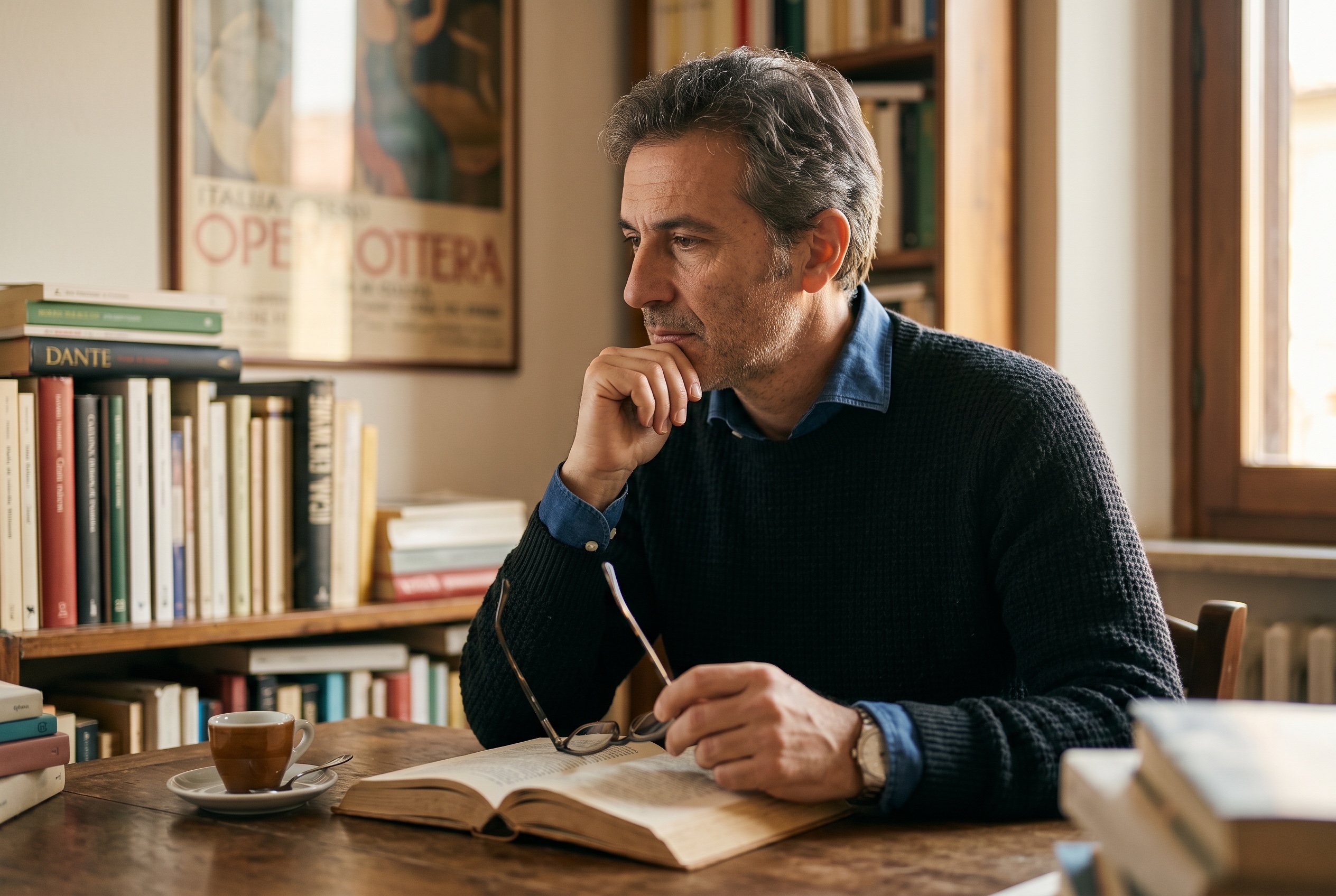
Your instructors
CILS Tre C1 tutors for private lessons & classes
Strommen has prepped CILS TRE C1 candidates across the academic-admission track, the teaching-credential track, and the long-arc B2-to-C1 upgrade. Most students arrive with a defined professional or academic reason for needing C1 specifically, a target exam date, and an honest sense of which section worries them most. Every tutor below was met and vetted by us in person or via thorough video interview. No marketplace. No automated profile-creation. Real teachers with serious reading lives in Italian and direct C1 prep experience.
Filter by location, age, or price. Then book a 30-minute free trial.
Below are the Strommen tutors who prep candidates for the CILS TRE C1. Photos, ratings, and rates are real. Click any card to read their bio and book a free 30-minute trial.
I want to learn…
Every tutor, personally met. — founder-vetted since 2006, in Los Angeles and online worldwide.
Get a personalized plan
Pick your language — a language advisor will match you with the right tutor and map out your path.


Psychology · N/A
Expert Native Italian Tutor | Personalized Lessons | Learn Italian with confidence, clarity, and authentic conversation
Specialties
Also speaks: French, Japanese, Russian, Welsh
Psychology · N/A
Expert Native Italian Tutor | Personalized Lessons | Learn Italian with confidence, clarity, and authentic conversation
Specialties
I also speak: French, Japanese, Russian, Welsh

I have a degree in "Media and Journalism" from the Faculty of Political Science in Florence.I have obtained several certificates of suitability for teaching the Italian language L2/Ls to foreigners, and as administrator of the CILS exams (of all levels... · The certificate of suitability for teaching the Italian language L2/Ls to foreigners was issued by DILIT International House in Rome after being admitted through an initial test and passing the various stages of the training.
Learn Italian with confidence, clarity, and real-world results.
Personally vetted · Strommen’s note
Federica covers every CILS certification level from A2 to C2 in her Italian lessons, out of Barcelona, with Sicilian dialect and opera-singer coaching too.
Specialties
Also speaks: English, Spanish
I have a degree in "Media and Journalism" from the Faculty of Political Science in Florence.I have obtained several certificates of suitability for teaching the Italian language L2/Ls to foreigners, and as administrator of the CILS exams (of all levels... · The certificate of suitability for teaching the Italian language L2/Ls to foreigners was issued by DILIT International House in Rome after being admitted through an initial test and passing the various stages of the training.
Learn Italian with confidence, clarity, and real-world results.
Specialties
I also speak: English, Spanish
Personally vetted · Strommen’s note
Federica covers every CILS certification level from A2 to C2 in her Italian lessons, out of Barcelona, with Sicilian dialect and opera-singer coaching too.

Cultura colta — advanced cultural depth
5 advanced touchpoints worth knowing at the C1 tier
These are the cultural reference points that surface in C1 reading prompts, speaking interactions, and the serious Italian press the level prepares you to read fluently. Screenshot the infographic, then book a tutor to work through the rest.
-
01
L'opera lirica
Italian opera as a living cultural reference, from Verdi (Aida, La Traviata, Otello) to Puccini (La Bohème, Tosca, Madama Butterfly) to Rossini (Il barbiere di Siviglia). Knowing the major composers and a few canonical works matters at C1 because the cultural press references them constantly and assumes the reader catches the allusion. The C1 reading section often features opinion writing on the contemporary opera scene at La Scala, San Carlo, or the Arena di Verona.
e.g. Il nuovo allestimento dell'<em>Otello</em> alla Scala ha diviso i critici per la regia minimalista.
-
02
Luciano Pavarotti e i Tre Tenori
The reference point most Italians cite for the modern global reach of Italian classical music. Pavarotti's collaborations with José Carreras and Plácido Domingo as the Tre Tenori at the 1990 World Cup in Rome marked Italian opera's late-twentieth-century crossover moment. C1 reading prompts on Italian cultural exports routinely use this story as a touchstone for the broader argument about Italian soft power abroad.
e.g. Il fenomeno Pavarotti dimostrò che l'opera lirica poteva ancora riempire gli stadi alla fine del Novecento.
-
03
Il neorealismo
The postwar Italian cinema movement that produced Vittorio De Sica's Ladri di biciclette, Roberto Rossellini's Roma città aperta, and Luchino Visconti's La terra trema. The films matter not only as cinema but as a national narrative about the immediate postwar period. C1 prompts on Italian cinema, on Italian postwar history, or on the relationship between art and politics regularly invoke the neorealist movement.
e.g. Il neorealismo di De Sica e Rossellini definì la narrazione del dopoguerra italiano per una generazione.
-
04
Dante e la Commedia
The Divina Commedia as the foundational text of Italian literature, finished around 1321 in the Florentine vernacular that became standard Italian. At C1, candidates aren't expected to read the Trecento original fluently but are expected to know what the Commedia is, who Dante is in Italian cultural life, and why Inferno, Purgatorio, and Paradiso remain the reference points the modern press uses for allegorical writing. Our Italian Literature specialty covers the canon in depth.
e.g. Il discorso politico citava il celebre verso dantesco "nel mezzo del cammin di nostra vita."
-
05
L'Italianistica
The academic discipline of Italian philology and literature as taught at Italian universities, descended from Gianfranco Contini, Cesare Segre, and Alberto Asor Rosa. The Italianistica tradition's emphasis on philological awareness and historical layering of registers is the intellectual framework behind serious Italian academic writing, and a C1 candidate moving into Italian graduate work will meet the references constantly.
e.g. L'edizione Petrocchi della Commedia è il riferimento standard nell'Italianistica universitaria.
About CILS Tre C1
Italian at the advanced tier
CILS TRE C1 is the advanced certification issued by the Università per Stranieri di Siena and sits at the level the CEFR calls "Effective Operational Proficiency." The Italian here is not just competent. It is the register an Italian-speaking academic, journalist, lawyer, doctor, or executive uses in professional life, with the connector density, lexical range, and structural sophistication that mark a candidate as ready to operate inside Italian-language institutions rather than alongside them. C1 sits above the B2 university-entry threshold and below the C2 mastery level. Most candidates who sit C1 do so because their specific path names it: an Italian graduate program at a research university, a teaching-license pathway for Italian-as-a-foreign-language abroad, an Italian civil-service or academic competition that requires advanced certification, or a serious professional context where B2 isn't sufficient. C1 is also the level where the Italianistica tradition that runs through Gianfranco Contini and Cesare Segre starts to surface in the reading material: candidates encounter literary prose and serious essays where philological awareness genuinely matters. Students looking for the broader Italian program our tutors teach can start at our main Italian page.
The exam structure follows the standard five-section CILS pattern, but the scale and complexity step up substantially from B2. Ascolto tests listening through four longer audio documents at full native pace: news bulletins delivered without slowing for non-natives, an interview at academic or professional register, a panel discussion or roundtable, and a longer narrative or analytical piece. The audio runs faster, the speakers don't accommodate, and the questions require inference more than literal extraction. Comprensione della lettura tests reading through longer multi-paragraph texts from real Italian press, academic Italian, and serious nonfiction: opinion columns from Il Foglio or La Stampa, long-form features from Internazionale, essays from cultural reviews like Letteratura e altre cose or Doppiozero, and occasionally short literary prose. The texts are dense, the syntactic complexity is real, and the questions probe argument structure as much as comprehension. Analisi delle strutture di comunicazione tests grammar and lexis at the full C1 floor: the subjunctive in all four tenses with all triggers including the rarer ones (chiunque, qualunque, per quanto, cosicché, nel caso in cui), conditional present and past, the passive voice in formal contexts, the periphrastic constructions (andare a + infinito, stare per + infinito, essere in procinto di), pronoun combinations in their full inventory, and the lexical groupings around academic and professional Italian. Produzione scritta at C1 demands serious argumentative writing: a structured analytical text (often a synthesis from multiple short sources, an opinion piece on a current issue, or a formal report) plus a longer composition of roughly 250-300 words. The synthesis task is the format that catches most American candidates off guard: read two or three short documents, then write a coherent text that integrates them with the candidate's own argument. Produzione orale at C1 is the most demanding section. The candidate selects from prompts, gets prep time, then delivers a structured monologue defending a position, followed by a sustained interactive exchange where the examiner pushes back at academic pace and probes the argument's coherence. The whole sitting runs roughly four hours including listening audio. The fee at the Siena center is around €150; overseas centers set their own modestly higher price. Sessions run twice a year, in June and December. Verify the current calendar and fees at cils.unistrasi.it before registering.
The per-section pass model still applies at C1, and the gap between sections widens further. Most American candidates at C1 are noticeably stronger in reading and listening than in writing and speaking, often by a wide margin, because reading and listening grow naturally with exposure while production demands deliberate practice with feedback. A serious C1 prep plan diagnoses every section in week one and rebalances accordingly, because the per-section floor punishes any one weak skill. A C1 candidate who scores brilliantly on the four other sections but writes a synthesis that doesn't actually synthesize will receive insufficiente regardless. The eighteen-month single-module retake window exists for exactly this scenario.
What C1 adds beyond B2, and where Anglophone candidates most often stall. The synthesis-writing task is the most surprising single feature for candidates coming from American academic training. The rubric expects the candidate to read two or three short source texts, identify the common thread or the points of disagreement, integrate the sources into a coherent argument of their own, and cite the source perspectives accurately as they go. American academic writing trains students to argue from research and to cite sources, but it trains five-paragraph thesis-first essays more than it trains tight short syntheses. C1 candidates need to drill the specific format. Beyond the synthesis, the C1 lexical floor is the second-most-cited stumble: the connector inventory expected in formal Italian writing widens to include per quanto attiene a, per converso, in tal senso, in linea con quanto detto, fermo restando che, al fine di, nondimeno, per altro verso, plus the discourse markers around concession and reformulation. A C1 essay without these reads as polished B2, which the rubric scores accordingly. The third stumble: subjunctive in the rarer triggers and in hypothetical sequences (se avessimo avuto, avremmo potuto; nel caso in cui dovesse verificarsi) that B2 prep often skims. The fourth: the speaking section's interactive exchange, which at C1 demands sustained academic register under counter-argument pressure. The candidate has to defend a position, accept a partial counter, restate with refinement, and avoid the conversational fillers (cioè, tipo, in pratica) that read as register slippage. The fifth, easy to fix but routinely overlooked: punctuation discipline in formal Italian, which has its own conventions (commas with relative clauses, semicolons in long argumentative sentences, the dash used sparingly) that American candidates often handle by English convention and lose correttezza grammaticale points on.
How tutors prep CILS TRE C1. Most first lessons are a placement diagnostic. The tutor administers a past C1 sample paper, scores every section against the official rubric, and identifies which section is the weakest. From there, lessons rebalance toward that section while keeping the others sharp. Writing is drilled with real timed compositions on past C1 prompts, with particular emphasis on the synthesis task, graded against the full rubric with rewrite cycles. Speaking is rehearsed as full mock interviews with the monologue-plus-sustained-interaction structure, recorded and reviewed for register, pacing, connector usage, and the consistency of academic register across both halves. Listening uses Italian audio at full native pace: RAI Radio Uno news magazines, RaiPlay Sound's longer analytical podcasts (Pascal, Tabloid, Stories), Internazionale's audio archive at full register. Reading uses serious Italian press and academic prose: La Repubblica's Idee section, Corriere della Sera's editorial pages, Internazionale's translated long-form journalism, Il Foglio's opinion columns, and occasionally short essays from cultural reviews. Grammar runs through the C1 floor: full subjunctive inventory with rare triggers, conditional sequences, passive voice in formal Italian, periphrastic constructions, pronoun combinations in full. A reasonable arc is six to nine months for a B2-to-C1 jump at one or two lessons per week with steady self-study; candidates already operating in Italian at near-C1 from immersion or extended professional use can compress to three to four months of focused exam-strategy prep.
Between lessons, immerse with C1-appropriate Italian media. La Repubblica's Idee opinion section, Corriere della Sera's editorial and Cultura pages, Il Foglio's daily commentary, Internazionale's full magazine, and Il Sole 24 Ore for register-heavy professional Italian. The cultural reviews Doppiozero, Letteratura e altre cose, and Le Parole e le Cose carry essays at C1/C2 register. RaiPlay Sound's longer-form podcasts (Pascal, Stories, Tintoria, Power) sit at full C1 listening pace. For books at C1: Italo Calvino's nonfiction (Lezioni americane), Primo Levi's essays (I sommersi e i salvati), Umberto Eco's cultural criticism (Costruire il nemico), Elena Ferrante's I quattro romanzi napoletani read in sequence. The official CILS sample-paper archive at the Siena website has past C1 listening audio with answer keys; drill these directly. The best Italian textbooks post lists C1-level Italian textbooks tutors lean on, and our best Italian books for advanced students covers reading-list recommendations specifically calibrated to upper-intermediate and advanced candidates.
The Strommen CILS TRE C1 roster includes native Italian teachers based in Italy, several with formal CEDILS examiner certification from the Università per Stranieri di Venezia, longtime US-based Italian-American bilinguals with direct C1 prep experience, several tutors with Italian university teaching backgrounds at the graduate level, and several writers and translators working professionally in Italian. The C1 specialty draws our deepest-reading tutors on the Italian roster; the level genuinely benefits from a tutor who reads serious Italian for their own pleasure, not only for work. Each tutor's bio specifies which levels they prep, what registers they're strongest on (academic, journalistic, literary, professional), and which candidate profiles fit them best (graduate-program admission, teaching credential, professional advancement, B2-to-C1 upgrader on the longer arc). Match yourself to a Siena- or Perugia-trained teacher for the closest rubric familiarity, an Italianistica-trained teacher for the literary and academic register, or a US-based bilingual for in-person weekly lessons and the experience of guiding many candidates through the B2-to-C1 jump. For broader Italian foundations alongside CILS TRE C1 prep, our CILS overview, Italian Literature, Italian academic writing, and general Italian specialty pages cover related programs. Browse the tutor list, find a bio that matches your situation, and book the trial.
What you'll cover
Lessons & classes tailored to CILS Tre C1
C1 diagnostic and section-by-section plan
Your first lesson is a diagnostic against a past CILS TRE C1 sample paper from the Università per Stranieri di Siena archive. The tutor scores all five sections on the real rubric (coerenza, adeguatezza, correttezza grammaticale, ricchezza lessicale) and identifies the weakest section. At C1 the gap between sections often widens further than at B2 for American candidates, particularly between reading-listening and writing-speaking. The plan rebalances toward the weakest section without letting the others slide.
Synthesis writing and the C1 lexical floor
The C1 synthesis task is the most surprising single feature for American candidates: read two or three short sources, integrate them into a coherent argument of your own, cite source perspectives accurately. Drilled directly with past C1 prompts and rewrite cycles. The C1 lexical floor (per quanto attiene a, per converso, fermo restando che, al fine di, nondimeno, per altro verso) is built deliberately through writing practice; without it, a C1 essay reads as polished B2 and the rubric scores accordingly.
Advanced grammar and the C1 subjunctive inventory
Full subjunctive across all four tenses with all triggers including the rarer ones (chiunque, qualunque, per quanto, cosicché, nel caso in cui, laddove). Conditional sequences in hypothetical narratives. Passive voice in formal Italian. Periphrastic constructions (andare a + infinito, stare per + infinito, essere in procinto di). Pronoun combinations in their full inventory. Drilled with structured exercises and reinforced through writing and speaking until they come without thinking.
Sustained academic-register speaking and listening
The C1 oral block demands a monologue plus a sustained interactive exchange at academic pace, with the examiner pushing back, requesting examples, and probing the argument's coherence. Rehearsed as full mock interviews under real prep-time constraints, recorded and reviewed for register, pacing, connector usage, and the consistency of academic register across both halves. Listening practice uses RAI Radio Uno news magazines, RaiPlay Sound's longer analytical podcasts (Pascal, Tabloid, Stories), and the official Siena listening archive in the final month.
FAQ
About CILS Tre C1 lessons & classes
Is CILS C1 enough to teach Italian abroad?
For many Italian-as-a-foreign-language teaching contexts, C1 is the floor and is sometimes the named requirement. Italian cultural institutes (Istituti Italiani di Cultura), Italian-program teaching positions at universities abroad, and the Comites-funded Italian-language schools in the Italian diaspora typically expect C1 minimum, with C2 preferred for senior teaching roles. The DITALS certification (Didattica dell'Italiano a Stranieri) from the Università per Stranieri di Siena is the teaching credential that pairs with C1 or C2 Italian and is the standard pathway for an Italian-as-a-foreign-language teaching career. The CEDILS certification from the Università per Stranieri di Venezia is the equivalent from the Venice institution. CILS C1 plus DITALS is a common credential pairing for the teaching pathway.
Who actually sits CILS TRE C1, and why?
Most C1 candidates have a specific reason for needing the level rather than B2. Italian graduate programs at research universities frequently name C1 as the language requirement for international applicants, particularly in humanities and social sciences. Italian civil-service and academic competitions (concorsi) sometimes require C1 documentation. Professional contexts where the candidate is operating inside Italian-language institutions (Italian law firms, Italian academic publishing, Italian diplomatic or cultural affairs) typically expect C1. The teaching-credential pathway (DITALS, CEDILS) pairs with C1. And some candidates sit C1 voluntarily as the final substantial step before considering whether to pursue C2, the prestige credential that opens few additional doors but represents serious achievement.
How long does B2-to-C1 prep take?
Six to nine months at one or two lessons per week plus consistent self-study is the realistic arc for most candidates. Faster timelines (three to four months) are possible for candidates already operating in Italian at near-C1 from immersion in Italy, extended professional use, or graduate-level coursework in Italian. The gap is rarely about vocabulary; it's about the synthesis-writing skill, the connector density, the academic-register speaking, and the rarer subjunctive triggers. None of these can be rushed cleanly. The candidates who try to compress C1 prep into eight weeks usually walk into the exam under-prepared on the synthesis task and the sustained speaking exchange.
How does CILS C1 compare to CELI 4 and PLIDA C1?
All three are state-recognized Italian certifications aligned to the CEFR at the same C1 level. CILS TRE C1 is issued by the Università per Stranieri di Siena. CELI 4 is issued by the Università per Stranieri di Perugia. PLIDA C1 is issued by the Società Dante Alighieri. The four-skill content is similar but the question formats, the synthesis-task structure, and the rubric details differ. Sit whichever the receiving institution (your graduate program, your employer, your professional body) names; when they accept any, CILS TRE is generally the most widely recognized in Italian academic admissions.
Is the C1 synthesis task really as hard as people say?
Yes, and for American candidates trained in five-paragraph thesis-first essay writing, the synthesis task is genuinely a separate skill that needs to be drilled rather than absorbed. The format demands reading two or three short Italian sources, identifying the common thread or points of disagreement, and integrating them into a coherent argument of your own with accurate citation of source perspectives. The rubric scores synthesis specifically under coerenza: a candidate can write grammatically perfect Italian and still score poorly on the synthesis if the integration is missing. The good news: with deliberate practice on past prompts and graded rewrites, the synthesis skill develops reliably in three to four months.
Can I take CILS C1 prep lessons online?
Yes. Most of our CILS C1 tutors prep students entirely online via Zoom or Jitsi, which works well for advanced prep work: timed writing drills with shared screens, recorded speaking practice with playback, sample-paper review with annotated notes, source-text synthesis work using shared documents. Several tutors also offer in-person lessons in Los Angeles for candidates who prefer face-to-face work. The booking widget on each tutor's profile shows their available formats and locations.
Are your C1 tutors writers or academics themselves?
Several are, and the C1 specialty draws our deepest-reading tutors on the Italian roster. The level genuinely benefits from a tutor whose own Italian reading life is serious: writers, translators, academic researchers in Italian literature or linguistics, journalists with Italian-language publications, and longtime literature teachers from Italian universities. Each tutor's bio specifies their background and what registers they're strongest on. For a candidate moving toward Italian graduate work or a serious Italian professional context, working with a tutor whose own Italian reading life sits at C1+ is meaningfully different from working with a tutor who teaches C1 from a textbook.
Should I sit C1 or C2?
For most candidates, C1 is the right ceiling and offers a strong return on prep time. C2 (the QUATTRO level) is the prestige credential and represents serious mastery, but it opens few additional doors beyond what C1 already opens: it is rarely the named requirement for graduate admission, employer hiring, or professional licensing. Pursue C2 only if your specific situation names it (some senior academic appointments, certain literary-translation accreditations, occasional teaching positions at the most competitive Italian programs), or if you want the credential as a personal milestone. Most candidates who reach C1 fluently keep developing their Italian without sitting C2 formally, and that's the rational choice.
Ready for CILS Tre C1 lessons or classes?
Book a free 30-minute trial with one of our personally vetted tutors. Private lessons or small-group classes — your choice.