



Personally vetted instructors
Greek for Kids tutors, lessons & classes
Γεια! Yia! The casual hello a Greek child uses with friends and family, the first word in any kids' Greek lesson.
Personally vetted Modern Greek tutors who teach children. Lessons built around picture books, songs, the Greek-school tradition, and the kind of warmth that heritage families recognize from their own grandparents' kitchens.
Your instructors
Greek for Kids tutors for private lessons & classes
Strommen has been teaching languages since 2006, and we vet every teacher ourselves rather than running an open marketplace. Our Greek roster is curated tightly, with several tutors who specifically work with heritage children and a few who teach Greek from scratch to relocation families.
Filter by location, age, or price, then book a 30-minute free trial so the tutor can meet your child.
Below are the Strommen tutors who teach Greek to children. Photos, ratings, and rates are real. Click any card to read the bio and book a free 30-minute trial.
I want to learn…
Every tutor, personally met. — founder-vetted since 2006, in Los Angeles and online worldwide.
Get a personalized plan
Pick your language — a language advisor will match you with the right tutor and map out your path.



"Mittlere Reife", Germany equivalent to High School in the US · https://www.wallstreetenglish.com/
I'm passionate about empowering others to discover the beauty and practicality of new languages and cultures. Whether through traditional teaching, creative exercises, or immersive experiences, I’m eager to help you on your learning journey!
Personally vetted · Strommen’s note
A performance and voice-coaching background shapes Sofia's English and German lessons. She also teaches Greek on the side.
Specialties
"Mittlere Reife", Germany equivalent to High School in the US · https://www.wallstreetenglish.com/
I'm passionate about empowering others to discover the beauty and practicality of new languages and cultures. Whether through traditional teaching, creative exercises, or immersive experiences, I’m eager to help you on your learning journey!
Specialties
Personally vetted · Strommen’s note
A performance and voice-coaching background shapes Sofia's English and German lessons. She also teaches Greek on the side.

Παιδιά — Greek the way kids learn it
5 things every Greek-learning kid encounters early
These are the building blocks Greek children grow up with, the same anchors used in heritage families and Greek-school programs across the country. Save the list and book a tutor.
-
01
Το ελληνικό αλφάβητο · the alphabet song
The 24-letter Greek alphabet learned through one of several melodic versions every Greek kindergartener knows. The song works as the first reading anchor because the rhythm holds attention and the melody locks the letter sequence into memory. Tutors loop it regularly with younger kids and reinforce the false-friend letters (rho, eta, chi, ypsilon) that catch English-speaking learners.
e.g. Alpha, beta, gamma, delta, epsilon, zeta, eta, theta...
-
02
Ονομαστική γιορτή · namedays
Most Greeks are named for an Orthodox saint, and the saint's feast day is the namesake's nameday, often celebrated more than the actual birthday. Heritage kids learn to call their pappou (grandfather) on his nameday with χρόνια πολλά (chronia polla, "many years"). The nameday tradition is one of the warmest pieces of Greek family culture to teach a child.
e.g. October 26, Saint Demetrios's day: "Χρόνια πολλά, Δημήτρη!"
-
03
Πάσχα · Greek Easter
The biggest holiday in the Greek calendar, with its own vocabulary, food traditions (lamb, tsoureki sweet bread, red-dyed eggs), and the midnight liturgy with candles. Tutors typically run an Easter unit each spring with the relevant vocabulary, the holiday greetings (Χριστός ανέστη, Christos anesti, "Christ is risen," with the response Αληθώς ανέστη, alithos anesti, "truly risen"), and the song traditions that go with the week.
e.g. Easter Sunday greeting: "Χριστός ανέστη!" Reply: "Αληθώς ανέστη!"
-
04
Παππούς και γιαγιά · pappou and yiayia
Grandfather and grandmother, the kinship terms every heritage child uses for their Greek grandparents. The relationship between Greek-American kids and their Greek-speaking grandparents is one of the strongest motivators for kids' Greek lessons, and tutors build family-call vocabulary deliberately so the child can have real conversations rather than just exchanging greetings.
e.g. On the phone with grandfather: "Παππού, σ' αγαπώ." ("Grandpa, I love you.")
-
05
Παιδικά βιβλία · children's books
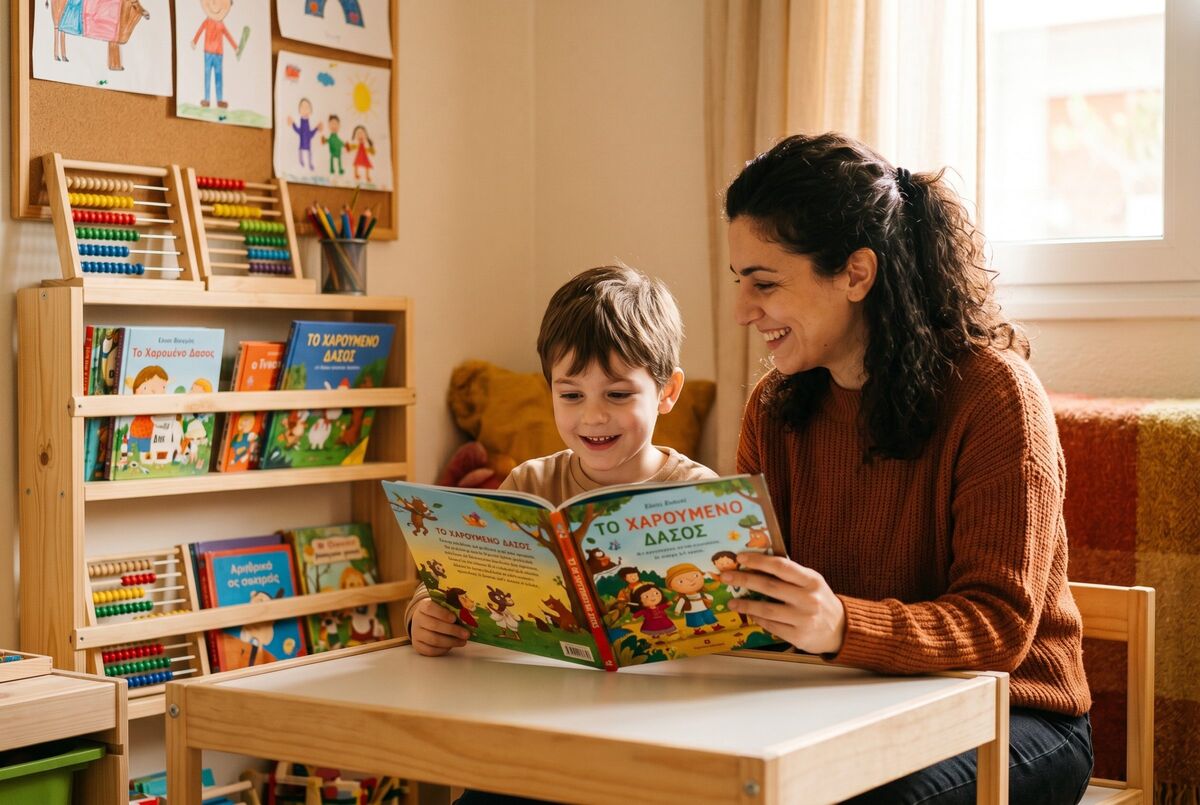
Modern Greek children's literature is strong, with Eugene Trivizas ("The Three Little Wolves and the Big Bad Pig") as the most internationally recognized contemporary author. Tutors lean on bilingual editions of Aesop's fables, Trivizas picture books, and various beautifully illustrated traditional folktales for kids' lessons.
e.g. Τα τρία μικρά λυκάκια και ο κακός χοίρος. (The Three Little Wolves and the Big Bad Pig, Eugene Trivizas.)
About Greek for Kids
Greek for kids, the yiayia way
Teaching Greek to a child sits in a particular cultural context that distinguishes it from teaching most other languages. The Greek-American community has invested heavily in language transmission for over a century, with Greek schools attached to Greek Orthodox parishes across the country running afternoon and Saturday programs for children of Greek heritage. The tradition is real and active: New York's Astoria, Chicago's Greektown, Boston, Tarpon Springs in Florida, and several Los Angeles neighborhoods all have multi-generational Greek-school traditions that have produced multiple waves of Greek-American children with at least some literacy and conversation in the language. For many heritage families, private tutoring fits alongside or as an alternative to Greek school depending on the family's specific situation. Some kids attend Greek school for the community and add a private tutor for individual attention. Some families chose not to attend Greek school for logistical or denominational reasons and rely on a tutor for the language transmission. Some kids attend Greek school and need supplemental support to keep up with the curriculum. Strommen has tutors who fit all of these arrangements.
The families who come to Strommen for kids' Greek split roughly into a few groups. The largest is Greek-American heritage families, often with one or two Greek-immigrant grandparents who speak Greek at home and who want their grandchildren to maintain the language as a real conversational link. Right behind them are second or third-generation Greek-American families whose own Greek faded after childhood and who want their kids to reach further than they did. A smaller but consistent group is mixed-heritage families with one Greek parent and one non-Greek parent, where the Greek parent often has fluent but unstructured spoken Greek and wants formal lessons to fill in the literacy and grammar pieces. We see relocation families moving to Greece or Cyprus for work or family reasons, usually on a one-to-three-year timeline, who want the child to walk into a Greek school environment with some Greek already in place. And occasionally non-heritage families who chose Greek for cultural reasons round out the roster.
The pedagogy for kids' Greek has its own established shape, shaped substantially by the Greek-school curriculum tradition. Younger children (ages 4 to 7) learn through song, repetition, story, and physical activity rather than through grammar explanation. The Greek alphabet song that Greek kindergarteners learn is a real teaching tool, with multiple melodic versions in circulation. Picture books work well at this age, and the canon includes Eugene Trivizas (the most widely translated contemporary Greek children's author, whose "The Three Little Wolves and the Big Bad Pig" turned up in English bookstores worldwide), Alki Zei's children's work, and the various beautifully illustrated bilingual editions of Aesop's fables that pair Greek text with English translations. Tutors working with this age usually have a small library of bilingual or vocalized books they work from, and they hold a child's attention through variety: 10 minutes of letter practice, 10 minutes of song, 10 minutes of conversation game, 10 minutes of story. The hour-long structured lesson is not realistic and not useful for this age.
Elementary-school children (ages 8 to 11) can handle longer lessons, basic conversation, real reading drills, and the beginnings of formal grammar. This is also the age at which most Greek-school students start working seriously on the alphabet, on basic verb conjugation, and on the religious vocabulary that anchors the holiday cycle of the Greek Orthodox liturgical year. Tutors weave the religious vocabulary into the broader language work rather than treating it as separate, so a heritage child meets Christmas (Χριστούγεννα, Christougenna), Easter (Πάσχα, Pascha), and the major feast days (Άγιος Δημήτριος, Saint Demetrios; Αγία Ειρήνη, Saint Irene; and so on) as part of the rhythm of the language. The nameday tradition is a particularly rich teaching opportunity: most Greeks are named for an Orthodox saint, and the saint's feast day is the namesake's nameday, often celebrated more than the actual birthday with the phrase χρόνια πολλά (chronia polla, "many years"). Heritage kids learn to call their pappou (grandfather) on his nameday with the right greeting and the right warmth.
Middle-school kids and teens (ages 12 and up) can usually move into more adult-pattern lessons, with explicit grammar work, substantive conversation, and real reading. This is the age at which a heritage child who has stayed with Greek school or private tutoring through elementary years really pulls ahead of a child starting from scratch, and at which a new starter can still make meaningful progress but needs to commit to a longer timeline. Many teen heritage learners are also approaching their bar/bat mitzvah-equivalent in the Greek tradition, which is the Greek Orthodox sacrament of communion preparation and various church involvement milestones rather than a single coming-of-age ceremony. Lessons at this age can support the church-tradition vocabulary alongside conversational and reading work.
For relocation families, the curriculum shifts substantially. A child moving to Athens, Thessaloniki, or any other Greek city to attend a Greek-language school benefits from focused preparatory work on classroom vocabulary, school phrases, and the social language a child needs in a Greek school yard. Tutors with relocation experience can map a three-to-six-month preparation track that gives the child enough Greek to function in the new environment, with the recognition that full immersion in a Greek school will accelerate the language faster than any tutored preparation alone. Most kids walk into a Greek classroom with some preparation in place and reach functional school Greek within a few months of immersion, with private tutoring continuing alongside the school as supplemental support.
The Greek-school tradition itself is worth understanding even for families who do not attend. Greek school typically runs as a Saturday morning program or as an after-school program two or three afternoons a week, hosted by a Greek Orthodox parish, with a curriculum that covers Greek language, Greek history, Greek geography, and Greek Orthodox religious education in age-graded groups. The community piece is substantial. Greek school is where heritage kids meet other heritage kids, where the language environment extends beyond the immediate family, and where the cultural identity gets reinforced by peers. Families that do not attend Greek school sometimes recreate parts of this community through Greek-American organizations, summer camps (Camp Saint Paul, Camp Good Shepherd, and others), youth groups (the Greek Orthodox Youth of America, GOYA), and adult-led cultural activities. Tutors with this context can advise families on how private tutoring fits alongside or complements community engagement.
A practical note on the alphabet and reading. The 24-letter Greek alphabet is genuinely manageable for an elementary-age child with weekly lessons, and most kids reach competent letter recognition within 2 to 3 months. Reading aloud at speed builds across the following year. The Greek stress-accent system is taught alongside the alphabet because every multi-syllable word carries an acute accent that is part of the spelling. Spelling itself is highly regular in Modern Greek, which means a child who learns the sound of each letter can read aloud almost any word after a few months. The harder pieces (the gender system, the cases, the verb conjugations) come gradually and are calibrated to the child's age.
The practical side is uncomplicated. Lessons typically run 30 minutes for ages five to nine, 45 minutes for ages ten to twelve, and an hour for thirteen and fourteen-year-olds. Online lessons over Zoom or Jitsi work well from about age seven. In-person lessons are available across the LA area, with several tutors near neighborhoods that have established Greek-American communities. Parents do not need to sit through every lesson, but a brief review afterward (asking the child what they learned, greeting them in Greek through the day) accelerates retention noticeably. Heritage families often book a trial with a Greek-speaking grandparent listening in via speakerphone or video call, which is both meaningful and pedagogically useful.
Our kids' Greek tutors include Greece-born native speakers with classroom or Greek-school teaching experience, Cyprus-born native speakers, and longtime Greek-American bilinguals who themselves grew up with the language and now teach it to the next generation. Each bio specifies background, regional accent, and the age range each tutor most enjoys. With a young child, the trial lesson is the place to confirm the rapport. The right tutor is the one your kid is excited to see again next week, and the alphabet song they bring home from the first lesson is the one that gets stuck in everybody's head.
What you'll cover
Lessons & classes tailored to Greek for Kids
The alphabet, taught the way kids learn
The 24 letters of the Greek alphabet introduced through song, repetition, and play rather than worksheets. Younger children learn the letters in a sensible reading order, paired with sound values, with tutors flagging the false-friend letters (rho, eta, chi, ypsilon) explicitly. Most kids reach competent letter recognition within 2 to 3 months of weekly lessons. Reading aloud at speed builds across the following year.
Heritage conversation and family-call practice
For Greek-American heritage families, the priority is usually the conversation the child needs to have with grandparents and extended family. Tutors build family-call vocabulary deliberately: kinship terms, holiday greetings, food words, school and daily-life vocabulary. Many heritage children move from passive listening to active speaking on family calls within a single semester of regular lessons.
The Greek-school curriculum tradition
Many of our tutors have Greek-school teaching backgrounds and can coordinate with or supplement a child's Greek-school program. For families who do not attend Greek school, the tutor effectively provides the language piece of the Greek-school curriculum on a private lesson schedule. The cultural and religious pieces get woven in through the holiday cycle, namedays, and the picture-book canon.
Relocation preparation when families move to Greece
Families relocating to Athens, Thessaloniki, or another Greek city for a 1-to-3-year timeline get focused preparation on classroom vocabulary, school phrases, and the social language a child needs in a Greek school. Most kids walk into a Greek classroom with some preparation in place and reach functional school Greek within a few months of immersion, with private tutoring continuing alongside the school.
FAQ
About Greek for Kids lessons & classes
What age can kids start Greek lessons?
Most tutors take students from around age 5 or 6, when a child can sit through a 30-minute lesson and is starting to read in their primary language. Younger kids (3 to 5) can do introductory Greek through song, color words, and simple greetings, but structured lessons usually wait until kindergarten or first grade. Older kids and teens can start at any age. The trial lesson is where the tutor assesses whether a particular child is ready.
My child attends Greek school. Why add private tutoring?
Greek school is a group setting with limited individual attention, and many kids benefit from extra one-on-one support to keep up with the curriculum. Private tutoring is also useful when a child is ahead of the group and bored, when the family wants more reading and grammar focus than the Greek-school cadence provides, or when the family lives too far from a Greek school to attend regularly. Tutors typically coordinate with what the Greek school is teaching rather than running a parallel curriculum, so the two reinforce each other.
We are not part of a Greek Orthodox parish. Can my child still learn Greek?
Yes. Greek language and Greek Orthodox tradition are tightly linked culturally, but the language itself is teachable in any family context. Tutors calibrate the cultural framing to your family's situation. Heritage families with a secular orientation, mixed-heritage families with a non-Greek parent, and non-Greek families who chose Greek for other reasons all have a place on our roster. The holiday and saint-day vocabulary gets framed as cultural literacy rather than religious instruction for families that prefer that approach.
How long should a Greek lesson be for a young child?
Thirty minutes is the typical sweet spot for ages 5 to 9. Forty-five minutes works for ages 10 to 12. A full hour fits most thirteen and fourteen-year-olds. Shorter, more frequent sessions almost always outperform a single longer weekly lesson at the younger end, both for retention and for keeping the child looking forward to the next session.
Will my child get confused between Greek and English?
Some mixing in the first months is normal and self-correcting. Bilingual kids briefly use both languages in the same sentence as they sort out which words belong to which language, and the pattern fades on its own as both languages develop. A tutor who is consistently Greek during lessons gives the child a clean environment without disturbing English at all.
We are moving to Greece next year. Can lessons get my child ready for school?
Yes, and this is a common request. Tutors run a relocation-specific track that focuses on the practical school vocabulary, classroom phrases, and social language a child needs in a Greek school. Most kids walk into a Greek first or second grade with enough Greek to function within a few weeks once they are in the immersion environment. The preparation work makes the first month dramatically less stressful and the long-term outcome substantially stronger.
Are online Greek lessons effective for kids?
Yes, from about age seven. Younger than that, in-person tends to hold attention better because the tutor can use physical books, props, and movement. For elementary-age and older kids, online lessons via Zoom or Jitsi work well, and a parent does not need to sit through the lesson. Heritage families often arrange for a Greek-speaking grandparent to listen in via speakerphone or video call, which is both meaningful and pedagogically useful.
Are your kids' Greek tutors native speakers?
Most are Greece-born or Cyprus-born native speakers with classroom or Greek-school teaching experience. A few are longtime Greek-American bilinguals raising their own children with the language. Each bio specifies background, regional accent, and the age range each tutor most enjoys.
Ready for Greek for Kids lessons or classes?
Book a free 30-minute trial with one of our personally vetted tutors. Private lessons or small-group classes — your choice.