



Personally vetted instructors
Turkish for Kids tutors, lessons & classes
Merhaba! The standard friendly hello a Turkish teacher uses with a child arriving for class.
Personally vetted Turkish tutors who teach children. Lessons built around picture books, the Children's Day national holiday, and the wonderfully regular grammar that rewards a kid's brain for spotting patterns.
Your instructors
Turkish for Kids tutors for private lessons & classes
Strommen has been teaching languages since 2006, and we vet every teacher ourselves rather than running an open marketplace. Our Turkish roster is small and curated, with several tutors who specifically work with heritage children and a few who teach Turkish from scratch.
Filter by location, age, or price, then book a 30-minute free trial. The trial is also a chance for the child to meet the tutor; rapport is usually obvious within ten minutes.
Below are the Strommen tutors who teach Turkish to children. Photos, ratings, and rates are real. Click any card to read a bio and book a free 30-minute trial.
I want to learn…
Every tutor, personally met. — founder-vetted since 2006, in Los Angeles and online worldwide.
Get a personalized plan
Pick your language — a language advisor will match you with the right tutor and map out your path.


I have a Master's degree in Communication Sciences
From Amsterdam's Heart to Global Fluency, Eser Offers Experience-Driven Coaching!
Specialties
I have a Master's degree in Communication Sciences
From Amsterdam's Heart to Global Fluency, Eser Offers Experience-Driven Coaching!
Specialties

The Department of Turkish Language and Literature:Bachelor's & Master's DegreePhD (Ongoing)
Learn Turkish with Me! Friendly professional teacher.
Personally vetted · Strommen’s note
Osman teaches Turkish with what he calls the 'Eclectic Method,' eight or nine years of figuring out that no two students need the same one.
Specialties
The Department of Turkish Language and Literature:Bachelor's & Master's DegreePhD (Ongoing)
Learn Turkish with Me! Friendly professional teacher.
Specialties
Personally vetted · Strommen’s note
Osman teaches Turkish with what he calls the 'Eclectic Method,' eight or nine years of figuring out that no two students need the same one.
Çocuklar — Turkish the way kids learn it
5 things every Turkish-learning kid encounters early
These are the building blocks Turkish children grow up with. Save the list and book a tutor to build a lesson around them.
-
01
23 Nisan
April 23rd, National Sovereignty and Children's Day. The only children's day in the world established by a country's founder; Atatürk dedicated it to children in 1920. Turkish kids fill parliament for a day, host the president, march in parades, and recite poems. A spring unit on 23 Nisan is a fixture in any kids' Turkish program.
e.g. 23 Nisan Ulusal Egemenlik ve Çocuk Bayramı kutlu olsun. ("Happy 23 Nisan, National Sovereignty and Children's Day.")
-
02
-cik / -ciğim (the warmth suffix)
Turkish builds affection into everyday speech by attaching diminutive endings to nouns. Anneciğim (my dear little mother), babacığım (my dear little father), and a child's own name becomes Aliciğim or Ayşeciğim. The suffix is the audible signature of Turkish family talk, and a child who uses it sounds instantly more grounded in real Turkish.
e.g. Anneciğim, yardım eder misin? ("Dear mom, can you help?")
-
03
Keloğlan
The classic Turkish folk character. A clever bald-headed boy who outwits giants and dragons across a centuries-old story cycle. Every Turkish child grows up with Keloğlan, and the stories work as a kids' Turkish reading text because the vocabulary is age-graded across the cycle and the storytelling holds attention. Contemporary illustrated editions are widely available.
e.g. Keloğlan dev ile karşılaştı. ("Keloğlan met the giant.")
-
04
Daha Dün Annemizin
The alphabet-song equivalent that Turkish kids sing through all 29 letters of the modern alphabet. The melody locks the letter order into a child's ear, and tutors use it as the first reading anchor for younger kids. Mini Mini Bir Kuş and Portakalı Soydum are other nursery-song regulars from the same canon.
e.g. Daha dün annemizin kollarında yaşarken... (Opening line of the alphabet song.)
-
05
Şeker Bayramı
The sweet-tasting end of Ramadan, also called Eid al-Fitr. Children go door to door receiving candy and small gifts from neighbors, the Turkish version of a holiday that combines aspects of Halloween and Christmas in terms of how kids experience it. Tutors run a unit on Şeker Bayramı each year covering the vocabulary, the greetings, and the customs.
e.g. Bayramınız mübarek olsun. ("May your holiday be blessed.")
About Turkish for Kids
Turkish for kids, with the country that invented Children's Day
Turkish is one of the more rewarding languages for a child to learn because the grammar is structured the way a kid's brain likes structure. Words build by sticking suffixes onto a root, and the suffixes follow vowel-harmony rules a child internalizes within a few months of regular lessons. There are essentially no irregularities to memorize. There are no grammatical genders. The verbs conjugate by adding endings in a consistent pattern. A child who would have struggled with the irregular verbs of French or the gender system of German often finds Turkish unexpectedly clean. Reading is the easy part too; the modern Turkish alphabet adopted in 1928 is fully phonetic, with 29 letters that each map to a single sound, and kids reach automatic reading inside a few months.
Most of the families who come to Strommen for kids' Turkish are Turkish-American heritage families, often in their second generation, and the goal is almost always for the child to have real conversations with grandparents and cousins in Turkey rather than the half-English mix that creeps in by elementary school. A few families are not Turkish but have chosen the language for cultural or relocation reasons. Heritage children arrive with strong listening comprehension and a small spoken vocabulary, so the work is about activating production and adding the script. From-scratch children build all four skills from the ground up.
One thing every Turkish kids' program leans into is the country's unusual relationship with childhood. April 23rd is 23 Nisan, the National Sovereignty and Children's Day, a holiday Atatürk dedicated specifically to children in 1920. It is the only national children's day in the world established by a country's founder, and Turkey makes a big deal of it. Children fill parliament for a day, host the president, march in parades, and recite poems. Tutors run a spring unit on 23 Nisan every year, covering the vocabulary, the songs, the famous Atatürk quotes about children, and the history. Heritage kids especially love this unit because it gives them something concrete to share with American friends. The other annual cultural unit most tutors run is around Şeker Bayramı, the sweet-tasting end of Ramadan when children go door to door receiving candy and small gifts from neighbors.
Vocabulary for younger kids leans on the warmth Turkish builds into family talk. Kinship words come with affectionate suffixes; a grandmother is anne (mother) but also anneciğim (my dear little mother) with the diminutive endings -cik and -ciğim that turn any noun warmer. A child saying anneciğim or babacığım to their parents sounds instantly more grounded in real Turkish. The same suffix attaches to friends, pets, and favorite things. A tutor folds these into the lesson naturally so the child learns the language as a culturally warm one rather than as a flat list of words.
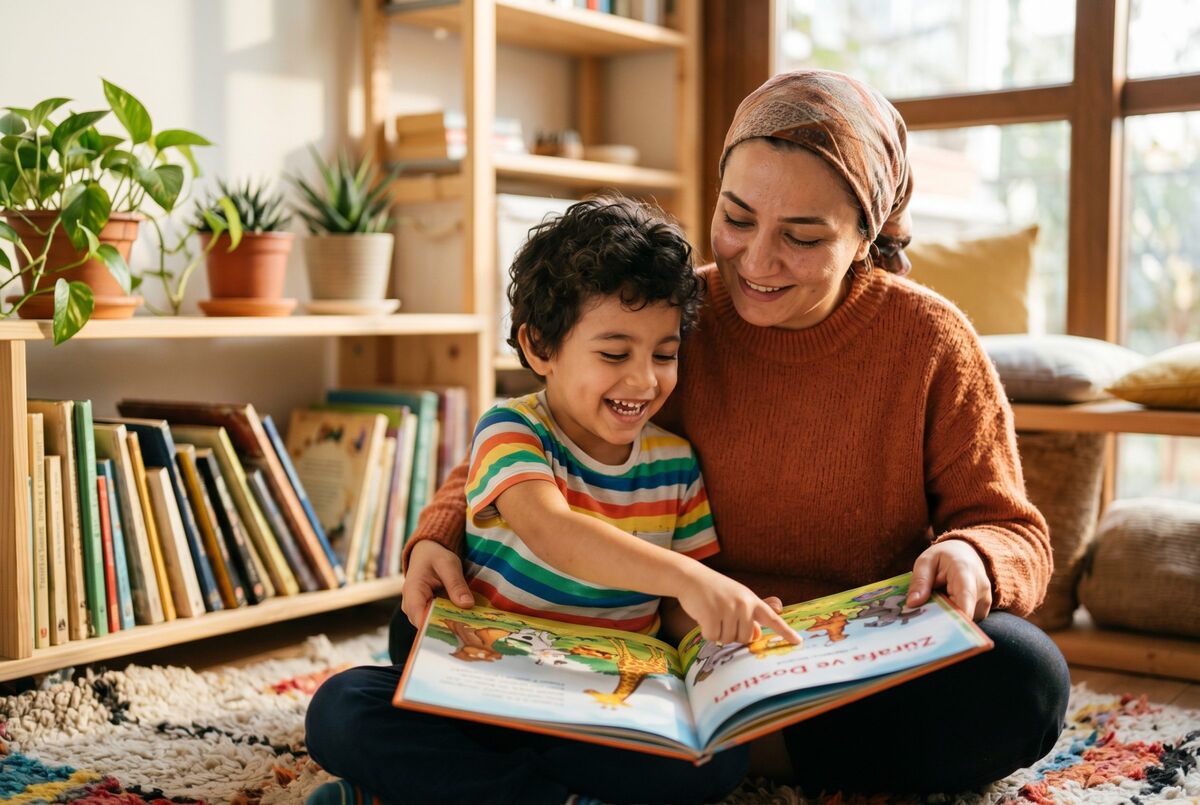
Picture books in Turkish have a deep tradition. The Keloğlan stories, a centuries-old folk-character cycle about a clever bald-headed boy who outwits giants and dragons, are the closest equivalent to a Turkish Pippi or Curious George; every Turkish child grows up with Keloğlan. The works of Nasrettin Hoca, the legendary trickster figure with his short comic anecdotes, are read aloud in Turkish kindergartens across the country, and the humor lands at a level a six-year-old can appreciate. Contemporary children's authors like Aytül Akal and Behiç Ak have a steady output of picture books at all reading levels. A tutor working with younger kids keeps a small library and reads aloud with expression, modeling the natural rhythm of Turkish in a way no app can manage.
Songs are the other reliable channel into a young learner's memory. "Daha Dün Annemizin" (Just Yesterday, Our Mother's), the alphabet-song equivalent that Turkish kids sing through 29 letters, is most lessons' starting song. "Mini Mini Bir Kuş" (A Tiny Tiny Bird) and "Portakalı Soydum" are nursery-rhyme regulars. The seasonal songs cycle through with the weather. Tutors who sing along, even imperfectly, give the lesson a quality that an academic class cannot.
Older kids (twelve to fourteen) can move into more substantive territory: Turkish pop music, the kid-friendly Yeşilçam film canon, and short reading from the YA shelf. This is also the age at which a child can start working toward real conversational goals if the family is heritage-focused, and at which a relocating child can prepare for school in Turkey. Turkish does not have a kids-level standardized test the way some languages do, so most kid programs stay credential-free and focus on building real-life capability.
Logistics are straightforward. Lessons typically run 30 minutes for ages five to nine, 45 minutes for ages ten to twelve, and an hour for the older end of the range. Online lessons over Zoom or Jitsi work well from about age seven, and in-person lessons are available around LA. Heritage families sometimes arrange for a grandparent in Turkey to listen in over speakerphone, which is both lovely and pedagogically useful because the child practices Turkish with a real native ear in the same hour they are learning it.
Our kids' Turkish tutors include Turkey-born native speakers with classroom experience, longtime Turkish-American bilinguals who specialize in heritage learners, and a few tutors trained specifically in pediatric language acquisition. Each bio specifies background and teaching style. The trial lesson is the place to confirm the rapport; with a young child, the right tutor is the one the kid wants to see again next week.
What you'll cover
Lessons & classes tailored to Turkish for Kids
The 29-letter alphabet through games
Early lessons teach the modern Turkish alphabet via memory games, songs, and short tracing drills rather than worksheets. Children reach automatic reading inside a few months because Turkish spelling is fully phonetic; each letter maps to exactly one sound. The 'Daha Dün Annemizin' alphabet song carries the letter order and most tutors loop it weekly for younger kids.
Vowel harmony, suffixes, and pattern-spotting
Turkish grammar is famously regular. Words build by sticking suffixes onto a root, and the suffixes follow vowel-harmony rules a child internalizes within a few months. There are no grammatical genders and essentially no irregularities. For kids who like spotting patterns, Turkish often clicks faster than European languages. Our general Turkish tutors page covers the adult-track equivalent.
Heritage conversation and family calls
For Turkish-American families, the priority is usually the conversation the child needs to have with grandparents and cousins in Turkey. Tutors build family-call vocabulary deliberately: kinship terms, holiday words, food words, and the everyday phrases that come up in a video call. Heritage children typically move from passive listening to active speaking on family calls in a single semester of regular lessons.
23 Nisan, Şeker Bayramı, and the cultural cycle
A school-year arc cycles through the major Turkish cultural moments. The 23 Nisan Children's Day unit in spring, the Şeker Bayramı candy-and-visit unit at the end of Ramadan, the Cumhuriyet Bayramı (Republic Day) unit on October 29th, and the seasonal songs across the year. Vocabulary, songs, and short stories anchor each, and the child grows up able to participate in family celebrations rather than watching from outside.
FAQ
About Turkish for Kids lessons & classes
Is Turkish hard for an English-speaking child to learn?
It looks intimidating at first glance because the writing system is different from English in feel even though it uses Latin letters, but the actual grammar is one of the most regular in the world. No genders, no irregular verbs, fully phonetic spelling. Kids who like patterns often find Turkish unexpectedly easy. The trickiest piece is vowel harmony, which takes a few months of regular exposure to internalize.
My child understands Turkish at home but won't speak it. Can a tutor help?
Yes, and this is one of the most common reasons heritage families book lessons. The pattern of strong receptive Turkish and weak productive Turkish is normal in second-generation kids, and the fix is structured practice with a tutor who is not a family member. Tutors trained on heritage learners spend the first few months activating the speaking the child already has stored, then build out vocabulary and grammar from there.
What age can my child start learning the Turkish alphabet?
Most kids are ready for letter work around age six, once they have a few months of spoken Turkish behind them. The modern Turkish alphabet has 29 phonetic letters and a kid who knows the sound of each letter can read aloud almost any word inside a few months. Younger kids can recognize a small set of high-image letters before they read them as language.
Will my child get confused between Turkish and English?
No. Bilingual kids develop both languages fully and often gain a small cognitive edge on certain measures by elementary school. Some mixing of words in the first months is normal and self-corrects on its own as both languages develop. A tutor who is consistently Turkish during lessons gives the child a clean second-language environment.
How long should a Turkish lesson be for a young child?
Thirty minutes is the sweet spot for ages five to nine. Forty-five minutes works for ages ten to twelve. A full hour fits most thirteen and fourteen-year-olds. Shorter, more frequent sessions outperform a single longer weekly lesson at the younger end, both for retention and for keeping the child looking forward to the next session.
Are online Turkish lessons effective for kids?
Yes, from about age seven. Younger than that, in-person tends to hold attention better because the tutor can use physical books, props, and movement. For elementary-age and older kids, online lessons via Zoom or Jitsi work well, and a parent does not need to sit through the lesson.
Are your kids' Turkish tutors native speakers?
Most are Turkey-born native speakers with classroom or private-teaching experience. A few are longtime Turkish-American bilinguals who specialize in heritage learners. Each bio specifies background and teaching style so you can match to a tutor whose approach fits your child.
Ready for Turkish for Kids lessons or classes?
Book a free 30-minute trial with one of our personally vetted tutors. Private lessons or small-group classes — your choice.