



Personally vetted instructors
Conversational Turkish tutors, lessons & classes
Merhaba! The everyday Turkish hello, friendly and safe across any context.
Personally vetted Conversational Turkish tutors. Lessons grounded in the Turkish people actually use in Istanbul, Ankara, Izmir, and across the wider Turkish-speaking world.
Your instructors
Conversational Turkish tutors for private lessons & classes
Strommen has placed Turkish tutors for years, and the steady ask has always been conversational fluency rather than certificate prep. Strommen is a curated practice rather than an open marketplace, so every teacher below was met and vetted by us. Bios are the tutors' own.
Filter by location, age, or price. Then book a free 30-minute trial and tell the tutor where in Turkey your interest sits or which family register you are working toward.
Below are the Strommen tutors who specialize in Conversational Turkish. Photos, ratings, and rates are real. Click any card to read a bio and book a free 30-minute trial.
I want to learn…
Every tutor, personally met. — founder-vetted since 2006, in Los Angeles and online worldwide.
Get a personalized plan
Pick your language — a language advisor will match you with the right tutor and map out your path.


I have a Master's degree in Communication Sciences
From Amsterdam's Heart to Global Fluency, Eser Offers Experience-Driven Coaching!
Specialties
I have a Master's degree in Communication Sciences
From Amsterdam's Heart to Global Fluency, Eser Offers Experience-Driven Coaching!
Specialties

The Department of Turkish Language and Literature:Bachelor's & Master's DegreePhD (Ongoing)
Learn Turkish with Me! Friendly professional teacher.
Personally vetted · Strommen’s note
Osman teaches Turkish with what he calls the 'Eclectic Method,' eight or nine years of figuring out that no two students need the same one.
Specialties
The Department of Turkish Language and Literature:Bachelor's & Master's DegreePhD (Ongoing)
Learn Turkish with Me! Friendly professional teacher.
Specialties
Personally vetted · Strommen’s note
Osman teaches Turkish with what he calls the 'Eclectic Method,' eight or nine years of figuring out that no two students need the same one.
Günlük Türkçe — daily Turkish
5 things that mark Turkish you actually hear
These are not vocabulary items. They are the cues that separate someone who has been around Turks from one who has only worked through a course. Save the list. Then book a tutor to drill them in real conversation.
-
01
Hoş geldiniz / Hoş bulduk
The hospitality exchange that opens almost any arrival. Hoş geldiniz literally means "you came pleasantly" (welcome). The expected response is hoş bulduk, "we found it pleasantly," which is not a phrase any beginner course teaches as a unit but which every Turk uses without thinking. A learner who answers hoş geldiniz with a simple teşekkürler reads as someone who has not yet absorbed the rhythm. Saying hoş bulduk back marks calibration immediately.
e.g. Walking into a friend's home: Hoş geldiniz! Hoş bulduk.
-
02
Suffix chains
Turkish builds meaning by stacking suffixes onto a root. Geliyorum (I am coming), gelemiyorum (I cannot come), gelemeyeceğim (I will not be able to come). Each layer of meaning is its own suffix added to the same root verb gel-. The system is the deepest feature of Turkish grammar, and the place where beginner students are most tempted to disengage. A conversational tutor drills the most-used suffixes through dialogue rather than charts so the chains become automatic.
e.g. Türkçe öğreniyorum (I am learning Turkish) → Türkçe öğrenebilirim (I can learn Turkish) → Türkçe öğrenemedim (I could not learn Turkish).
-
03
Abi, abla, amca, teyze
Family-respect terms extended into everyday social space. Abi (older brother) and abla (older sister) are used freely with any peer-aged person you are warm with. Amca (uncle) and teyze (aunt) cover the parent-generation in the same way. The bakkal owner is amca, the simit-cart woman is teyze. Filipinos, Koreans, and Turks all do this; a learner who only uses first names reads as someone still translating from English.
e.g. Abi, bir çay daha alabilir miyim? ("Older brother, can I get one more tea?")
-
04
Çay culture
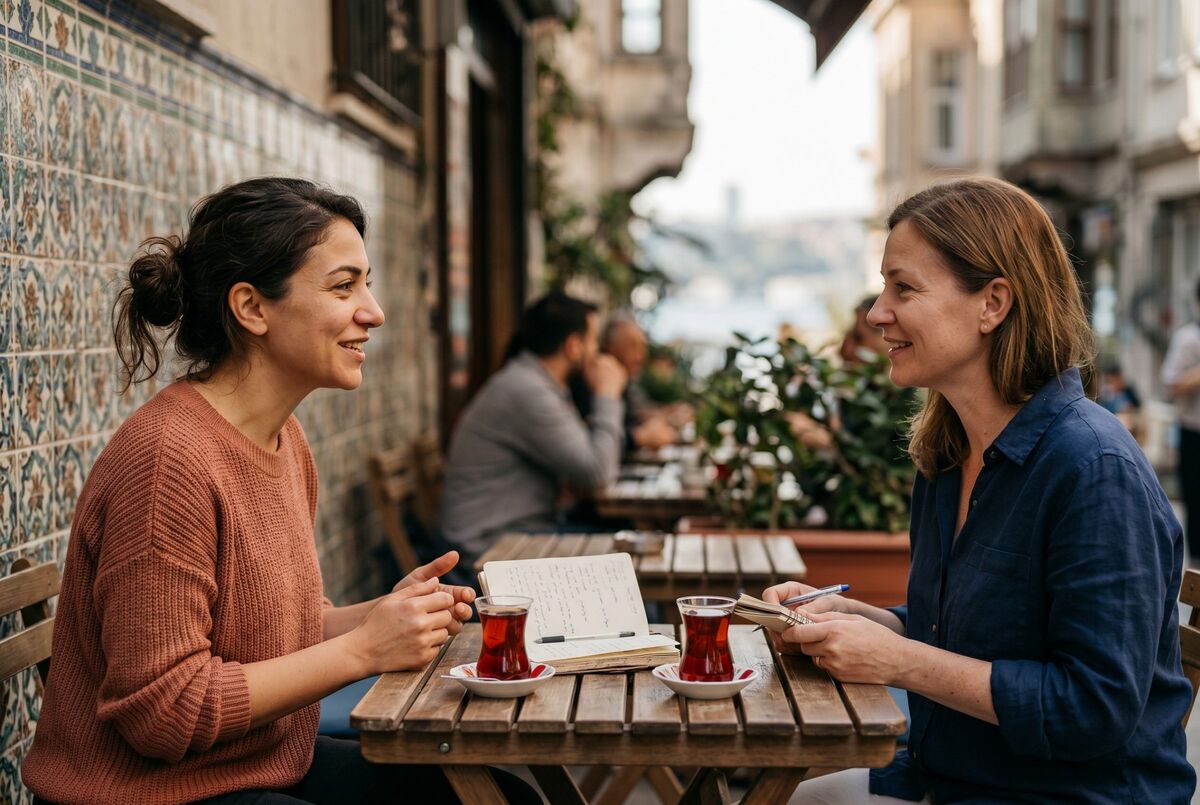
Tea is not a drink in Turkey, it is the social ritual that frames almost every conversation. Çay arrives unbidden in offices, shops, and homes; refusing it is a small social move that needs to be done warmly rather than briskly. Knowing how to accept, how to say afiyet olsun, and how to thank the host with eline sağlık ("health to your hand") is part of conversational fluency. A tutor folds these phrases in from week one.
e.g. Bir çay içer misiniz? Tabii, çok teşekkürler. ("Will you have a tea?" "Of course, thank you very much.")
-
05
Vowel harmony
Turkish vowels divide into front and back groups, and suffixes pick their vowel to match the root word. The plural suffix is -ler after front vowels (evler, houses) and -lar after back vowels (kitaplar, books). Once a learner internalizes the pattern it becomes automatic, and it gives Turkish a musical regularity that students often comment on. Working tutors drill it until the wrong vowel literally sounds wrong.
e.g. Ev → evler (houses), but kitap → kitaplar (books). The suffix vowel mirrors the root vowel.
About Conversational Turkish
Turkish is not Arabic, and it does not work anything like it
The single most useful thing to settle before the first Turkish lesson is what Turkish is not. It is not Arabic. Despite a long Ottoman history with Arabic loanwords and a religious culture that overlaps with the Arabic-speaking Muslim world, Turkish belongs to a completely different language family (Turkic) and works in a completely different way. The grammar is agglutinative: meaning gets built by stacking suffixes onto a root word. Vowels follow harmony rules that govern which suffix is added. The script has been Latin since Atatürk's 1928 reform, with eight extra letters layered in. A student who arrives expecting Turkish to behave like Arabic is in for a surprise and usually a happy one. Turkish reads phonetically, spells almost exactly how it sounds, and has no grammatical gender, no articles, and no irregular verbs to memorize. The complexity lives somewhere else entirely.
Where it lives is the suffix chain. Turkish words can grow long, sometimes amusingly so. The textbook curiosity case is Çekoslovakyalılaştıramadıklarımızdanmışsınız ("apparently you are one of those whom we could not Czechoslovakify"), which no one says in real life but which captures how the system works. Real spoken Turkish stays shorter, but the principle is the same: roots take stacks of suffixes that carry tense, person, mood, modality, evidentiality, and case. Geliyorum means "I am coming." Gelemiyorum means "I cannot come." Gelemeyeceğim means "I will not be able to come." Each layer of meaning is a separate suffix added to the same root verb gel-. Once the system clicks, Turkish sentences become elegant and economical. Until it clicks, lessons sequence the suffixes that show up most often first and drill the chains through real dialogue rather than tables.
Vowel harmony is the other piece a learner runs into within the first week. Turkish vowels divide into front and back groups, and rounded and unrounded. The vowel in a suffix has to match the vowel in the root word according to harmony rules. The plural suffix is -ler after front vowels (evler, "houses") and -lar after back vowels (kitaplar, "books"). Once a student internalizes the pattern, vowel harmony becomes automatic and gives Turkish a musical quality that learners often comment on. Working tutors do not present harmony as a chart to memorize; they drill it in real words until the wrong vowel literally sounds wrong to the student's ear.
The culture around Turkish hospitality runs straight through how people speak. Turks have a famously dense hospitality script that starts before guests have taken off their shoes. The phrase hoş geldiniz ("welcome," literally "you came pleasantly") gets a near-mandatory response of hoş bulduk ("we found it pleasantly"). Tea, çay, is more than a drink: it is the social ritual that frames almost any conversation, business or personal. Lokum, Turkish delight, comes out before food and after coffee, and refusing it is something a learner needs to do warmly rather than directly. The afiyet olsun said before someone eats, the eline sağlık ("health to your hand") said after, and the elinize sağlık in the formal-plural version when said to an elder or a host, are not optional politeness, they are how the meal is framed. A conversational tutor weaves these in from week one because pretending they are decorative makes a learner's Turkish read as flat and foreign.
The age-and-respect register is the other layer. Abi (older brother) and abla (older sister) extend outward from family into any close relationship with an older male or female peer. The bakkal (corner store) owner is amca (uncle), the older woman who runs the simit cart is teyze (aunt). Filipino-style and Korean-style age-relative terms find a parallel here, and a learner who refers to people only by name reads as someone still translating from English. The polite plural pronoun siz governs most adult conversation with anyone you do not know well, and Turks shift from sen to siz with each other based on age, context, and how well they know the person. American learners, used to first-name informality as a sign of warmth, often want to skip past siz and have to be slowed down. Warmth in Turkish lives inside the polite register, not by abandoning it.
There is also the layer of Atatürk-era language reform that any conversational learner runs into. Turkish underwent a deliberate purge of Persian and Arabic loanwords starting in the 1930s, with new vocabulary coined from Turkic roots to replace them. The reform was partial: many Arabic and Persian words survived, especially in older speakers and in literary or religious contexts. The result is that modern Turkish has parallel vocabulary in many areas, and the choice of word can mark a speaker as older or younger, more secular or more religious, urban or rural. Cevap (Arabic-origin, "answer") and yanıt (Turkic-origin, same meaning) both work, but they carry different registers. A working tutor names these choices as they come up rather than pretending Turkish is one undifferentiated vocabulary.
Most students who come to Conversational Turkish fall into recognizable groups. Heritage Turks in the United States, Germany, or the Netherlands reactivating dormant family language. Partners and spouses of Turks preparing for in-law family contexts. Researchers and journalists with Turkey-focused work. Travelers planning long trips through Istanbul, Cappadocia, the Aegean, or the Black Sea coast who want to do more than survive in English. Business travelers heading to Istanbul or Ankara for work. Adoptees reconnecting as adults. Music and television fans who arrived at the language through Sezen Aksu, Tarkan, or the global wave of Turkish drama. Each group has a different starting point, and a working tutor adjusts the plan accordingly.
Our Conversational Turkish tutors are native and longtime bilingual speakers, several from Istanbul, several from Ankara and the Aegean, and several with serious experience teaching adult beginners and heritage learners. They calibrate at the trial, build a lesson plan around your actual goal, and update the plan as you progress. Bios on each tutor's profile tell you where they are from and what kind of student they have moved the furthest. The full Strommen tutor directory shows the wider roster if you want to compare options first.
What you'll cover
Lessons & classes tailored to Conversational Turkish
Suffix chains, built into real sentences
Turkish builds meaning by stacking suffixes onto a root, and the system is the heart of the grammar. Lessons sequence the most-used suffixes first (present tense, past, future, ability, negation, plural, possessive) and drill the chains through dialogue rather than tables. Once the reflex is in place, students stop thinking suffix-by-suffix and start producing the chains automatically. The reward is elegant, economical Turkish sentences that read as fluent rather than translated.
Vowel harmony as a reflex
Vowel harmony is the rule that makes Turkish sound musical and that catches beginners off guard. Lessons present it not as a chart to memorize but as a feel: the wrong vowel sounds wrong, and the drill is to build the ear that catches it. Within a few weeks of consistent practice, students stop having to think about which suffix vowel to pick. The system becomes invisible the way native speakers experience it.
Hospitality scripts and the polite register
Turkish hospitality runs through Turkish speech in concrete ways: hoş geldiniz answered with hoş bulduk, çay framing every conversation, afiyet olsun and eline sağlık around meals, lokum at the right moment. Lessons fold these in alongside vocabulary because the social cues are the language. Students preparing for in-law family contexts or business travel get extra time on the polite register (siz vs sen) and on the diplomatic phrasing that frames awkward moments warmly rather than abruptly.
Modern Turkish vocabulary, with register awareness
The Atatürk-era language reform left modern Turkish with parallel vocabulary in many areas: cevap and yanıt both mean "answer," with different registers and different speaker associations. Lessons name these choices as they come up rather than pretending Turkish is one undifferentiated lexicon. Students working with older Turkish speakers, religious contexts, or literary texts get pointed toward the older Arabic-and-Persian-derived words; students working with younger urban speakers stay closer to the Turkic-derived reform vocabulary. For a fuller introduction to the family of languages Turkish belongs to, our blog post on the Turkic language family is a useful starting point (blog post not yet published).
FAQ
About Conversational Turkish lessons & classes
Is Turkish related to Arabic?
Not at all. Turkish is a Turkic language, in a completely different family from Arabic, which is Semitic. The grammar works differently, the script has been Latin since the 1928 reform, and the underlying logic of word formation is agglutinative rather than root-and-pattern. The two languages share a long history of cultural and religious contact, which left a layer of Arabic loanwords in older Turkish vocabulary, but the languages themselves are unrelated. A student who already speaks Arabic gets very little structural help with Turkish.
How hard is Turkish for an English speaker?
Moderate. The phonetics are clean, the spelling is regular (Turkish reads almost exactly how it is written), there is no grammatical gender, no articles, and almost no irregular verbs. The challenging piece is the agglutinative grammar: stacking suffixes onto roots to build complex meanings, with vowel harmony governing the suffix forms. The system takes time to internalize and pays off once it does. Most committed adult students reach conversational comfort in eight to fourteen months at one or two lessons a week with steady practice in between.
How long until I can actually have a conversation in Turkish?
Depends on what counts. Holding a basic cafe or market exchange comes within two or three months of consistent lessons. Holding a relaxed ten-minute conversation about your day, your work, and your family takes longer, typically six to nine months for an adult starting from beginner. Following native speakers at full speed is later still. Your tutor sets concrete weekly targets at the trial lesson and adjusts based on what is working.
Are your Conversational Turkish tutors native speakers?
Most are native speakers, several from Istanbul, several from Ankara and the Aegean, and several with serious experience teaching adult beginners and heritage learners. A few are longtime bilingual teachers who lived in Turkey for years and married into Turkish families. Each tutor's bio specifies background, regional grounding, and which kinds of students they have worked with most. For heritage learners reactivating dormant Turkish, several tutors specifically work in that space.
Should I learn the Ottoman Turkish script too?
Only if you have a specific reason. Modern Turkish has been written in the Latin alphabet since the 1928 Atatürk reform, and everything published in the country today uses it. Ottoman Turkish, written in a Perso-Arabic script, is its own academic study and is the right path for researchers working with pre-1928 sources, religious texts, or Ottoman archives. A conversational learner does not need it and adding it would slow down the spoken Turkish work. If the Ottoman side becomes relevant later, a tutor can point you toward the specialists.
Can I take Conversational Turkish lessons online?
Yes. Most of our Conversational Turkish tutors teach online via Zoom or Jitsi and work with students worldwide, which suits this specialty well since the lesson is mostly speaking and listening. A few also teach in person in Los Angeles. The booking widget on each tutor profile shows the available formats and live availability.
I am a heritage speaker who understands but barely speaks. Is this the right specialty?
Often it is. Heritage learners arrive with a strong listening foundation and real vocabulary from family contexts, and what is missing is active speaking, modern register beyond the household, and confidence in unfamiliar situations. A conversational tutor builds on the listening you already have rather than restarting from beginner one, which is much faster than treating you as a new learner. Many heritage students are functional in conversation within a few months of regular practice.
What does a typical Conversational Turkish lesson look like?
Lessons are one-on-one and built around your goal. A session might open with guided conversation in Turkish on a topic you chose, pause for targeted work on a suffix chain or a vowel-harmony issue that surfaced, add a piece of cultural register (a hospitality phrase, a polite-plural cue) when relevant, then close with listening practice on real Turkish audio. No two students get the same plan. The tutor tracks what you actually want to be able to say and works backward from it.
Ready for Conversational Turkish lessons or classes?
Book a free 30-minute trial with one of our personally vetted tutors. Private lessons or small-group classes — your choice.