



Personally vetted instructors
Arabic Dialect Coach tutors, lessons & classes
Min al-sifr From zero, the actor-prep refrain when a role lands cold.
Personally vetted Arabic dialect coaches for actors and voice-over artists. Script-led phonetic and cultural prep across the full regional range of Arabic: Levantine, Egyptian, Maghrebi, Gulf, Iraqi, and MSA, for film, TV, voice, theater, and games.
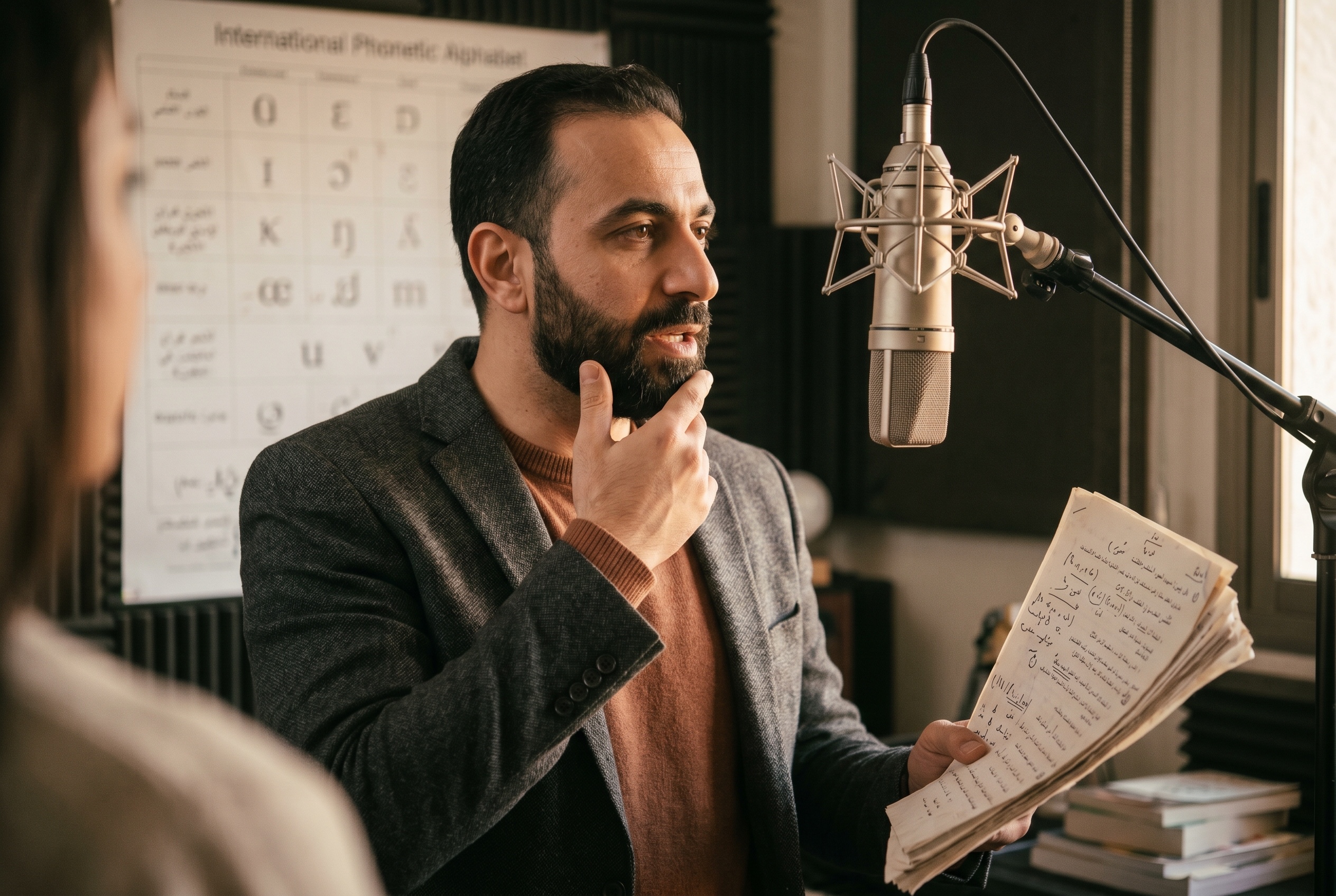
Your instructors
Arabic Dialect Coach tutors for private lessons & classes
Strommen has coached Arabic dialect work for film, TV, theater, and voice productions since the early 2010s, with the roster expanding substantially as international casting has shifted toward authentic Arab and Arab-diaspora representation. Our coaches range from native speakers across the Arabic-speaking world to second-generation heritage coaches and MSA specialists for formal-register work. Every tutor below was met and vetted by us in person or via thorough video interview. No marketplace. No automated profile-creation. Real coaches with real on-set, on-stage, and in-booth credits.
Filter by location, age, or price. Then book a 30-minute free trial.
Below are the Strommen tutors who specialize in Arabic dialect coaching for actors. Photos, ratings, and rates are real. Click any card to read their bio and book a free 30-minute trial.
I want to learn…
Every tutor, personally met. — founder-vetted since 2006, in Los Angeles and online worldwide.
Get a personalized plan
Pick your language — a language advisor will match you with the right tutor and map out your path.



BA in English Literature · TOT , ITM Interactive teaching methodology. BA in English Literature
Step by step to English mastery.
Personally vetted · Strommen’s note
Emad's Arabic dialect range is genuinely enormous: Syrian, Gulf, Levantine, Emirati, Saudi, Moroccan. English is taught step by step alongside it.
Specialties
Also speaks: Copywriting, Spanish, Translation
BA in English Literature · TOT , ITM Interactive teaching methodology. BA in English Literature
Step by step to English mastery.
Specialties
I also speak: Copywriting, Spanish, Translation
Personally vetted · Strommen’s note
Emad's Arabic dialect range is genuinely enormous: Syrian, Gulf, Levantine, Emirati, Saudi, Moroccan. English is taught step by step alongside it.

Fī al-stage — dialect & culture
5 features that separate one Arabic dialect from another
Five phonological and grammatical features, five regional fingerprints. Each is the kind of detail a coach marks up on the first read because each one places the character in a specific country and decade.
-
01
Qaaf (q): /q/ vs /ʔ/ vs /g/
The Classical Arabic q realizes differently across regions. Egyptian and Levantine usually render it as a glottal stop /ʔ/: qalb (heart) sounds as 'alb. Gulf and Bedouin varieties preserve the uvular /q/. Iraqi and some rural Levantine speakers render it as /g/: qultu (I said) becomes gilit. One feature, three regional fingerprints.
e.g. Cairo: <em>'alb</em>. Damascus: <em>'alb</em>. Riyadh: <em>qalb</em>. Baghdad: <em>galb</em>.
-
02
Jīm (j): /ʒ/ vs /g/ vs /dʒ/
The Classical Arabic j sound varies regionally. Cairo Egyptian famously realizes it as /g/ (the signature feature): jamīl (beautiful) sounds as gamīl. Levantine renders it as /ʒ/ as in French jour. MSA and most other regions use /dʒ/ as in English judge. One letter, three sounds, three regional anchors.
e.g. Cairo: <em>gamīl</em>. Beirut: <em>žamīl</em>. Riyadh: <em>jamīl</em>.
-
03
Future tense markers
The future-tense particle differs by region. Egyptian uses ḥa-: ḥarūḥ (I will go). Levantine uses raḥ or laḥ: raḥ rūḥ. Gulf often uses bi- or ba-: barūḥ. MSA uses sa- or sawfa: sa-adhhabu. The wrong marker in a regional dialect line cracks the character's geography.
e.g. Cairo: <em>ḥarūḥ as-sūq</em>. Beirut: <em>raḥ rūḥ ʿas-sūq</em>. Riyadh: <em>barūḥ as-sūq</em>.
-
04
Negation patterns
Egyptian and some Levantine speech use a circumfix negation: mā-prefix plus š-suffix on the verb. mā baʿrafš (I don't know). MSA and Gulf use a simpler particle: lā aʿrif. The circumfix is one of the most audible markers of Egyptian and Palestinian-Lebanese dialect; an actor going for Egyptian who forgets the š reads as MSA-trained immediately.
e.g. Cairo: <em>mā ʿarafš</em>. MSA: <em>lā aʿrif</em>. Riyadh: <em>mā adri</em>.
-
05
Pharyngeals (ʿ, ḥ)
Arabic uses two pharyngeal consonants produced from the back of the throat: ʿayn /ʕ/ (voiced pharyngeal fricative) and ḥā' /ħ/ (voiceless pharyngeal fricative). English has no equivalent sounds. Non-Arab actors typically soften them toward /a/ or /h/, which collapses the consonant. Coaches drill the pharyngeals in isolation first, then in word context, until the throat position is automatic.
e.g. <em>ʿarabī</em> /ʕarabiː/ (Arab/Arabic), <em>ḥubb</em> /ħubb/ (love).
About Arabic Dialect Coach
Arabic is many languages wearing one name
Arabic dialect coaching at Strommen begins with one question the actor's representatives almost never include in the casting note: which Arabic? The casting breakdown will say "Arab character, must speak Arabic credibly," and that's most of what arrives. But the Arabic of a Syrian refugee in 2015 Berlin, a Saudi diplomat in 1980s Riyadh, a Lebanese-American playwright's mother in Brooklyn, a Moroccan rapper in 2020s Casablanca, and an Iraqi engineer in 1990s Basra are not the same language, and a single coach who claims to deliver "Arabic" without specifying the dialect is probably about to teach a stage-Arabic accent that will read as wrong to Arab audiences. The first conversation with a Strommen Arabic dialect coach is about which regional variety the part actually requires, why, and what the production knows or doesn't know about that distinction yet.
The regional landscape covered by the coaching roster. Levantine Arabic (Syria, Lebanon, Palestine, Jordan) for Mediterranean-Arab roles, refugee-narrative drama, Lebanese-diaspora characters, and the prestige Arab cinema (Nadine Labaki's Caramel and Capernaum, Annemarie Jacir's Palestinian work, Cherien Dabis's diaspora films) that Levantine actors have dominated internationally. Egyptian Arabic for the broadest and historically most-recognized variety, owing to Cairo's century-long position as the Arabic film and television capital; Egyptian is the variety most Arab audiences outside Egypt still understand by default from media exposure. Maghrebi Arabic (Morocco, Algeria, Tunisia, Libya) for North African characters, with the substantial Berber and French substrate that differentiates Maghrebi from Eastern varieties; Maghrebi roles have grown significantly in international casting since 2015 with French and Belgian co-productions. Gulf Arabic (Saudi Arabia, UAE, Kuwait, Qatar, Bahrain, Oman) for Khaleeji characters, the rapidly growing Saudi entertainment industry (NEOM, MBC, Telfaz11), and the diplomatic-political prestige roles. Iraqi Arabic as its own variety, distinct from both Levantine and Gulf, for Iraq-set drama, post-2003 war narrative, and the substantial Iraqi diaspora. Modern Standard Arabic (MSA, fuṣḥā) for news-broadcast registers, official-speech contexts, classical poetry recitation, and the formal-political characters where colloquial would read wrong. The roster also covers Yemeni, Sudanese, and Libyan as separate calibrations on a per-project basis.
The phonetic and grammatical distance between Arabic varieties is substantial and audible. Phonology: Egyptian renders the Classical Arabic q as glottal stop /ʔ/ (qalb heart sounds as 'alb); Levantine usually does the same; Gulf preserves /q/ closer to the classical form; Iraqi often realizes q as /g/ (qultu as gilit). The classical j is /ʒ/ in Levantine, /g/ in Egyptian (the famous Cairo g), /j/ in some Gulf varieties, and /dʒ/ in MSA and most other regions. Vowel systems differ in length, quality, and the presence or absence of imāla (the fronting of long /a:/ toward /e:/, characteristic of Lebanese and some Damascene speech). Grammar: pronoun systems vary, verb conjugation patterns vary, the negation particle is la/mā in some varieties and the prefix-suffix combination mā ... š in others, and the future-tense marker is ḥa- in Egyptian, raḥ or laḥ in Levantine, and bi- in some Gulf varieties. Lexicon diverges across thousands of everyday words; kayfa ḥāluk for "how are you" in MSA becomes izzayyak in Egyptian, kīfak in Levantine, šlōnak in Iraqi and Gulf, kī dāyer in Moroccan. None of this is rounding error. Arab audiences hear every line of it.
The craft of script-led dialect coaching has a shape that matches what Strommen does in Italian and Spanish, with one Arabic-specific addition: the coach has to make explicit calibration decisions about diglossia. Arabic exists in a diglossic state where MSA is the formal-written-broadcast register and the regional varieties are the everyday-conversational register, and the script will mix them in ways that have to be parsed before any phonetic work begins. A line of dialogue in a domestic-drama scene almost always uses the colloquial register; a line of broadcast journalism or a political speech moves toward MSA; characters who are educated, religious, or formal in context may code-switch between the two within a single scene. The coach reads the script, identifies which lines sit where on the diglossic spectrum, calibrates the regional dialect for the colloquial passages, and handles the MSA passages separately. This is unique to Arabic among the major languages Strommen covers and is one of the most common things to get wrong in script preparation done by someone outside the coaching tradition.
The heritage-actor calibration is a separate and important conversation. Many actors auditioning for Arabic-speaking roles in the US, UK, and France grew up in Arabic-speaking households and have one regional variety from one generation already, often in the kitchen-register or Friday-prayer-register rather than the professional or media register the role might require. The advantage is real (native phonology, native intonation, cultural fluency on context) but it's not a substitute for the calibration work. A heritage Lebanese actor cast as a 60-year-old Egyptian newspaper editor in 1965 Cairo has the right linguistic foundation but the wrong dialect, the wrong decade, and possibly the wrong professional register. Coaches who understand the heritage-vs-learned distinction work with both, often differently. Heritage actors get coaching that builds out the registers they don't have; non-heritage actors get coaching that builds the dialect from a foundation up.
The Hollywood-Arab role authenticity question is the cultural-and-political layer over all of this. The recent decades of casting have moved toward Arab and Arab-diaspora actors in Arabic-speaking roles, partly in response to the criticism that earlier productions cast Arabic with stereotype rather than craft. Strommen's roster operates inside this evolving standard: coaches who understand the cultural and political stakes, who can advise on what reads as authentic versus stereotyped, who have worked on productions that have faced these questions in development. The coach is also frequently a cultural consultant by default. When the production has questions about whether a costume choice, a gesture, a food reference, or a religious-practice detail will read credibly to Arab audiences, the dialect coach is often the first person on the call sheet who can answer. The trial conversation includes scope for this broader cultural-consulting role when the production wants it.
Observations from coaches on what trips up actors stepping into Arabic dialect work. Defaulting to MSA when the script wants colloquial is the most common error, usually because the actor learned classroom Arabic and assumes that's the register that works on camera; it almost never is for dramatic dialogue. Mixing dialects within a single character's lines is the next most common, usually because the actor didn't know the dialects were different enough to matter. The q versus glottal-stop versus /g/ question catches actors stepping between Egyptian, Levantine, and Iraqi or Gulf characters. Pharyngeal consonants (ʿ, ḥ) are produced from the back of the throat in ways English doesn't train and are often softened by non-Arab actors to the point of disappearing entirely. And the broader stylistic surprise is that Arab audiences pay close attention to dialect authenticity in a way Western audiences sometimes underestimate; getting it right opens doors, and getting it wrong closes them in front of the people the part is meant to honor.
Between sessions, the coach sends a curated reference list calibrated to the role. Caramel and Capernaum for Lebanese; Yousry Nasrallah and Yousef Chahine for Egyptian; The Square and Mohammed Diab's work for contemporary Egyptian; Wadjda for Saudi; Sarah Maldoror for Algerian roots; the contemporary Saudi-MBC productions for current Gulf; Theeb for Jordanian; Atlal and Reem Saleh's documentary work for Egyptian texture; Inshallah a Boy for Jordanian contemporary; the Arabic-language work of Hany Abu-Assad, Annemarie Jacir, and Cherien Dabis across Palestinian and diaspora narratives. Watch with subtitles to track the dialect markers, then watch without. For broader Arabic foundations, the Arabic course page covers the program family. For an actor without prior Arabic, the foundation work runs alongside the dialect work; you don't wait until your Arabic is conversational to start coaching for a specific role.
The Strommen Arabic dialect coaching roster includes native speakers from Beirut, Cairo, Damascus, Casablanca, Riyadh, Baghdad, Amman, and Tripoli, plus second-generation diaspora coaches with deep heritage fluency, MSA specialists for formal-register work, and several coaches with direct on-set credits on prestige Arabic-language productions and Hollywood productions with Arab characters. Each tutor's bio specifies regional background, dialect specialties, and student profile fit (film/TV, theater, voice-over, dubbing). Pricing reflects experience and credit list. You can match yourself to a Cairo-born coach for Egyptian roles, a Beirut-born coach for Lebanese, a Damascene coach for Syrian, a Moroccan coach for Maghrebi, a Saudi coach for Gulf, or an MSA specialist for formal-register work. Our individual regional pages (Egyptian Arabic, Levantine Arabic, Moroccan Arabic, Gulf Arabic, Modern Standard Arabic) cover those rosters from a learner angle; this page is the actor-craft entry point. Or just browse the full tutor list and book a trial. Bring the script. Tell us the role. We start with which Arabic.
What you'll cover
Lessons & classes tailored to Arabic Dialect Coach
Regional dialects: Levantine, Egyptian, Maghrebi, Gulf, Iraqi, MSA
Native or near-native coaches across the major Arabic-speaking regions. Levantine (Lebanon, Syria, Palestine, Jordan) for Mediterranean-Arab roles and diaspora characters. Egyptian for Cairo-tradition film and the broadest media register. Maghrebi (Morocco, Algeria, Tunisia, Libya) for North African characters with the Berber and French substrate. Gulf (Saudi, UAE, Kuwait, Qatar, Bahrain, Oman) for Khaleeji characters and the growing Saudi entertainment industry. Iraqi for Iraq-set drama and post-2003 war narrative. MSA for news, formal speech, and classical-register characters.
Script-led diglossic calibration
Arabic exists in a diglossic state, with MSA as the formal-written-broadcast register and regional varieties as the everyday-conversational register. The script will mix them in ways that have to be parsed before any phonetic work begins. The coach reads the script, identifies which lines sit where on the diglossic spectrum, calibrates the regional dialect for the colloquial passages, and handles the MSA passages separately. This step is unique to Arabic and is the most common thing for outside script-prep to get wrong.
Heritage actor calibration
For actors who grew up in Arabic-speaking households, the coaching builds out the registers and dialects beyond the kitchen-fluency they already have. A heritage Lebanese actor cast as a Cairo character in 1965 has the right linguistic foundation but the wrong dialect, decade, and register. Coaches who understand the heritage-vs-learned distinction work with both, focusing on filling specific gaps rather than starting over.
On-set, on-Zoom, and cultural-consultant support
For shoot weeks, coaches can be available on-set or on-Zoom for emotional-scene work where dialect tends to drop under pressure. Many Arabic dialect coaches also serve as cultural consultants on questions about gesture, costume, food, religious practice, and what reads as authentic versus stereotyped for Arab audiences. The trial conversation includes scope for the broader cultural-consulting role when the production wants it.
FAQ
About Arabic Dialect Coach lessons & classes
The casting note just says "Arab character speaks Arabic." What questions should I ask before booking a coach?
What country is the character from. What decade. What city or region within the country. What class background. What education level. Whether the character is religious or secular in context. Whether the production wants colloquial dialogue, MSA, or a mix. If you don't have answers, the coach can help you ask your representation or the production directly. The dialect choice depends entirely on those answers, and no coach can deliver authentic Arabic without them.
I studied MSA in college. Will that work for the role?
Almost certainly not for a colloquial dramatic scene. MSA is the language of news broadcasts, formal speeches, and classical literature; Arabs don't use it in casual conversation, family dialogue, or most film dialogue. If your script is set in a domestic, professional, or street context, the role needs the regional colloquial variety. MSA training is useful as a foundation, but the dialect work has to be done separately.
I'm a heritage Arabic speaker. Do I still need a coach?
Often yes, with focused goals. Heritage speakers usually have one regional variety from one generation in one register (the household register from their parents or grandparents) and need to build out the others: a different region, a different decade, a more professional or more colloquial register, a different class background than the household's. A coach who shares your background knows where the gaps usually sit and works on those directly.
Can you coach Modern Standard Arabic separately if the role calls for it?
Yes. MSA is its own coaching track for journalist characters, political-speech roles, news-broadcast settings, classical poetry recitation, and any context where colloquial would read wrong. Several roster coaches specialize specifically in MSA, with conservatory-level training in classical Arabic phonology and grammar. The work is technical and rigorous, distinct from regional-dialect coaching.
Do you support cultural consulting beyond dialect?
Yes. Arabic dialect coaches are frequently the first person on the call sheet who can answer questions about gesture, costume, food, religious practice, and what reads as authentic to Arab audiences. The scope of the cultural-consulting role gets scoped at the trial. Some productions want dialect only, some want full cultural-consultant collaboration through development and shoot.
I don't speak any Arabic. Can I still take coaching for an Arabic role?
Yes. For non-Arabic-speaking actors with a part that requires Arabic dialogue, the foundation work runs alongside the dialect work rather than before it. The coach builds out the specific lines and sounds the part requires, while the actor picks up enough Arabic phonetics, vocabulary, and grammar to support the performance. Many actors with no prior Arabic have delivered credible dialect work on screen this way.
Do you support on-set coaching during production?
Yes. For lead roles in feature films, prestige TV, or theater productions with extended runs, on-set or on-Zoom coaching during shoot is common, especially for emotional scenes where dialect tends to drop, or for last-minute script changes. Rates and availability for on-set work are arranged per project; the trial conversation scopes it. We have staffed productions in Los Angeles, New York, London, and on location internationally.
What does the trial cover?
30 minutes, free, with the coach you select. Bring the script if you have one. The coach will read or listen, ask the questions about the character that need answering, identify the highest-impact prep areas, and propose a study plan calibrated to your audition, shoot, or rehearsal date. Most actors continue with their trial coach; if the fit isn't right, swapping is easy.
Ready for Arabic Dialect Coach lessons or classes?
Book a free 30-minute trial with one of our personally vetted tutors. Private lessons or small-group classes — your choice.