



Personally vetted instructors
Conversational Polish tutors, lessons & classes
Cześć! The universal Polish hello and goodbye, used between people on first-name terms.
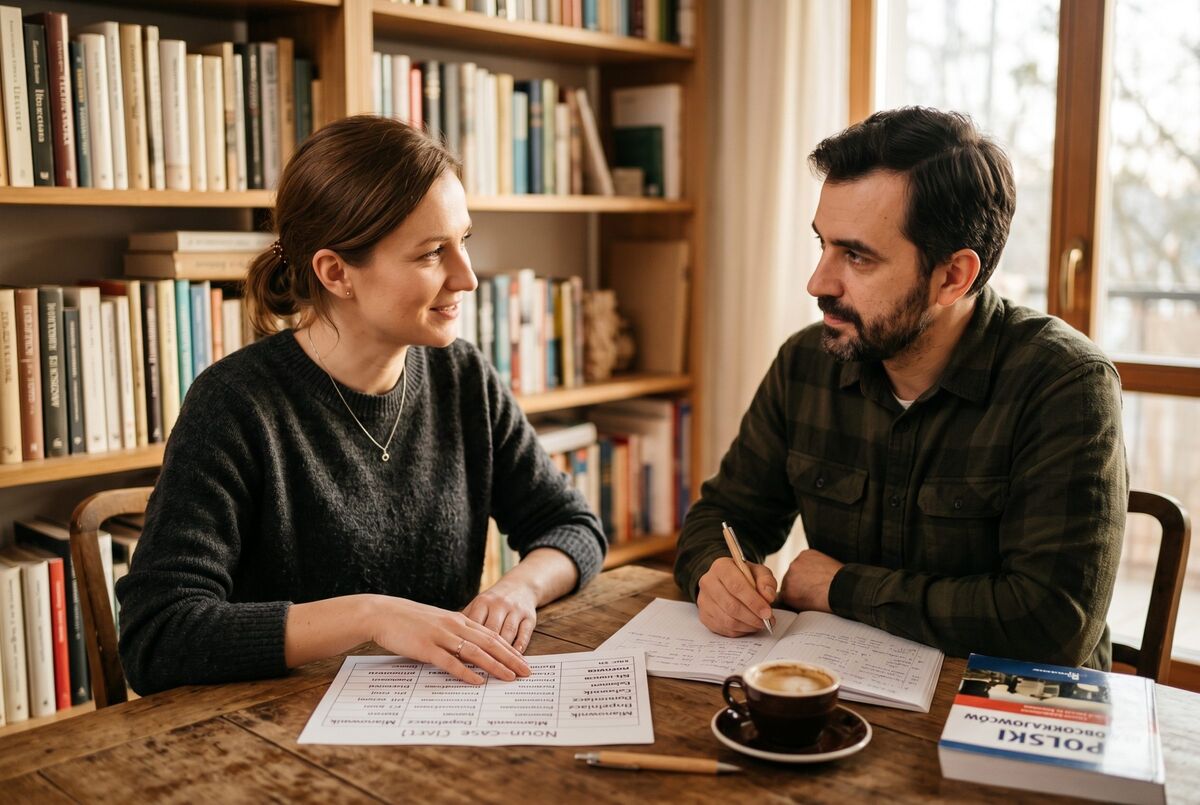
Personally vetted Conversational Polish tutors. Lessons centered on the Polish a learner can actually use in a Kraków bar, a Warsaw office, or a phone call with the family in Poznań, not the careful written register of an exam prep book.
Your instructors
Conversational Polish tutors for private lessons & classes
Strommen runs a curated Polish practice. Every teacher here was met and vetted by us. Bios are the tutors' own.
Filter by location, age, or price. Then book a 30-minute free trial.
Below are the Strommen tutors who specialize in Conversational Polish. Photos, ratings, and rates are real. Click any card to read a bio and book a free 30-minute trial.
I want to learn…
Every tutor, personally met. — founder-vetted since 2006, in Los Angeles and online worldwide.
Get a personalized plan
Pick your language — a language advisor will match you with the right tutor and map out your path.



University of Toronto Bachelor's Diploma
Your Multicultural Language Companion: Expert Guidance in English, French, German, and Spanish
Personally vetted · Strommen’s note
Maria has spent thirty years teaching across Czech, English, French, German, Polish, and Spanish, much of it inside government departments and international organizations.
Specialties
University of Toronto Bachelor's Diploma
Your Multicultural Language Companion: Expert Guidance in English, French, German, and Spanish
Specialties
Personally vetted · Strommen’s note
Maria has spent thirty years teaching across Czech, English, French, German, Polish, and Spanish, much of it inside government departments and international organizations.

Slang — culture & spoken Polish
5 cues that mark Polish you actually hear
These are the small details that mark a learner who has spent time among Polish speakers from one who has only studied the language on paper. Save the list. Then book a tutor for the practice that uses them.
-
01
Pan / pani and the formal register
Polish uses pan (sir) and pani (madam) plus a third-person verb form as the formal you, rather than a separate pronoun. The shift from formal to informal happens through a specific ritual where the older or higher-status person proposes przejść na ty. Until then, formal is the default with anyone you do not know well. American learners raised on first-name warmth often need to slow down here, because using informal forms with strangers reads as rude or naive.
e.g. To a stranger: "Czy mógłby pan podać sól?" ("Could you pass the salt, sir?") To a friend: "Podaj sól."
-
02
Już as finality
Już means "already" or "by now," and Polish speakers drop it into conversation constantly to signal completion, change of state, or finality. Polish without już sounds slow and translated; Polish with the right już in the right place sounds natural. The English equivalent shifts depending on context and the closest single word often does not exist.
e.g. Wracam już. ("I'm heading back now.") Nie ma już chleba. ("There's no more bread.")
-
03
Smacznego and the kitchen-table register
Smacznego ("enjoy your meal") is said before every meal in Polish, by hosts, by waiters, by people sitting at the next table. A learner who forgets it sounds rushed. Polish hospitality runs deeper than the phrase: czuj się jak u siebie ("feel at home") is more instruction than courtesy, and a guest who refuses food, tea, or a second helping is committing a small social violation. Knowing how to accept warmly and not over-refuse is part of conversational Polish.
e.g. Host setting down plates: "Smacznego!" Reply: "Smacznego, dziękuję."
-
04
Kurwa — handled with care
Polish's most-recognised vulgar intensifier, used widely as filler, exclamation, and emphasis across casual contexts. Vulgar in origin and effectively universal in casual speech, with the exact same word working as "damn," as a comma, or as an expression of surprise depending on tone. Used inappropriately, a learner sounds vulgar. Avoided entirely in casual contexts, a learner sounds stiff. A good tutor names the boundaries clearly and lets the student decide.
e.g. Casual exasperation among friends: "Kurwa, znowu spóźnię się." ("Damn, I'm going to be late again.") Never in a job interview.
-
05
Seven cases doing all the work
Polish nouns, adjectives, and pronouns inflect through seven cases in singular and plural across three genders, with an animacy distinction in the masculine that adds a further layer. The cases drive verb agreement, prepositions, word order, and most of what makes a Polish sentence cohere. There is no shortcut around them. Adult learners spend their first six to nine months settling into the system, after which the rest of Polish becomes a much smaller hill.
e.g. Książka (book, nominative), nie ma książki (there is no book, genitive), czytam książkę (I read a book, accusative). One word, three forms, three roles.
About Conversational Polish
Polish is hard, and the work is worth it
Polish has a reputation, and the reputation is earned. About forty-five million native speakers globally, the largest of the West Slavic languages, with the homeland in Poland and substantial communities across the UK, Germany, Ireland, the US (especially Chicago, the second-largest Polish city in the world by population), and Canada. The language is closely related to Czech and Slovak, more distantly to Ukrainian and Russian, and it preserves a Slavic case system that the language has refined over a thousand years. Seven cases, three genders, two numbers, and an aspectual verb system where almost every verb comes in a perfective-imperfective pair. The case system drives almost everything: noun and adjective endings, verb agreement, prepositions, and word order. The first six to nine months of serious Polish study are essentially a long apprenticeship in the cases, after which the language opens up dramatically.
The sound system has its own reputation. Polish has consonant clusters that look impossible to English speakers but are perfectly natural once the ear adjusts. Szczęście ("happiness") has six consonants in a row to an English eye and breaks cleanly into two syllables (szczęś-cie) once you know the digraphs. The famous combination szcz appears in many common words and is one sound, not four. The nasal vowels ą and ę, the soft consonants (ć, ś, ź, ń) marked with acute accents, and the hard-soft distinction running through every consonant pair are the work most adult learners spend their first year on. The pronunciation is also highly regular, which is the consolation: once you know the rules, the spelling tells you exactly how a word is pronounced.
Polish hospitality and the kitchen-table register are central to spoken Polish. The Polish phrase czuj się jak u siebie ("feel like you're at home") is more than a courtesy. It is an instruction with cultural weight, and a guest who refuses food, refuses tea, or refuses a second helping of pierogi is committing a small social violation. Smacznego ("enjoy your meal") is said before every meal, and a learner who forgets it sounds rushed. Coffee culture, kawa po polsku, has its own register that is more present and slower than the American to-go version. A conversation over coffee in a Kraków cafe is its own social event, not a refueling stop.
The Polish kurwa is the linguistic feature outsiders ask about most often, and any honest conversational lesson has to name it without making it the centerpiece. Literally translating to a vulgar word for a sex worker, kurwa has evolved into a near-universal intensifier and filler in Polish casual speech, used by speakers of every age and social class in the right context. The exact same word can mean "damn" or "goddamn," can function as a comma, can be an expression of surprise, anger, frustration, or even mild affection depending on tone, and can be entirely absent from polite or professional contexts. A learner who uses it inappropriately sounds vulgar; a learner who avoids it entirely in casual contexts sounds stiff. A good tutor names the boundaries clearly and lets the student decide when, if, and with whom to deploy it. Most learners settle on understanding the word fully and using it sparingly.
The finality of Polish już is a small grammatical feature that carries a large conversational weight. Już means "already" or "by now," and Polish speakers use it constantly to signal completion, change of state, or finality. Idziemy już ("we're going now"), wszystko już dobrze ("everything is already fine"), nie ma już chleba ("there is no more bread"). A learner who notices when Poles drop już into a sentence and starts using it themselves takes a real step toward sounding natural rather than translated. The English equivalent shifts depending on context, and the closest single word does not always exist.
The register split is another piece worth understanding early. Polish uses pan (sir, for a man) and pani (madam, for a woman) plus a third-person verb form as the formal you, rather than a separate pronoun. So "How are you?" to a stranger is jak się pan ma? (literally "how is sir doing himself?") rather than the informal jak się masz?. The shift from formal to informal happens through a specific ritual: someone, usually the older or higher-status person, proposes przejść na ty ("to switch to ty") and the relationship moves to first names and the informal you. Until that moment, the formal register is the default with anyone you do not know well, and a learner who uses informal forms with strangers reads as rude or naive. American learners, raised on first-name informality as warmth, often have to be slowed down here.
The political and historical layer is impossible to fully separate from the language. Poland survived as a nation through more than a century of partition (1795-1918) when the country did not exist on European maps but the language did, kept alive in homes, churches, and underground schools. The language carries the weight of survival in ways that mean a learner is going to encounter cultural references, songs, and historical idioms a tutor can name in passing but cannot fully unpack. Mickiewicz, Słowacki, Wisława Szymborska, Czesław Miłosz, and the contemporary writers who follow them are part of the cultural fabric in a way American literature rarely is in everyday American life. Polish speakers quote poems in casual conversation more often than English speakers do, and learning to recognise the cadence is part of learning the language.
Who learns Polish with us. Strommen sees expats and partners of Polish speakers preparing for life or extended visits in Warsaw, Kraków, or Wrocław, heritage learners with Polish grandparents or parents reconnecting with the language, business professionals whose work has shifted toward Poland's growing economy, and the occasional EU professional or academic adding Polish to a working set. Each has a different finish line. A good conversational tutor will not run them through the same lesson plan.
Our Conversational Polish tutors are native speakers from Warsaw, Kraków, Poznań, Gdańsk, and elsewhere, alongside Polish-Americans who grew up between Poland and the US and longtime bilingual teachers experienced with the specific way English speakers stall in Polish. They calibrate to your goal at the trial, build the lesson plan around it, and adjust as you progress. You can browse the wider Strommen tutor directory for the rest of our Slavic-language roster.
What you'll cover
Lessons & classes tailored to Conversational Polish
The case system, taught from the first month
Polish has seven cases working across three genders in singular and plural, with an animacy distinction in the masculine. Lessons introduce the cases gradually but use them in real speech from the first month, because postponing them creates a wall later. Nominative and accusative come first, then locative for talking about places, then genitive (which is everywhere in Polish), then dative and instrumental, then vocative. By month six the system stops feeling like a separate burden and becomes ordinary grammar.
Pronunciation: consonant clusters, nasal vowels, soft consonants
The consonant combinations that look impossible to an English eye (szcz, dzi, prze) are perfectly natural once the ear adjusts. Lessons include shadowing with native audio, direct feedback on the soft consonants (ć, ś, ź, ń) and the nasal vowels (ą, ę), and drills on the consonant clusters that high-frequency words contain. Polish spelling is highly regular once the sound system is in place, so the work is in the mouth and ear rather than in memorising arbitrary spellings.
Formal-informal calibration and the przejść na ty ritual
Polish has no neutral register. Every conversation sits somewhere on the pan/pani versus ty scale, and the shift from formal to informal happens through a specific ritual rather than gradually. Lessons drill the formal register from the first month, because that is the default with anyone you do not know well, and teach the social cues that govern when and how the shift to informal happens. Getting this wrong is the fastest way a learner reads as off.
Spoken register, kitchen-table Polish, and the layer between textbook and reality
Real Polish conversation runs on a layer of fillers, softeners, and stance words that textbooks underplay. Już to mark completion or finality, no ("well," "yeah") as a near-universal opener, the kitchen-table warmth around food and tea, the literary references that drop into casual speech more often than American learners expect. Lessons treat this layer as core content rather than bonus material, because it is what separates correct Polish from natural Polish.
FAQ
About Conversational Polish lessons & classes
Is Polish really one of the harder languages for English speakers?
Yes, honestly. The US Foreign Service Institute groups Polish with the Category III languages, estimating about 1,100 hours of focused study to reach professional proficiency from English. The case system, the consonant clusters, the aspectual verb pairs, and the formal-informal register split all add real work. That said, Polish rewards consistent practice in ways that less inflected languages do not, and a learner who puts in nine focused months on the foundations is on solid ground for the rest of the language.
How long until I can hold a real conversation in Polish?
Depends on what counts as a conversation. Holding a simple cafe or shop exchange usually comes within four to six months of one or two lessons a week with steady practice. Holding a relaxed ten-minute conversation about your day takes longer, often nine to fifteen months for an adult starting from beginner. Following a casual exchange between two native speakers at full Warsaw speed takes longer still. Your tutor sets concrete weekly targets at the trial and adjusts based on what is working.
Will Polish help me with other Slavic languages?
Yes, especially with Czech and Slovak (closest relatives), Ukrainian, Russian, Belarusian, and to a lesser extent the South Slavic languages. The case system, the aspectual verb pairs, and a substantial vocabulary base transfer. Reading any other Slavic language is meaningfully easier once you have Polish. Speaking another Slavic language still requires direct study, but the structural framework you have built in Polish accelerates it considerably.
How do I handle vulgar slang like kurwa?
Understand the word, learn its uses, and choose your moments. Kurwa is effectively universal in Polish casual speech, used by speakers of every age and social class in the right contexts, and entirely absent in polite or professional ones. A learner who uses it inappropriately sounds vulgar. A learner who avoids it entirely in casual contexts sounds stiff. Most learners settle on understanding the word fully and deploying it sparingly. A tutor names the boundaries clearly and lets the student decide.
Are your Polish tutors native speakers?
Most are native speakers from Warsaw, Kraków, Poznań, Gdańsk, Wrocław, and elsewhere in Poland, alongside Polish-Americans who grew up between Poland and the US and longtime bilingual teachers experienced with adult learners. Each tutor's bio specifies background, region, and teaching experience. For conversational practice, what matters most is a tutor who can hear what is keeping your Polish from sounding natural and diagnose it specifically.
Can I take Polish lessons online?
Yes. Most of our Polish tutors teach online via Zoom or Jitsi and work with students worldwide, which fits this specialty well since the lesson is mostly speaking and listening. A few teach in person around Los Angeles when schedules align. The booking widget on each tutor profile shows the available formats and live availability.
I am a heritage speaker who understands but barely speaks. Is this the right specialty?
Yes, and it is the most common Strommen profile for Polish. Heritage learners usually have a strong passive ear from family conversations and very little active production, often combined with a feeling that their grandparents would have strong opinions about how they speak. A conversational tutor builds on the listening foundation rather than starting from zero, which is much faster than a beginner course. Most heritage learners are functional in real conversation within a few months of regular practice.
What does a typical conversational Polish lesson look like?
Lessons are one-on-one and built around your goals. A typical hour pairs guided conversation in Polish on a topic you chose, focused work on whatever case or aspectual issue surfaced, a short listening segment from Polish media, and feedback on your output. No two students get the same plan. A heritage learner reconnecting with grandparents and a business professional preparing for a year in Warsaw get genuinely different lessons.
Ready for Conversational Polish lessons or classes?
Book a free 30-minute trial with one of our personally vetted tutors. Private lessons or small-group classes — your choice.